



Precision in measurement isn't just about the fit; it's about the integrity of your environmental footprint. A single error in calculating your 4 LM requirements can lead to significant material waste or costly project delays. You've likely felt the frustration of staring at a site plan, unsure if your linear estimates align with the actual surface area of your deck. It's a common challenge that many face when transitioning to high-performance composite materials.
This article ensures you order with absolute confidence. You'll learn the exact formula to convert 4 LM into square meters and determine the precise number of planks needed for a 4-meter span. We'll also examine the technical requirements for joist spacing to support your structure for its 50-year service life. By mastering these calculations, you protect your investment and respect the raw materials used in our regional manufacturing process. This knowledge transforms a complex ordering process into a logical, waste-free exercise in sustainable craftsmanship.
Key Takeaways
- Understand the fundamental distinction between linear and square meters to ensure your material order aligns perfectly with your site dimensions.
- Master the technical formula for converting 4 LM into exact plank quantities based on specific profile widths and necessary expansion gaps.
- Learn the engineering requirements for residential sub-frames, specifically the 600cc spacing rule that ensures long-term structural integrity.
- Discover how precision in measurement supports a Cradle to Cradle model by eliminating site waste and reducing your project's total carbon footprint.
- Gain professional implementation strategies for using the HidLoc™ Hidden Fastening System to achieve a seamless, screw-free finish on long-span decking.
Table of Contents
- Decoding '4 LM': What Linear Meters Mean for Your Decking Project
- Calculating Coverage: How Much WPC Decking is in 4 Linear Meters?
- Engineering for a 4-Meter Span: Joist Spacing and Load Bearing
- The Environmental Impact of Material Precision
- Professional Implementation: From 4 LM to a Finished Space
Decoding '4 LM': What Linear Meters Mean for Your Decking Project
Precision in a construction project begins with a clear understanding of your measurement units. A linear meter (LM) is a one-dimensional measurement of length. It doesn't account for width or thickness; it simply tells you how much material exists from one end to the other. In the context of Wood-plastic composites (WPCs), measuring in linear meters allows for an exact count of the physical planks required to cover a structural frame. We prioritize this unit because it reflects the reality of the installation process and ensures every board is accounted for before it leaves the factory.
Measuring a perimeter is fundamentally different from measuring coverage. A perimeter defines the boundary of your space, while coverage determines the volume of material needed to fill that boundary. By focusing on 4 LM as a baseline, you can quickly determine how many planks are needed to span a specific distance. This approach eliminates the guesswork often associated with square meter estimations, where board widths and expansion gaps can skew the final numbers. We use these precise linear calculations to maintain our commitment to regional reliability, providing exactly what you need without excess.
Linear Meters vs. Square Meters: The Core Difference
Square meters define the space, but linear meters define the supply. To calculate the total surface area, you multiply length by width. To calculate your actual material needs, you must translate that area back into the total length of all planks combined. Knowing both values is essential for an accurate project quote. If you rely solely on area, you risk under-ordering because you haven't accounted for the "lost" length in cuts or staggered patterns. Understanding 4 LM as a specific length unit helps you visualize how many individual boards will cross your sub-frame.
Why 4 Meters is a Critical Planning Unit
The 4-meter span is a cornerstone of modern deck planning. Many residential outdoor spaces naturally fall within this dimension, making it a highly efficient unit for material allocation.
- Reduced Waste: Using 4-meter planks on a 4-meter deck eliminates the need for cutting, which directly reduces site waste and preserves the material's integrity.
- Consistent Aesthetics: Installing full-length boards creates a cleaner, more premium look without the interruption of joints or seams.
- Simplified Calculations: Working with 4 LM increments allows contractors to estimate joist support and fastener counts with greater speed and accuracy.
Our Green Plank ranges, including the Terra Tuff and Nordeka series, are optimized for these lengths to ensure structural stability and manufacturing efficiency. This logical approach to supply chain management reduces our CO2 footprint by optimizing transport and minimizing overproduction. By choosing these standard units, you're participating in a circular "Cradle to Cradle" ownership model that respects both your time and the environment.
Calculating Coverage: How Much WPC Decking is in 4 Linear Meters?
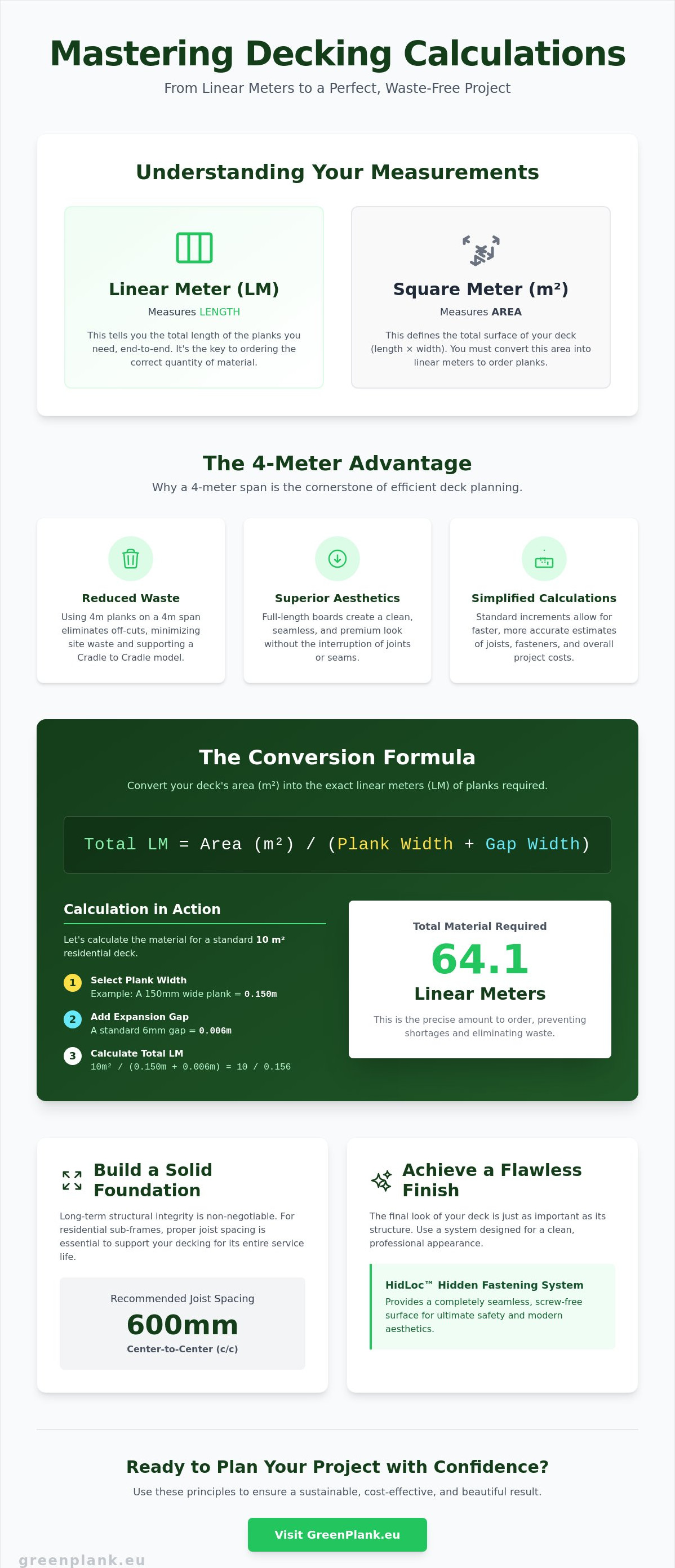
Translating a design into a material list requires more than a simple surface area measurement. To achieve the precision that defines professional craftsmanship, you must apply a specific formula to your project dimensions. The standard equation for determining your total material requirement is: Total LM = Area (SQM) / [Plank Width + Gap Width]. This calculation ensures you account for every millimeter of the installation, transforming a conceptual 4 LM unit into a tangible quantity of high-performance composite boards.
Plank width is the primary variable in this equation. A wider profile covers more ground per board, which naturally reduces the total linear meters required for the same surface area. For example, our Nordeka series features a wider profile that optimizes installation speed. This engineering choice provides a dual benefit: it creates a modern, expansive aesthetic while simultaneously lowering the total number of boards you need to handle and secure. When you visualize 4 LM on your site, you're looking at the physical length of one standard board, but its contribution to your deck's coverage depends entirely on its width and the spacing between its neighbors.
The Math Behind the Measurement
Consider a standard 10 SQM residential deck. If you select a plank with a 150mm width and account for a 6mm expansion gap, each board effectively covers 0.156 meters of width. Dividing 10 SQM by 0.156m results in approximately 64.1 linear meters of material. If you chose a narrower 140mm board, that requirement would jump to roughly 68.5 LM. We recommend adding a 5% to 10% waste factor to your final linear estimation to account for end-cuts and site-specific adjustments. This buffer protects your project timeline and ensures you don't fall short during the final stages of installation.
Green Plank Product Width Comparisons
Our product range is designed with specific engineering goals in mind, which impacts your linear meter calculations.
- Nordeka Series: These wider planks require fewer linear meters per square meter, making them ideal for large, open spaces.
- Terra Tuff Series: A classic 140mm width that offers exceptional durability and a traditional plank aesthetic.
- Smart System: Engineered for efficiency, this system balances width and weight for easy handling on complex sites.
Precision is further enhanced by the HidLoc™ hidden fastening system, which automatically sets a consistent 6mm gap between every board. This system eliminates the need for manual spacing and ensures your coverage calculations remain accurate throughout the entire build. For those seeking the most efficient path to a finished space, reviewing our technical product specifications will help you choose the profile that best aligns with your project's linear requirements.
Engineering for a 4-Meter Span: Joist Spacing and Load Bearing
Structural integrity is the foundation of long-term performance. When planning a deck with a 4 LM board length, the sub-frame must be engineered to prevent sagging and ensure safety. A 4-meter span places specific demands on the joists, requiring a support structure that accounts for both the weight of the composite material and the intended live load of the space. We design our profiles to withstand these stresses, backed by a 50-year service life warranty that reflects our engineering confidence.
A well-built sub-frame protects your investment and ensures the longevity of the installation. Without proper support, even the highest quality composite boards can experience deflection. By following established engineering standards, you ensure that your outdoor space remains a safe, level extension of your home for decades.
Residential vs. Commercial Joist Spacing
For private residential projects, a 600cc (center-to-center) spacing is the standard for most Green Plank profiles. This specific spacing ensures that each 4 LM plank is supported at regular intervals, maintaining a flat, stable surface. Commercial applications require a different approach. High foot traffic and increased load requirements necessitate tighter joist spacing, often reduced to 300mm or 400mm. Our commercial infrastructure profiles are engineered with a blend of 75% hardwood fiber and 25% HDPE. This high-density composition offers several advantages:
- Increased rigidity: The hardwood fibers provide a stiff internal matrix that resists bending under weight.
- Enhanced load capacity: Tighter spacing combined with material density supports heavy equipment or frequent crowds.
- Structural longevity: Regional manufacturing standards ensure the material doesn't degrade under constant mechanical stress.
Material Expansion and 4-Meter Lengths
Thermal expansion is a natural characteristic of all composite materials. A continuous 4-meter run will expand and contract as temperatures fluctuate. Managing this movement is critical to preventing buckling or warped boards. Our use of 100% EU raw materials results in a more predictable expansion rate compared to products using varied, lower-quality inputs. This predictability allows for more accurate planning during the construction phase.
Professional installation requires precise end-to-end gap spacing. When two 4-meter planks meet, a specific gap must be maintained to allow for summer expansion. By utilizing our regional manufacturing expertise, we provide clear expansion tables that guide installers on the exact gap needed based on the ambient temperature during the build. This technical precision ensures your deck remains beautiful and functional regardless of the season, respecting the material's natural physical properties.
The Environmental Impact of Material Precision
Precision is a form of environmental stewardship. When you calculate your requirements down to the final 4 LM unit, you are actively participating in a circular economy that prioritizes resource conservation. Our manufacturing process follows a "Cradle to Cradle" ownership model. This approach ensures that materials are not just used but are managed responsibly throughout their entire lifecycle. Accurate measurement is the first step in this cycle; it prevents the overproduction of materials and ensures that every plank delivered to your site has a designated purpose.
Ordering with exactness directly reduces your project's carbon footprint. Site waste is one of the leading contributors to construction-related landfill volume. By utilizing 4 LM as a standard planning unit, you eliminate the "off-cut" culture that defines traditional timber installations. Our regional manufacturing standards allow for higher measurement accuracy, which means the product you receive matches your technical specifications with surgical precision. This logical approach to supply chain management minimizes transport energy and reduces the total CO2 impact of your outdoor space.
Sustainable Sourcing: From Raw Material to 4 LM Plank
We utilize 100% EU raw materials to maintain total transparency in our supply chain. Our composite profiles consist of 75% hardwood fiber and 25% HDPE, creating a material that is both high-performance and eco-conscious. This high wood content provides natural structural integrity while repurposing industrial byproducts that would otherwise be discarded. Choosing regional manufacturing over long-distance imports significantly slashes transportation emissions. For a deeper look at how we integrate these principles into our production, consult our Sustainable Building Materials Guide.
Longevity as a Sustainability Metric
Durability is the ultimate expression of sustainability. A product that lasts for half a century requires far fewer resources than a material that needs replacement every decade. Our 50-year service life warranty is a testament to our engineering confidence and our commitment to the planet. Precision-engineered profiles like Terra Tuff and Nordeka are designed to resist structural failure, preventing the need for early replacement materials.
- Resource Preservation: Long-life products reduce the demand for new raw material extraction.
- Waste Elimination: Maintaining a single deck for 50 years keeps tons of replacement timber out of the waste stream.
- Chemical Reduction: Unlike traditional wood, our WPC requires no toxic stains or preservatives to maintain its integrity.
When you choose our sustainable profiles, you are investing in a future where high-end design and ecological responsibility coexist. Explore our range of sustainable composite decking solutions to find the perfect fit for your eco-conscious project.
Professional Implementation: From 4 LM to a Finished Space
The transition from technical planning to physical construction is where your calculations materialize into a functional outdoor living zone. Handling planks of this length requires steady, coordinated movement to prevent unnecessary flex or surface marring. While our WPC is engineered for high-strength durability, a 4-meter board is a significant physical asset that demands respect during the transport and positioning phases. Utilizing standard woodworking tools with carbide-tipped blades ensures clean, surgical cuts that maintain the professional aesthetic of your regional manufacturing investment.
Installing a continuous 4 LM run requires a systematic approach to ensure the boards remain perfectly parallel. We recommend starting from the outer edge of the deck and working toward the structure. This method allows you to establish a straight baseline that guides the rest of the installation. Every plank should be inspected for alignment before being secured, ensuring the 600cc joist support we discussed previously is fully utilized to prevent any future deflection.
Installing with HidLoc™ Fastening Systems
A premium finish is defined by what you don't see. Our HidLoc™ Hidden Fastening System utilizes stainless steel clips to secure the boards from the side; this creates a seamless, screw-free surface that highlights the natural wood-grain texture of the composite. These fasteners do more than provide a clean look. They are engineered to allow for the natural thermal movement inherent in a 4 LM span, preventing the internal stresses that lead to warping in traditional face-screwed installations. For a comprehensive walkthrough of this process, consult our detailed Deck Installation Guide.
Finishing Touches and Maintenance
The final aesthetic is completed through the use of matching skirting and fencing systems. Our skirting profiles are designed to hide the sub-frame on elevated 4-meter spans, providing a unified, grounded appearance that respects the surrounding architecture. Unlike traditional timber, our composite profiles require no staining, oiling, or chemical preservatives over their entire service life. This low-maintenance attribute is a core benefit of our material science, saving you time and reducing the introduction of toxins into your local environment.
Before concluding your project, perform a final inspection using this professional checklist:
- Verify Joist Alignment: Ensure every 4-meter board is supported at the required 600cc intervals.
- Check Expansion Gaps: Confirm that end-to-end spacing matches the ambient temperature requirements.
- Inspect Fastener Tension: Ensure HidLoc™ clips are securely engaged but allow for lateral movement.
- Surface Uniformity: Sweep the area to remove any construction debris and inspect for a level finish.
Once the installation is complete, you can register your project to activate our 50-year service life warranty. This guarantee is our signature of engineering confidence, ensuring your space remains a maintenance-free sanctuary for decades to come. By following these professional implementation standards, you honor the "Cradle to Cradle" ownership model and secure a high-end result that balances luxury with eco-conscious responsibility.
Building Your Sustainable Outdoor Legacy
Precision in your initial measurements is the first step toward a high-performance outdoor space. By mastering the 4 LM calculation, you've ensured that your material order aligns with the principles of zero-waste construction and engineering excellence. You now understand how to translate surface area into physical planks and why specific joist spacing is essential for maintaining structural integrity over decades. This technical foundation allows you to transition from planning to implementation with absolute confidence.
Our commitment to regional reliability means you receive a product engineered for longevity and environmental responsibility. We utilize 100% EU raw materials to ensure superior durability, backed by a Cradle to Cradle ownership model that respects the natural world. If you're ready to transform your vision into a professional reality, Request a Professional Quote for Your WPC Project today. Our profiles are supported by a service life warranty of up to 50 years; this provides you with a maintenance-free sanctuary that stands the test of time.
Your investment in quality today secures a beautiful, sustainable environment for the future.
Frequently Asked Questions
How many linear meters of decking do I need for a 10 square meter area?
You will need between 64 and 69 linear meters depending on the specific profile width and gap spacing you select. For a standard 150mm plank width paired with a 6mm expansion gap, the calculation results in approximately 64.1 LM. Using a narrower 140mm board increases this requirement to roughly 68.5 LM. It's best to add a 5% to 10% waste buffer to these figures to account for end-cuts and site-specific adjustments.
Is it better to buy 4 LM planks or shorter boards for a deck?
Selecting a 4 LM plank is typically superior for both structural integrity and visual continuity. Longer boards reduce the number of end-to-end joints, which creates a more premium, seamless aesthetic for your outdoor space. This choice also minimizes site waste by aligning with common residential deck depths, supporting our commitment to a circular Cradle to Cradle ownership model.
What is the standard joist spacing for a 4-meter span using WPC?
Residential projects require a standard joist spacing of 600cc (center-to-center) to support the weight of our composite profiles. This spacing ensures the planks remain level and resist deflection over their 50-year service life. Proper sub-frame engineering is essential for maintaining the structural warranty and ensuring the safety of the installation.
How do I convert linear meters to square meters for composite cladding?
To convert linear meters to square meters, multiply the total LM by the effective width of the cladding plank, including the overlap or gap. For example, a board with an effective coverage width of 0.145 meters multiplied by 100 LM results in 14.5 square meters of coverage. This precision ensures you order exactly what's needed for your wall cladding project without excess.
Does Green Plank offer 4-meter board lengths as standard?
Yes, we provide 4 LM lengths as a standard unit across our primary product ranges, including Terra Tuff and Nordeka. These lengths are engineered to optimize transport efficiency and reduce site waste, which helps lower the total CO2 footprint of your project. Our regional manufacturing process ensures these dimensions are consistent and meet high European quality standards.
What happens if I calculate my LM needs incorrectly?
Incorrect calculations often lead to project delays or unnecessary material waste. Under-ordering requires additional shipping, which increases your carbon footprint and extends the construction timeline. Over-ordering results in surplus material that contradicts our sustainable craftsmanship goals. We provide detailed formulas to help you achieve the precision required for a professional finish.
Can I use a 4 LM plank for a commercial project without extra support?
Commercial projects require tighter joist spacing, typically between 300mm and 400mm, to handle increased foot traffic and heavier loads. While a 4-meter plank is structurally robust, the sub-frame must be reinforced to meet commercial engineering standards. Our high-density profiles, containing 75% hardwood fiber, provide the necessary strength when paired with a correctly engineered support system.
How does the HidLoc™ system affect my linear meter calculations?
The HidLoc™ system establishes a consistent 6mm expansion gap between every plank, which you must include in your coverage formula. Adding this gap to the physical width of the board ensures your linear meter estimation is accurate across the entire surface area. This system simplifies the installation process while maintaining the technical precision required for long-term performance.
Specificera produkten
Använd den här guiden i en Green Plank-specifikation
Tekniska WPC-artiklar ska stärka de kommersiella sidorna — inte konkurrera med dem. Fortsätt till komposittrall, TerraTuff, Nordeka eller de tekniska nedladdningarna.