



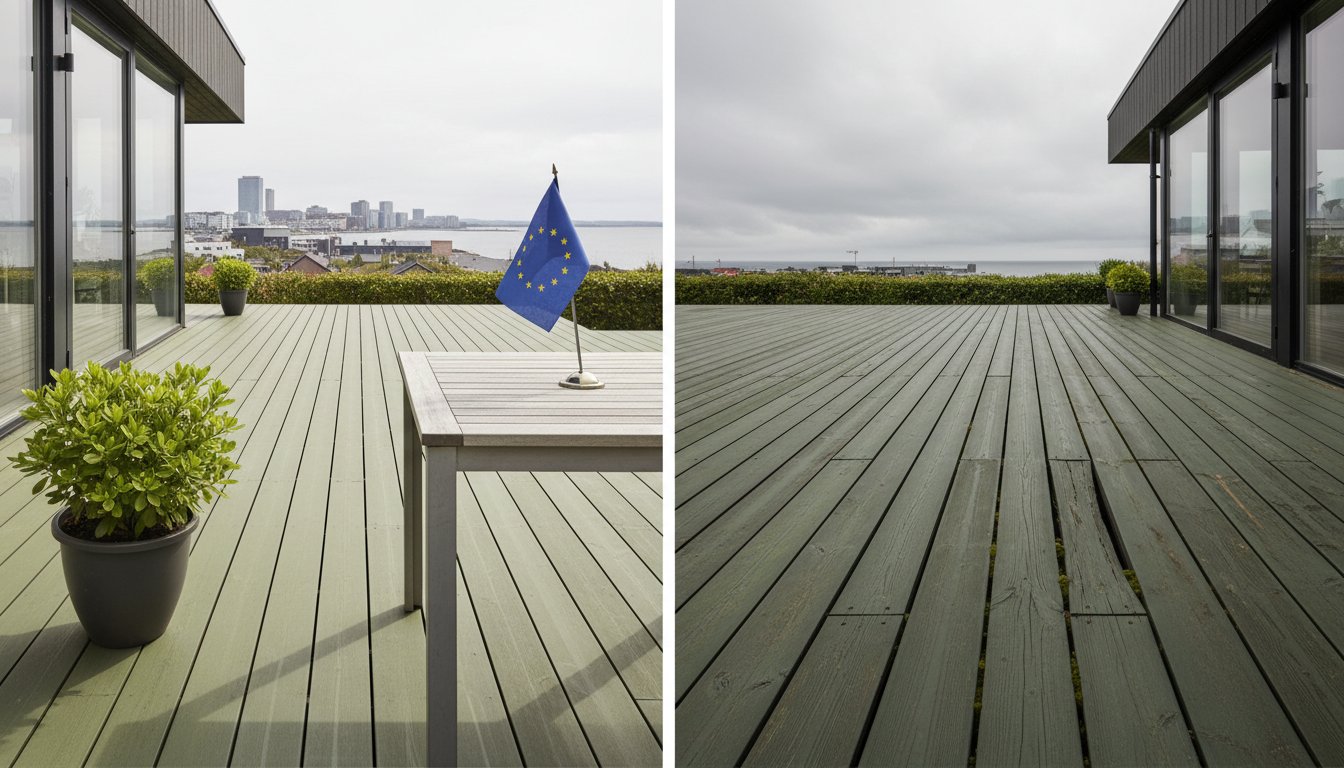
A deck that looks identical on the showroom floor can be the difference between a 50-year architectural legacy and a structural failure within five seasons. Choosing between Euorpean materials with traceability in wpc products vs chines raw materials without traceability in wpc proudcts isn't just a matter of price; it's a critical engineering decision that dictates the chemical safety and structural integrity of your outdoor space. You likely want the peace of mind that comes with knowing exactly what's inside your composite boards, especially when untraceable plastics often hide unstable additives.
We believe your project deserves the certainty of Nordic reliability. This guide explains why material origin is the primary factor in achieving a 30 to 50 year service life and full EU environmental compliance. We'll analyze the technical advantages of our 75% hardwood fiber composition and show how 100% traceable supply chains eliminate the risk of premature degradation. You'll gain the technical facts needed to justify a professional-grade budget. Designed in Scandinavia. Produced in Europe. Built to last. Designed for life.
Key Takeaways
- Understand why tracking every raw material from source to board is the only way to guarantee the structural integrity and chemical safety of your project.
- Compare the long-term engineering value of Euorpean materials with traceability in wpc products vs chines raw materials without traceability in wpc proudcts to prevent early deck failure.
- Learn how a documented 75/25 hardwood to HDPE ratio creates the durability needed for a 50-year service life in demanding climates.
- Identify the essential certifications and safety data sheets you must request to confirm a product's free from hazardous contaminants like lead or PVC.
- Discover how choosing traceable, European-made composite decking reduces your carbon footprint while ensuring compliance with strict EU environmental standards.
What is Material Traceability in WPC and Why Does it Matter?
Traceability isn't a marketing buzzword; it's an engineering requirement. In the production of Wood-plastic composites (WPCs), traceability represents the ability to track every raw material from its geographic origin to the finished board on your job site. For a professional specifier, this documentation acts as a technical insurance policy. It guarantees that the physical properties of the board you install today will remain consistent for the next five decades. Without this data, you're essentially installing a "black box" product where the chemical stability is unknown.
The distinction becomes clear when evaluating Euorpean materials with traceability in wpc products vs chines raw materials without traceability in wpc proudcts. Untraceable imports often rely on fragmented supply chains where batches of recycled plastic are mixed without testing for contaminants. This creates a significant liability for architects and developers. If a deck fails due to internal chemical reactions or excessive thermal expansion, untraceable materials offer no recourse and no data to explain the failure. Traceable materials, by contrast, provide a transparent record of density, moisture content, and polymer purity.
Regulatory pressure is also mounting. By 2026, the EU Corporate Sustainability Due Diligence Directive (CSDDD) will require firms to identify and account for environmental impacts throughout their entire supply chain. Using traceable European materials ensures your project meets these upcoming legal standards today. This transparency directly impacts performance; documented material origins allow for predictable expansion and contraction rates. When you know the exact species of hardwood and the grade of HDPE used, you can calculate gap requirements with millimeter precision. Built to last. Designed for life.
The Components of Traceable WPC
- Certified Hardwood Fibers: We use 75% hardwood fiber sourced from sustainably managed European forests. This stands in contrast to untraceable products that often use agricultural waste or softwoods, which lack the structural density required for long-term durability.
- Pure HDPE Polymers: Our 25% polymer content consists of high-quality HDPE. Untraceable imports frequently contain "mystery" plastics contaminated with PVC or polypropylenes, leading to brittle boards that crack under UV exposure.
- Documented Additives: Every UV stabilizer and fire retardant in our boards is batch-tested. This ensures the color stays vibrant and the safety ratings are genuine.
Why 'Made in EU' is a Technical Specification
Choosing European-made WPC is a choice for rigorous chemical safety. All our materials comply with REACH and RoHS standards, which strictly limit hazardous substances like lead and phthalates. Proximity matters; our short supply chain prevents the "material substitution" common in long-distance imports. When production happens in Europe, adherence to strict manufacturing tolerances is a constant, not an option. This results in professional-grade profiles that deliver stability, strength, and refined Nordic character. Designed in Scandinavia. Produced in Europe.
European Engineering vs. Untraceable Imports: A Chemical Breakdown
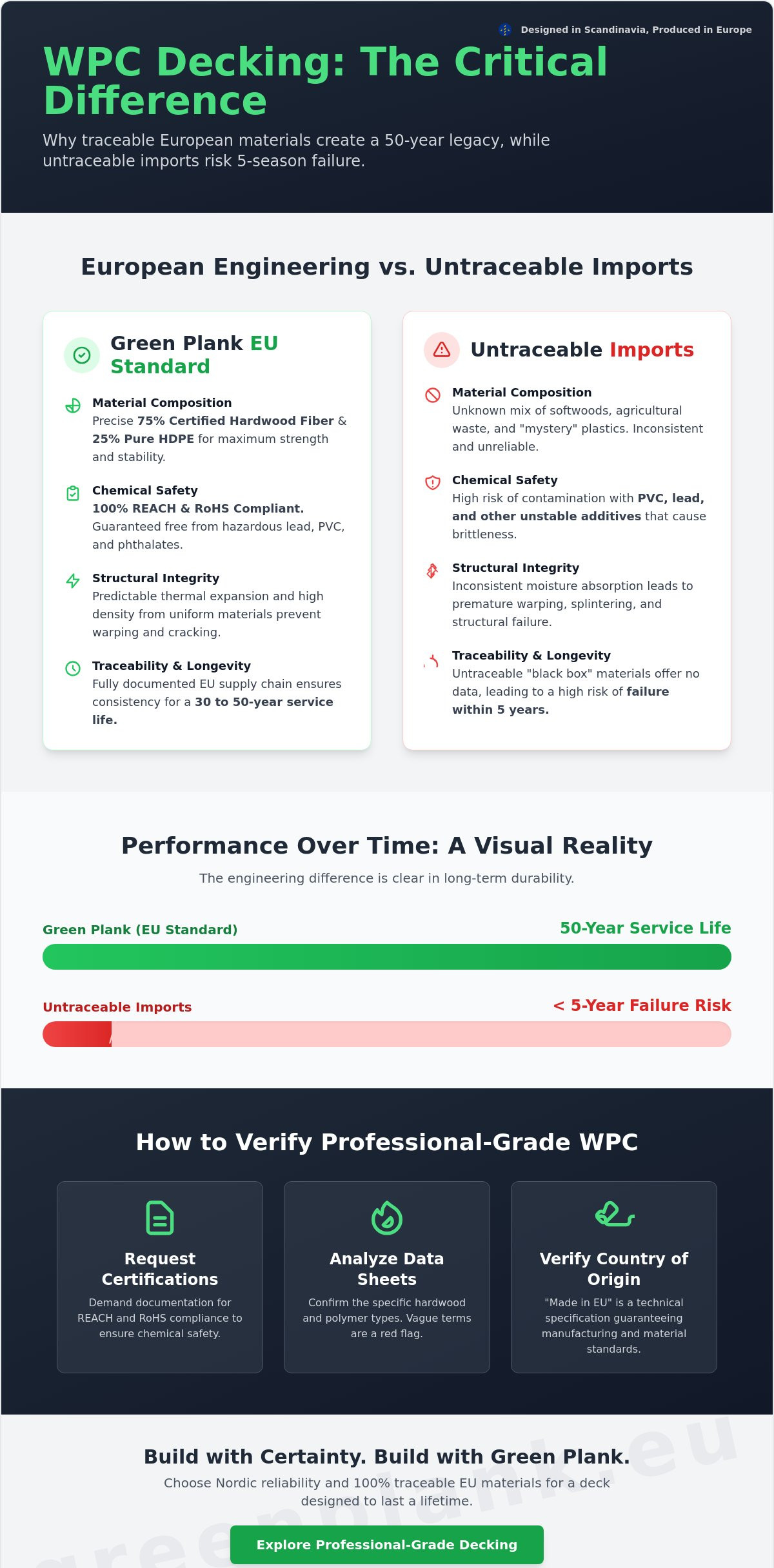
The structural integrity of a composite board is determined at the molecular level. At Green Plank, we utilize a precise 75/25 formula: 75% hardwood fiber and 25% High-Density Polyethylene (HDPE). This specific ratio isn't a suggestion; it's the technical threshold required to ensure a board remains rigid under heavy loads while maintaining enough flexibility to resist impact. When you evaluate the difference between Euorpean materials with traceability in wpc products vs chines raw materials without traceability in wpc proudcts, the most dangerous variable is the presence of "mystery" plastics. Untraceable raw materials often test positive for PVC and lead, substances strictly regulated under European law. PVC is particularly problematic; during the extrusion process, it can release hydrochloric acid, which weakens the HDPE matrix and leads to premature brittleness.
Inconsistent wood species are another hidden failure point for low-cost imports. If a board contains a mix of softwoods, hardwoods, and agricultural waste, each fiber absorbs moisture at a different rate. Industry testing indicates that boards with inconsistent wood species can experience up to 15% more moisture-related expansion than those using uniform, traceable hardwood fibers. This volatility creates internal stress that eventually overcomes the board's structural bond. To ensure your project maintains its integrity, you can explore our range of engineered composite decking designed for extreme durability. High-quality coupling agents are essential to bond these fibers to the HDPE. Without these specific additives, which are often reduced in untraceable products to cut costs, the board will eventually undergo internal delamination. This is where the layers physically separate, causing the board to crumble from within.
Hardwood Fiber vs. Generic Biomass
Green Plank uses 75% hardwood fiber because of its superior density and mechanical strength. Untraceable WPC often substitutes wood with generic biomass, such as rice husks, straw, or even peanut shells. These fillers have shorter fiber lengths, which prevents a strong mechanical bond within the composite matrix. Shorter fibers mean lower tensile strength and a higher probability of the board snapping under pressure. Our traceable hardwood is processed to specific micron sizes to ensure a uniform, high-performance matrix. Built to last. Designed for life.
The HDPE Advantage: Traceable vs. Mixed Plastics
Traceable HDPE ensures consistent thermal expansion across every board in your installation. Mixed plastics, a staple of untraceable imports, result in varying expansion rates that cause boards to warp or pop out of their fasteners during temperature swings. Pure, traceable polymers prevent the chalking and rapid fading that occurs when low-grade plastics break down under UV radiation. This engineering precision ensures your deck retains its refined Nordic character for decades. Designed in Scandinavia. Produced in Europe.
Performance Comparison: 50-Year Reliability vs. Early Degradation
A low initial price often masks a high lifecycle cost. When evaluating the engineering behind Euorpean materials with traceability in wpc products vs chines raw materials without traceability in wpc proudcts, the true value isn't found on the invoice; it's found in the maintenance logs of year seven. While our premium WPC is engineered for a 50-year service life, untraceable imports often show visible structural degradation within 60 months. This early failure stems from the lack of a controlled chemical matrix. Without traceability, there's no way to confirm if the UV stabilizers or coupling agents were correctly dosed during the extrusion process.
The "Ghost Warranty" remains a significant risk for the unwary buyer. Many imported boards boast a 25-year warranty, yet these are often unenforceable "paper warranties" issued by manufacturers without European legal entities or documented quality control. If the product fails, the supplier is nowhere to be found. In contrast, Green Plank provides up to a 50-year warranty backed by batch-tested results and traceable raw materials. For commercial infrastructure, where structural safety is paramount, this accountability is non-negotiable. You can't risk public safety on a board with an unknown chemical history.
By year 10, the economic reality of "cheap" WPC becomes clear. Untraceable boards often require replacement or intensive cleaning due to internal fungal growth and surface chalking. A project using professional-grade European materials remains structurally sound and aesthetically pleasing with minimal intervention. This long-term stability justifies a higher initial budget by eliminating the need for a full deck replacement every decade. Designed in Scandinavia. Produced in Europe.
Weathering and Nordic Climate Resistance
Our boards are designed for the harsh Scandinavian climate. We use traceable UV inhibitors that prevent the polymer chains from breaking down under intense sun exposure. This engineering ensures the board maintains its flexural strength even after decades of freeze-thaw cycles. Our 75% hardwood composition also provides natural resistance to rot and fungal decay, unlike imports that use agricultural fillers susceptible to moisture absorption. Choosing sustainable building materials with documented origins ensures your deck remains a maintenance-free asset rather than a liability. Built to last. Designed for life.
Warranty and Manufacturer Accountability
Traceability allows for precise batch-testing. If a board leaves our facility, we know exactly which European forest provided the fiber and which facility produced the HDPE. This data-driven approach is why we can confidently offer a 50-year performance guarantee. An engineered warranty is based on technical facts, not marketing hopes. By year 20, the cost of replacing a failed deck twice far exceeds the initial investment in a professional-grade European system. We prioritize Nordic reliability so you don't have to worry about what's under your feet.
How to Verify Material Traceability for Your Project
Verification's the bridge between a promise and performance. When you're choosing between Euorpean materials with traceability in wpc products vs chines raw materials without traceability in wpc proudcts, you've got to look beyond the surface texture of the board. Start by requesting a full Material Data Safety Sheet (MSDS). A legitimate European supplier will provide a document detailing the exact chemical composition, ensuring the absence of hazardous substances like lead or phthalates. If a supplier can't produce an MSDS that matches their specific product line, it's a clear sign of untraceable, potentially contaminated raw materials.
Don't settle for verbal assurances; demand physical documentation. First, verify the origin of the wood fiber through FSC (Forest Stewardship Council) or PEFC certifications. These documents prove the 75% hardwood fiber content comes from managed forests rather than agricultural waste or softwoods. Second, look for "Cradle to Cradle" ownership models which ensure the manufacturer takes responsibility for the product's entire lifecycle. Finally, inspect the physical boards for batch numbers. Traceable products feature unique identifiers that link each board back to a specific production date and raw material lot. This transparency is the hallmark of Nordic reliability.
Questions to Ask Your WPC Supplier
- HDPE Source: Is the polymer post-consumer or industrial grade? Industrial-grade HDPE offers higher purity and more predictable thermal expansion than mystery recycled plastics.
- CO2 Analysis: Can you provide a CO2 footprint analysis for this specific line? Green Plank products are engineered to reduce carbon footprints by utilizing local European supply chains.
- Hardwood Species: Which specific hardwood species are used? Knowing the species allows for accurate predictions of moisture resistance and structural density.
Spotting the Red Flags of Untraceable Materials
Vague marketing is usually the first warning sign of a sub-par product. If a supplier uses terms like "recycled wood" without identifying the species, they're likely using inconsistent fillers that compromise structural integrity. Unusually low prices are another indicator; high-purity polymers and batch-testing have a fixed engineering cost that can't be bypassed. A lack of a physical manufacturing presence within the EU is perhaps the biggest risk. Without a local facility, accountability vanishes once the shipping container is unloaded. To ensure your project meets professional standards, you can view our technical specifications and certifications. Designed in Scandinavia. Produced in Europe. Built to last. Designed for life.
The Green Plank Standard: 100% EU Materials for Nordic Reliability
Green Plank sets a benchmark for the industry by removing the "black box" of material sourcing. We don't just assemble; we engineer. Our commitment to 100% European raw materials ensures every board is a known quantity. When you compare Euorpean materials with traceability in wpc products vs chines raw materials without traceability in wpc proudcts, the distinction is found in the molecular stability of the product. We eliminate the risk of heavy metal contamination and structural instability by vetting every supplier within the European Union. This control allows us to deliver professional-grade profiles that maintain their integrity in high-traffic commercial environments.
Sustainability is a technical requirement, not a secondary goal. Our Cradle to Cradle ownership model depends entirely on material purity. If a board contains untraceable toxins or mixed plastic resins, it can't be safely recycled into new composite products at the end of its service life. By maintaining a circular supply chain, we significantly reduce the project's CO2 footprint. Localized production in Europe means fewer shipping miles and a lower environmental impact compared to long-haul imports. We prioritize the planet by prioritizing the purity of our 75% hardwood fiber and 25% HDPE composition.
Designed in Scandinavia, Produced in Europe
Our design philosophy blends refined Nordic character with rigorous engineering precision. The Terra Tuff and Smart System lines are built to withstand the most demanding climates, from freezing winters to intense UV exposure. Every board is manufactured in Europe to ensure consistent density and moisture resistance. This proximity prevents the material substitution common in untraceable supply chains. For a deeper look at the technology behind our boards, read our guide on wpc composite decking. We offer stability you can trust.
Built to Last. Designed for Life.
A project's success is measured in decades. We provide the peace of mind that comes with professional-grade infrastructure profiles and a documented 50-year service life. Our warranty isn't a marketing promise; it's a testament to the traceability of our raw materials. When every batch is tested and every fiber is accounted for, the risk of early degradation disappears. You can explore our Terra Tuff range for your next commercial project to experience the difference that European engineering makes. Designed in Scandinavia. Produced in Europe. Built to last. Designed for life.
Engineering Your Outdoor Legacy
Building a sustainable outdoor space requires more than just an aesthetic eye; it demands an understanding of the molecular stability beneath the surface. We've explored how the choice between Euorpean materials with traceability in wpc products vs chines raw materials without traceability in wpc proudcts directly impacts the longevity of your investment. While untraceable imports often hide chemical contaminants, our 100% EU raw materials provide the engineering certainty needed for professional-grade results. By prioritizing documented origin, you ensure your project avoids the structural failures common in sub-standard composites.
Our commitment to a Cradle to Cradle ownership model and batch-tested manufacturing is why we confidently offer a 50-year warranty. This isn't just decking; it's a long-term asset designed to withstand the harshest climates while respecting the natural world. Take the first step toward a maintenance-free future today. Request a sample of our 100% traceable European WPC decking to feel the difference of Nordic reliability. Your vision deserves a foundation that's built to last. Designed for life. Designed in Scandinavia. Produced in Europe.
Frequently Asked Questions
Is European-made WPC really better than Chinese imports?
European-made WPC is superior because it adheres to strict REACH chemical safety standards. These regulations prevent the use of hazardous substances like lead and phthalates. When analyzing Euorpean materials with traceability in wpc products vs chines raw materials without traceability in wpc proudcts, the European option ensures a consistent 75% hardwood fiber and 25% HDPE matrix. This engineering precision results in a 50-year service life.
What does 'traceability' actually mean for a homeowner?
Traceability provides a documented history of every component in your decking boards. For a homeowner, this means knowing the exact species of wood and the grade of polymer used in your outdoor space. This transparency eliminates the risk of installing materials that might warp or fade inconsistently. It's the ultimate guarantee of Nordic reliability and long-term structural safety. Designed in Scandinavia. Produced in Europe.
Can untraceable WPC products contain toxic chemicals?
Yes, untraceable WPC products frequently contain contaminants such as PVC, lead, and cadmium. Industry reports have identified these substances in 20% of tested untraceable samples. These toxins aren't just an environmental hazard; they physically weaken the board's internal bond. Choosing traceable materials ensures your deck remains safe for children and pets while meeting all EU environmental compliance standards.
How does material origin affect the warranty of a WPC deck?
A product's origin determines the accountability of the manufacturer. European-made WPC is backed by enforceable warranties that are grounded in batch-tested technical facts. If a board fails, the traceable batch number identifies the exact production lot. Untraceable imports often offer long "paper warranties" that are impossible to claim against because the manufacturer has no physical or legal presence within the European Union.
Why is the wood fiber type (hardwood vs. softwood) so important?
Hardwood fibers offer superior mechanical strength and lower moisture absorption compared to softwoods or agricultural waste. We use 75% hardwood fiber because its longer, denser fibers create a stronger bond with the HDPE polymer. This prevents the internal delamination and fungal rot that often plague boards made with rice husks or generic biomass found in untraceable products. It's the standard for professional-grade decking.
Does European WPC have a lower carbon footprint than imports?
European WPC significantly reduces your project's CO2 footprint by eliminating thousands of miles of maritime transport. Using 100% European raw materials means the supply chain is localized and easier to monitor. Our circular Cradle to Cradle ownership model ensures that every board can be safely recycled. This supports a sustainable construction lifecycle that is built to last and designed for life.
How can I prove material traceability for a LEED or BREEAM project?
Proving traceability for green building certifications requires providing batch-specific Material Data Safety Sheets and FSC or PEFC certificates. These documents allow auditors to verify the technical differences between Euorpean materials with traceability in wpc products vs chines raw materials without traceability in wpc proudcts. Without this data, your project can't earn the necessary credits for responsible sourcing and chemical safety under LEED frameworks.
Are Chinese raw materials always of lower quality?
While some Chinese materials meet high standards, the absence of traceability makes it impossible to verify batch-to-batch consistency. The primary risk with untraceable raw materials is the high probability of material substitution during production. Without a transparent supply chain, you have no way to confirm that the HDPE purity or UV stabilizer dosage remains constant across your entire project. Reliability requires a documented origin.
Specificera produkten
Använd den här guiden i en Green Plank-specifikation
Tekniska WPC-artiklar ska stärka de kommersiella sidorna — inte konkurrera med dem. Fortsätt till komposittrall, TerraTuff, Nordeka eller de tekniska nedladdningarna.