




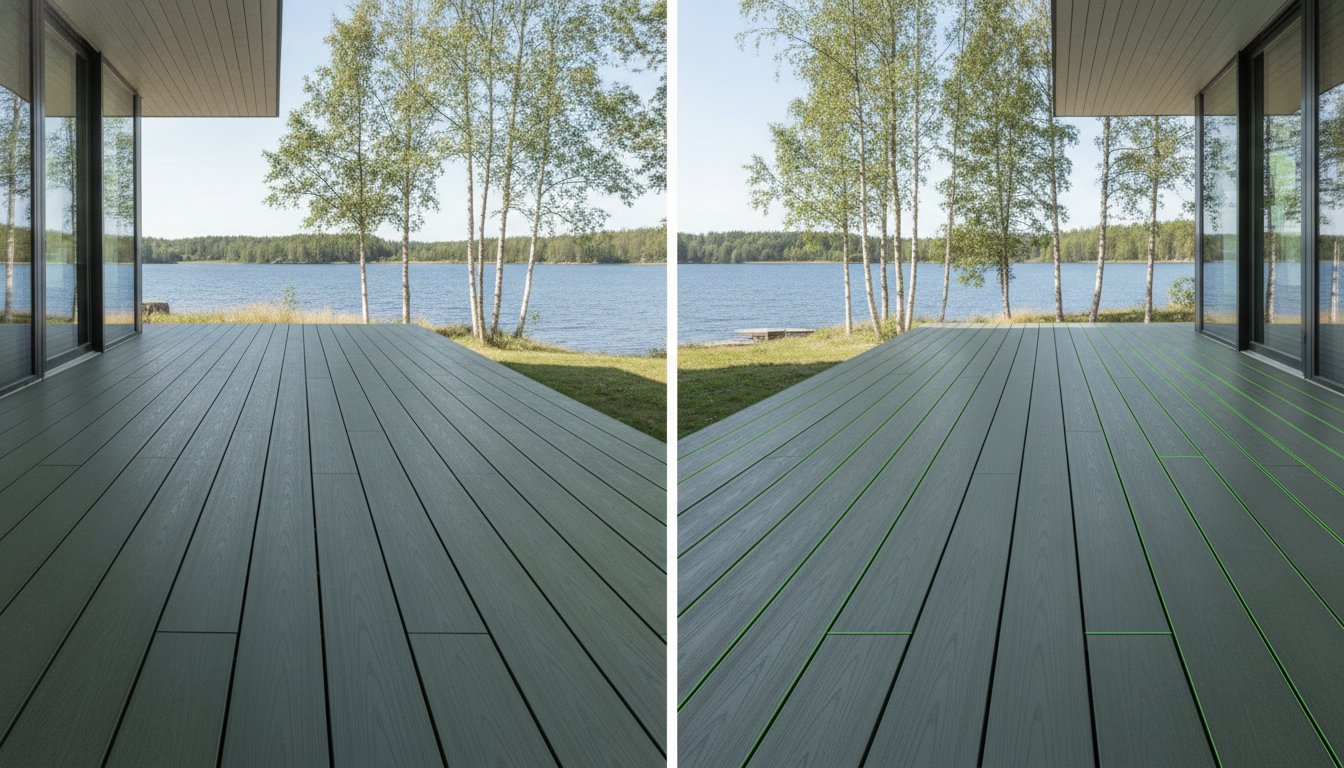
Your deck's greatest threat isn't the heavy rain or the summer sun; it's the invisible physics of thermal movement. It's frustrating to watch a premium investment develop uneven gaps or begin to buckle and shear fasteners. You expect your outdoor space to remain as straight and flush as the day it was installed. However, composite decking expansion and contraction issues often turn a beautiful architectural feature into a tripping hazard. We understand that a deck is an extension of your home's integrity and your commitment to quality.
This article explores the science of thermal movement in Wood Plastic Composites (WPC) and how our 75/25 hardwood-fiber engineering eliminates common structural failures. You'll gain a clear understanding of the correct gapping math and why choosing a material with a low expansion coefficient is the only way to ensure a 50-year service life. We will explain how proper material science, precision installation techniques, and floating fastening systems create a maintenance-free space that respects nature and performs for decades.
- Understand the physical response of WPC to temperature changes and why heat drives board movement more than moisture.
- Discover how 75% hardwood-fiber engineering creates a stabilizing internal skeleton to prevent composite decking expansion and contraction issues.
- Master the "Gap Map" technique to calculate exact spacing based on ambient temperature for a perfectly straight, flush deck.
- Learn the critical steps for on-site acclimation to protect your fasteners from shearing and your boards from buckling.
- Explore how EU manufacturing and Cradle to Cradle material purity support a reliable 50-year service life for your outdoor project.
Table of Contents
- Understanding Thermal Movement: Why Composite Decking Expands and Contracts
- Common Composite Decking Expansion and Contraction Issues
- The Science of Stability: 75% Hardwood Fiber vs. Plastic-Heavy Alternatives
- Installation Rules to Prevent Expansion Problems
- Green Plank Engineering: Designed for 50 Years of Performance
Understanding Thermal Movement: Why Composite Decking Expands and Contracts
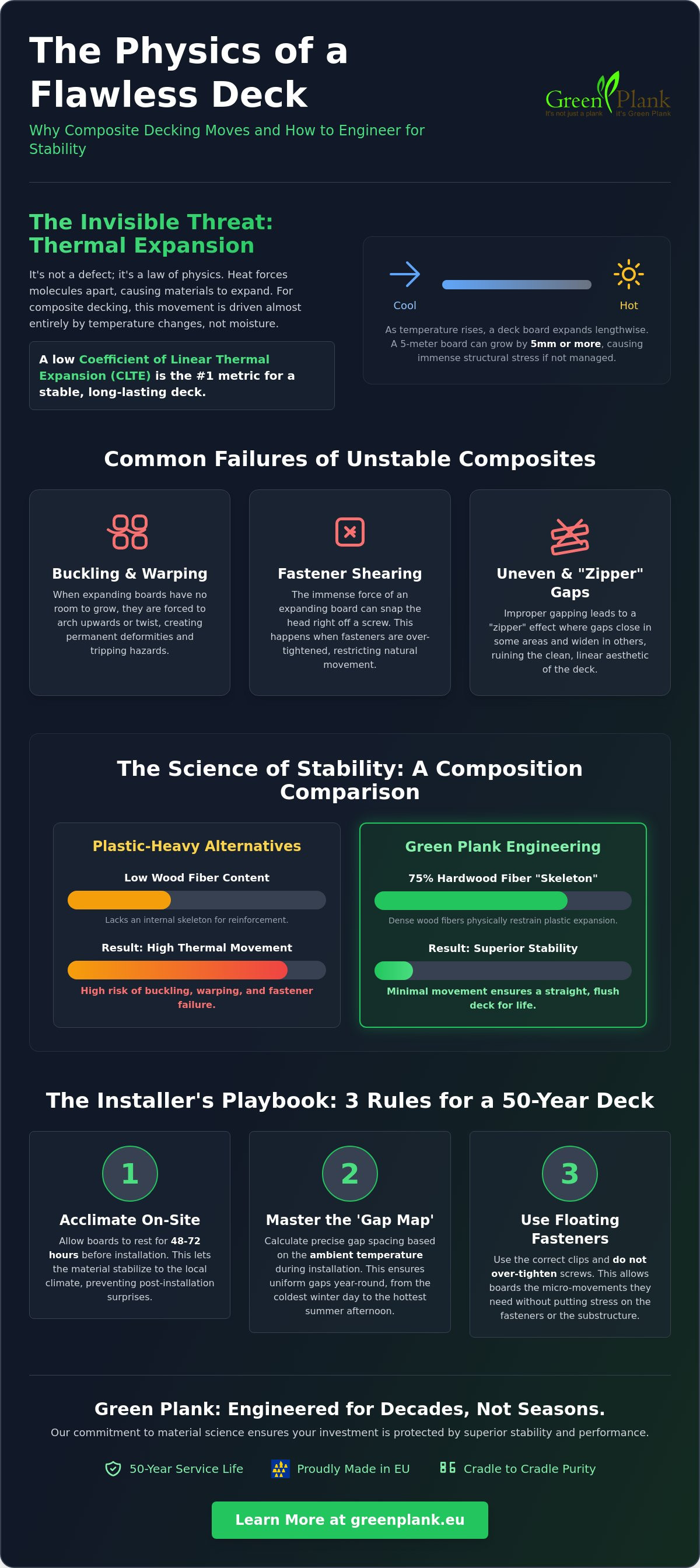
Thermal expansion isn't a defect; it's a law of physics. At the molecular level, heat introduces kinetic energy that forces molecules to vibrate more vigorously and push away from one each other. This results in a physical increase in volume. For outdoor structures, this means your deck boards are constantly "breathing" as the sun rises and sets. Managing composite decking expansion and contraction issues begins with recognizing that this movement is inevitable but entirely predictable.
Traditional timber moves because it's thirsty. It swells with rain and shrinks as it dries out. In contrast, Wood-plastic composites (WPCs) flip this script. Their movement is almost entirely driven by heat rather than moisture. While moisture has a negligible effect on high-quality composites, thermal energy causes linear changes that installers must account for. Engineers use the Coefficient of Linear Thermal Expansion (CLTE) to measure this behavior. It's a vital quality metric. A lower CLTE indicates a board that stays put, while a high CLTE signals a board that will shift aggressively with every passing cloud.
Lengthwise expansion is the primary concern for any professional installer. While a board might grow slightly in width or thickness, the cumulative movement over a five-meter span is much more significant. If a board expands by just 0.1 percent, that results in five millimeters of growth. Without proper planning, those millimeters lead to buckled boards and failed joists.
The Role of Polymers in Thermal Movement
High-Density Polyethylene (HDPE) is the polymer of choice for durability, but it's inherently sensitive to solar gain. When boards sit in direct sunlight, they absorb energy rapidly. This causes the plastic components to expand. Boards made of 100% plastic often move significantly more than wood-plastic blends because they lack internal reinforcement. Acclimatisation is the professional's secret weapon. You've got to allow boards to rest on-site for at least 48 to 72 hours. This ensures the material reaches a state of equilibrium with the local environment before the first fastener is secured. It's a simple step that prevents massive headaches later.
Moisture vs. Thermal Expansion: A Critical Distinction
Green Plank utilizes a 75 percent hardwood fiber ratio to provide superior structural rigidity. This high wood-to-plastic ratio creates an internal skeleton that physically restrains the HDPE from moving too much. The plastic acts as a protective shield, encapsulating every fiber to prevent moisture-driven swelling. This balance is critical for long-term performance in varied climates. While the wood provides the "stop," the HDPE provides the "shield." Thermal memory is the material's inherent ability to return to its original manufactured length once the heat source is removed and temperatures stabilize. This ensures that composite decking expansion and contraction issues don't become permanent deformities over the 50-year life of the deck.
Common Composite Decking Expansion and Contraction Issues
When thermal movement is ignored during installation, the results are both visible and structural. A deck that looked perfect in the spring can transform into a series of wavy lines by mid-July. These composite decking expansion and contraction issues aren't just cosmetic flaws; they represent significant mechanical stress on the entire system. Understanding these failures is the first step toward preventing them and ensuring the longevity of your outdoor space.
Buckling occurs when boards have no room to grow. As the temperature rises, the planks expand lengthwise. If they hit a fixed boundary like a wall or a neighboring board, they're forced to arch upward. This creates tripping hazards and uneven surfaces. Warping follows a similar logic but often involves the board twisting as internal stresses find the path of least resistance. These deformities often become permanent once the material's elastic limit is exceeded, requiring a full replacement of the affected boards.
Fastener shearing is a more insidious problem. Many installers attempt to "lock" a board in place by over-tightening screws or using the wrong clips. This is a mistake. According to research on thermal properties, the force exerted by an expanding composite board can be immense. If the board is restricted, it will eventually shear the head right off the fastener. You might not notice it until you see a board lifting or hear a distinct "pop" on a hot afternoon when the sun is at its peak.
Gap creep and the "zipper" effect ruin the architectural lines of a high-end project. Without a central pinning point, boards can migrate toward one end over several seasons. This leaves one side with no gap and the other with a cavernous opening. This cumulative movement creates the "zipper" effect at butt-joints, where the alignment of the deck is lost entirely. Consistency is key to a professional finish that lasts for decades.
Structural Risks of Improper Gapping
Expanding WPC puts incredible pressure on joists and sub-frames. When boards are butted too tightly, they can pull joists out of alignment or cause them to rotate. Common structural warning signs include:
- Mushrooming: Plastic material forcing itself upward around a screw head because of restricted lateral growth.
- Joist Stress: Lateral forces warping the underlying timber or metal frame as the boards expand.
- Board Lifting: Planks detaching from the sub-structure as they arch under extreme thermal pressure.
Aesthetic Failures and Homeowner Complaints
Winter gaps are the most frequent source of homeowner dissatisfaction in Northern climates. A gap that was five millimeters in summer can double in size during a cold snap. Dark-coloured boards are particularly susceptible to this; they absorb more solar energy and experience 20 to 30 percent more movement than lighter tones. This creates a "bouncing" feel as boards lose their friction fit against the joists. To avoid these common pitfalls, it's essential to choose a high-stability product like Terra Tuff composite decking which is engineered for minimal movement and maximum durability.
The Science of Stability: 75% Hardwood Fiber vs. Plastic-Heavy Alternatives
True stability in a deck board is an internal achievement. While surface treatments can protect against UV rays, they do little to alter the material's inherent physics. At Green Plank, we utilize an "Internal Skeleton" theory to mitigate composite decking expansion and contraction issues. By incorporating 75 percent hardwood fiber, we create a rigid matrix that physically restrains the polymer. This high fiber-to-plastic ratio is the highest in the EU market, providing a level of structural integrity that plastic-heavy alternatives simply cannot match.
The effectiveness of this engineering is measured by the Coefficient of Linear Thermal Expansion (CLTE). An academic study on thermal expansion confirms that the formulation of the core material dictates how much a board will grow. When hardwood fibers are densely packed and encapsulated in a 25 percent HDPE blend, they act as a stabilizing force. This reduces the board's tendency to move by creating a more predictable and lower CLTE. We use 100 percent EU raw materials to ensure that these expansion rates remain consistent across every batch, giving professionals the confidence to plan precise gaps that stay uniform for decades.
HDPE vs. PVC: Which Moves Less?
There's a common misconception that all polymers behave the same way under heat. PVC is often touted for its rigidity, yet it can be brittle and prone to cracking if it's not engineered correctly. Our 25 percent HDPE blend sits in the "Goldilocks" zone of material science. It offers enough flexibility to handle natural shifts without snapping, while the hardwood skeleton provides the necessary strength. We've found that recycled EU HDPE actually outperforms many virgin imports. The recycling process often results in a more stable polymer chain that, when combined with our proprietary additives, delivers superior thermal resistance. It's a choice that balances high-end performance with a grounded, eco-conscious responsibility.
The Green Plank Density Advantage
Board density plays a silent but critical role in how your deck handles the sun. Low-density boards, which are often hollow to save on material costs, struggle with heat dissipation. They trap thermal energy, which can lead to localized "hot spots" and aggressive expansion. Solid profiles like Terra Tuff handle thermal loads much more predictably. The increased mass allows the board to absorb and release heat slowly, preventing the rapid spikes in movement that cause buckling. If you're interested in a deeper dive into how these materials are made, you can read our guide on What is WPC Composite Decking? to understand the full scope of sustainable outdoor engineering.
Installation Rules to Prevent Expansion Problems
A deck's longevity depends on the precision of its installation. While high-quality material science provides the foundation, the way you handle the boards on-site determines whether you'll face composite decking expansion and contraction issues. Success begins with patience and ends with engineering. Follow these five essential steps to ensure a stable, flush surface that stands the test of time.
- Acclimatise the material: You must place your boards on-site for at least 48 to 72 hours before the first cut. This allows the internal temperature of the WPC to reach equilibrium with the local environment.
- Calculate the Gap Map: Never use a "one-size-fits-all" spacing. You must adjust your gaps based on the current ambient temperature. If it's a cold morning, leave more room; if it's a hot afternoon, the boards have already expanded.
- Use floating fasteners: Fixed fasteners like top-screws restrict natural movement. Utilizing clips that allow longitudinal sliding prevents internal stress and surface cracks.
- Install Breaker Boards: Continuous runs exceeding six meters are difficult to manage. Use perpendicular breaker boards to divide the deck into smaller, more stable sections.
- Ensure Ventilation: Heat trapped beneath a deck accelerates thermal movement. Maintain at least 100mm of clear air space under the joists to allow for natural cooling.
The HidLoc™ Advantage for Thermal Management
Traditional top-screwing is the primary cause of expansion-related failures. When you drive a screw through the face of a board, you "lock" it to the joist. As the board tries to move, the screw acts as a wedge, leading to mushrooming or splitting. HidLoc™ hidden fastening systems solve this by providing a "floating" fit. The 2026 engineering behind these clips allows the board to slide lengthwise within the groove while keeping it securely attached to the sub-frame. This mechanism absorbs the stress of thermal shifts without compromising the structural integrity of the deck.
Managing Butt-Joints and Perimeter Gaps
Precision at the joints is what separates a professional build from an amateur one. Always implement the "Double-Joist" rule at butt-joints. By using two joists where board ends meet, you ensure each end is independently supported and fastened. This prevents the boards from pulling on a single set of screws as they contract. Additionally, a 10mm to 15mm gap is mandatory wherever the deck abuts permanent structures like walls or posts. When installing at an ambient temperature of 20°C, set a 4mm expansion gap at butt-joints to accommodate peak summer growth while maintaining a tight aesthetic during cooler months.
Explore our range of high-performance WPC profiles to see how precision engineering simplifies your next project.
Green Plank Engineering: Designed for 50 Years of Performance
Engineering for longevity requires a deep understanding of regional climates. In Northern Europe and Scandinavia, where seasonal temperature swings can exceed 50 degrees Celsius, composite decking expansion and contraction issues are a rigorous test of material purity. We've designed our products to withstand these extremes through a commitment to 100 percent EU raw materials. This ensures every board meets the most stringent European building codes for safety, stability, and load-bearing performance. By sourcing materials locally, we maintain a level of quality control that imported alternatives cannot match.
The Cradle to Cradle ownership model isn't just an ethical stance; it's a technical advantage. It ensures that every component in our WPC is documented and free from the contaminants that cause unpredictable expansion rates. Commercial specifiers and architects frequently choose Green Plank for public infrastructure projects because they require a material that won't buckle under heavy foot traffic or shear fasteners during a heatwave. Our boards are built to stay straight and flush for a 50-year service life, providing a reliable foundation for any high-end outdoor space.
Terra Tuff and Smart System: Built for the Elements
Our Terra Tuff Composte Decking undergoes extreme temperature cycling tests to prove its resilience in sub-zero winters and scorching summers. This solid profile offers the thermal mass needed for slow heat dissipation, which prevents the rapid spikes in movement that lead to structural stress. Meanwhile, Smart System wpc composite decking simplifies professional installation by integrating movement management into the system's design. It's a technical solution that balances aesthetic appeal with the physical necessity of thermal movement.
Reducing the CO2 Footprint Through Durability
The most sustainable product is the one that doesn't need to be replaced. Every time a deck is torn up due to warping or structural failure, the environmental cost of the project doubles. Our engineering philosophy focuses on three core pillars of sustainability:
- Resource Efficiency: Utilizing a 75 percent hardwood fiber blend that repurposes timber waste into high-performance architecture.
- Carbon Reduction: Minimizing transport emissions by using 100 percent EU-sourced raw materials and manufacturing.
- Lifecycle Longevity: Providing a 50-year warranty that reflects our confidence in the material's thermal stability.
A deck should be a place of rest, not a source of maintenance anxiety. By mastering the science of thermal movement and choosing materials engineered for the European climate, you ensure your project remains a beautiful, safe extension of your home for decades. If you are ready to transition from temporary solutions to permanent architectural excellence, Contact Green Plank for a Professional Project Consultation today.
Building for a Lifetime of Stability
Thermal movement is an engineering reality, but it shouldn't compromise the integrity of your architectural vision. By prioritizing a high 75 percent hardwood fiber ratio, you provide your deck with the internal skeleton required to resist aggressive shifting. We've detailed how precision gapping, on-site acclimation, and floating fasteners protect your investment from buckling and sheared fasteners. Successfully managing composite decking expansion and contraction issues isn't about fighting the laws of physics; it's about utilizing superior material science to work alongside them.
Choosing 100 percent EU raw materials ensures that every board performs predictably under the most demanding environmental conditions. This commitment to engineering precision is why we provide an industry-leading 50-year warranty on our premium profiles. It's a promise of performance that respects both your home and the natural world. You deserve an outdoor space that remains straight, flush, and beautiful for decades to come.
Request a Technical Specification Sheet for Your Next Project and take the first step toward a maintenance-free legacy of quality.
Frequently Asked Questions
How much does composite decking expand and contract?
A standard composite board typically moves about 1mm per linear meter for every 20°C change in temperature. High-quality WPC with a 75 percent hardwood fiber ratio experiences less movement than plastic-heavy alternatives. This internal stability ensures that your deck maintains its architectural lines throughout the year. You must account for this movement during the planning phase to avoid structural stress on the joists.
Do I need an expansion gap for composite decking?
You absolutely need expansion gaps to prevent boards from warping or buckling. These gaps allow the material to breathe as it reacts to solar gain. We recommend calculating specific spacing based on the ambient temperature during installation. Proper gapping is the primary defense against composite decking expansion and contraction issues that can ruin a deck's aesthetics and safety over time.
Can I install composite decking tight against a wall?
Never install boards tight against a permanent structure like a wall or a post. You must leave a perimeter gap of 10mm to 15mm to allow for thermal growth. If the boards are restricted at the ends, the resulting pressure can pull fasteners loose or cause the planks to arch. Maintaining this clearance ensures the deck remains flush and safe for the duration of its 50-year service life.
Why is my composite deck buckling in the summer?
Buckling occurs when boards expand in the heat but have no room to grow lengthwise. This happens if the initial installation gaps were too small or if the boards were installed tight against a fixed boundary. The internal pressure forces the boards to lift off the joists. Ensuring adequate sub-surface ventilation and correct gapping during the build phase prevents this common summer failure.
Does the colour of the decking affect how much it moves?
Darker colours absorb significantly more solar energy, which leads to higher internal temperatures and increased movement. A dark charcoal board can expand 20 percent to 30 percent more than a light grey board in the same sunlight. We engineer our 75/25 hardwood-fiber blend to mitigate these effects. However, you should still account for colour-driven heat absorption when calculating your installation gaps.
What is the best temperature to install composite decking?
The ideal installation temperature is between 10°C and 20°C. Installing in extreme heat or bitter cold makes it difficult to set the Gap Map accurately. If you're installing in high temperatures, remember that the boards are already at their maximum expansion. Conversely, boards installed in the winter will expand significantly once the first warm days of spring arrive.
Will hidden fasteners stop my deck from moving?
Hidden fasteners don't stop movement; they manage it safely. Our HidLoc™ fastening system provides a floating fit that allows boards to slide longitudinally while remaining secure to the sub-frame. This prevents the fastener shearing and surface cracking often caused by rigid top-screwing. Using a system designed for thermal management is essential for maintaining a premium outdoor space.
How long will composite decking last if it expands?
Composite decking is designed to handle thermal movement throughout its entire lifespan without degrading. When installed correctly with proper gapping and ventilation, our boards are warranted for up to 50 years. The material's thermal memory allows it to return to its original state once temperatures stabilize. Expansion is only a threat to longevity if the installation fails to accommodate the material's natural physics.
Specificera produkten
Använd den här guiden i en Green Plank-specifikation
Tekniska WPC-artiklar ska stärka de kommersiella sidorna — inte konkurrera med dem. Fortsätt till komposittrall, TerraTuff, Nordeka eller de tekniska nedladdningarna.