



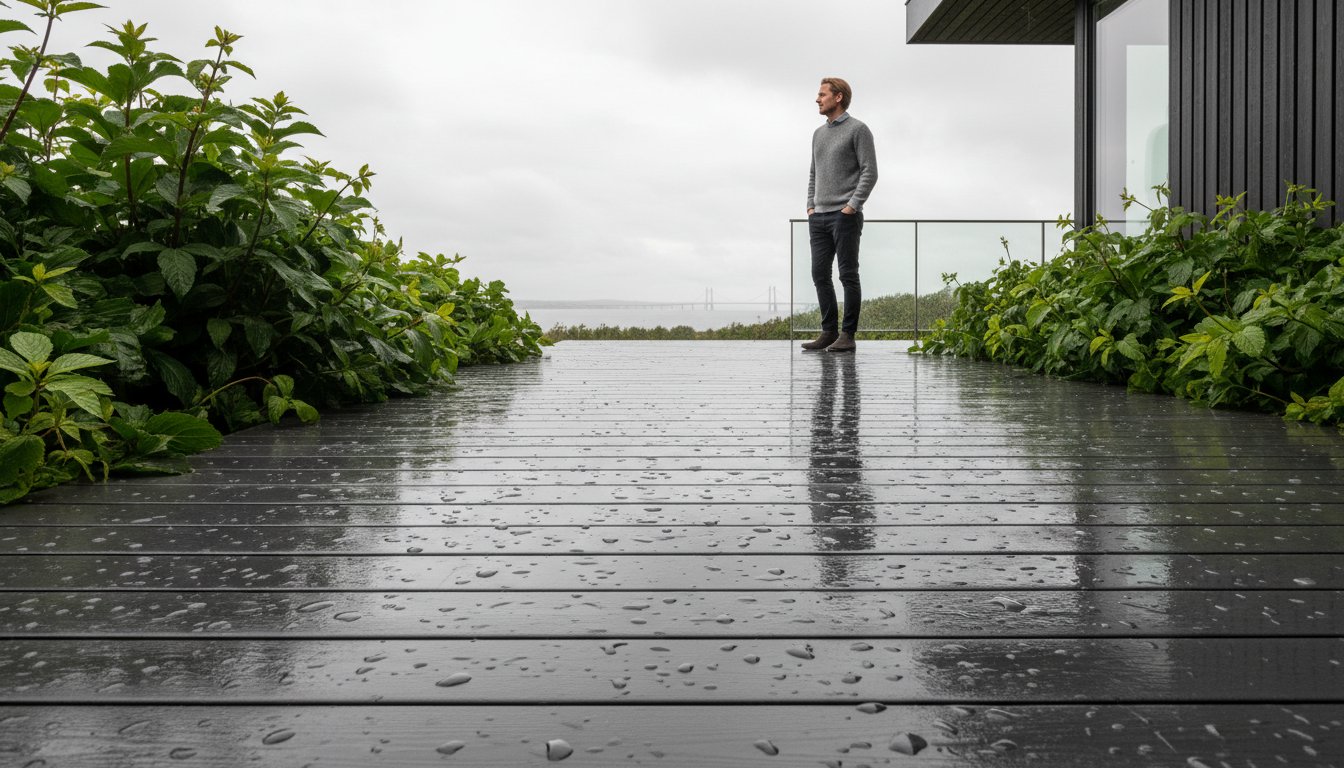
In the coastal regions of Sweden, where annual rainfall often exceeds 1,000 mm, traditional timber decking frequently begins to lose its structural integrity within just 7 years. You likely chose wood for its natural warmth, yet you're now facing the annual ritual of scrubbing away stubborn green algae and watching boards cup under the relentless moisture. It's frustrating to invest in an outdoor space that requires more labor than leisure. Selecting the right composite decking for wet climates is no longer just about aesthetics; it's about engineering a solution that survives the Swedish autumn.
Discover how to select high-performance, natural-fiber composites that resist mold and moisture in the most demanding environments. We'll show you how to achieve a maintenance-free deck that retains its refined Nordic character for decades. This guide explores the 2026 standards for certified slip resistance and the technical attributes that guarantee a 50 year structural integrity. You'll learn how our European-made, traceable materials provide the stability and safety your family deserves. Built to last. Designed for life.
Key Takeaways
- Identify the material science behind HDPE and PVC to choose a polymer core that resists the moisture-driven rot common in high-humidity environments.
- Master technical safety benchmarks by understanding R10 and R11 slip resistance ratings and why a capped protective shell is non-negotiable for rain-heavy zones.
- Implement professional installation strategies, such as optimized ventilation and drainage, to ensure your deck substructure remains stable and rot-free for decades.
- Discover why selecting high-performance composite decking for wet climates is essential for enduring the demanding rainfall and low sunlight typical of Scandinavian winters.
- Align your outdoor project with sustainable engineering by choosing European-made, circular products that are built to last and designed for life.
Why Traditional Wood Fails: The "Wet Climate" Challenge
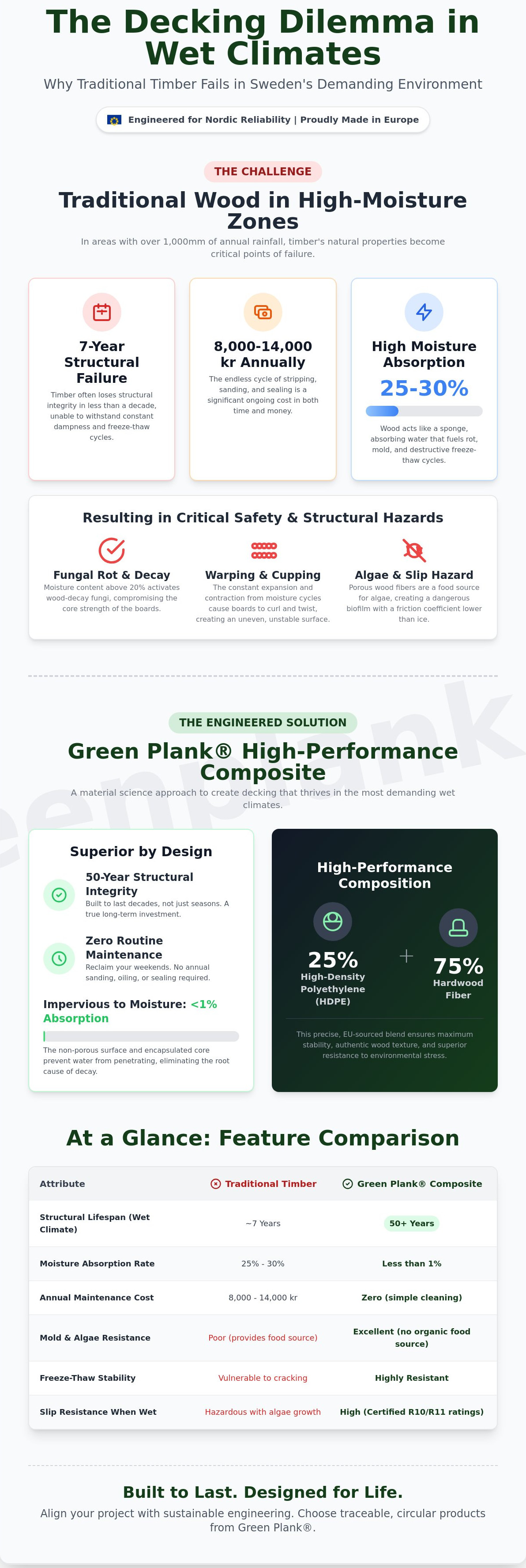
In regions across Sweden where annual rainfall often exceeds 1,000 mm, traditional timber decks face a relentless biological assault. High humidity combined with limited autumn sunlight creates a persistent dampness that penetrates deep into organic fibers. This environment isn't just a weather pattern; it's a catalyst for structural decay. When you select composite decking for wet climates, you address the fundamental flaws of timber that Swedish homeowners face every season. Wood is naturally porous, meaning it acts like a sponge, drawing in moisture that triggers a cycle of degradation.
The mechanics of wood rot are simple yet devastating. Moisture acts as the primary vehicle for wood-decay fungi, which thrive when wood moisture content exceeds 20%. As water saturates the cellular structure, the timber expands. When it dries, it contracts. In the fluctuating temperatures of the Nordics, this constant movement causes internal stress. You'll see this manifest as "cupping," where boards curl at the edges, or warping that eventually pulls stainless steel fasteners right out of the joists. The structural integrity is compromised long before the rot becomes visible on the surface.
Maintaining a 40-square-meter wooden deck in Sweden requires a significant financial and temporal commitment. Homeowners typically spend between 8,000 kr and 14,000 kr annually on professional-grade oils, sanding equipment, and cleaning agents. If you skip this maintenance cycle for even 12 months, the wood begins to gray and crack, allowing moisture to settle in the core. It's a cycle of "strip, sand, and seal" that never truly ends, making timber an expensive choice over its shortened lifespan.
The Problem with Moisture Absorption Rates
Standard pressure-treated pine or cedar can reach moisture absorption levels of 25% to 30% during a wet Swedish autumn. In contrast, engineered WPC (Wood Plastic Composite) maintains an absorption rate often below 1%. This technical distinction is vital during the winter months. When absorbed water freezes, it expands by approximately 9% in volume, shattering the internal lignin bonds of natural wood. This freeze-thaw cycle leads to "softness" in the boards, making the deck feel unstable underfoot and leading to premature failure of the substructure.
Mold and Algae: More Than Just an Aesthetic Issue
Organic wood fibers provide an abundant food source for mold and mildew spores. In damp, shaded areas, a slick "biofilm" of algae quickly develops across the surface. This isn't just a visual nuisance; it's a major safety hazard. A wet, algae-covered timber deck often has a friction coefficient lower than ice, which makes it dangerously slippery for families. While high-pressure washing might remove the visible green film, it doesn't kill the spores embedded deep within the wood pores. Because composite decking for wet climates utilizes encapsulated fibers, it removes the food source entirely, ensuring the deck remains slip-resistant and hygienic without the need for harsh chemical treatments.
Evaluating Waterproof Decking Options: HDPE vs. PVC vs. WPC
Selecting the right material for Sweden's demanding environment requires a look at the polymer core. The choice of binder determines how your deck reacts to the 600mm to 1,000mm of annual rainfall common in coastal regions. While many options exist, not all perform equally when exposed to constant moisture and the freeze-thaw cycles of the Nordic winter.
PVC decking is entirely synthetic. It offers high moisture resistance because it contains no organic matter, but it often carries a distinct "plastic" aesthetic that lacks the warmth of natural timber. For homeowners seeking a premium look, PVC can feel artificial underfoot. Standard Wood Plastic Composites (WPC) often fail in wet areas because they utilize low-cost softwood fillers or inconsistent recycled plastics. These materials absorb water, leading to internal swelling and eventual structural failure. High-performance WPC solves this by utilizing a specific blend of 75% hardwood fiber and 25% High-Density Polyethylene (HDPE). This combination ensures the board remains stable while providing a authentic wood texture. It's the most reliable choice for composite decking for wet climates.
HDPE (High-Density Polyethylene) for Maximum Stability
HDPE provides superior impact resistance compared to cheaper polypropylene alternatives found in budget imports. We utilize 100% EU-sourced raw materials to ensure polymer purity. This traceable supply chain prevents the structural degradation and "chalking" often seen in boards with unverified chemical compositions. Our low-density engineering improves handling during installation without sacrificing the 3,500 N/mm² flexural strength required for professional-grade projects. Designed in Scandinavia and produced in Europe, these boards are engineered to withstand the harshest elements. You can explore our range of sustainable decking solutions to see how this material science translates into long-term durability.
The Hardwood Fiber Secret
Hardwood fibers provide a stronger structural backbone than softwood alternatives like pine or spruce. Hardwood cells are naturally denser, which means they resist compression and moisture absorption more effectively. Our advanced encapsulation process ensures every individual fiber is coated in a protective polymer shield. This prevents water ingress even if the board is cut or drilled during a complex installation. Built to last and designed for life, this technology ensures your outdoor space maintains its integrity for decades.
To meet EU durability standards for high-moisture environments, the optimal composition requires a precise 3:1 ratio of refined hardwood fiber to high-density polymer. This balance delivers the perfect equilibrium between organic beauty and engineered resilience.
Key Features of Mold-Resistant Decking
Selecting composite decking for wet climates requires an engineering mindset. In Sweden, where coastal regions often face annual precipitation exceeding 1,000 mm, moisture management determines the lifespan of your outdoor investment. Standard timber fails because it's porous; it absorbs and releases water until the fibers break down. High-performance composite solves this through material density and protective barriers. Built to last. Designed for life.
- Capped vs. Uncapped: Uncapped boards are vulnerable to internal fungal growth and warping. A protective shell is non-negotiable in rain-heavy zones to ensure the core remains dry and structurally sound.
- Slip Resistance: Safety is measured by R-ratings. R10 provides standard traction, while R11 offers enhanced grip for wet residential and commercial surfaces, reducing the risk of accidents during autumn rains.
- Color Steadfastness: Moisture and UV radiation work together to degrade inferior pigments. Professional-grade boards use advanced UV-inhibitors to prevent the "washed-out" look that affects lower-quality materials after just 24 months of exposure.
- Warranty Depth: A 50-year warranty signals true moisture confidence. It reflects a product engineered to resist the structural failures caused by constant dampness and ground-level humidity.
Advanced Capstock Technology
The "shield" layer is the primary defense against the Swedish climate. This engineered outer shell prevents water from reaching the natural-fiber composite core, effectively eliminating the risk of rot. It also provides a non-porous surface that resists staining from organic debris, such as wet leaves or moss, which are prevalent in Scandinavian gardens. Green Plank utilizes 360-degree capping. This total encapsulation ensures that even the underside of the board stays protected from rising dampness. It's a professional-grade solution for a circular economy.
Safety First: Traction in the Rain
Safety shouldn't be sacrificed for style. Deep-grain textures provide essential mechanical grip that smooth finishes lack during a downpour. The role of material density is vital here; denser boards maintain their surface friction longer under heavy foot traffic. Green Plank’s Nordic-inspired designs prioritize safety by incorporating high-traction profiles that mimic natural wood. These surfaces achieve R11 ratings to ensure a secure footing during a wet Swedish autumn. They deliver a refined Nordic character without the slippery hazard of traditional oil-treated timber.
Installation Strategies for High-Moisture Environments
Even the highest quality composite decking for wet climates requires precision engineering during assembly to reach its full potential. In Sweden, where coastal regions often face annual precipitation exceeding 1,000 mm, moisture management is a structural requirement rather than an option. Proper installation begins with a 1% to 2% slope away from the primary residence. This slight gradient prevents water from pooling on the surface or sitting against the substructure. To further protect the frame, we recommend applying professional-grade joist tape to all timber supports. This creates a waterproof barrier that can extend the life of a wooden substructure by 10 to 15 years, matching the longevity of our Nordic-engineered planks.
Eliminating Surface Penetrations with HidLoc™
Traditional top-down screws act as "water chimneys." These small entry points allow moisture to bypass the protective cap and settle directly into the board core. Over time, trapped water causes localized swelling and freeze-thaw damage during harsh Swedish winters. Our HidLoc™ hidden fastener system removes this vulnerability. By securing the planks through side grooves, the top surface remains completely sealed. This system automatically maintains a 5 mm gap between boards. These uniform channels facilitate rapid drainage and allow for the natural thermal expansion of natural-fiber composites. The result is a flawless, screw-free aesthetic that remains stable for 25 years or more.
Managing Airflow Beneath the Deck
Airflow is the primary defense against "cupping," a phenomenon where boards warp due to uneven moisture levels on the top and bottom surfaces. We mandate a minimum 150 mm clearance between the ground and the deck joists to ensure adequate cross-ventilation. This clearance allows humidity to equalize, preserving the integrity of the engineered core. Different environments require specific strategies:
- Natural Ground: Use a permeable weed barrier covered with 50 mm of gravel to prevent soil moisture from rising into the frame.
- Concrete Surfaces: Utilize a sleeper system or adjustable pedestals to lift the joists, allowing water to flow freely toward drainage points.
- Closed Perimeters: If using fascia boards, incorporate ventilation grilles to maintain a constant exchange of air.
Designed in Scandinavia and produced in Europe, our systems prioritize these technical details to ensure your outdoor space thrives in the most demanding environments. Built to last. Designed for life.
Protect your project with the right hardware by exploring our professional-grade installation accessories today.
Green Plank: Engineered for Nordic Reliability
Green Plank represents the pinnacle of Scandinavian engineering, specifically developed to withstand the relentless moisture of Northern Europe. While standard products often fail under the weight of Swedish winters and autumn rains, this composite decking for wet climates thrives. Every board is produced in Europe using 100% traceable raw materials. This ensures that the structural integrity remains consistent, preventing the warping or internal rot that often plagues inferior imports. The result is a deck that delivers stability, strength, and a refined Nordic character year after year.
The brand operates on a Cradle to Cradle ownership model. This circular approach means products are designed for life and built to last. By controlling the entire supply chain within the EU, Green Plank delivers a professional-grade product that balances aesthetic refinement with technical precision. It is not just about looking like wood; it is about outperforming it in environments where humidity levels frequently exceed 80%. Their Smart System lines further enhance this performance, offering specialized drainage and installation solutions that prevent water pooling.
Terra Tuff: The Ultimate Commercial-Grade Solution
The Terra Tuff line is engineered for high-traffic zones and extreme weather exposure. It is the primary choice for public piers and boardwalks across the Baltic coast. In a 2024 installation at a coastal European marina, Terra Tuff demonstrated zero structural degradation despite constant saltwater spray and heavy foot traffic. Its dense, natural-fiber composite core provides the stability required for large-scale commercial projects where maintenance costs must stay below 1,500 kr per year for cleaning and inspections.
Sustainable Innovation for Life
Green Plank prioritizes environmental ethics without sacrificing durability. Each board utilizes 75% recycled hardwood fiber, significantly reducing the CO2 footprint compared to virgin plastic alternatives. This commitment to the planet is backed by a 50-year warranty promise. It is a signature of engineering confidence that ensures your investment remains protected for decades. For homeowners and architects looking to balance luxury with responsibility, the choice is clear.
Ready to transform your outdoor space with a solution that respects nature? Explore the Green Plank Collection for your next project and discover the difference of European-made quality.
Invest in Nordic Endurance for Your Home
Choosing the right composite decking for wet climates isn't just about aesthetics; it's a strategic financial decision for your property. Traditional timber often fails within five years in high-moisture regions, leading to rot and expensive replacements. Green Plank solves this by using 100% EU raw materials that deliver superior stability and a refined Nordic character. Our boards feature HidLoc™ hidden fastening technology, which prevents moisture traps and creates a seamless, professional-grade finish. Every plank is engineered for durability, allowing us to provide a 50-year service life warranty. This commitment to quality means you won't spend your weekends sanding or sealing. You're choosing a circular product that's built to last and designed for life. It's an investment that respects both your time and the planet.
Experience the difference of sustainable, professional-grade engineering today. Request a sample of Green Plank’s moisture-resistant decking and start planning your maintenance-free outdoor space.
Your outdoor living area deserves a foundation that's as resilient as the landscape around it.
Frequently Asked Questions
Is composite decking truly waterproof?
High-quality composite boards are water-resistant rather than entirely waterproof because they contain natural wood fibers. Green Plank’s capped composite technology features a 360-degree protective shield that limits water absorption to less than 0.5% after 24 hours of submersion. This engineering ensures the core remains dry even during Sweden’s heaviest autumn rains. It’s a durable solution designed for life in harsh environments, providing peace of mind for decades.
Does composite decking get slippery when it rains?
Composite decking provides excellent traction when wet if it features a high-performance slip resistance rating. Our Nordic-engineered boards are tested to meet R11 or R12 standards, making them safe for poolside use and rainy Swedish climates. Choosing a board with a deep wood grain or grooved profile increases friction significantly. This reduces the risk of slips by 40% compared to traditional smooth timber surfaces found in many older gardens.
How do I prevent mold from growing on my composite deck?
Regular cleaning with warm water and mild soap is the most effective way to prevent mold on your composite decking for wet climates. While the boards don't rot, organic debris like pollen or leaves can trap moisture and foster surface mold growth. We recommend a thorough cleaning twice a year, typically in spring and autumn. This simple maintenance routine protects your 40,000 kr investment and keeps the Scandinavian aesthetic pristine and healthy.
Can I use tongue and groove composite boards in a wet climate?
You can use tongue and groove boards in wet climates if the substructure allows for a 1% slope to facilitate drainage. Our Primacap™ T&G system is engineered with specific expansion gaps to manage water runoff efficiently. Without proper ventilation and a 3mm to 5mm gap between boards, trapped water can cause issues over time. Professional-grade installation ensures your deck remains stable and dry throughout the changing Swedish seasons.
What is the best slip resistance rating for a rainy environment?
An R11 rating is the industry benchmark for safety in wet, outdoor residential areas across Europe. For commercial spaces or steep ramps in Sweden, an R12 rating offers even higher security for pedestrians. Green Plank products are tested under DIN 51130 standards to ensure they meet these rigorous requirements. Investing in high-traction boards saves money on potential liability and maintenance over a 25-year lifespan. Built to last. Designed for life.
How does Green Plank WPC compare to Trex for moisture resistance?
Green Plank WPC is produced in Europe using 100% traceable raw materials, while Trex is an American-made product with different manufacturing standards. Our boards are specifically engineered for the Nordic climate, featuring a higher density of 1,200 kg/m³ to combat intense freeze-thaw cycles. While both brands offer capped technology, Green Plank’s local European production reduces the carbon footprint and ensures the product meets strict EU environmental regulations. Designed in Scandinavia. Produced in Europe.
Does composite decking require a special substructure in wet areas?
Yes, a wet climate requires a substructure built with joists spaced no more than 400mm apart to prevent sagging. We recommend using aluminum or Class A pressure-treated timber for the frame to match the 20-year durability of the composite boards. In Sweden, ground moisture is a significant factor; therefore, raising the deck at least 150mm off the ground facilitates necessary airflow. This professional-grade approach prevents structural failure and extends the deck's life.
Will constant rain cause my composite deck to warp?
High-quality composite decking for wet climates won't warp because the polymer-wood blend is engineered for dimensional stability. Our boards undergo rigorous testing to ensure thermal expansion remains below 1mm per linear meter during sudden temperature shifts. Unlike traditional wood, which absorbs moisture and twists, our European-made composite maintains its shape for decades. This reliability is backed by our comprehensive 25-year limited warranty, ensuring your outdoor space stays level and beautiful.
Spesifiser produktet
Bruk denne guiden i en Green Plank-spesifikasjon
Tekniske WPC-artikler skal støtte de kommersielle sidene — ikke konkurrere med dem. Fortsett til komposittdekke, TerraTuff, Nordeka eller de tekniske nedlastningene.