


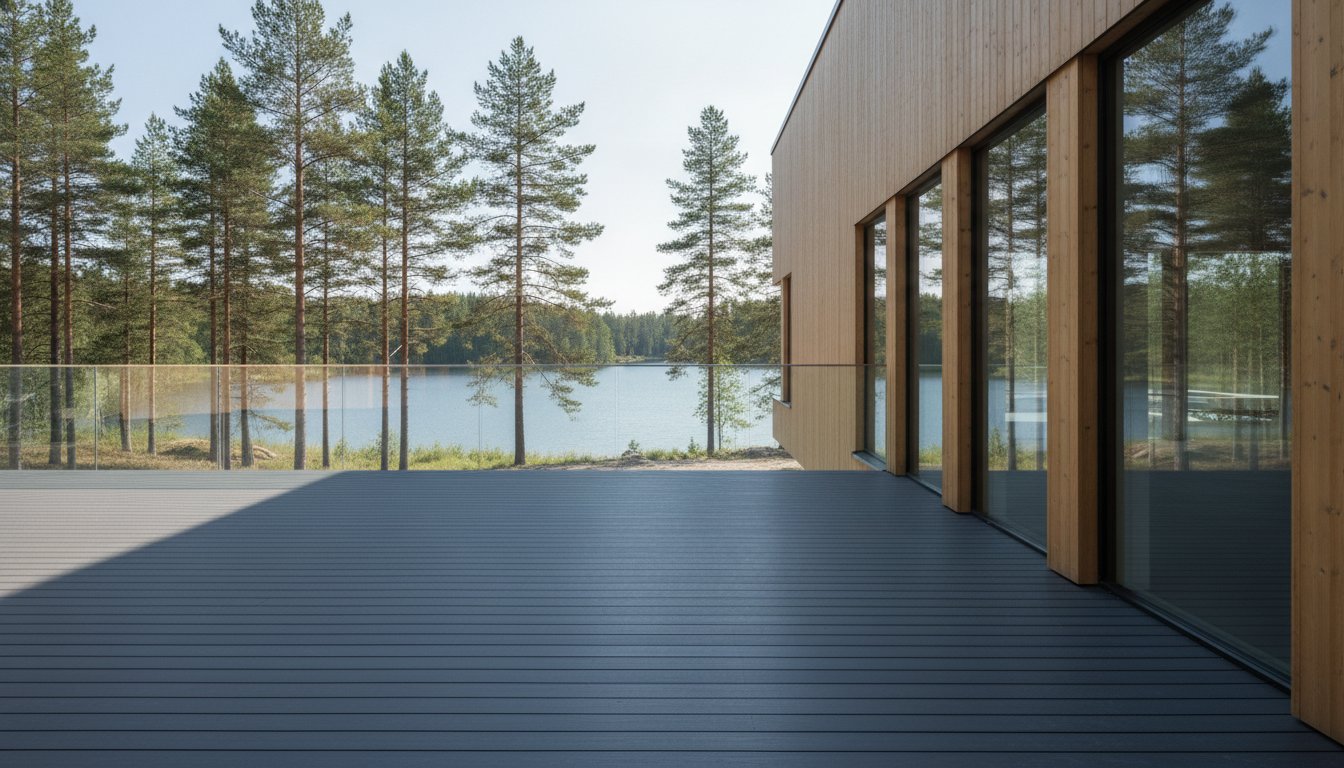
The construction of buildings accounts for approximately 33% of Sweden's national greenhouse gas emissions when accounting for imported materials. This data point has shifted sustainability och Swedish market expectations from voluntary initiatives to mandatory structural requirements. You likely feel the pressure of balancing high aesthetic standards with the strict CO2 footprint limits imposed by the climate declaration act. Identifying truly circular materials in a sea of greenwashed alternatives remains a complex task for any industry professional.
This article reveals how Sweden's commitment to circularity is redefining material standards and why engineered composite solutions are leading the green transition. You will gain a clear understanding of the Swedish "Green Model" as it stands in 2026. We provide a practical framework for evaluating circular building materials, giving you the confidence to select long-life exterior solutions that prioritize both engineering precision and ecological responsibility. By focusing on material science and long-term performance, you can ensure your projects respect nature while maintaining a premium finish; for interior requirements, you can visit Gyp Artisan to explore specialized gypsum solutions that meet these same high standards.
Key Takeaways
- Learn why the shift toward mandatory circularity is redefining project success for those navigating sustainability och Swedish market regulations.
- Understand the critical role of EU-sourced raw materials in ensuring material traceability and reducing the hidden environmental costs of global supply chains.
- Discover the performance advantages of wood-plastic composites over traditional timber in high-traffic commercial zones through detailed lifecycle analysis.
- Access a professional framework for evaluating material longevity and verifying Cradle to Cradle ownership credentials during procurement.
- Explore how engineering-led manufacturing using 75% hardwood fiber directly supports Sweden’s 2030 national climate targets.
Table of Contents
The Evolution of Sustainability och Swedish Market Dynamics
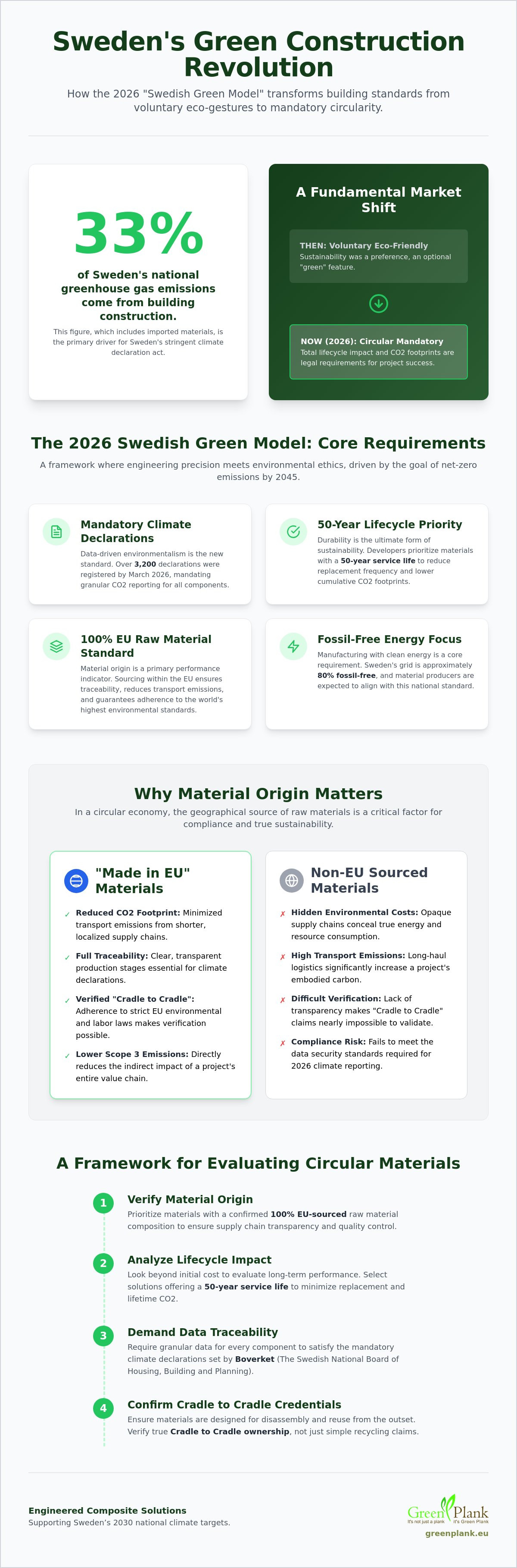
The landscape of sustainability och Swedish market expectations has undergone a fundamental transformation. What began as a voluntary "eco-friendly" preference has matured into a "circular mandatory" framework. As of 2026, the Swedish Green Model dictates that construction projects aren't just judged on their initial aesthetic appeal but on their total lifecycle impact. This shift is driven by the national goal of achieving zero net greenhouse gas emissions by 2045. By March 2026, over 3,200 climate declarations were registered, proving that data-driven environmentalism is the new industry standard. The Swedish sustainability market represents a seamless fusion of engineering precision and environmental ethics.
Local procurement standards now mirror international trade policies and the UN Sustainable Development Goals (SDGs). Developers increasingly view sustainable construction principles as the baseline for any viable commercial bid. This rigorous approach ensures that every material choice contributes to a building's mandatory climate declaration. It's a system where traceability is paramount. Every component must prove its origin to satisfy both regulators and investors who are increasingly wary of greenwashing.
Long-Term Thinking as a Market Driver
Swedish developers prioritize 50-year lifecycles over short-term savings. This long-term mindset stems from the understanding that durability is the ultimate form of sustainability, a principle also championed by heritage-led businesses like Arborfield Joinery through their focus on high-quality doors, windows, and stairs. High-performance materials that offer a 50-year service life reduce the frequency of replacement. This directly lowers the cumulative CO2 footprint of the infrastructure. The Environmental Performance Index now heavily influences local brand reputation. Firms are moving beyond simple recycling toward a true circular economy where materials are designed for disassembly and reuse from the outset.
The 2026 Regulatory Landscape
The 2026 regulatory landscape is defined by the Swedish National Board of Housing, Building and Planning (Boverket). Current BBR regulations demand granular CO2 reporting for all structural and exterior components. Manufacturing with fossil-free energy is a core requirement, as Sweden utilizes approximately 80 percent fossil-free energy in its grid. This focus on electrification allows developers to find out more about energy-efficient infrared heating as a key component of low-carbon building systems. By utilizing 100 percent EU-sourced materials, companies significantly reduce logistics-related carbon footprints. This regional sourcing strategy ensures that the supply chain remains as green as the product itself, avoiding the high emissions associated with long-distance shipping.
Circular Construction: Why Material Origin Matters in Sweden
Material origin serves as the foundation for modern circularity. In the context of sustainability och Swedish market regulations, the geographical source of raw materials is no longer a footnote; it's a primary performance indicator. Non-EU materials often carry hidden environmental costs that compromise a project's climate declaration. These costs manifest as high transport emissions and opaque supply chains that make "Cradle to Cradle" verification nearly impossible. Selecting materials with a clear European lineage ensures that every stage of production adheres to the world's most stringent environmental and labor standards.
A localized supply chain directly reduces a building's CO2 footprint by minimizing the carbon debt of long-haul logistics. When materials travel shorter distances, the total embodied energy of the project drops significantly. This traceability is essential for meeting the Swedish National Board of Housing, Building and Planning (Boverket) requirements. Choosing "Made in EU" products acts as a proxy for both high-end quality and strict environmental compliance, providing specifiers with the data security they need for 2026 climate reporting.
The 100% EU Raw Material Standard
Ethical sourcing is a non-negotiable pillar of the Swedish construction sector. By utilizing 100% EU raw materials, manufacturers can guarantee transparency that globalized supply chains lack. This regional focus is a key driver in reducing Scope 3 emissions, which represent the indirect impact of a company's value chain. A recent Research Institutes of Sweden (RISE) report highlights how material reuse and localized sourcing are critical for the sector's green transition. Understanding why European raw materials matter for quality and safety allows professionals to avoid the risks associated with unverified imports. This commitment to regional reliability ensures that the finished outdoor space is as ethical as it is beautiful.
Hardwood Fiber and HDPE: A Sustainable Synergy
The engineering logic behind high-performance composite profiles relies on a precise 75/25 blend. Using 75% hardwood fiber provides the structural rigidity and natural aesthetic required for premium Swedish architecture. This high-density organic content is then stabilized by 25% HDPE (High-Density Polyethylene). The HDPE component acts as a moisture barrier, which is vital in the fluctuating Swedish climate. This synergy creates a low-maintenance solution that resists rot and decay without the need for toxic chemical treatments. The result is a low-density, high-strength profile that offers a service life of up to 50 years. You can achieve this balance of performance and responsibility by choosing a Sustainable Craftsman approach for your next infrastructure project.
Circularity vs. Traditional Materials: The Shift to Composite
The debate between traditional timber and modern composites has reached a turning point within the sustainability och Swedish market framework. While timber is often viewed as the default green choice, a comprehensive lifecycle analysis reveals a more complex reality for exterior applications. In high-traffic commercial zones, the "wood is always better" myth is challenged by the high environmental cost of frequent maintenance and replacement. Circular urban development requires materials that remain functional for decades without demanding resource-intensive upkeep. When a material fails prematurely, its initial "natural" status doesn't compensate for the carbon cost of its replacement.
Maintenance-free materials are essential for reducing the long-term carbon footprint of Swedish infrastructure. Every time a wooden deck is sanded, oiled, or stained, it consumes chemicals and energy that aren't usually accounted for in initial climate declarations. By contrast, composite solutions provide a stable, long-life alternative that supports the circular economy by staying in use longer. Systems like HidLoc™ hidden fastening play a critical role here. They allow for secure installation without damaging the material surface, which makes it far easier to disassemble and repurpose boards at the end of a building's life cycle. This preservation of material integrity is a core requirement for any truly circular project.
The Problem with Traditional Wood in 2026
By 2026, the resource intensity of chemical treatments for softwood has become a significant liability for developers. Traditional pressure-treated wood often relies on biocides to survive the damp Swedish climate, which can lead to hazardous runoff into local soil. These maintenance cycles create a hidden CO2 debt that grows every year the structure is in use. Understanding the 5 common problems with traditional wood decking is vital for specifiers who want to avoid these long-term pitfalls. Choosing a material that doesn't rot or warp ensures the architectural vision remains intact without constant intervention.
WPC as a Sustainable Innovator
Composite cladding and fencing systems do more than just provide a premium finish; they contribute to building insulation and thermal efficiency. Products like Terra Tuff and the Smart System wpc composite decking offer engineered durability that thrives in harsh environments. They achieve a natural wood aesthetic through a 75% hardwood fiber blend without the need for toxic coatings. This means zero chemical runoff into the local ecosystem. It's a premium solution that respects nature while providing the maintenance-free lifestyle modern consumers expect. By shifting to these innovative profiles, the Swedish market is proving that high-end design and ecological responsibility can coexist perfectly.
Evaluating Material Longevity: A Framework for Swedish Specifiers
Navigating the complexity of sustainability och Swedish market regulations requires a rigorous methodology. Professional specifiers can no longer rely on vague environmental claims. They must utilize a technical framework that evaluates material performance alongside ecological impact. This shift ensures that high-end aesthetic standards are met without compromising the mandatory climate declarations required for new builds. A robust procurement strategy focuses on five critical pillars: traceability of origin, composition ratio, maintenance intensity, verified service life, and end-of-life recovery.
This framework allows developers to calculate the true Total Cost of Ownership (TCO) in green building projects. While a material might appear cost-effective during the initial bid, its long-term value is determined by its durability and resource consumption. A project that requires replacement every fifteen years creates double the carbon debt of one designed for a half-century. By prioritizing materials that offer a Cradle to Cradle Ownership model, you ensure that resources remain within a productive loop rather than entering a landfill—a philosophy also seen in the interior sector where urban-reclamation.com repurposes reclaimed timber into rustic furniture.
The 50-Year Warranty Benchmark
Longevity serves as the ultimate form of waste reduction. In the Swedish market, specialized commercial infrastructure profiles now offer warranties of up to 50 years. This level of engineering confidence is a primary signature of material quality. It's directly linked to material density. High-density profiles resist the structural fatigue caused by heavy foot traffic and extreme temperature fluctuations. When you specify these long-life solutions, you're making a declarative choice for regional reliability and environmental ethics. Browse our high-performance infrastructure profiles to see how engineering precision supports long-term sustainability.
Circular Design Integration
Designing for disassembly is a fundamental requirement for 2026 construction projects. It isn't enough for a material to be recyclable; it must be removable without damage. Hidden fastening systems facilitate this process by preserving the integrity of the boards. This allows for straightforward end-of-life pathways where composite decking and cladding can be repurposed or returned to the manufacturing cycle. You can learn more about this philosophy by reading about Cradle to Cradle: Our Commitment to Circular Design. This approach ensures that your outdoor spaces respect nature while providing a maintenance-free experience for decades.
Green Plank operates as a "Sustainable Craftsman" by merging regional heritage with advanced material science. As Sweden moves toward its 2030 climate goals, our role in the sustainability och Swedish market becomes a benchmark for responsible manufacturing. We don't just produce decking; we engineer circular systems that actively reduce CO2 footprints in national infrastructure projects. By utilizing 100% EU raw materials and leveraging Sweden's high percentage of fossil-free energy, we ensure that every profile supports the structural shift toward circularity. Our approach prioritizes the longevity of the installation, proving that engineering precision is the most effective tool for environmental protection.Our commitment to the Swedish "Green Model" is reflected in our manufacturing logic. We use a precise blend of 75% hardwood fiber and 25% HDPE to create a product that's both durable and ecologically sound. This density ensures that our commercial infrastructure profiles can offer a service life of up to 50 years. When a material lasts this long, it significantly reduces the need for replacement, which is the most direct way to lower a building's total carbon debt. It's a pragmatic solution for a market that values both quality and conscience.
Engineered for the North
The Swedish climate presents unique challenges that require specific technical solutions. Materials must withstand extreme temperature fluctuations, heavy snow loads, and intense UV exposure without degrading. Our Terra Tuff and Smart System wpc composite decking lines are built for these exact conditions. The hardwood fiber provides the natural rigidity needed for structural stability, while the HDPE component acts as a permanent moisture barrier. Professional installers consistently choose HidLoc™ Hidden Fastening Systems for high-end finishes. This system secures the boards from the side, which prevents water ingress and ensures a maintenance-free surface that remains beautiful for decades.
The Future of Circular Building
Our roadmap for 100% circularity by 2030 is more than a policy; it's a commitment to the next generation of builders. We work alongside architects to design large-scale sustainable facades that satisfy the rigorous 2026 climate declaration standards. Being a family-owned, independent manufacturer gives us the freedom to prioritize quality over volume. it allows us to maintain a Cradle to Cradle Ownership model where we take responsibility for the material's entire lifecycle. This independence ensures that our customers receive a product backed by regional reliability and a 50-year service life guarantee on specialized profiles; for industrial access solutions that match these high standards, click here.The transition to a circular economy requires partners who understand the balance between aesthetics and ethics. By choosing a manufacturer that controls its entire EU-based supply chain, you eliminate the risks of greenwashing and unverified carbon claims. We invite you to explore our range of sustainable WPC solutions for your next Swedish project and experience the difference that true engineering confidence makes.
Defining the Future of Circular Construction
The transition toward circularity isn't just a regulatory hurdle; it's a structural shift in how we value durability and origin. We've explored how the Swedish "Green Model" requires a move away from resource-intensive maintenance cycles toward long-life materials. By prioritizing a 75% hardwood and 25% HDPE circular blend, you ensure that your projects meet the highest aesthetic standards while adhering to the evolving landscape of sustainability och Swedish market requirements. This approach transforms exterior spaces from high-maintenance liabilities into permanent, maintenance-free assets that honor the environment.
Selecting the right partners is the final step in securing your project's environmental legacy. Our commitment to using 100% EU raw materials and providing up to 50-year performance warranties reflects our identity as a Sustainable Craftsman. You don't have to compromise between maintenance-free performance and ecological ethics. Engineering precision allows us to deliver products that respect nature without sacrificing premium quality. Request a Sustainable Material Consultation today to align your next project with the world's most rigorous environmental standards. We look forward to building a resilient, beautiful, and circular future with you.
Frequently Asked Questions
What makes a building material "sustainable" in the Swedish market?
A material is sustainable in Sweden if it prioritizes circularity, traceability, and a documented low carbon footprint. In the context of sustainability och Swedish market requirements, this means providing data for mandatory climate declarations and ensuring the material doesn't require toxic chemical treatments. True sustainability focuses on the total lifecycle, from ethical EU sourcing to the ability to repurpose the product at the end of its use.
How does WPC composite decking contribute to a circular economy?
WPC composite decking contributes to a circular economy by extending the functional life of organic fibers and preventing premature waste. By blending 75% hardwood fiber with stabilized HDPE, the material resists the rot and decay that often send traditional timber to landfills. This durability ensures that resources remain in a productive state for decades, reducing the demand for virgin raw materials in future projects.
Are Green Plank products compatible with Swedish BBR regulations?
Yes, our products are engineered to comply with all relevant Swedish building regulations (BBR). We provide the technical documentation necessary for the mandatory climate declarations that 2026 construction projects require. Our focus on engineering precision ensures that our decking, cladding, and fencing systems meet strict safety and environmental standards for both private residential and high-traffic commercial applications.
What is the CO2 footprint of composite vs. traditional wood cladding?
Composite cladding often achieves a lower total CO2 footprint over its lifecycle because it eliminates the carbon debt of maintenance. Traditional wood requires frequent sanding, staining, and chemical sealing, each adding to its cumulative environmental impact. Our composite profiles use 100% EU raw materials and fossil-free energy during manufacturing, which significantly reduces the embodied carbon compared to imported timber or high-maintenance softwoods.
Does Green Plank offer a warranty for commercial projects in Sweden?
We provide specific long-term performance guarantees of up to 50 years for our specialized commercial infrastructure profiles. This warranty serves as a primary signature of our engineering confidence and our commitment to regional reliability. It ensures that public works and large-scale commercial developments remain functional and beautiful without the need for frequent replacements, which is the ultimate form of environmental responsibility.
How does the "Cradle to Cradle" model work for fencing and decking?
The Cradle to Cradle model views our products as a continuous resource rather than consumable waste. We design our fencing and decking systems for disassembly by utilizing HidLoc hidden fastening technology, which preserves the integrity of the boards. This allows the materials to be easily removed and repurposed at the end of a building's life, ensuring the raw materials stay within a productive loop.
Why is EU-sourced raw material better for Swedish sustainability goals?
EU-sourced materials are superior for sustainability och Swedish market goals because they guarantee supply chain transparency and lower Scope 3 emissions. Sourcing within Europe avoids the massive carbon footprint associated with long-distance global shipping. It also ensures that every component of the product adheres to the world's most stringent environmental and labor laws, providing a level of ethical security that unverified imports cannot match.
Can composite materials be recycled at the end of their 50-year service life?
Yes, our composite materials are fully recyclable after they have completed their service life. The unique blend of hardwood fiber and HDPE can be reprocessed into new high-performance profiles without losing its structural integrity. This closed-loop process ensures that the material remains a valuable resource for future generations, perfectly aligning with the Swedish commitment to a zero-waste, circular construction industry.
Spesifiser produktet
Bruk denne guiden i en Green Plank-spesifikasjon
Tekniske WPC-artikler skal støtte de kommersielle sidene — ikke konkurrere med dem. Fortsett til komposittdekke, TerraTuff, Nordeka eller de tekniske nedlastningene.