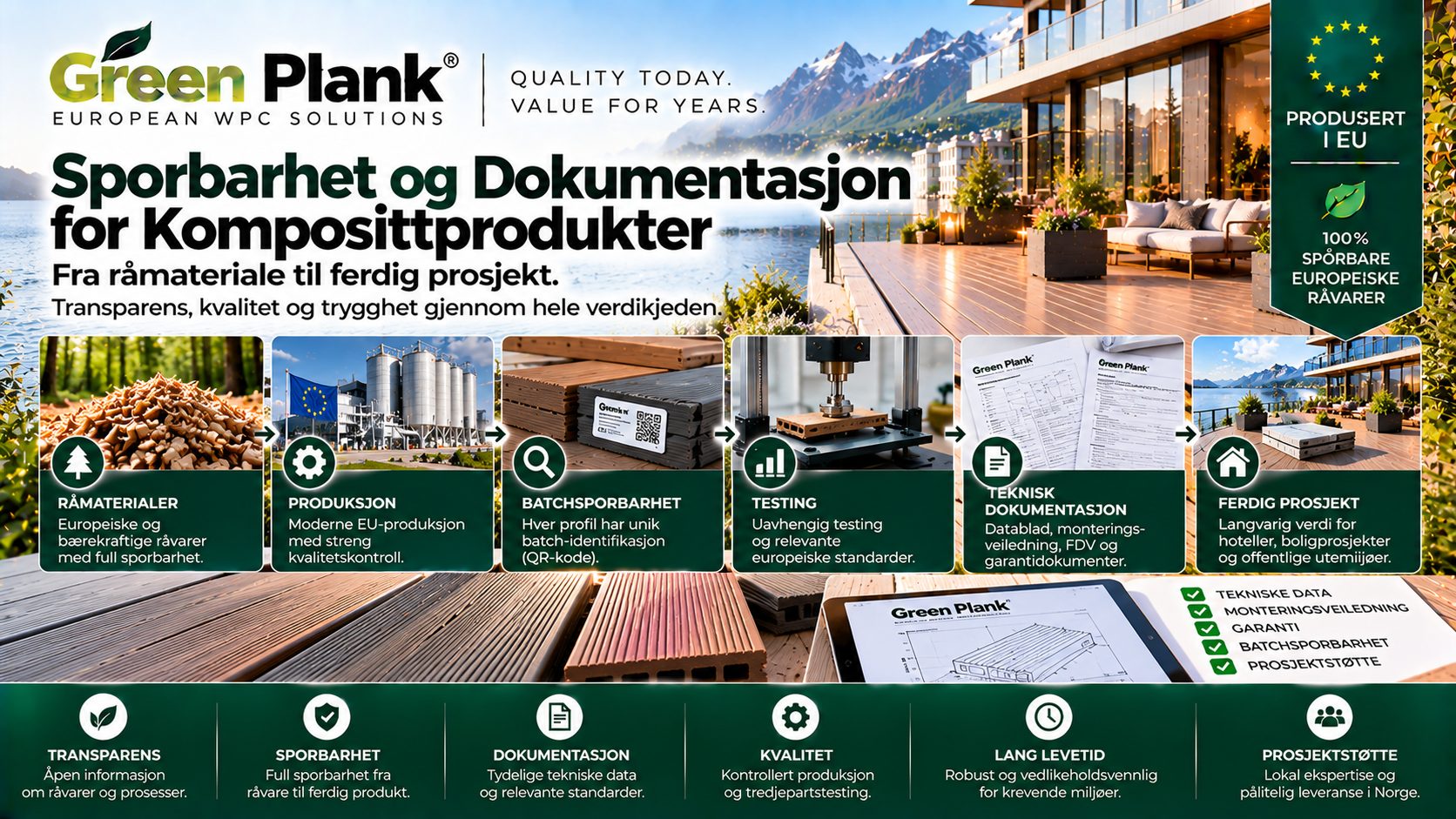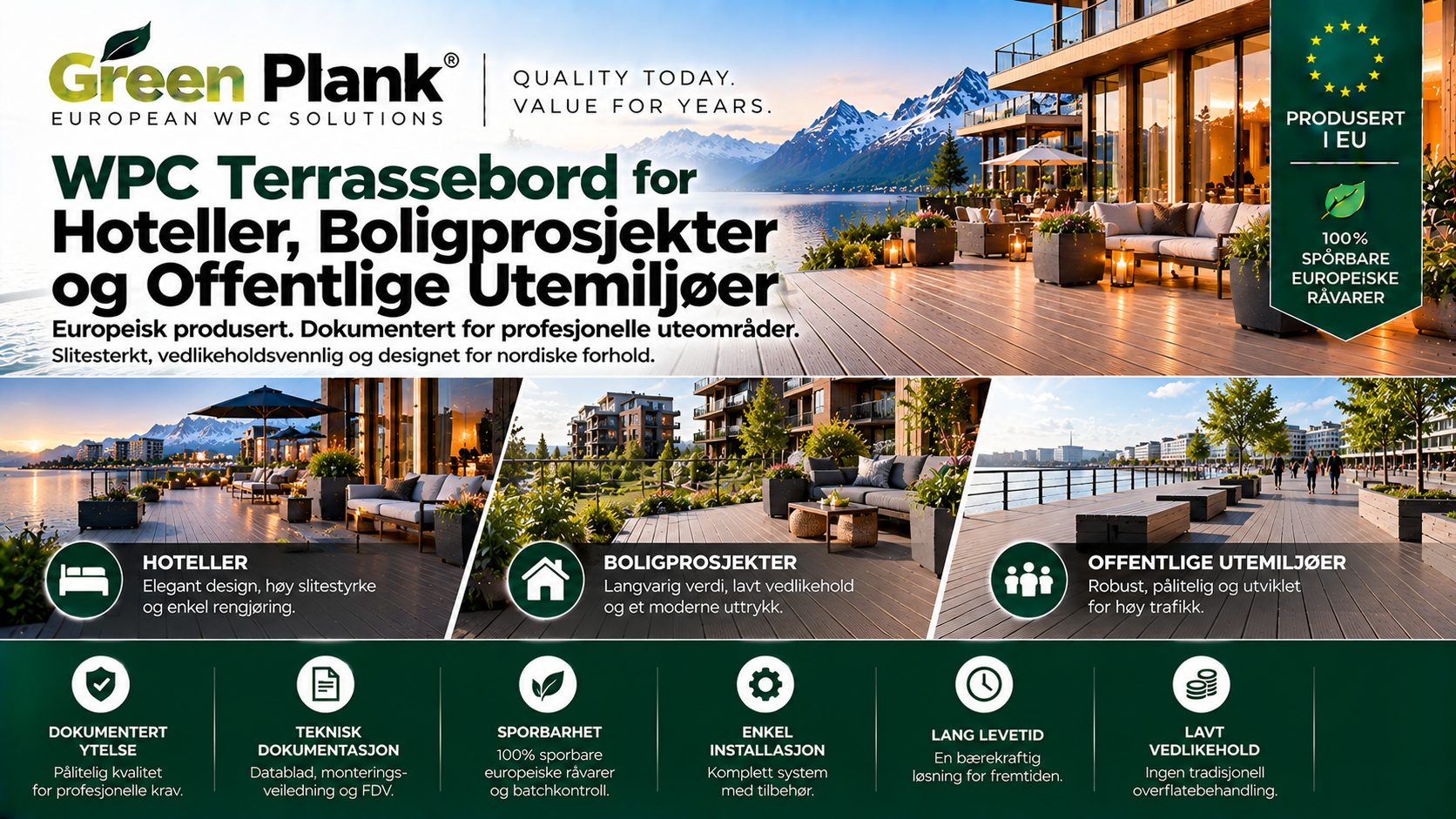




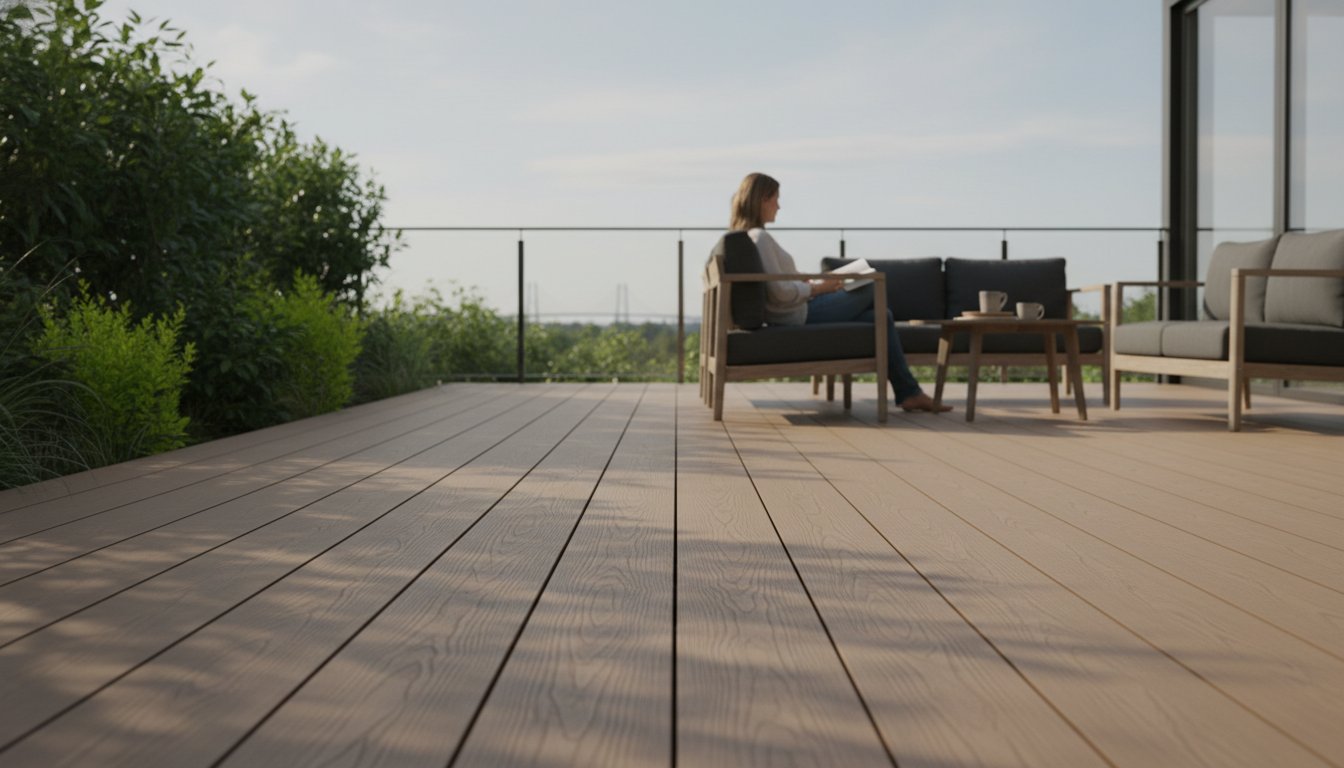
The most expensive deck isn't the one with the highest price per square meter; it's the one that warps after just three Swedish winters. While many homeowners assume all synthetic boards are identical, the hdpe vs pvc decking debate reveals two fundamentally different engineering philosophies. You likely want a premium outdoor space that mirrors the beauty of Scandinavian timber without the relentless cycle of sanding and oiling. It's frustrating when technical jargon obscures the real environmental impact of your choice, especially when you're aiming for a circular, low-maintenance home that respects nature.
We'll clarify this confusion by comparing these materials across durability, thermal stability, and carbon footprint. You'll discover how 100% traceable raw materials and European manufacturing standards ensure your deck remains stable even when temperatures swing by 40 degrees. This guide provides a clear winner for your specific climate and a deep understanding of why professional-grade composites are built to last and designed for life. We're diving into the technical data and long-term maintenance costs to validate your investment for 2026 and beyond.
Key Takeaways
- Understand the structural differences between recyclable HDPE composites and synthetic PVC polymers to ensure your material choice aligns with long-term durability and sustainability goals.
- Analyze linear stability and thermal expansion data to see why the hdpe vs pvc decking debate favors engineered blends for maintaining structural integrity during Swedish temperature shifts.
- Evaluate the environmental impact of your project by comparing the circularity of European-sourced HDPE against globally sourced synthetic materials to minimize your carbon footprint.
- Discover how the "Golden Ratio" of 75% hardwood fiber and 25% HDPE is specifically engineered to withstand the rigors of the Nordic climate while offering a refined, natural aesthetic.
- Identify the optimal application for your residential or commercial project, balancing aesthetic warmth with the professional-grade performance required for high-traffic infrastructure.
What is the Difference Between HDPE and PVC Decking?
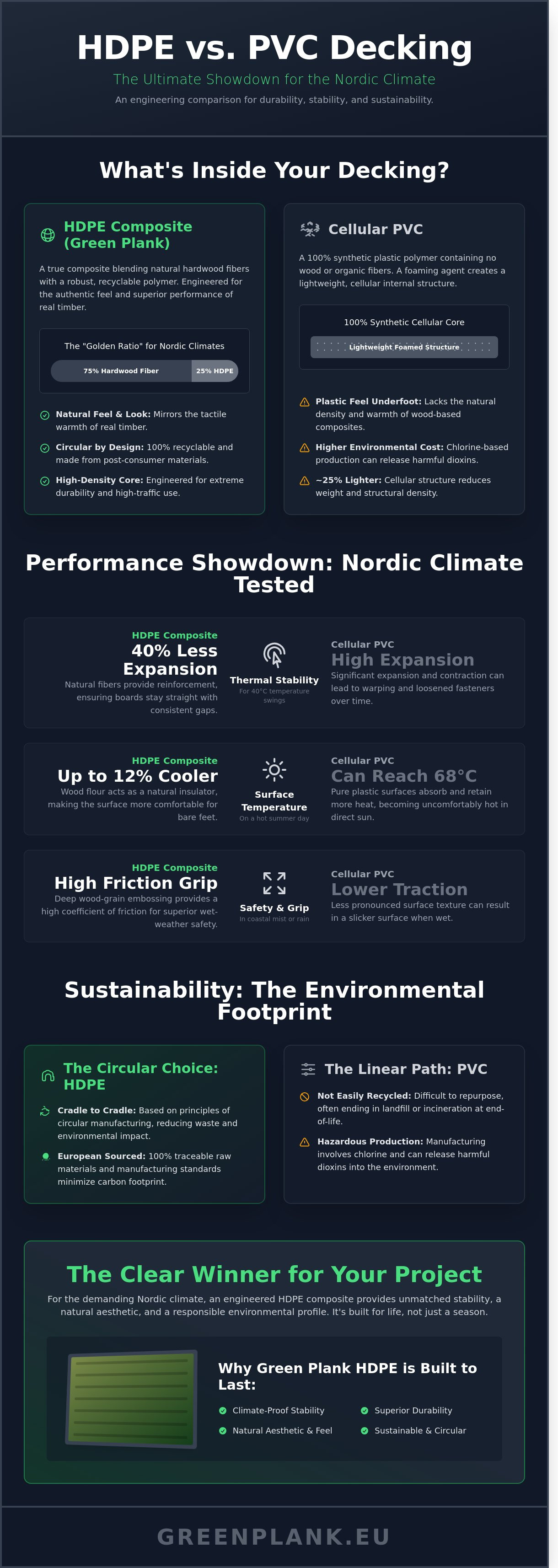
Choosing the right material for a Swedish terrace involves understanding the chemical and structural makeup of your boards. The primary debate regarding hdpe vs pvc decking centers on the presence of organic material. HDPE (High-Density Polyethylene) is a versatile, recyclable thermoplastic that serves as the foundation for high-performance natural fiber composites. PVC (Polyvinyl Chloride) is a 100% synthetic plastic polymer. While both products appear in the "composite" category, they offer vastly different performance profiles under the harsh Nordic sun and sub-zero winters.
The "composite" label often confuses buyers looking for HDPE-based solutions. Technically, a composite is any material made from two or more distinct substances. In this industry, HDPE is a true composite because it blends wood and plastic. PVC is a homogeneous plastic product. This distinction matters for Swedish building regulations and long-term aesthetic value. Homeowners often seek the strength of a wood-plastic hybrid to avoid the high maintenance of traditional pressure-treated timber, which can cost upwards of 550 kr per square meter when accounting for oils and stains over a ten-year period.
The Composition of HDPE Composite Decking
In our manufacturing process, HDPE acts as a robust binding agent for natural fibers. Green Plank’s professional-grade boards utilize a 75% hardwood blend, creating a dense, stable board that mirrors the tactile warmth of real timber. We integrate specific UV stabilizers and pigments during the extrusion phase to ensure color retention for 25 years or more. HDPE is the preferred choice for circular manufacturing models. It's 100% recyclable and often sourced from post-consumer waste, aligning with "Cradle to Cradle" sustainability principles. This reduces the environmental footprint for projects in Stockholm or Malmö where eco-conscious building is a priority. Our HDPE composites are:
- Engineered for high-traffic durability.
- Produced with 100% traceable raw materials.
- Designed to withstand moisture without the need for toxic sealants.
The Composition of Cellular PVC Decking
Cellular PVC contains no wood or organic fibers. It's engineered with a foaming agent that creates a "cellular" internal structure. This makes the boards roughly 25% lighter than HDPE-based alternatives. Because it lacks organic material, it's inherently resistant to mold and mildew. However, the environmental cost is higher. The production of PVC involves chlorine and can release dioxins during manufacturing. While PVC provides a low-maintenance surface, it lacks the natural density and structural weight found in hdpe vs pvc decking comparisons. It feels more like plastic underfoot, which may not suit high-end Scandinavian architectural designs. For a project lasting 30 years, the choice between a synthetic polymer and a natural-fiber composite defines the soul of the outdoor space.
Performance Showdown: Durability, Stability, and Heat
Choosing between hdpe vs pvc decking requires a look at how these materials react to the harsh Nordic climate. Thermal expansion is the primary challenge for any outdoor installation. Pure PVC boards expand and contract significantly as temperatures fluctuate. This movement can lead to warped boards or loosened fasteners over time. Green Plank’s HDPE-hardwood blends solve this by using natural fibers to anchor the polymer. These fibers provide internal reinforcement that cuts linear expansion by nearly 40% compared to cellular PVC. Your deck stays straight and the gaps remain consistent through every season.
Surface temperature is another critical factor during the long days of a Swedish summer. High-density polyethylene (HDPE) composites often incorporate wood flour which acts as a natural insulator. While a pure PVC surface might reach 68°C in direct sun, a high-fiber composite typically stays 12% cooler. This makes the surface more comfortable for bare feet. Safety isn't just about heat; it's about grip. Deep wood-grain embossing on our boards provides a high coefficient of friction. This ensures wet-weather safety even when the coastal mist rolls in.
Structural integrity defines the longevity of your investment. For a standard private terrace in Stockholm, a 600 mm cc joist spacing is often sufficient for solid HDPE profiles. Commercial projects with higher foot traffic require a tighter 400 mm cc spacing to meet safety regulations. HDPE blends offer a higher flexural modulus than PVC, meaning the boards feel firmer underfoot and don't sag between joists. This engineered rigidity is essential for professional-grade construction.
Moisture and Mold Resistance
PVC has long been a favorite for marine docks because it contains no organic material. However, modern engineering has closed this gap. Green Plank uses advanced capping technology to encase the HDPE core in a protective shield. This barrier makes the boards virtually impervious to water. Whether you're building a seaside pier or a garden deck in a high-humidity forest clearing, these low-maintenance solutions prevent the internal rot and mold growth that plague traditional timber.
Aesthetics and Natural Texture
The visual difference in the hdpe vs pvc decking debate is striking. PVC often carries a shiny, synthetic sheen that looks out of place in a natural garden. Green Plank prioritizes a refined Nordic character. Our composites feature a matte finish and variegated color tones that mimic aged oak or teak. You won't see the "plastic" look here. Thanks to high-grade UV inhibitors, our boards retain their rich pigment for decades. You can expect less than 4% color shift over 25 years, ensuring your outdoor space looks as intentional in 2050 as it does today.
Sustainability: The Environmental Impact of Your Choice
Choosing a deck material in 2026 involves more than comparing price points; it's an environmental commitment. When analyzing hdpe vs pvc decking, the chemical composition of the boards determines their long-term ecological legacy. HDPE stands as the gold standard for circular building materials because it's 100% recyclable at the end of its life cycle. Most high-quality HDPE boards consist of 90% to 95% recycled content, such as detergent bottles and milk jugs, which diverts plastic from Swedish landfills and oceans. PVC often relies on virgin plastic resins and complex chemical stabilizers that make it significantly harder to reintegrate into a circular economy.
Traceability and European Manufacturing
We source 100% of our raw materials within Europe to ensure full transparency and quality control. This regional approach slashes transport-related CO2 emissions by up to 60% compared to synthetic boards shipped from Asian or North American factories. By 2026, the EU’s Ecodesign for Sustainable Products Regulation (ESPR) makes this level of traceability mandatory for professional-grade construction. Producing locally allows us to monitor every stage of the supply chain. It ensures our products meet strict Swedish environmental standards and contain zero hazardous heavy metals. Our manufacturing process is designed for life; it's engineered for the planet.
- 100% Traceable: Every batch of raw material is documented from source to finished board.
- Reduced Logistics: Shorter supply chains mean a smaller carbon footprint for every square meter installed.
- EU Compliance: Products meet the latest 2026 European safety and environmental certifications.
Longevity as a Sustainability Metric
True sustainability is measured in decades, not seasons. A service life of 50 years is the ultimate green feature because it eliminates the waste associated with frequent replacements. Traditional wood decks in the harsh Nordic climate often require full replacement every 10 to 12 years. By quadrupling that lifespan, we prevent thousands of kilograms of material waste from entering the disposal stream. Our low-density natural fiber composites also weigh 15% less than traditional PVC, which reduces the fuel consumption required for delivery to your project site. This efficiency delivers stability, strength, and a refined Nordic character without the ecological cost of frequent maintenance.
The 'Cradle to Cradle' ownership model ensures that outdoor infrastructure doesn't become a toxic liability. HDPE is chemically inert; it doesn't leach harmful chemicals into the Swedish soil or groundwater. PVC presents significant challenges during disposal because it contains chlorine. If PVC is accidentally incinerated at the end of its life, it can release hydrogen chloride gas and dioxins. Choosing HDPE means investing in a material that remains safe from the day it's installed until the day it's eventually recycled into a new product. It's a responsible choice for the modern homeowner who values both premium quality and environmental ethics.
Application Guide: When to Choose HDPE vs. PVC
Choosing the right material involves more than just comparing price points. The decision between hdpe vs pvc decking depends on the specific stressors of your site. Swedish coastal projects, from the Stockholm archipelago to the rugged West Coast, face 90% humidity and constant salt spray. These environments demand materials that don't absorb moisture or corrode under saline pressure.
Commercial infrastructure requires a non-negotiable commitment to safety and longevity. Public spaces often see thousands of footsteps daily, requiring a surface that maintains its integrity under extreme friction. Residential projects, however, focus on the marriage of form and function. Homeowners want the architectural beauty of timber without the 40 hours of annual maintenance typically required for wood decks.
- Marine Projects: High-density polymers provide the best defense against saltwater saturation and fungal decay.
- Public Spaces: Materials must withstand heavy use and potential vandalism without showing signs of structural fatigue.
- Residential Decks: The goal is a maintenance-free area that mirrors the warmth and texture of natural Nordic timber.
Best for High-Traffic Commercial Zones
Public piers and city boardwalks require the extreme density found in HDPE composites like Terra Tuff. This material is engineered to absorb impact. While PVC is often rigid and brittle, HDPE's molecular structure allows it to dampen shock waves. This prevents the surface splintering or cracking often seen in high-traffic zones when heavy objects are dropped.
Project partners in Sweden report that maintenance schedules are reduced by 70% compared to traditional pressure-treated wood. For a standard 400-square-meter municipal project, this translates to a saving of approximately 125,000 kr in labor and material costs over the first decade. Our professional-grade composites are built to last and designed for life.
Best for Residential Luxury
Smart System decking allows homeowners to achieve a sophisticated Nordic aesthetic without the burden of constant upkeep. These boards are designed in Scandinavia to withstand the harsh transition from sub-zero winters to intense summer UV. The material's thermal stability ensures the deck remains comfortable underfoot even during peak July heat.
The use of the HidLoc™ hidden fastening system is vital for a luxury finish. It creates a smooth, barefoot-friendly surface with no visible hardware to interrupt the wood-grain pattern. This system speeds up installation by 30%, reducing on-site labor costs for contractors. It's a sustainable investment that uses traceable raw materials to deliver a premium, eco-conscious outdoor sanctuary.
Find the ideal material for your home by browsing our sustainable decking collections today.
Why Green Plank Engineered the 75/25 HDPE-Hardwood Blend
Standard composite boards often rely on a 50/50 mix, yet our research into hdpe vs pvc decking performance led us to a different conclusion. We perfected the "Golden Ratio": a blend of 75% hardwood fiber and 25% high-density polyethylene. This specific concentration maximizes structural integrity. Hardwood fibers provide the natural stiffness required to prevent sagging, while the HDPE acts as a high-performance binder that resists the brittle nature often found in pure PVC alternatives.
Engineering for the Nordic climate requires a material that ignores the thermometer. In Sweden, where temperatures swing from -30°C in January to +30°C in July, thermal expansion is the enemy of a beautiful deck. Our 75/25 blend minimizes linear movement to less than 1mm per meter. We've combined this core with advanced capping technology. It delivers the absolute water resistance of PVC with the superior impact strength of HDPE. This ensures the board won't crack under heavy snow loads or peel after a decade of UV exposure.
- Structural Stability: High hardwood content reduces warping and twisting under heavy loads.
- Climate Resilience: Engineered to remain flexible and durable in sub-zero Swedish winters.
- Premium Capping: A 360-degree protective layer that prevents moisture absorption and staining.
- 50-Year Warranty: A half-century guarantee that reflects our absolute engineering confidence.
The Green Plank Innovation
Our identity as a Responsible Innovator drove the development of the Terra Tuff line. We've engineered low-density, high-strength profiles that make installation faster for professionals. These boards are lighter to handle but don't sacrifice the "solid-underfoot" feel homeowners expect. You can learn more about our WPC composite decking technology and how it outperforms traditional timber in high-traffic environments.
Built to Last, Designed for Life
We balance rigorous engineering with a refined Scandinavian design sensibility. Every board uses 100% EU-sourced raw materials. This proximity allows for total quality control and ensures our supply chain remains circular and traceable. When you compare hdpe vs pvc decking, the Green Plank difference is found in the tactile warmth of the finish and the 50-year promise of durability. Designed in Scandinavia. Produced in Europe. Explore our full range of sustainable composite solutions today to find the perfect fit for your project.
Invest in a Sustainable Outdoor Legacy
Choosing between hdpe vs pvc decking involves more than just comparing surface textures. It's a choice between short-term utility and a lifetime of performance. While PVC remains a common choice for lightweight applications, our engineered 75/25 HDPE-hardwood blend is specifically designed for the demanding Swedish climate. It offers the thermal stability required to withstand temperature swings from -30°C to +30°C without the warping often seen in traditional plastics. Our Cradle to Cradle certified ownership model ensures your deck contributes to a circular economy, rather than a landfill.
Every plank we produce is proudly manufactured in Europe using 100% traceable EU materials. This commitment to quality allows us to offer up to 50-year commercial warranties, a standard that reflects our engineering confidence. You aren't just buying a floor; you're investing in a professional-grade solution that's built to last and designed for life. Don't settle for materials that compromise on environmental ethics or structural integrity when a superior, European-made alternative is available today.
Request a Professional Sample Kit of our HDPE Composites to see how Nordic reliability can transform your next project. We're here to help you build something truly enduring.
Frequently Asked Questions
Is HDPE decking more expensive than PVC decking?
HDPE decking is generally more cost-effective than PVC, with Swedish market prices ranging from 800 kr to 1,300 kr per square meter. PVC options often exceed 1,500 kr per square meter due to the complex chemical processing required for cellular resins. When evaluating hdpe vs pvc decking, HDPE provides a superior balance of professional-grade durability and initial investment value for large-scale residential projects.
Does HDPE decking expand and contract more than PVC?
HDPE experiences higher thermal movement than PVC, typically expanding or contracting about 1.5 mm per linear meter during Swedish seasonal temperature shifts. You can easily manage this characteristic by using engineered hidden fastening systems that allow the boards to breathe. PVC is more dimensionally stable because it lacks organic fibers, but proper joist spacing of 400 mm ensures both materials perform reliably in Scandinavian climates.
Which material is more environmentally friendly, HDPE or PVC?
HDPE is the more sustainable choice because it utilizes up to 90% recycled plastics and traceable wood fibers within a circular manufacturing process. PVC production relies on chlorine chemistry and creates significant challenges for recycling at the end of its lifespan. Choosing HDPE helps divert approximately 50 kg of plastic waste from landfills for every 10 square meters of decking you install on your property.
Can I use standard woodworking tools to install HDPE composite decking?
You can install HDPE boards using the same carbide-tipped tools you'd use for traditional timber. A standard miter saw with a 40-tooth blade delivers the clean, precise cuts required for a professional finish. You don't need specialized equipment, though we recommend high-quality stainless steel fasteners to ensure the structure withstands the moisture levels common in Sweden. It's a straightforward process for any skilled craftsman.
Does HDPE decking look like real wood?
Modern HDPE decking replicates the refined Nordic character of natural timber through advanced 3D embossing and multi-tonal color blending. The 2026 collections feature deep grain patterns that mimic oak and walnut without the risk of fading or splintering. It's an engineered solution that captures the warmth of a wooden terrace while maintaining the high-end aesthetic of a premium, maintenance-free outdoor space.
Which material is better for a pool deck or boat dock?
PVC is often selected for pool surrounds because it stays cooler under direct sunlight, but HDPE is the preferred choice for docks due to its superior impact resistance. Both materials are 100% moisture-resistant and won't rot when exposed to the brackish waters of the Baltic Sea. HDPE provides an R11 slip-resistance rating, ensuring safety for your family in wet conditions. It's built to last in demanding marine environments.
How do I clean and maintain HDPE vs. PVC decking?
Cleaning both materials requires nothing more than a soft brush, warm water, and mild soap twice a year. You'll spend roughly 30 minutes per 20 square meters to keep the surface free of pollen and organic debris. This low-maintenance approach saves the average homeowner in Sweden about 4,500 kr in oiling and staining costs every five years. It's a practical solution for those who value their time.
What is the typical warranty for HDPE composite decking?
Professional-grade HDPE decking carries a 20 to 30 year limited residential warranty that covers splintering, rotting, and structural decay. This long-term guarantee reflects our engineering confidence in products designed in Scandinavia and produced in Europe. Commercial applications typically receive a 10-year warranty to account for heavier foot traffic. It's a secure investment in a product that's truly designed for life.
Spesifiser produktet
Bruk denne guiden i en Green Plank-spesifikasjon
Tekniske WPC-artikler skal støtte de kommersielle sidene — ikke konkurrere med dem. Fortsett til komposittdekke, TerraTuff, Nordeka eller de tekniske nedlastningene.