



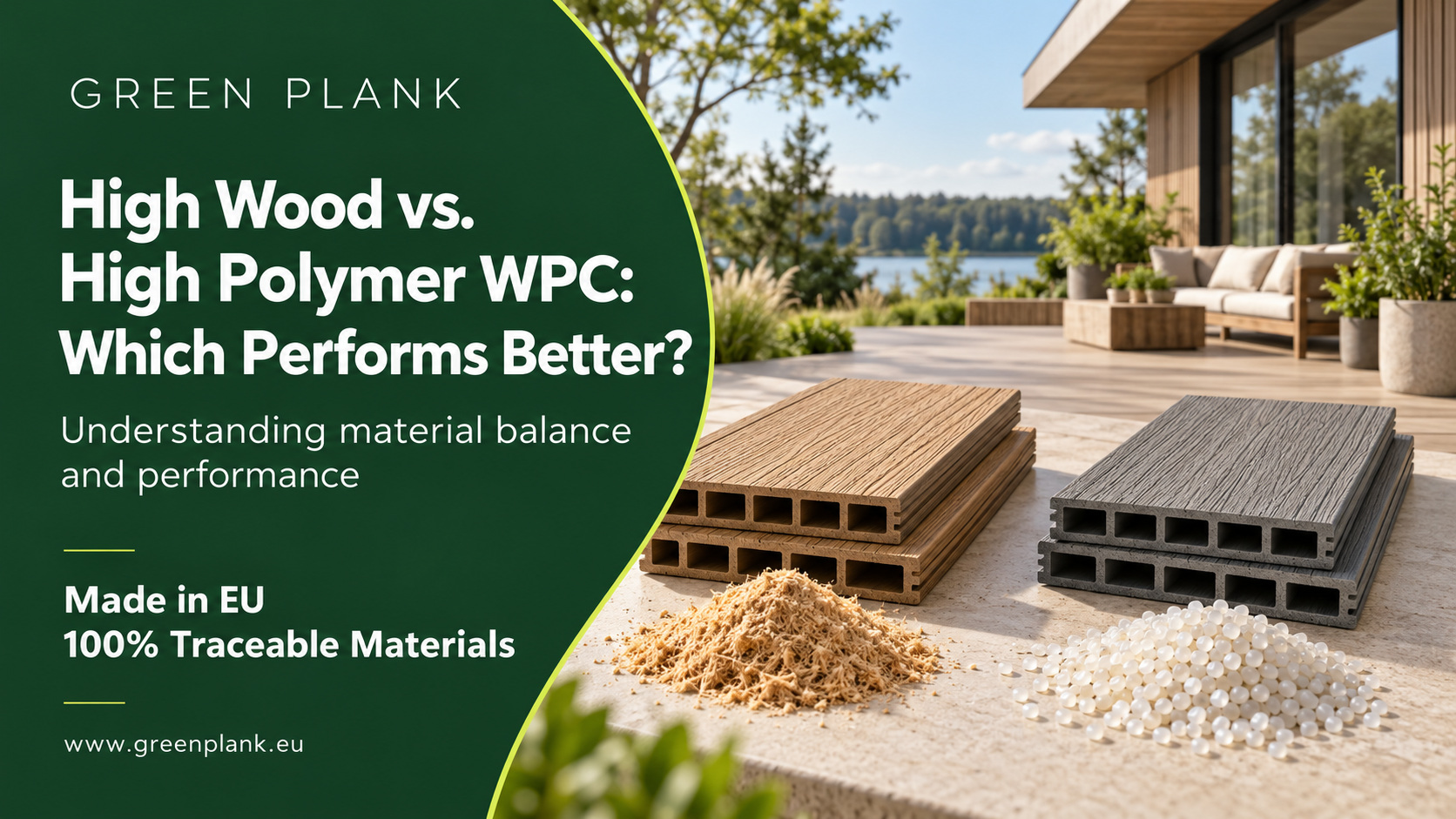
High Wood Content vs. High Polymer Content: Which WPC Performs Better? When comparing Wood Plastic Composite (WPC) decking, buyers often focus on one number: the percentage of wood fibre. A board containing 70% wood may appear more natural or technically superior, while another manufacturer may promote higher polymer content for moisture resistance and durability. In reality, neither percentage alone determines performance. WPC is an engineered material system. Wood content, polymer quality, fibre characteristics, coupling chemistry, additives, extrusion conditions and profile geometry interact to determine how the finished board behaves. Research confirms that adding wood can increase stiffness, while moisture behaviour, strength and durability depend strongly on formulation and fibre-polymer bonding. The key principle: More wood does not automatically mean better WPC, and more polymer does not automatically mean greater durability. Premium performance comes from finding the correct balance for the intended application. What Happens When Wood Content Increases? Wood flour or fibre acts as reinforcement within the thermoplastic matrix. Increasing wood content can raise stiffness and reduce the proportion of polymer required. Commercial WPC products commonly operate at substantial wood loadings, although the practical optimum varies according to material system and application. Higher wood content can offer several advantages: Greater stiffness in appropriately formulated composites Higher natural-fibre content Lower polymer requirement per kilogram of composite A more wood-oriented material character Potentially attractive resource efficiency when responsible fibre streams are used However, wood is hydrophilic. As its proportion increases, moisture management, fibre dispersion and fibre-polymer adhesion become increasingly important. Recent research on highly filled wood-flour/polyethylene systems found that increasing wood loading can reduce melt fluidity and water-resistance performance unless the interface and formulation are effectively engineered. What Happens When Polymer Content Increases? In an HDPE-based WPC, the polymer forms the continuous matrix surrounding and connecting wood particles. Increasing polymer content provides more matrix material for fibre wetting and encapsulation, which can simplify processing and potentially improve moisture management and toughness. Higher polymer content may provide: Easier fibre encapsulation Greater processing flexibility Potentially improved toughness and impact behaviour Lower moisture sensitivity when the composite is well manufactured A more continuous polymer matrix But adding more polymer does not automatically create premium decking. Polymer type, molecular characteristics, recycled or prime feedstock quality, stabilisation and extrusion control remain important. High Wood vs. High Polymer: The Engineering Trade-Off Performance Factor Higher Wood Content Higher Polymer Content Stiffness Often increases with effective reinforcement Generally more dependent on polymer and profile design Toughness Can decline at excessive loading Often easier to maintain Moisture management More technically demanding More matrix available for encapsulation Processing Higher loading can reduce melt flow Generally offers easier processing Natural-fibre content Higher Lower Polymer consumption Lower Higher Final performance Depends on formulation and processing Depends on formulation and processing The Hidden Factor: Fibre-Polymer Bonding One of the most important factors in WPC performance is invisible from the outside. Wood fibres are naturally hydrophilic, whereas polyethylene is hydrophobic. Without effective compatibility between these phases, increasing wood content can create weak interfaces instead of useful reinforcement. Coupling agents are therefore critical in many high-performance formulations. Maleic-anhydride-grafted polyethylene, commonly known as MAPE, is widely used in polyethylene-based WPC to improve interaction between wood and the polymer matrix. Research reviews show that suitable coupling systems can improve mechanical properties, dimensional stability and fibre encapsulation. A Better Way to Think About WPC High wood + weak interface does not equal premium WPC. High polymer + poor engineering does not equal premium WPC. Controlled fibre + appropriate polymer + effective coupling + balanced additives + precision manufacturing = high-performance WPC. Why High Wood Content Requires Greater Process Control Increasing fibre loading changes the rheology of the composite melt. The material can become more difficult to mix, transport through the extruder and push uniformly through the die. Fibre moisture also requires careful control because excess moisture can contribute to voids and surface defects. For highly filled WPC, manufacturers must carefully manage: Wood species and fibre quality Particle size and distribution Fibre moisture HDPE properties and consistency Coupling-agent efficiency Internal and external lubrication Temperature, pressure and screw conditions Calibration and cooling This is why a sophisticated 70% wood formulation can perform very differently from another product carrying the same 70% claim. Stiffness Is Not the Same as Strength or Toughness This distinction is particularly important when evaluating decking. Adding wood reinforcement commonly increases stiffness, but tensile strength, flexural strength, impact resistance and elongation do not necessarily follow the same trend. At very high fibre loadings, performance depends increasingly on dispersion and interfacial bonding. Consequently, buyers should be cautious about statements such as more wood means stronger decking. Without comparable finished-product testing, such a conclusion is technically incomplete. Moisture Resistance Is More Than Polymer Percentage Because HDPE has much lower affinity for water than wood, it may seem logical that more polymer automatically means better water resistance. Polymer content certainly matters, but finished-product moisture behaviour is also influenced by fibre loading, porosity, encapsulation, interfacial adhesion and manufacturing quality. Scientific literature shows that water absorption in WPC is strongly influenced by fibre fraction, matrix type, interfacial bonding and compatibilisation. Professional buyers should therefore compare measured water absorption and dimensional stability rather than relying only on the polymer percentage. Can Co-Extrusion Offer the Best of Both Approaches? Advanced WPC technology provides another option: different parts of the profile can perform different functions. In a co-extruded core-shell construction, a highly filled structural core can be combined with a differently formulated outer layer. Research into highly filled core-shell wood/polyethylene composites found that an HDPE-rich shell improved impact performance and dimensional stability compared with control structures. This demonstrates an important principle: modern composite engineering does not always require one formulation to perform every function. What Should Professional Buyers Compare? Instead of choosing decking simply because it contains more wood or more polymer, professional buyers should request performance information for the finished board. Flexural strength and modulus Impact performance Water absorption and dimensional change Thermal expansion Density and profile weight UV and weathering information Slip resistance where relevant Recommended joist spacing Raw-material traceability Batch-to-batch quality controls These factors provide a far more meaningful indication of suitability than a single formulation percentage. Which WPC Performs Better? The technically correct answer is: the formulation that is best engineered for its intended application. Higher wood content can provide valuable stiffness and reduce polymer consumption, but it places greater demands on coupling, moisture control and processing. Higher polymer content can improve matrix continuity, processing and toughness, but additional polymer alone does not guarantee superior structural performance or durability. The optimum WPC is therefore a balance of stiffness, strength, toughness, moisture resistance, dimensional stability, weathering performance, processability, profile design and resource efficiency. Green Plank: Engineering the Balance At Green Plank, premium WPC is approached as a complete material system rather than a competition between wood and polymer percentages. The objective is to combine carefully selected fibres, appropriate polymer technology, effective coupling, functional additives, controlled manufacturing and intelligent profile engineering. This engineering-led approach is important for residential decking, commercial developments, landscape architecture and demanding outdoor projects where long-term performance matters more than a percentage printed on a brochure. Explore Green Plank composite solutions at www.greenplank.eu. Conclusion High wood content and high polymer content each offer potential advantages, but neither automatically creates a better WPC. Wood can increase stiffness and natural-fibre content, while polymer contributes matrix continuity, toughness and moisture protection. The real performance comes from how successfully these materials are combined. For architects, distributors and professional buyers, the best question is therefore not which WPC contains more wood? It is which finished WPC demonstrates the right balance of properties, manufacturing control and verified performance for the intended application? Sources Polymers – A Concise Review of the Components and Properties of Wood-Plastic Composites Construction and Building Materials – Core/Shell Structured Wood Flour/Polyethylene Composites Journal of Materials Research and Technology – Ultrahigh-Filled Wood Flour/Polyethylene Composites Composites Part B – Dimensional Stability and Mechanical Behaviour of HDPE Wood-Plastic Composites
Produkt spezifizieren
Diese Anleitung in einer Green Plank-Ausschreibung nutzen
Technische WPC-Artikel sollen die kommerziellen Seiten stärken — nicht mit ihnen konkurrieren. Weiter zu WPC-Terrasse, TerraTuff, Nordeka oder den technischen Downloads.