



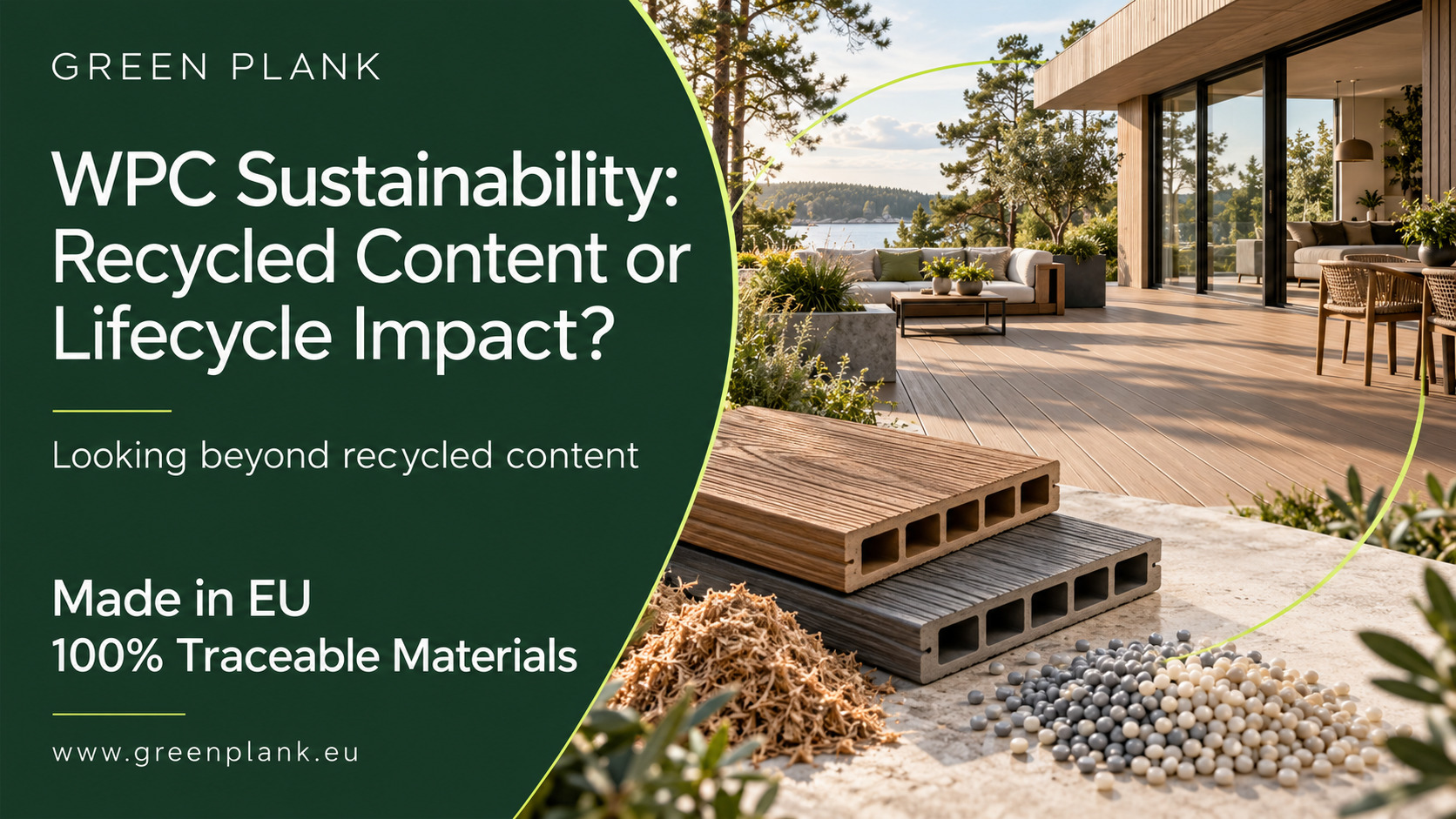
WPC Sustainability: Should We Measure Recycled Content or Total Lifecycle Impact? Sustainability has become a central consideration in modern construction. Architects, developers, municipalities and building-material buyers increasingly expect products to use resources responsibly, reduce waste and support circular-economy principles. For Wood Plastic Composite (WPC), however, sustainability is sometimes reduced to one headline figure: the percentage of recycled material. Recycled content is important, but it represents only one part of a much larger environmental picture. A meaningful assessment should consider how raw materials are sourced, how efficiently the product is manufactured, how far it travels, how long it performs, what maintenance it requires and what happens at the end of its useful life. A sustainable WPC product should not be judged by one percentage alone. The more relevant question is how efficiently it delivers the required performance throughout its complete lifecycle. Why Recycled Content Matters Using recycled polymers and recovered wood resources can reduce demand for virgin raw materials and help keep valuable resources in productive use. This makes recycled content an important component of circular material strategies. However, recycled content alone cannot describe the complete environmental performance of a decking system. The quality and consistency of secondary raw materials, manufacturing requirements, durability and eventual recovery options must also be considered. How much recycled material is incorporated? Where does the recycled feedstock originate? How is contamination and consistency controlled? Does the formulation achieve the required technical performance? Can the finished product be recovered or recycled later? Lifecycle Thinking Changes the Comparison Life Cycle Assessment (LCA) provides a broader framework for evaluating environmental impacts associated with products across defined lifecycle stages. International standards ISO 14040 and ISO 14044 establish principles and requirements for LCA, including goal and scope definition, inventory analysis, impact assessment and interpretation. Lifecycle Stage Key Sustainability Question Raw materials Where do wood fibre, polymer and additives originate? Manufacturing How much energy and material are required? Transportation How far does the product travel to the project? Installation How much decking, substructure and fastening material is needed? Use phase How durable is the product and what maintenance is required? End-of-life Can materials be reused, recovered or recycled? Durability Is an Environmental Performance Factor Durability deserves particular attention. If a building product requires premature replacement, another cycle of raw-material extraction, manufacturing, packaging, transportation, installation and waste management may be required. A long-lasting product can therefore help keep resources in service for longer, provided it continues to fulfil its intended technical function. For exterior WPC, professional evaluation should consider properties such as: mechanical strength and stiffness; moisture and water resistance; dimensional stability; thermal expansion behaviour; UV and weathering resistance; surface durability; long-term performance under intended loading. Manufacturing Efficiency Matters The environmental discussion should extend beyond what enters the extruder. Electricity consumption, production efficiency, process waste, scrap recovery and manufacturing yield can influence the environmental profile of WPC. For buyers comparing suppliers, useful questions include whether production waste is recovered, whether energy consumption is monitored and whether quality control reduces off-specification production. Efficient manufacturing can support both environmental performance and consistent product quality. Transportation and Regional Supply Chains Transportation is another part of lifecycle assessment. A product may contain a high proportion of recycled material but still travel considerable distances through complex supply chains before reaching a construction project. For European projects, regional sourcing and manufacturing can potentially shorten transport routes, improve supply-chain transparency and simplify communication between manufacturers, distributors and project teams. The actual environmental benefit, however, should be assessed using real transport distances, modes and quantities rather than broad marketing assumptions. Look Beyond Recycled Percentage A strong sustainability assessment combines material circularity, manufacturing efficiency, technical durability, logistics, maintenance and end-of-life planning. Recycled content remains valuable, but it should be interpreted within this wider system. Material Efficiency per Square Metre Comparing WPC by kilogram or linear metre can also be misleading. Decking is installed as a complete system, so architects should consider how much material is required to deliver one square metre of functional deck area. Important factors include board dimensions, profile weight, coverage, installation gaps, joist spacing, fastening requirements, substructure quantity and expected installation waste. A technically optimised profile may deliver the required performance using resources more efficiently than a heavier alternative. Maintenance Is Part of the Lifecycle WPC is frequently selected because it can avoid some of the recurring treatments associated with conventional exterior timber systems. The environmental significance of this benefit depends on the specific products being compared, their service environments and the maintenance regimes assumed. Lifecycle comparisons should therefore account for cleaning, coatings or treatments where required, repairs, replacement components and other resources consumed throughout the use phase. End-of-Life: Where Circularity Becomes Critical A circular product strategy considers what happens when a decking installation eventually reaches the end of service. Technical recyclability is valuable, but real circularity also depends on collection, separation, logistics, recycling infrastructure and demand for recovered material. The European Commission reports that construction and demolition waste accounts for more than one-third of all waste generated in the EU. Designing construction products for durability, resource efficiency and improved recovery therefore forms an important part of Europe's transition toward a circular economy. What Should Architects and Buyers Compare? Indicator What It Helps Evaluate Recycled content Use of secondary resources Raw-material traceability Origin and supply-chain transparency LCA / EPD data Environmental impacts within defined boundaries Product weight and coverage Material efficiency Technical durability Potential length of functional service Maintenance requirements Resources consumed during use Transport Logistics-related impacts End-of-life options Potential reuse, recovery or recycling Recycled Content or Lifecycle Impact? The answer should not be one or the other. Both matter, but they answer different questions. Recycled content tells us something about the origin of selected raw materials. Lifecycle assessment provides a framework for understanding environmental impacts across multiple stages while considering the function being delivered. For professional specification, the stronger sustainability equation is therefore: responsible materials + efficient manufacturing + verified performance + durability + material efficiency + responsible logistics + realistic end-of-life planning. Green Plank: Performance and Lifecycle Thinking At Green Plank, we believe composite sustainability should be approached through responsible material selection, engineering performance, manufacturing control, traceability and long-term thinking. Environmental claims should increasingly be supported by transparent and comparable documentation rather than isolated percentages. For architects, distributors, developers and contractors, this broader approach creates a better basis for selecting WPC systems that combine durability, design flexibility and responsible resource use. Explore Green Plank composite solutions at www.greenplank.eu. Conclusion Recycled content remains an important sustainability indicator, but it should not become the sole measure of responsible WPC. A product's environmental story extends from raw-material sourcing and manufacturing through transportation, installation, decades of use and eventual end-of-life management. The future of sustainable composite construction therefore lies in asking a more complete question: how much useful, durable performance does the product deliver for the environmental resources invested throughout its lifecycle? That perspective moves WPC sustainability beyond a single percentage and toward measurable lifecycle value. Sources ISO 14040 - Environmental Management and Life Cycle Assessment Principles ISO 14044 - Life Cycle Assessment Requirements and Guidelines European Commission - Construction and Demolition Waste Green Plank - European Composite Solutions
Specifikér produktet
Brug denne guide i en Green Plank-specifikation
Tekniske WPC-artikler skal understøtte de kommercielle sider — ikke konkurrere med dem. Fortsæt til kompositterrasse, TerraTuff, Nordeka eller de tekniske downloads.