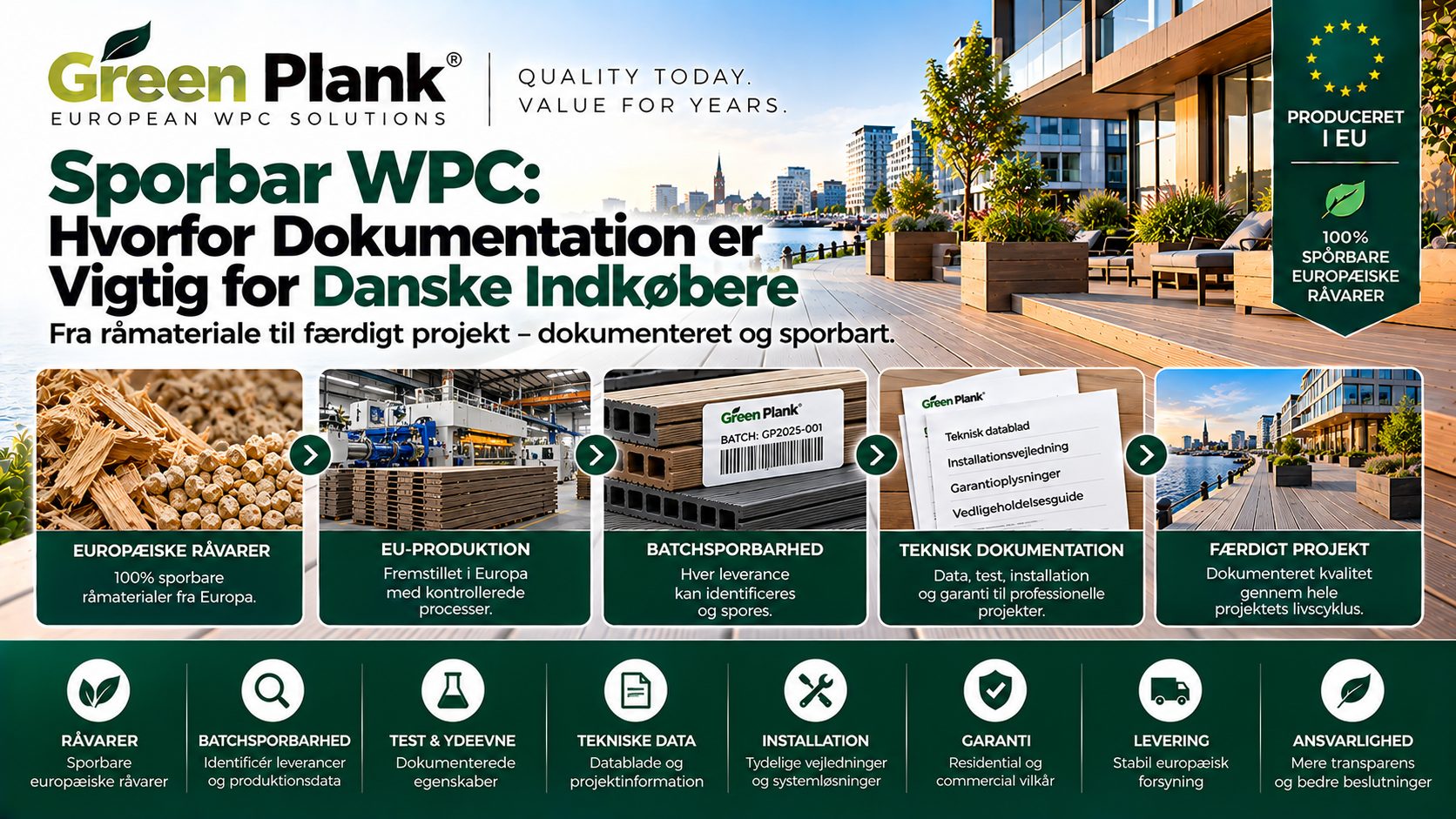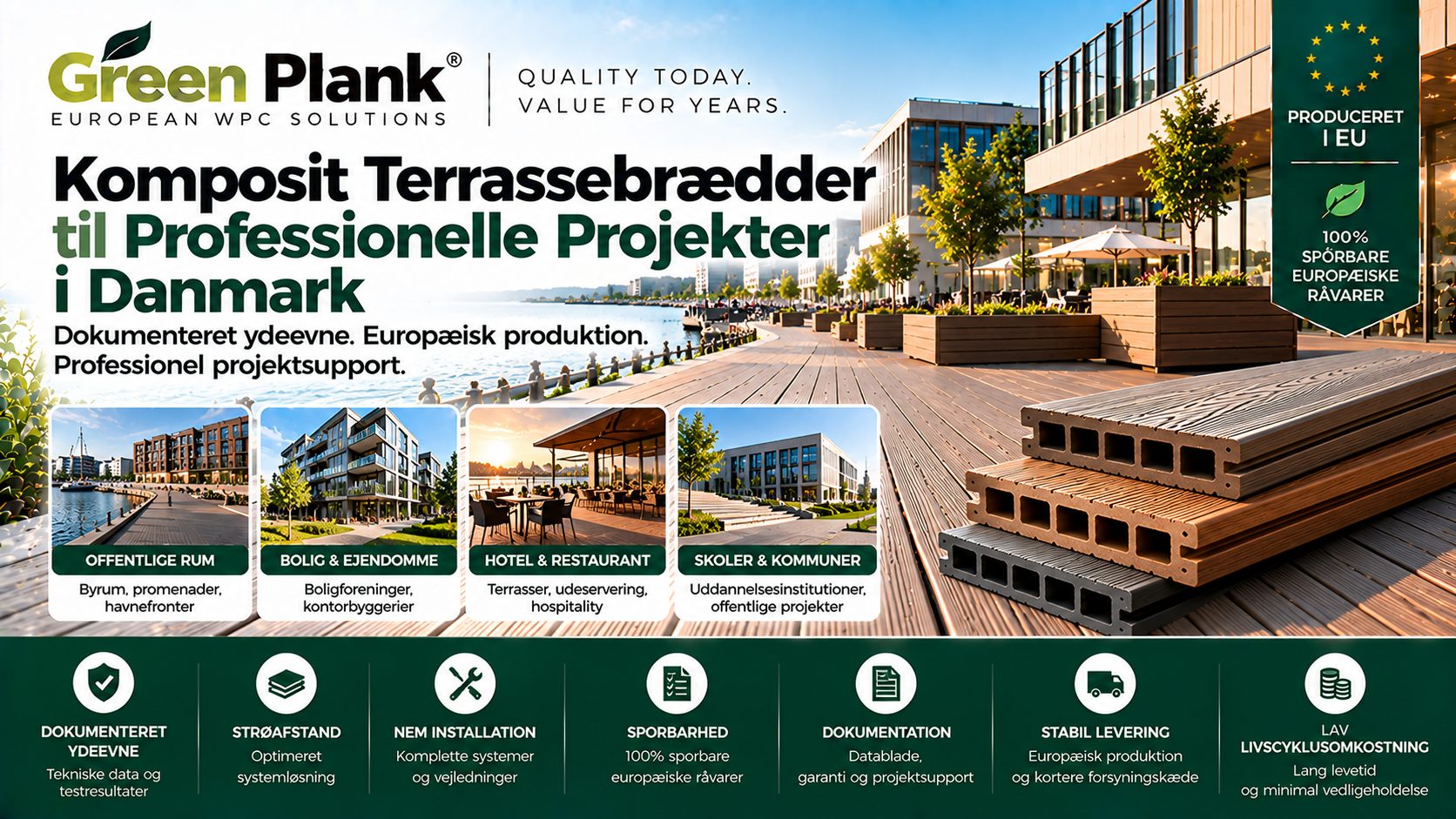




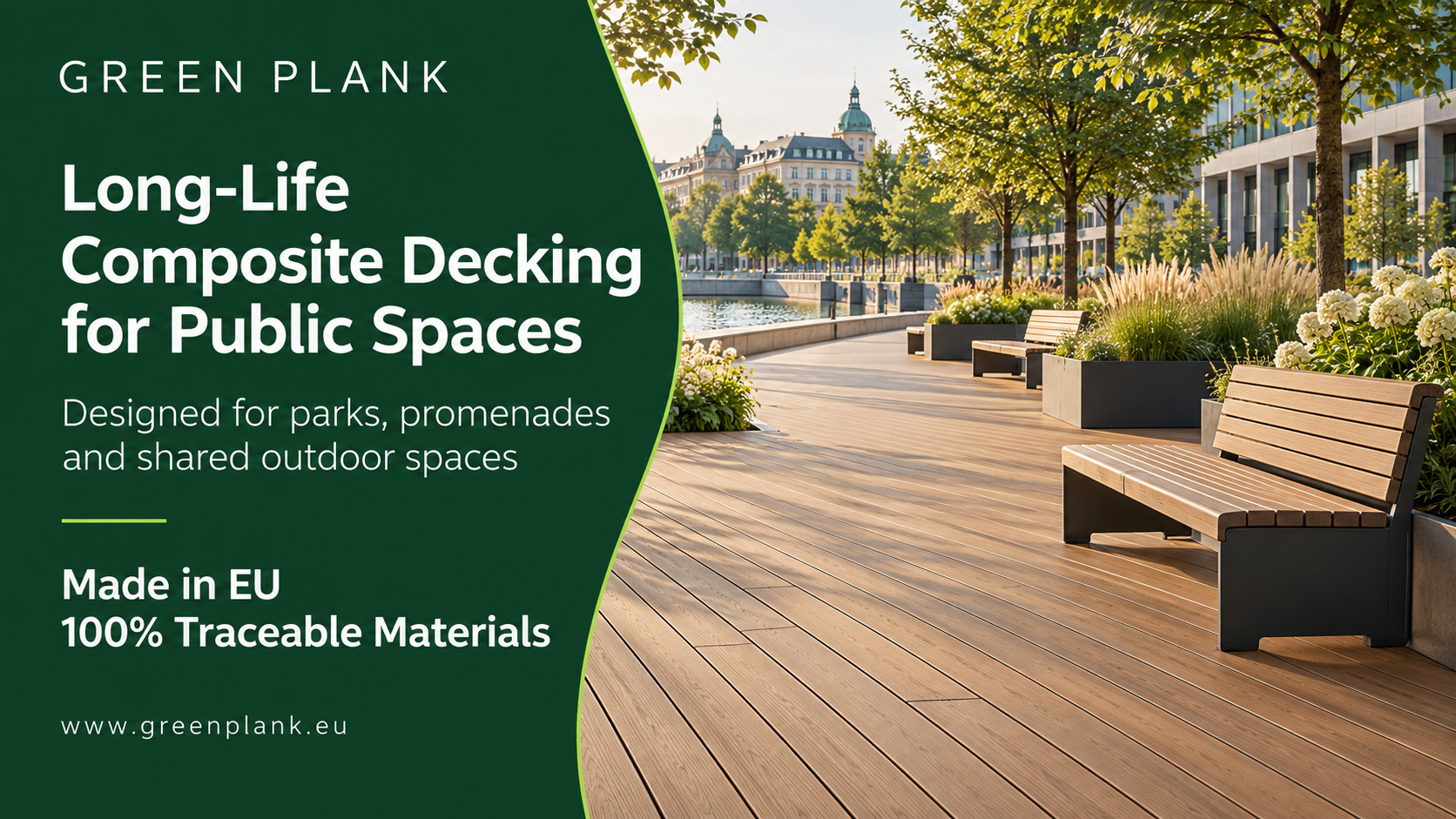
Long-Life Decking for Public Spaces: Designing Beyond the Opening DayPublic spaces demand more from decking than private residential terraces. Boardwalks, parks, promenades, waterfronts, hospitality areas, schools, roof terraces and municipal developments can experience intensive pedestrian traffic alongside rain, frost, UV exposure, dirt and seasonal temperature changes. For architects and public-sector buyers, the real question is therefore not simply which decking looks attractive today, but which system can continue performing over the long term.This is where high-quality wood plastic composite, or WPC, can offer important advantages. Properly engineered composite decking combines wood fibres, polymers and functional additives into a material designed for demanding outdoor applications. Yet not every composite board delivers the same performance. Formulation, profile engineering, manufacturing control, surface design and installation requirements all influence the final result. Think in decades, not purchasing cycles Public decking should be evaluated as an infrastructure investment rather than simply a material purchase. Initial price matters, but maintenance, cleaning, repairs, replacement, downtime and end-of-life considerations can matter just as much over the service period. Why Public-Space Decking Requires a Different ApproachA residential deck may serve a single household. A public walkway can accommodate thousands of footsteps while remaining exposed throughout the year. Consequently, professional specification should consider the complete decking system: boards, substructure, fixings, drainage, ventilation, movement allowances and maintenance procedures.Important performance considerations include: Mechanical performance under expected pedestrian and imposed loads. Dimensional stability through seasonal temperature changes. Wet-surface slip performance appropriate to the intended application. Moisture and weather resistance for continuous outdoor exposure. Surface durability in high-traffic locations. Maintainability without repeated painting, staining or oiling. Documented performance relevant to the project and applicable requirements. Composite Decking vs Traditional Timber: Look Beyond Purchase Price Project Consideration Traditional Timber Quality WPC Composite Routine cleaning Required Required Painting, staining or oiling May be required depending on timber and appearance expectations Generally not required Moisture response Depends strongly on species, treatment and detailing Engineered for exterior exposure Thermal movement Present, alongside moisture-related movement Must be considered in system design and installation Colour development Natural weathering occurs Depends on formulation, pigment and surface technology Lifecycle planning Maintenance regime can be significant Potential for reduced surface-treatment requirements These are general characteristics rather than universal performance claims. Timber species vary substantially, and WPC products can differ equally widely. Professional buyers should therefore compare verified product-specific data rather than assuming that all timber or all composite products perform identically.What Actually Makes Composite Decking Long-Lasting?The term WPC describes a category, not a quality level. Two decking boards may both be called wood plastic composite while differing considerably in raw materials, formulation, manufacturing precision and structural design.1. Controlled Wood FibreWood fibre quality, particle characteristics and moisture control influence processing and the interaction between fibre and polymer. Consistent raw materials help manufacturers maintain a stable extrusion process and repeatable product quality.2. The Polymer MatrixThe polymer provides an important continuous phase around the wood component. Polymer selection and processing influence properties such as moisture behaviour, toughness and thermal response.3. Coupling TechnologyWood is naturally hydrophilic while common thermoplastic matrices are comparatively hydrophobic. Appropriate coupling agents can improve interfacial adhesion between these components, supporting more effective stress transfer within the composite.4. Stabilisation and AdditivesUV stabilisers, antioxidants, lubricants, pigments and other processing additives can perform important functions. The correct package depends on polymer type, fibre loading, processing conditions, colour and intended outdoor exposure.5. Profile EngineeringComposition alone does not determine load-bearing behaviour. Board width, thickness, internal geometry, wall dimensions and support spacing all influence structural performance. A profile should therefore be evaluated as an engineered component rather than only by its weight or percentage of wood fibre. Premium composite decking is a system, not a percentage. Long-term performance comes from the interaction between raw materials, formulation, extrusion quality, profile engineering, installation and the environment in which the product is used. Slip Performance: Critical for Public EnvironmentsSlip resistance deserves particular attention on boardwalks, waterfronts, ramps, pool surroundings and exposed pedestrian areas. Surface texture can influence traction, but appearance alone cannot establish slip performance. Specifiers should request relevant test information for the specific decking product and consider both dry and wet service conditions where appropriate.Good project design also matters. Drainage, adequate falls, cleaning schedules and control of algae, leaves, ice and other contamination can materially affect the safety of an outdoor walking surface.Installation Can Determine Long-Term PerformanceA high-performance board cannot compensate for poor system design. WPC materials respond to temperature changes, meaning that movement allowances must be incorporated according to the manufacturer's instructions and project conditions.For professional installations, the specification should address: maximum permitted joist spacing for the chosen profile and application, support at board ends and joints, expansion clearances around fixed structures, adequate ventilation beneath the deck, drainage and prevention of standing water, approved clips, screws and fastening methods, edge details and heavily trafficked zones, installation temperatures and board lengths. The correct values should always come from the technical documentation for the specific product rather than generic WPC installation rules.Lifecycle Cost: A Better Measure of Public-Space ValueFor municipalities, developers and asset managers, cost per square metre at purchase is only one part of the financial picture. A more useful comparison considers the expenditure associated with the material throughout the planned service period. Lifecycle Stage Costs Worth Evaluating Procurement Boards, substructure, fixings and transport Installation Labour, equipment, access and site preparation Operation Cleaning, inspection and routine maintenance Maintenance Surface treatment, repairs and replacement boards where applicable Interruption Closures, restricted public access and operational disruption End of service Removal, transport, recovery, recycling or disposal This broader approach is consistent with lifecycle thinking. ISO 14040 establishes principles and a framework for life-cycle assessment, including inventory, impact assessment and interpretation stages. For public procurement, the same long-term mindset can help decision-makers avoid evaluating materials on initial cost alone. Specification Checklist for Architects and Municipal Buyers What loads and intended applications is the profile designed for? What joist spacing is permitted for the intended use? How is thermal expansion accommodated? Is relevant slip-resistance testing available? What cleaning and maintenance regime is recommended? What warranty conditions and exclusions apply? Is raw-material and manufacturing information available? What environmental documentation can be supplied? Which installation details are mandatory for warranty compliance? Can replacement boards or matching profiles be supplied in future? Environmental Performance: Look at the Complete LifecycleSustainable material selection should not rely on one headline figure. Recycled content can be relevant, but so can raw-material sourcing, manufacturing, transportation, service life, maintenance, replacement frequency and end-of-life scenarios.A credible environmental comparison therefore requires clearly defined system boundaries and comparable data. ISO 14040 provides the internationally recognised framework for lifecycle assessment, helping organisations evaluate environmental impacts systematically rather than focusing on a single stage of a product's existence.Technical Documentation MattersFor professional projects, marketing claims should be supported by appropriate technical information. Within the European construction-products framework, harmonised technical specifications provide common assessment methods where applicable, while Declarations of Performance communicate declared product performance under the relevant regulatory route.Architects and procurement teams should identify which requirements apply to the specific product, intended use and country. They should then request the corresponding evidence rather than assuming that a general certification or product label proves suitability for every application.Where Long-Life Composite Decking Makes SenseWell-engineered composite decking can be particularly attractive where accessibility, appearance and maintenance efficiency must be balanced over many years, including: municipal parks and recreation areas, pedestrian boardwalks and promenades, marinas and waterfront developments, hotel and restaurant terraces, schools and public institutions, commercial roof terraces, residential developments and shared courtyards, visitor centres and tourism infrastructure. Green Plank: Composite Solutions for Professional Outdoor ProjectsGreen Plank develops WPC solutions for decking and other outdoor applications with a focus on material engineering, design flexibility and long-term performance. For architects, distributors, municipalities, contractors and developers, the objective is to provide composite systems that can be evaluated on more than appearance alone.Professional specification should always be based on the technical documentation for the selected Green Plank profile, including its intended application, support requirements, installation instructions and available performance data.Explore Green Plank composite solutions at https://www.greenplank.eu/">Green Plank.Conclusion: Specify for the Life of the ProjectLong-life decking for public spaces requires a different mindset from short-term material purchasing. The strongest specification considers durability, mechanical performance, slip behaviour, dimensional movement, maintainability, installation quality and lifecycle economics together.For architects and public authorities, this approach creates a clearer basis for comparing alternatives. For asset owners, it can support outdoor spaces designed to remain attractive, functional and manageable long after the opening day. The best decking is therefore not necessarily the product with the lowest initial price or the strongest marketing claim, but the system whose documented performance best matches the project's real conditions.Sources https://www.iso.org/standard/37456.html">ISO 14040:2006 – Environmental management, life cycle assessment principles and framework https://single-market-economy.ec.europa.eu/sectors/construction/construction-products-regulation-cpr_en">European Commission – Construction Products Regulation https://single-market-economy.ec.europa.eu/sectors/construction/construction-products-regulation-cpr/harmonised-standards_en">European Commission – Harmonised standards for construction products https://www.greenplank.eu/">Green Plank – Composite decking and outdoor solutions
Specifikér produktet
Brug denne guide i en Green Plank-specifikation
Tekniske WPC-artikler skal understøtte de kommercielle sider — ikke konkurrere med dem. Fortsæt til kompositterrasse, TerraTuff, Nordeka eller de tekniske downloads.