



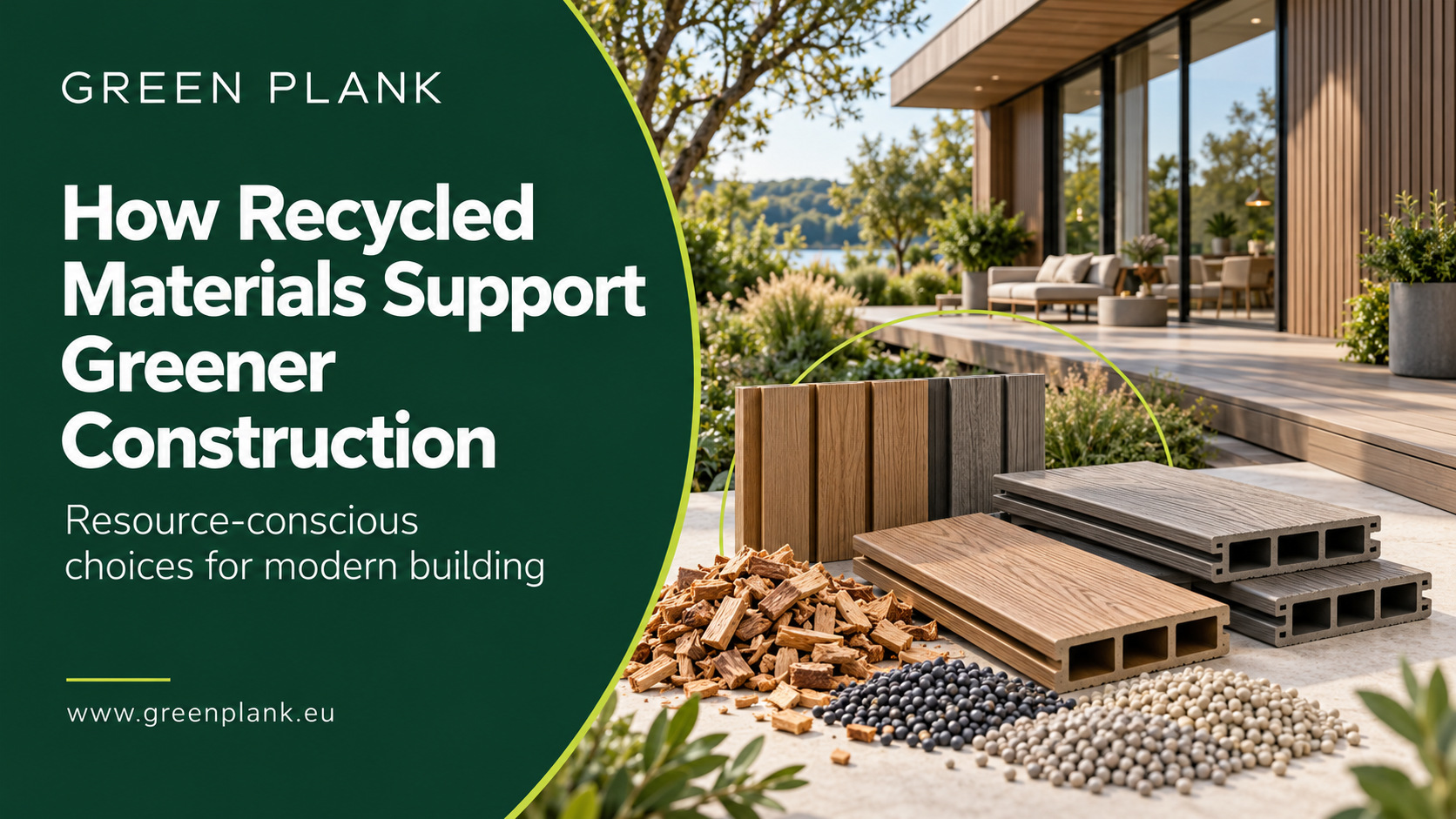
How Recycled Materials Support Greener Construction The construction industry is moving toward a more resource-efficient model in which materials are evaluated not only for performance and price, but also for their origin, durability, environmental impact and potential value after use. Recycled construction materials are an important part of this transition because they can return valuable resources to productive use instead of relying entirely on virgin raw materials. However, greener construction is more complex than simply choosing the product with the highest recycled-content percentage. Long service life, technical performance, responsible sourcing, efficient manufacturing, maintenance requirements, transport and end-of-life options should all be considered together. The goal of sustainable construction should not simply be to use more recycled material, but to use materials intelligently, preserve their value and keep them performing for as long as reasonably possible. Why Recycled Materials Matter to the Construction Industry Construction and demolition activities generate significant material flows. The European Commission identifies construction and demolition waste as an important waste stream and promotes environmentally sound management that contributes to the circular economy. :contentReference[oaicite:0]{index=0} Recovering appropriate materials can reduce disposal while creating secondary raw materials for new applications. The U.S. Environmental Protection Agency similarly promotes sustainable management of construction and demolition materials, including recovery and reuse where appropriate. :contentReference[oaicite:1]{index=1} reducing demand for selected virgin resources, keeping useful materials in economic circulation, diverting suitable materials from disposal, supporting circular product development, creating new markets for secondary raw materials, encouraging better material documentation and sorting. From Linear Construction to Circular Material Flows Traditional construction often follows a linear pathway: extract, manufacture, build, use and discard. Circular construction aims to retain product and material value through longer use, maintenance, repair, reuse and high-quality recycling. Linear Approach Greener Circular Approach Virgin resources as default Evaluate suitable virgin and secondary resources Lowest initial price Consider lifecycle value Replace complete systems Repair or replace individual components Waste after use Plan for reuse, recovery or recycling Limited material information Improve traceability and product documentation Where Can Recycled Materials Be Used? Secondary materials can enter construction through many different routes. Depending on technical requirements and local regulations, applications may include recycled aggregates, metals, glass, plastics, timber-derived materials and engineered composite products. European research also highlights the potential of recovering materials from existing buildings to reduce demolition waste and demand for new raw materials. :contentReference[oaicite:2]{index=2} The critical point is fitness for purpose. A recycled material must still satisfy the mechanical, durability, safety and processing requirements of its intended application. Recycled Content Alone Does Not Define Sustainability A product containing recycled material is not automatically the environmentally superior option in every application. Feedstock consistency, contamination, manufacturing efficiency, transport, product life and replacement frequency can influence the overall result. A Better Specification Strategy Instead of asking only how much recycled material does the product contain?, architects and buyers should also ask how long will it perform, what maintenance will it require and what happens to the material at the end of its service life? This distinction is especially important for construction products expected to remain outdoors for decades. A technically unsuitable material that requires premature replacement can undermine the benefits expected from recycled content. Recycled Plastics and Composite Building Materials Thermoplastics can be incorporated into certain construction products when their properties are sufficiently controlled for the intended application. One example is Wood Plastic Composite (WPC), where cellulose-based fibres are combined with thermoplastic polymer and functional additives. WPC can be used in applications such as decking, fencing, cladding and other outdoor profiles. Whether virgin, recycled or blended polymer is appropriate depends on the required mechanical performance, processing behaviour, consistency, appearance and expected service conditions. Factor Why It Matters Feedstock consistency Supports predictable manufacturing and product performance Contamination control Helps limit unwanted variation Polymer properties Influence processing and mechanical behaviour Fibre quality Affects processing and composite structure Additive system Supports processing and outdoor durability Quality control Helps maintain consistent production batches Durability Can Be Just as Important as Recycled Content Keeping a building product in useful service for longer can reduce the frequency of replacement and the associated need for new materials, manufacturing, transport and installation. For this reason, durability should form part of any serious discussion about greener construction. For exterior products, buyers should evaluate factors such as moisture resistance, UV exposure, dimensional stability, structural performance, surface behaviour and installation requirements rather than relying on recycled-content claims alone. Design for Repair, Replacement and Disassembly Greener construction also depends on how products are installed. The European Commission has highlighted that reversible building design can facilitate component separation, material recirculation and reduction of mixed demolition waste. :contentReference[oaicite:3]{index=3} Use mechanical connections where technically appropriate. Allow individual components to be removed and replaced. Keep fastening points accessible. Document the installed materials and systems. Consider future disassembly during the original design stage. A damaged component should ideally not force the replacement of a much larger area that remains technically sound. Traceability Will Become Increasingly Valuable A circular material system works better when future owners, contractors and recyclers know what a product contains. Product identification, raw-material information and reliable technical documentation can therefore support both quality management today and better material decisions tomorrow. The EU's revised Construction Products Regulation strengthens digitalisation in the construction-products sector. Digital Product Passports are intended to provide product information including performance, conformity, safety information and instructions for use. :contentReference[oaicite:4]{index=4} Lifecycle Assessment Creates a More Complete Picture ISO 14040 establishes principles and a framework for Life Cycle Assessment, including goal and scope definition, lifecycle inventory, impact assessment and interpretation. :contentReference[oaicite:5]{index=5} This approach helps prevent sustainability decisions from being reduced to a single characteristic. Lifecycle Stage Questions to Ask Raw materials Virgin, recycled or mixed? What is the origin? Manufacturing How efficiently are materials and production waste managed? Transport How far must materials and finished products travel? Use What is the expected service life and maintenance requirement? Repair Can individual components be replaced? End of life Are reuse, recovery or recycling routes available? Recycling solves only one part of the material equation. The stronger objective is to prevent valuable resources from becoming waste before their useful potential has been exhausted. What Should Architects and Buyers Ask Suppliers? What percentage and type of recycled material is used? Where do the recycled raw materials originate? How is feedstock quality controlled? Can production batches be traced? Which technical properties have been tested? What service life is the product designed for? What maintenance is required? Can individual components be replaced? Is lifecycle or environmental documentation available? What realistic end-of-life options exist? Building a Greener Future Requires Balance Recycled materials have an important role in reducing waste and developing more circular construction systems, but they work best as part of a broader material strategy. Performance, durability, traceability and lifecycle value must remain central to the decision. For composite decking and other outdoor building products, professional specification should therefore compare the entire system rather than relying on a single percentage or environmental claim. Explore composite building solutions and material information at www.greenplank.eu. Conclusion Recycled materials support greener construction by creating productive uses for secondary resources, reducing unnecessary disposal and supporting the transition toward circular material flows. Their greatest value, however, is achieved when recycled content is combined with reliable technical performance, long service life, efficient design and responsible end-of-life planning. The future of sustainable construction is therefore not about choosing between recycled content and durability. The strongest solutions are designed to deliver resource efficiency, performance and material value throughout the complete lifecycle. Sources European Commission – Construction and Demolition Waste U.S. EPA – Sustainable Management of Construction and Demolition Materials ISO 14040:2006 – Life Cycle Assessment Principles and Framework European Commission – Construction Products Regulation
Specifikér produktet
Brug denne guide i en Green Plank-specifikation
Tekniske WPC-artikler skal understøtte de kommercielle sider — ikke konkurrere med dem. Fortsæt til kompositterrasse, TerraTuff, Nordeka eller de tekniske downloads.