


Can a material born from rice husks really outlast traditional timber by half a century? It's a question that goes to the heart of modern outdoor design. Green plank started in 2001 with rice husk base wpc products, a pioneering step that challenged the status quo of European construction long before sustainability became a global trend. This early innovation wasn't just about finding a wood alternative; it was about engineering a solution that respected nature while delivering uncompromising durability.
You likely recognize the frustration of choosing between aesthetic beauty and long-term performance. It's common to feel skeptical about "new" materials, especially when trying to decipher the technical differences between PVC and HDPE compositions. This article clarifies that confusion. You'll discover how Green Plank's 25-year evolution from those initial rice husk composites to our current high-performance hardwood fiber technology has redefined the industry. We'll explore the science behind our 75% hardwood fiber blend and show you how our "Made in EU" standards support a 50-year warranty that you can actually trust. By the end, you'll understand why our commitment to the Cradle to Cradle model isn't just a label, it's a promise of regional reliability and engineering precision.
Key Takeaways
Green plank started in 2001 with rice husk base wpc products, establishing a legacy of sustainable innovation that now defines European building standards.
Understand the technical evolution from early rice husk composites to a sophisticated blend of 75% hardwood fiber and 25% HDPE.
Learn why "Made in EU" manufacturing and 100% European raw materials are vital for ensuring regional reliability and verified eco-credentials.
Gain confidence in long-term performance through our 50-year warranty claims and a comparison of HDPE versus traditional PVC materials.
Preview the future of maintenance-free exteriors with an overview of the Terra Tuff and Smart System product lines.
Table of Contents
The Origins of WPC: Green Plank’s 2001 Rice Husk Foundation
Why Material Science Evolved: From Rice Husk to Hardwood Fiber
European Manufacturing: The "Made in EU" Quality Advantage
Comparing Modern WPC: Green Plank vs. Traditional Alternatives
The Future of Sustainable Exteriors with Green Plank
The Origins of WPC: Green Plank’s 2001 Rice Husk Foundation
The early landscape of European construction in the late 1990s and early 2000s was heavily reliant on tropical hardwoods. Architects and builders prized these materials for their natural beauty and resistance to decay, but this aesthetic came at a steep environmental cost. Deforestation and long-distance shipping created a carbon footprint that was increasingly difficult to justify. It was within this context that Jamshaid and Nasir Gill identified a critical gap in the market. They saw an urgent need for a material that could mimic the warm, organic texture of wood while providing the industrial durability required for harsh climates.
Their search for a sustainable alternative led to a breakthrough in material science. Green plank started in 2001 with rice husk base wpc products, marking a departure from traditional timber sourcing. By utilizing agricultural residues, the company proved that high-quality building materials didn't need to depend on the destruction of old-growth forests. This mission was built on a foundation of engineering precision and ecological responsibility, setting a new standard for how outdoor spaces could be designed and maintained.
The Pioneering Spirit of the Gill Brothers
As a family-owned business, Green Plank challenged the established timber industry by introducing a product that many viewed with skepticism. The brothers spent years refining the technical process of bonding organic fibers with polymers. In those early stages, achieving a consistent structural integrity was the primary hurdle. They focused on creating a material that wouldn't warp, rot, or splinter like natural wood. Their persistence paid off, effectively setting the stage for the widespread adoption of wpc composite decking across the European market. They didn't just sell a product; they offered a reliable system that respected nature while serving the practical needs of high-end consumers and industry professionals.
Understanding Rice Husk as a Composite Base
Rice husk was chosen as the initial foundation because of its unique chemical composition. Unlike other plant fibers, rice husks have an exceptionally high silica content. This mineral presence acts as a natural shield, providing inherent resistance to moisture and fungal attacks. When these husks were integrated into Wood-Plastic Composites (WPCs), the resulting boards remained stable even in damp or humid environments. It was an elegant solution to a complex problem.
These early 2001 manufacturing processes were the first step toward a true circular construction model. By repurposing an abundant agricultural byproduct, Green Plank reduced waste and lowered the energy required for production. While the technology has since evolved toward hardwood fibers to meet even higher performance standards, the success of the rice husk base proved that sustainable innovation was both viable and necessary for the future of European architecture.
Why Material Science Evolved: From Rice Husk to Hardwood Fiber
The evolution of material science at Green Plank represents a strategic transition from basic agricultural waste to highly engineered sustainable building materials. When Green plank started in 2001 with rice husk base wpc products, the primary objective was to demonstrate that agricultural byproducts could replace virgin timber. Academic research into the viability of rice hulls in WPC confirmed their moisture resistance, yet as the brand moved into commercial infrastructure, the need for higher tensile strength became clear. Hardwood fibers provide a more consistent internal structure, which is vital for preventing the sagging or warping often seen in lower-grade composites.
Looking back at how Green plank started in 2001 with rice husk base wpc products, it's clear that our journey has always been defined by a willingness to improve. This shift wasn't a rejection of our roots but a refinement of our "Responsible Innovator" ethos. We discovered that engineered hardwood fibers allow for a tighter bond with the polymer matrix. This results in a material that handles thermal expansion much more effectively than rice-based alternatives. For architects and developers, this means tighter gaps and cleaner lines that remain stable from the heat of summer to the depths of winter. It's about providing a product that performs as beautifully as it looks, year after year.
The 75/25 Formula: Engineered for Extreme Environments
We've perfected our material composition to a precise ratio: 75% recycled hardwood fiber and 25% high-density polyethylene (HDPE). This specific formula provides a dense, wood-like texture that feels substantial underfoot. The choice of HDPE is a deliberate engineering decision. While many competitors use PVC, we prioritize HDPE because it remains ductile in cold climates. PVC can become brittle and prone to cracking when temperatures drop; conversely, our HDPE-based boards maintain their impact resistance. We achieve a low-density profile that reduces the weight on sub-structures without sacrificing the board's ability to withstand heavy loads. You can explore our full range of high-performance profiles at greenplank.eu to see this engineering in action.
Durability Milestones: Reaching the 50-Year Warranty
Engineering confidence is best expressed through a commitment to longevity. Our transition to hardwood fibers, combined with advanced UV stabilizers, has allowed us to set a new benchmark for service life. Each product, from our Terra Tuff decking to our Smart System profiles, undergoes rigorous testing to simulate decades of environmental stress. We don't rely on guesswork; we rely on data. This rigorous approach is why we can confidently offer a 50-year warranty on our premium residential lines. By incorporating specialized additives that prevent internal decay, we've created a product that effectively eliminates the need for toxic stains or oil treatments. It's a permanent solution for the modern, eco-conscious homeowner.
European Manufacturing: The "Made in EU" Quality Advantage
The shift to localized European production represents our commitment to regional reliability and environmental ethics. By sourcing 100% EU raw materials, we maintain absolute control over the manufacturing process, ensuring every profile meets rigorous safety and environmental standards. This localization significantly reduces the CO2 footprint associated with long-distance logistics. While Green plank started in 2001 with rice husk base wpc products, our move to a dedicated production unit in the EU has solidified our ability to deliver European-engineered WPC to the most demanding architectural projects. Utilizing recycled plastic or composite lumber sourced from within the continent ensures a predictable, high-quality output that respects both the builder and the biosphere.
Quality control in a localized setting allows for the precision that high-end consumers and industry professionals expect. We don't rely on generic global supply chains; instead, we prioritize verified sustainable sourcing that aligns with regional manufacturing quality. This approach ensures that our products are free from the unregulated additives often found in overseas imports. It's a strategy of "Responsible Innovation" that prioritizes long-term performance over short-term cost savings.
Cradle to Cradle: A Commitment to Circularity
Our Cradle to Cradle ownership model defines the entire lifecycle of our products. We design every board for eventual recycling and reuse, ensuring that materials remain within a closed-loop system. This commitment to circularity is a core identity marker for Green Plank. It moves beyond simple waste reduction and creates a framework where the end-of-life for one deck becomes the raw material for the next. This forward-thinking stance is what defines us as a "Sustainable Craftsman" in the modern building industry.
Infrastructure and Commercial Grade Reliability
Engineering for public spaces requires a deep understanding of structural integrity and pedestrian safety. We develop profiles specifically for public piers and boardwalks that can withstand constant environmental stress and high-traffic impact. The HidLoc™ hidden fastening system is essential here, as it provides a professional, screw-free finish that enhances safety. For private residential projects, we maintain these same rigorous standards. For example, adhering to 600 cc joist spacing is critical for ensuring the longevity and load-bearing capacity of the deck. This technical precision is why Green Plank remains the trusted choice for commercial infrastructure across the region.
Comparing Modern WPC: Green Plank vs. Traditional Alternatives
Selecting the right material for an outdoor space requires a clear understanding of how different compositions behave over time. While Green plank started in 2001 with rice husk base wpc products, the current engineered hardwood fiber and HDPE (High-Density Polyethylene) blend offers a distinct performance advantage over standard PVC composites. PVC often suffers from a "plastic" aesthetic and can become brittle under UV exposure. In contrast, our HDPE-based products retain their ductility and structural integrity. This engineering choice ensures that the boards remain resilient in fluctuating European temperatures, providing a stable foundation that resists cracking and splintering.
Thermal performance is another area where material evolution has yielded significant benefits. Hardwood fibers manage heat dissipation more effectively than agricultural residues like rice husks. This results in a surface that stays cooler underfoot and exhibits lower thermal expansion. You don't have to worry about the unsightly warping or shifting often associated with lower-density imports. The "feel" factor is equally important. We utilize advanced embossing techniques to create natural wood grain patterns that avoid the synthetic shine of many generic alternatives. You get the warmth of timber without the recurring labor of sanding or sealing.
WPC vs. Traditional Timber: The Long-Term ROI
Traditional timber decks demand annual staining and chemical treatments to prevent decay. These costs accumulate quickly over a 25 or 50 year period. Green Plank provides a superior return on investment by effectively eliminating these maintenance requirements. Our low maintenance decking serves as a primary value driver for property developers who prioritize long-term asset protection. We save forests through hardwood fiber reclamation, ensuring that no new trees are felled for your project. This commitment to the Cradle to Cradle model differentiates our brand history from manufacturers who merely view WPC as a wood replacement. We view it as a permanent, circular building solution.
Green Plank vs. Global Standards and Imports
European density standards are often more rigorous than those found in many North American or Asian models. While many global brands typically use a 50/50 wood-to-plastic ratio, Green Plank utilizes a 75% hardwood fiber composition. This higher fiber content provides several practical advantages:
Greater stiffness for a solid, timber-like feel underfoot.
Enhanced resistance to heavy furniture and high-traffic impact.
A more authentic, matte finish that mimics premium hardwoods.
The HidLoc™ hidden fastening system further elevates our profiles by achieving a clean, screw-free finish. You can view our commercial infrastructure profiles to see how these professional standards translate to real-world reliability. Green plank started in 2001 with rice husk base wpc products to solve a sustainability problem; today, we've refined that solution to outperform the global competition in both ethics and engineering.
The Future of Sustainable Exteriors with Green Plank
The trajectory of European outdoor architecture is moving toward a total integration of form, function, and environmental responsibility. Green Plank is leading this transition by expanding its engineering expertise beyond the forest floor and onto the building facade. Our recent innovations in composite wall cladding provide architects with a high-performance alternative to traditional render or timber siding. These systems utilize the same high-density hardwood fiber technology found in our Terra Tuff and Smart System decking lines, ensuring a cohesive aesthetic for the entire building envelope. This evolution reflects our role as a "Sustainable Craftsman," where every profile is designed to contribute to "Green Building" certifications like LEED and BREEAM.
It's remarkable to see how the industry has matured since Green plank started in 2001 with rice husk base wpc products. That early spirit of experimentation provided the foundational data we needed to develop the sophisticated, multi-purpose composites we manufacture today. While those initial products proved the viability of bio-based materials, our current output meets the rigorous demands of modern infrastructure. We've moved from simple boards to complex, engineered systems that help commercial specifiers hit their carbon reduction targets without compromising on the premium quality their clients expect.
Aesthetic Versatility: From Decking to Fencing
A truly maintenance-free outdoor space requires more than just a durable deck. It requires a coordinated ecosystem of materials that age at the same rate and share the same environmental pedigree. We've expanded our offerings to include composite fencing systems that mirror the textures and tones of our decking collections. This allows for a seamless visual flow from the ground to the boundary line. Our color-fast technology has also evolved. We now utilize advanced pigmentation processes that lock in deep, earthy hues, ensuring that your investment looks as vibrant in year twenty as it did on day one. For commercial partners, we offer custom profiles that satisfy the unique load-bearing and aesthetic requirements of public infrastructure projects.
Partnering with Green Plank for Your Next Project
We provide the technical tools necessary for professional success. Industry specifiers can access a comprehensive library of technical specifications and BIM objects, allowing for precise integration into digital workflows. Working with a manufacturer that controls its raw material source within the EU offers a level of regional reliability that global importers can't match. You don't have to worry about the ethical or quality inconsistencies of a fragmented supply chain. We invite you to join us in defining the next era of sustainable exterior design. By choosing materials that prioritize the Cradle to Cradle model, you're not just building a space; you're participating in a legacy of responsible innovation that began when Green plank started in 2001 with rice husk base wpc products. Let's create something that respects nature and stands the test of time.
Elevate Your Exterior with Proven European Engineering
The journey from pioneering agricultural experiments to high-performance material science defines the Green Plank standard. Green plank started in 2001 with rice husk base wpc products, a move that laid the groundwork for today's sophisticated 75% hardwood fiber and HDPE blend. This evolution ensures that your outdoor space isn't just beautiful; it's a testament to regional reliability and engineering precision. By prioritizing 100% European raw materials and a Cradle to Cradle ownership model, we offer a product that respects nature while delivering a service life of up to 50 years.
This isn't a temporary solution. It's a permanent investment in sustainable luxury that effectively eliminates the need for toxic stains and constant maintenance. We invite you to imagine an outdoor retreat that balances high-end quality with a grounded, eco-conscious responsibility. Explore Green Plank’s Sustainable WPC Solutions for Your Next Project and discover how our commitment to quality can transform your landscape. Your vision for a maintenance-free, beautiful space is within reach.
Frequently Asked Questions
When did Green Plank start manufacturing WPC products?
Green Plank's journey began conceptually in 2001, with the company officially established in 2004 by the Gill brothers. This early start positions us as one of the most experienced manufacturers of Wood-Plastic Composites in the European market. Our longevity is a primary signature of engineering confidence, allowing us to offer specific long-term performance guarantees that industry professionals and homeowners can trust for their outdoor projects.
What was the original material used in Green Plank composites in 2001?
Green plank started in 2001 with rice husk base wpc products as a pioneering step toward sustainable construction. Rice husks were initially chosen for their inherent silica content, which provides natural protection against moisture and fungal decay. This early innovation proved that agricultural residues could be successfully repurposed into durable building materials, setting the stage for our current high-performance hardwood fiber technology.
Why did Green Plank transition from rice husk to hardwood fiber?
We transitioned to hardwood fiber to achieve higher density and a more authentic wood-like feel. Hardwood fibers offer superior tensile strength compared to agricultural husks, which is essential for preventing sagging in commercial infrastructure profiles. This material evolution allows for a more stable product that handles thermal expansion with precision, ensuring that gaps remain tight and lines stay clean regardless of seasonal temperature shifts.
Is Green Plank WPC made in Europe?
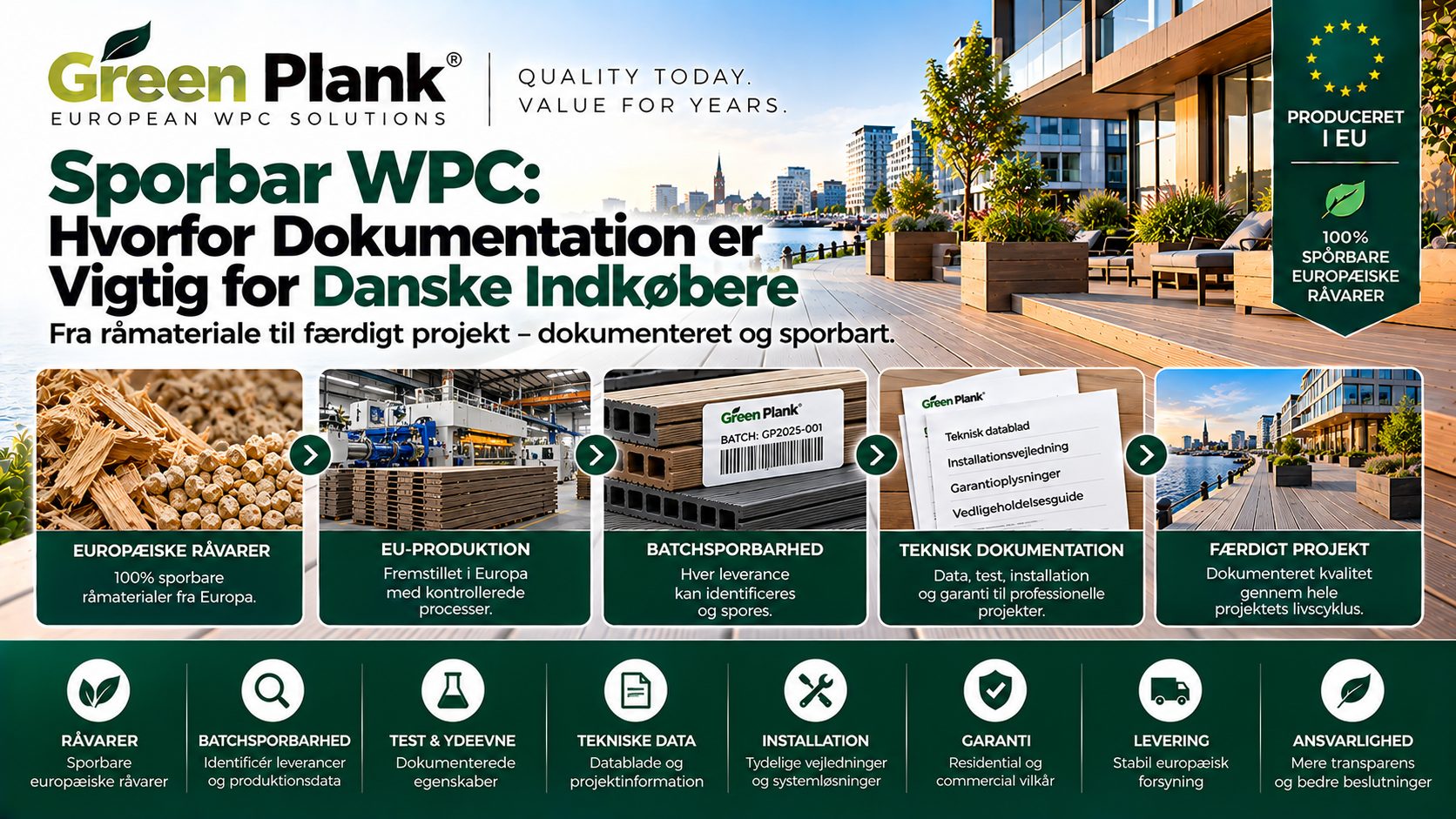
Every Green Plank product is manufactured within the European Union using 100% EU raw materials. We established a production unit in Klaipėda, Lithuania, to ensure our manufacturing standards align with the highest professional requirements. Localizing our supply chain reduces our CO2 footprint and provides the regional reliability that architects and property developers prioritize for high-end, eco-conscious residential and commercial developments.
What is the warranty period for Green Plank Terra Tuff decking?
Green Plank Terra Tuff decking carries a residential service life warranty of up to 50 years. This extensive guarantee is a direct result of our material science evolution and the use of specialized UV stabilizers in our 75% hardwood fiber blend. For commercial projects, we provide a robust 15-year warranty. These specific performance guarantees reflect our status as a "Responsible Innovator" focused on long-term value.
Does Green Plank use PVC or HDPE in its composite decking?
We use high-density polyethylene (HDPE) combined with 75% hardwood fiber to ensure maximum durability in extreme environments. Unlike PVC, which can become brittle and crack in cold climates, HDPE remains ductile and maintains its impact resistance. This engineering choice provides a safer, more reliable surface that withstands the heavy loads of public piers and private decks while maintaining a natural, matte appearance.
What is the HidLoc™ hidden fastening system?
The HidLoc™ system is our proprietary hidden fastening solution that creates a seamless, fastener-free finish. It secures the boards from the side, effectively eliminating visible screws and the potential for splinters or exposed metal. This professional installation standard not only improves the overall aesthetics of the outdoor space but also enhances safety for families and commercial pedestrians who use the space daily.
Is Green Plank decking truly sustainable?
Our commitment to sustainability is absolute. Green plank started in 2001 with rice husk base wpc products specifically to reduce the demand for tropical timber. Today, our products are made from 95% recycled materials and follow the Cradle to Cradle ownership model. We recycle approximately 11 million kg of waste each year, ensuring that our manufacturing process respects nature while delivering premium engineering standards.
Specifikér produktet
Brug denne guide i en Green Plank-specifikation
Tekniske WPC-artikler skal understøtte de kommercielle sider — ikke konkurrere med dem. Fortsæt til kompositterrasse, TerraTuff, Nordeka eller de tekniske downloads.