



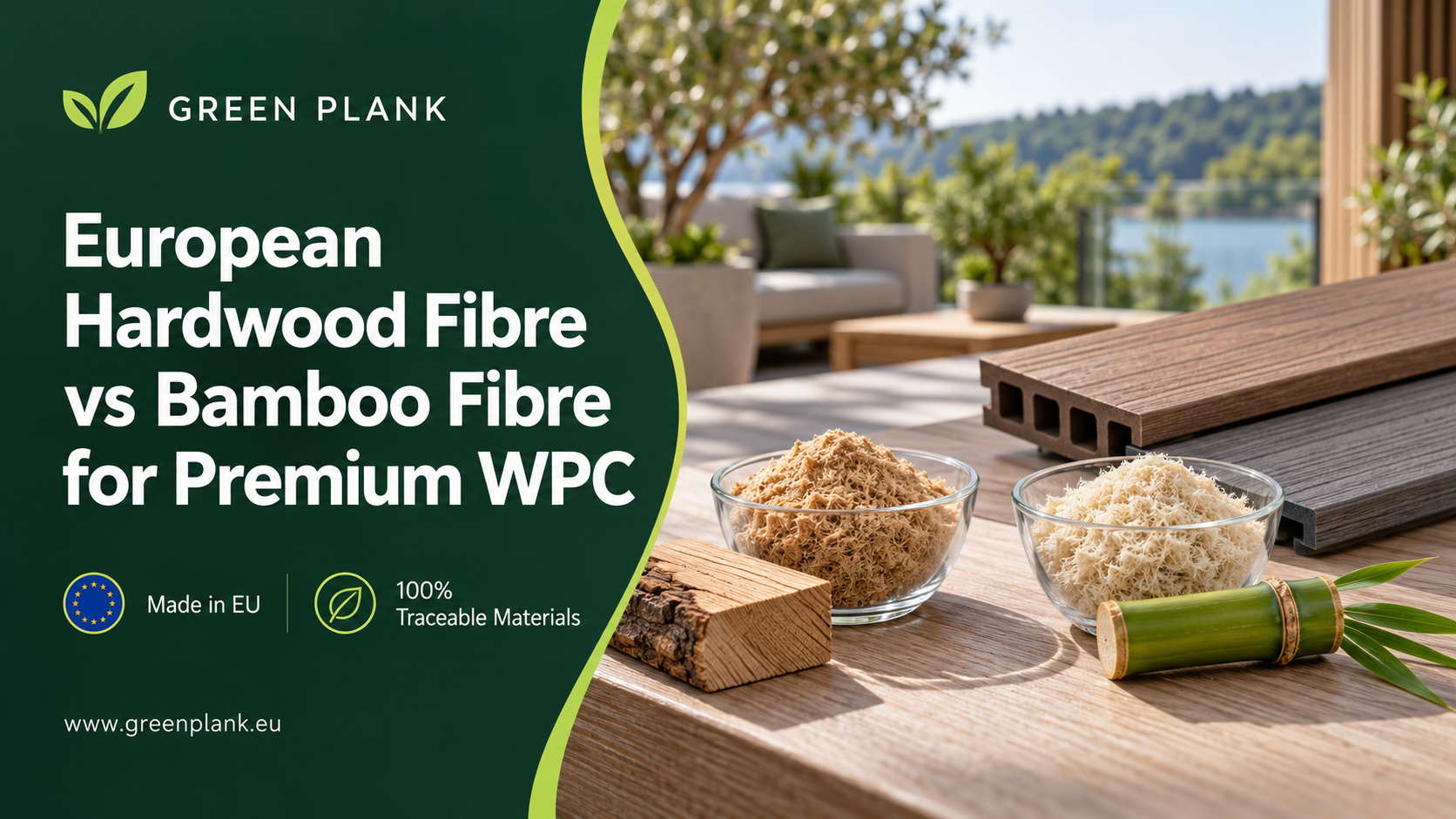
European Hardwood Fibre vs. Bamboo Fibre vs. Recycled Wood Fibre Choosing the right fibre is one of the most important decisions in manufacturing high-performance Wood Plastic Composite (WPC) products. While polymers, additives and production technology all influence the final product, the quality and consistency of the wood fibre largely determine mechanical strength, dimensional stability, appearance and long-term durability. Today, manufacturers typically use one of three fibre sources: Premium European hardwood fibre Bamboo fibre Recycled wood fibre recovered from flooring, furniture or sawmill production Each material offers unique advantages and challenges. Understanding these differences helps architects, contractors, distributors and project developers make informed decisions when selecting premium composite materials. Why Fibre Quality Matters Wood fibre is far more than a filler inside a composite profile. It contributes significantly to the product's overall performance by influencing: Mechanical strength Surface appearance Dimensional stability Moisture behaviour Processing consistency Long-term durability Overall product quality A premium WPC product is not defined by one ingredient alone, but by the quality of every component and the consistency of the manufacturing process. European Hardwood Fibre Premium European hardwood fibres are produced from carefully selected hardwood species processed under controlled manufacturing conditions. Uniform particle size, controlled moisture content and consistent fibre geometry contribute to reliable production and predictable product performance. Advantages Excellent fibre consistency High density and mechanical strength Smooth premium surface finish Excellent dimensional stability Reliable processing behaviour High batch-to-batch consistency Strong traceability within European supply chains These characteristics make hardwood fibres particularly suitable for premium decking, façade cladding, fencing, marine structures and public infrastructure projects. Bamboo Fibre Bamboo has become increasingly popular because of its rapid growth and renewable nature. It is widely available in Asian markets and offers attractive tensile properties. However, bamboo fibres behave differently during processing than traditional hardwood fibres. Performance depends heavily on fibre preparation, drying, grading and compatibility with polymer systems. Key Characteristics Rapidly renewable resource High natural tensile strength Good sustainability profile Requires careful processing control Performance varies with fibre preparation Well-engineered bamboo composites can deliver excellent results, but manufacturing consistency is critical. Recycled Wood Fibre from Flooring & Furniture Production Many manufacturers use recycled wood fibres recovered from flooring factories, furniture production, joinery workshops and sawmills. This supports the circular economy by giving wood waste a second life. However, recycled fibres can vary considerably depending on their origin and processing methods. Potential Variables Mixed wood species Variable particle sizes Different moisture levels Residual coatings or adhesives (depending on the source) Inconsistent fibre geometry High-quality manufacturers overcome these challenges through advanced cleaning, screening, drying and quality control procedures. Important Note Recycled wood fibre should not automatically be considered inferior. When properly processed and controlled, it can perform very well in many WPC applications while supporting responsible resource efficiency. Performance Comparison Property European Hardwood Fibre Bamboo Fibre Recycled Wood Fibre Consistency Excellent Good Variable Mechanical Strength Excellent High Depends on fibre quality Surface Finish Excellent Good Good to Variable Dimensional Stability Excellent Good Good when controlled Processing Consistency Excellent Moderate to High Variable Traceability Excellent Moderate Depends on supply chain Sustainability High High Very High through waste recovery Beyond Fibre: What Really Determines WPC Quality? The fibre source is only one element of a premium composite formulation. Long-term performance also depends on: Polymer quality Coupling agent technology UV stabilisers Production process control Moisture management Quality assurance Extrusion technology Raw material consistency Two products using the same fibre source can perform very differently depending on manufacturing standards. Sustainability Is More Than the Raw Material Modern sustainability assessments consider the complete product lifecycle rather than focusing on one ingredient. Responsible sourcing Manufacturing efficiency Transportation distance Product lifespan Maintenance requirements Repair frequency Recyclability Carbon footprint across the lifecycle A durable product requiring minimal maintenance and fewer replacements can significantly reduce environmental impact over its service life. Why Premium European Hardwood Fibre Remains a Preferred Choice Many premium European WPC manufacturers choose carefully selected hardwood fibres because they offer excellent consistency, predictable processing behaviour and high-quality surface finishes. Combined with premium polymers, advanced additives and strict production control, European hardwood fibres help manufacturers produce composites suitable for demanding residential, commercial, marine and infrastructure applications. Premium WPC is built on consistency. Consistent fibre quality contributes to reliable manufacturing, attractive aesthetics, dimensional stability and long service life—qualities that are especially important for outdoor applications exposed to changing weather conditions. Conclusion There is no universal "best" fibre for every composite application. European hardwood fibres, bamboo fibres and recycled wood fibres each have strengths, and each can contribute to high-quality WPC products when supported by proper engineering and manufacturing. For premium outdoor applications where consistency, traceability, surface quality and long-term performance are priorities, carefully selected European hardwood fibres remain an excellent choice. Ultimately, the best composite products result from the combination of quality raw materials, advanced formulation, precise manufacturing and rigorous quality control. Sources Food and Agriculture Organization (FAO) The International EPD System European Committee for Standardization (CEN) PEFC – Programme for the Endorsement of Forest Certification Forest Stewardship Council (FSC)
Specifikér produktet
Brug denne guide i en Green Plank-specifikation
Tekniske WPC-artikler skal understøtte de kommercielle sider — ikke konkurrere med dem. Fortsæt til kompositterrasse, TerraTuff, Nordeka eller de tekniske downloads.