



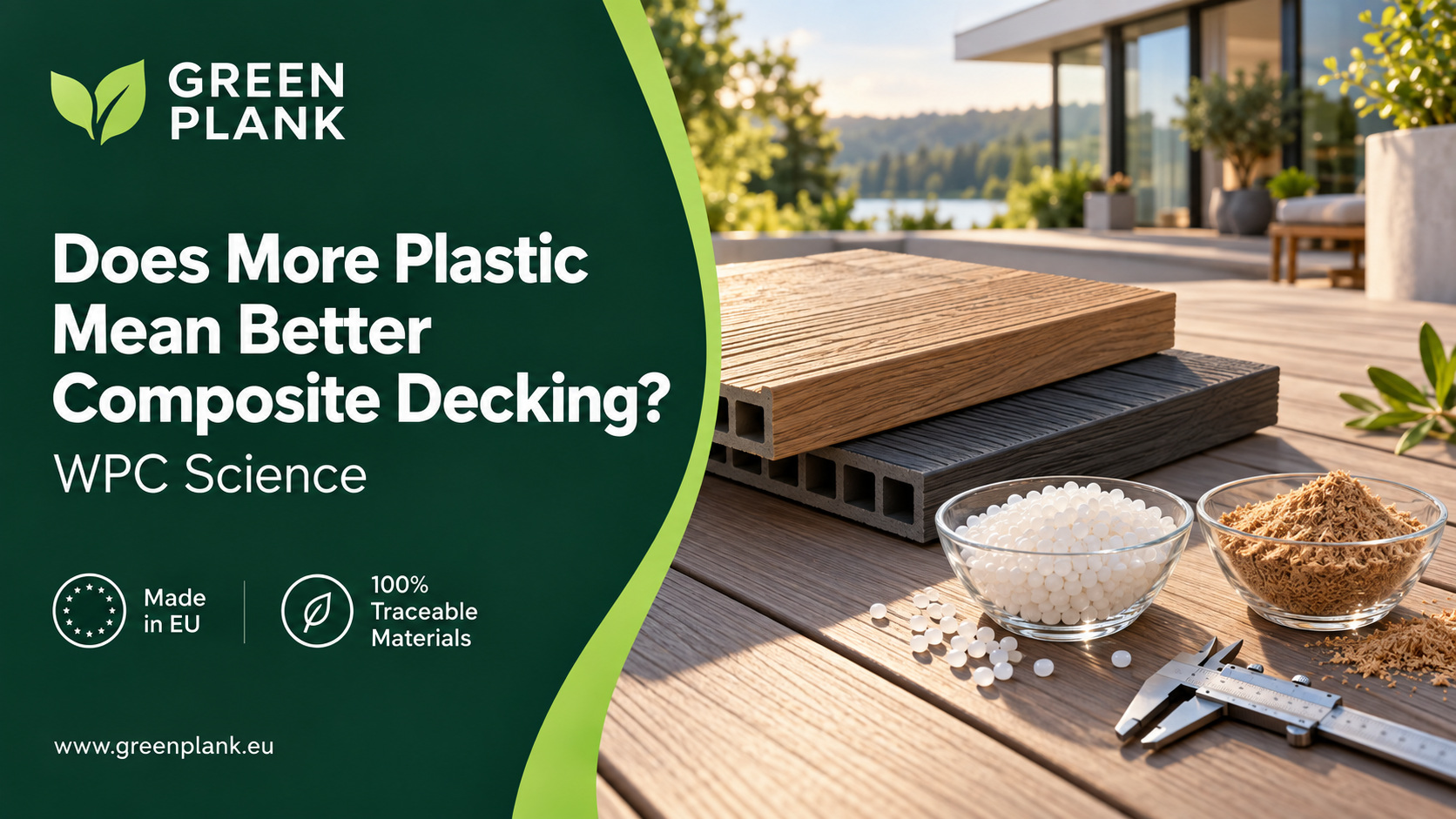
Does More Plastic Mean Better Composite Decking? The Science Behind WPC Formulation When comparing composite decking, it can be tempting to assume that a higher plastic content automatically means better strength, moisture resistance and durability. In reality, Wood Plastic Composite (WPC) is far more sophisticated. Research shows that performance depends on the interaction between the polymer matrix, wood fibres, coupling agents, additives and manufacturing conditions—not simply on how much plastic is used. The better question is therefore not how much plastic a board contains, but how intelligently the complete material system has been engineered. Key principle: Premium WPC is about balance. More plastic may improve certain properties in a particular formulation, but it does not automatically create a better decking board. What Makes a High-Performance WPC Formula? WPC combines natural fibres with a thermoplastic such as polyethylene or polypropylene. Wood contributes stiffness and a natural material character, while the polymer forms the matrix around the fibres. The challenge is that wood is naturally hydrophilic while polyethylene is hydrophobic, making the quality of the fibre-polymer interface particularly important. Research identifies coupling agents as a key tool for improving this compatibility. :contentReference[oaicite:0]{index=0} Component Main Function Wood / natural fibres Stiffness, reinforcement and natural character Polymer matrix Binds fibres and contributes moisture resistance and toughness Coupling agent Improves adhesion between fibre and polymer Lubricants Support stable extrusion and processing UV stabilisers & antioxidants Help protect the polymer system from environmental degradation Why More Plastic Is Not Automatically Better Increasing polymer content can improve some characteristics, including water resistance and certain mechanical properties, depending on the formulation. A 2026 study of wood-flour/HDPE composites, for example, found improved mechanical performance and reduced water absorption as recycled HDPE increased within the formulations tested. However, the same research also emphasises the influence of wood species, fibre characteristics and coupling agents. :contentReference[oaicite:1]{index=1} This illustrates an important point: there is no universal plastic percentage that guarantees superior decking. Optimisation depends on the target application and the complete formulation. The Fibre-Polymer Bond Can Matter More Than the Ratio Simply mixing wood fibre and HDPE does not guarantee a strong composite. Effective stress transfer requires good interfacial bonding. Maleic-anhydride-grafted polyethylene, commonly known as MAPE, is one compatibilisation technology used in polyethylene-based WPC systems. Studies have demonstrated that appropriate coupling treatments can significantly improve fibre-matrix adhesion and mechanical properties. Research on recycled HDPE and maple-fibre composites reported improvements after MAPE treatment, while other studies have shown that particle size, fibre geometry and processing conditions also influence final performance. :contentReference[oaicite:2]{index=2} What Should Buyers Evaluate? Instead of comparing products only by their wood-to-plastic ratio, architects, distributors and professional buyers should evaluate the finished product through relevant technical data. Flexural strength and modulus Water absorption and dimensional stability Thermal expansion UV and weathering performance Slip resistance for relevant applications Raw-material consistency and traceability Quality-control procedures Product-specific technical documentation Processing Technology Is Part of the Formula Two manufacturers can use similar ingredients and still produce very different WPC products. Fibre moisture, particle distribution, mixing, extrusion temperature, screw speed, pressure, cooling and profile geometry all influence the finished material. Research into WPC processing has examined wood-to-PE ratios ranging from 55:45 to 70:30 together with different coupling-agent levels and processing parameters, demonstrating why formulation and manufacturing cannot be evaluated separately. :contentReference[oaicite:3]{index=3} Green Plank: Engineering the Right Balance At Green Plank, the objective is not to maximise plastic content. The engineering philosophy is to achieve the appropriate balance between natural fibres, polymer technology, coupling, stabilisation, additives and controlled manufacturing for the intended application. This approach supports the development of composite solutions for residential terraces, commercial developments, landscape architecture, public spaces and specialised outdoor projects. Discover Green Plank European composite solutions at www.greenplank.eu. Conclusion So, does more plastic mean better composite decking? Not necessarily. Plastic percentage is only one variable within a complex engineered material. High-performance WPC depends on the quality of the fibres and polymer, effective fibre-matrix bonding, carefully selected additives, controlled processing and verified finished-product performance. For professional buyers, the most meaningful comparison is therefore not simply wood versus plastic percentage. It is the performance of the complete engineered system. Sources Polymers – A Concise Review of the Components and Properties of Wood-Plastic Composites Polymers – Interface Structure and Bonding Mechanism of Coupling-Agent-Treated WPC Materials – Wood Flour Size, Aspect Ratio and Processing Effects on WPC Journal of Composites Science – Wood Flour and HDPE Mechanical Performance
Specifikér produktet
Brug denne guide i en Green Plank-specifikation
Tekniske WPC-artikler skal understøtte de kommercielle sider — ikke konkurrere med dem. Fortsæt til kompositterrasse, TerraTuff, Nordeka eller de tekniske downloads.