



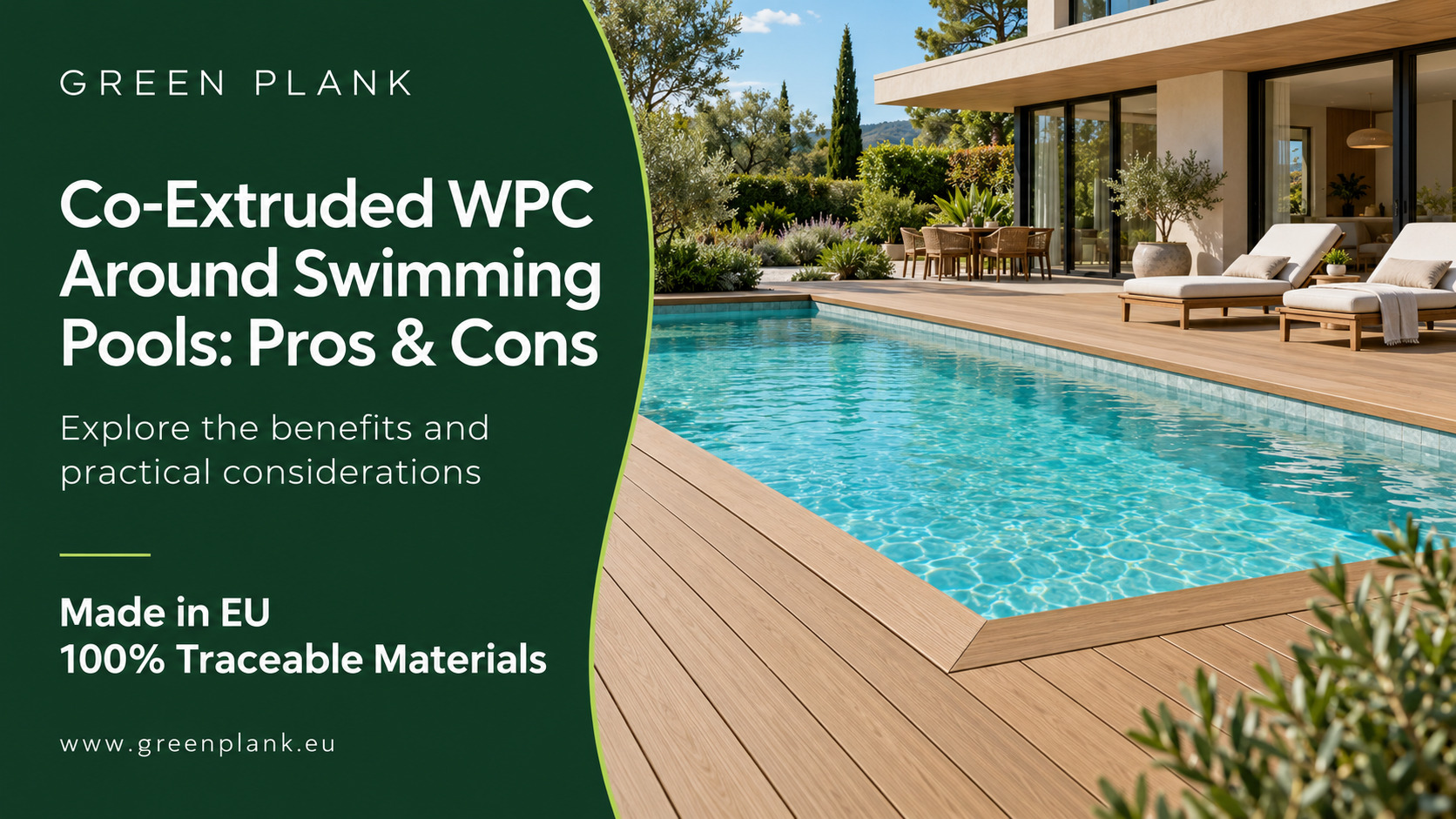
Is Co-Extruded WPC Suitable Around Swimming Pools? Choosing decking around a swimming pool is more demanding than selecting material for an ordinary terrace. Pool surrounds face repeated water exposure, chlorine, intense sunlight, wet barefoot traffic, sunscreen, cleaning products and rapid wet-dry cycles. The surface must also remain comfortable, attractive and practical to maintain. For these reasons, co-extruded WPC decking, also known as capped composite decking, can be an excellent solution for properly designed pool areas. Unlike conventional mono-extruded WPC, co-extruded decking combines a wood-polymer composite core with an engineered protective polymer surface. Research from the U.S. Forest Products Laboratory has identified moisture absorption as an important factor affecting WPC durability and studied co-extrusion as a method of improving exterior protection. This principle is particularly relevant around pools, where repeated moisture exposure is unavoidable. The key poolside advantage of co-extrusion is separation of functions: the composite core provides the body and mechanical properties of the board, while the engineered cap protects the exposed surface against moisture, staining and weathering. How Does Co-Extruded WPC Work? Traditional WPC is generally produced as one composite material throughout the profile. Wood fibres and thermoplastic are mixed with additives and extruded into the finished board. This technology can provide durable outdoor decking, but wood-based material remains present at the surface. Co-extrusion adds a second material during manufacturing. An engineered polymer layer is fused around the composite core as the profile is produced. Depending on the product, this cap may cover the upper surfaces or encapsulate the board around multiple sides. Green Plank describes its premium TerraTuff™ as a co-extruded composite decking system using FortiShell™ protective technology. Green Plank technical information states that capped TerraTuff products are designed for enhanced cleanability, colour stability and stain resistance. The company also describes its composite systems as PVC-free and based on high natural wood-fibre content. Learn more about Green Plank composite decking at www.greenplank.eu. Why Pool Environments Are Particularly Demanding A pool deck is exposed to several stresses simultaneously. Water itself is only part of the challenge. Continuous splash water: repeated wetting and drying can challenge porous materials. Chlorinated water: pool-treatment chemicals create additional surface exposure. UV radiation: open pool areas often receive strong direct sunlight. Wet barefoot traffic: slip performance becomes particularly important. Sunscreen and body oils: these can leave difficult stains on absorbent surfaces. Surface temperature: dark decking exposed to strong sunshine can become uncomfortable under bare feet. Cleaning: hospitality and public pools may require frequent maintenance. Advantages of Co-Extruded WPC Around Swimming Pools 1. Improved Protection Against Moisture One of the principal advantages of capped WPC is that the protective surface reduces direct contact between water and the wood-containing composite core. This can be particularly valuable where decking experiences frequent splash water. Full encapsulation can offer an additional design advantage because the sides and underside of the manufactured profile are protected as well as the walking surface. However, cut ends, drilled areas and damaged surfaces can expose the core and must be considered during installation. 2. Better Resistance to Everyday Poolside Stains Swimming-pool decks regularly encounter sunscreen, drinks, food, grease, leaves and organic contamination. A quality polymer cap provides a less absorbent surface than exposed wood fibres, making many everyday spills easier to remove when cleaned promptly. Green Plank recommends regular cleaning of capped decking with water, mild pH-neutral soap and appropriate cleaning methods. Abrasive methods that damage the protective cap should be avoided. 3. No Splinters One practical advantage of composite decking around barefoot areas is the absence of conventional timber splinters. Green Plank highlights splinter-free performance as one of the benefits of its composite decking systems. This does not eliminate every safety consideration, but it can improve barefoot comfort compared with deteriorating or poorly maintained timber. 4. Reduced Routine Maintenance Traditional timber decking can require periodic staining, oiling or painting depending on wood species and desired appearance. Green Plank states that its composite profiles do not require regular oiling, staining or painting under normal use. Pool decking still requires cleaning. Low maintenance should therefore never be confused with zero maintenance. 5. Improved Colour and Weather Protection The polymer cap can contain pigments, UV stabilisation and other surface-performance components specifically engineered for exterior exposure. Green Plank states that capped TerraTuff products are designed to provide improved colour stability compared with an exposed wood-composite surface. Co-Extruded WPC vs. Timber vs. Uncapped WPC Around Pools Characteristic Timber Uncapped WPC Co-Extruded WPC Moisture exposure Depends strongly on species and treatment Composite surface remains exposed Core receives additional cap protection Splinters Possible Generally avoided Generally avoided Stain resistance Variable Moderate/product dependent Typically improved by protective cap Painting/oiling May be required Normally unnecessary Normally unnecessary UV protection Requires material/finish strategy Depends on formulation Cap can be specifically UV engineered Poolside suitability Possible with correct specification Possible with correct product Potentially very suitable when tested and correctly installed What About Chlorine? This is one of the most important questions when selecting composite decking around swimming pools. Properly formulated capped composite surfaces can be suitable for normal pool environments, and WPC systems are widely used for pool surrounds. However, it is important to distinguish between normal chlorinated swimming-pool water and direct exposure to concentrated pool-treatment chemicals. Concentrated chlorine products, strong oxidising agents, aggressive acids or alkalis should not be assumed safe for any decking surface unless the manufacturer has specifically validated that exposure. Spilled pool chemicals should therefore be removed promptly according to the product's care instructions. Important Poolside Principle Water resistance does not automatically mean chemical immunity. For demanding residential, hotel or commercial pool projects, designers should verify the manufacturer's chemical-resistance, warranty and maintenance requirements for the specific decking product. Slip Resistance: The Most Important Safety Consideration A decking product can have excellent moisture resistance and still be unsuitable for a particular pool project if its wet slip performance is inadequate. Slip resistance depends on surface texture, contamination, wear, cleaning condition, direction of travel and the applicable test method. Designers should therefore request relevant wet-slip test data rather than relying only on terms such as anti-slip or pool safe. For commercial pools, hotels, spas and public facilities, the required slip classification should be established according to the regulations and standards applicable to the project location. Does Composite Decking Get Hot Around a Pool? Yes. Composite decking, timber, stone, ceramic tiles and other outdoor materials can all heat up in direct sunlight. Surface temperature depends on solar radiation, colour, material properties, ventilation and local climate. Darker colours generally absorb more solar energy than lighter surfaces. For barefoot pool areas exposed to intense sun, lighter composite colours can therefore be worth considering. Architects should evaluate thermal comfort and wet-slip resistance together. Choosing a surface only because it looks attractive when dry can produce disappointing results in a real pool environment. Drainage and Ventilation Matter Even highly moisture-resistant decking should never be installed as though drainage were unnecessary. Water must be able to leave the deck efficiently. Green Plank's current technical guidance specifies drainage considerations and states that decking profiles are walking surfaces rather than primary structural members. Correct joist spacing, ventilation, board gaps, drainage and substructure design remain essential. Create an appropriate stable substructure. Provide effective drainage away from standing-water areas. Maintain the specified spacing between boards. Provide adequate airflow beneath the deck. Follow the manufacturer's joist-spacing requirements. Consider exposed cut ends and penetrations carefully. Use corrosion-resistant fixings suitable for the environment. Disadvantages of Co-Extruded WPC Around Pools Co-extruded WPC offers significant advantages, but a professional specification should also acknowledge its limitations. Higher initial price: advanced co-extrusion normally costs more to manufacture than basic mono-extruded WPC. Surface heat: especially dark colours can become hot in strong sunlight. Not scratch-proof: a durable polymer cap can still be damaged by furniture, sharp objects or improper handling. Cut ends expose the core: factory encapsulation cannot remain continuous where a board has been cut. Wet slip must be verified: composite decking is not automatically slip-safe simply because it is capped. Concentrated chemicals require caution: pool-treatment chemicals should not be stored, mixed or allowed to remain on the decking. Correct installation remains essential: poor drainage, inadequate ventilation or incorrect substructure design can compromise even premium materials. Why TerraTuff™ Is an Interesting Solution for Wet Outdoor Environments Green Plank positions TerraTuff™ as its premium European-made co-extruded decking system. The product combines a high natural wood-fibre composite structure with FortiShell™ engineered surface protection, designed to improve weather resistance, cleanability, colour stability and resistance to staining. This material philosophy is particularly relevant to swimming pools, waterfront terraces, hospitality environments and other locations where conventional decking is repeatedly exposed to moisture. For professional projects, however, material selection should always be based on the exact product specification, wet-slip requirements, expected traffic, chemical exposure, local regulations and Green Plank's current technical documentation. Final Verdict: Is Co-Extruded WPC Good for Swimming Pools? Yes, co-extruded WPC can be an excellent decking technology for swimming-pool surrounds when the correct product is selected, independently tested where required and installed according to the manufacturer's instructions. Its principal advantages are the protective polymer surface, reduced moisture interaction with the wood-composite core, stain resistance, splinter-free character, low routine maintenance and long-term aesthetic potential. Its limitations should also be respected: composite surfaces can become hot, they are not impossible to scratch, concentrated chemicals require care, wet-slip performance must be verified, and proper drainage and ventilation remain essential. The best pool deck is therefore not simply the product advertised as most water resistant. It is a complete system combining appropriate materials, tested surface performance, correct substructure design, effective drainage, professional installation and responsible maintenance. For information about TerraTuff™, composite decking systems and technical documentation, visit Green Plank® at www.greenplank.eu. Sources Green Plank® – Composite Decking and Outdoor Building Products Green Plank® – Decking Products and TerraTuff™ Green Plank® – NFC/WPC Technical Data Sheet Green Plank® – Care and Maintenance Guide USDA Forest Products Laboratory – Coating WPCs Using Co-Extrusion to Improve Durability SIS – EN 15534-4, Specifications for WPC/NFC Decking Profiles and Tiles
Specifikér produktet
Brug denne guide i en Green Plank-specifikation
Tekniske WPC-artikler skal understøtte de kommercielle sider — ikke konkurrere med dem. Fortsæt til kompositterrasse, TerraTuff, Nordeka eller de tekniske downloads.