



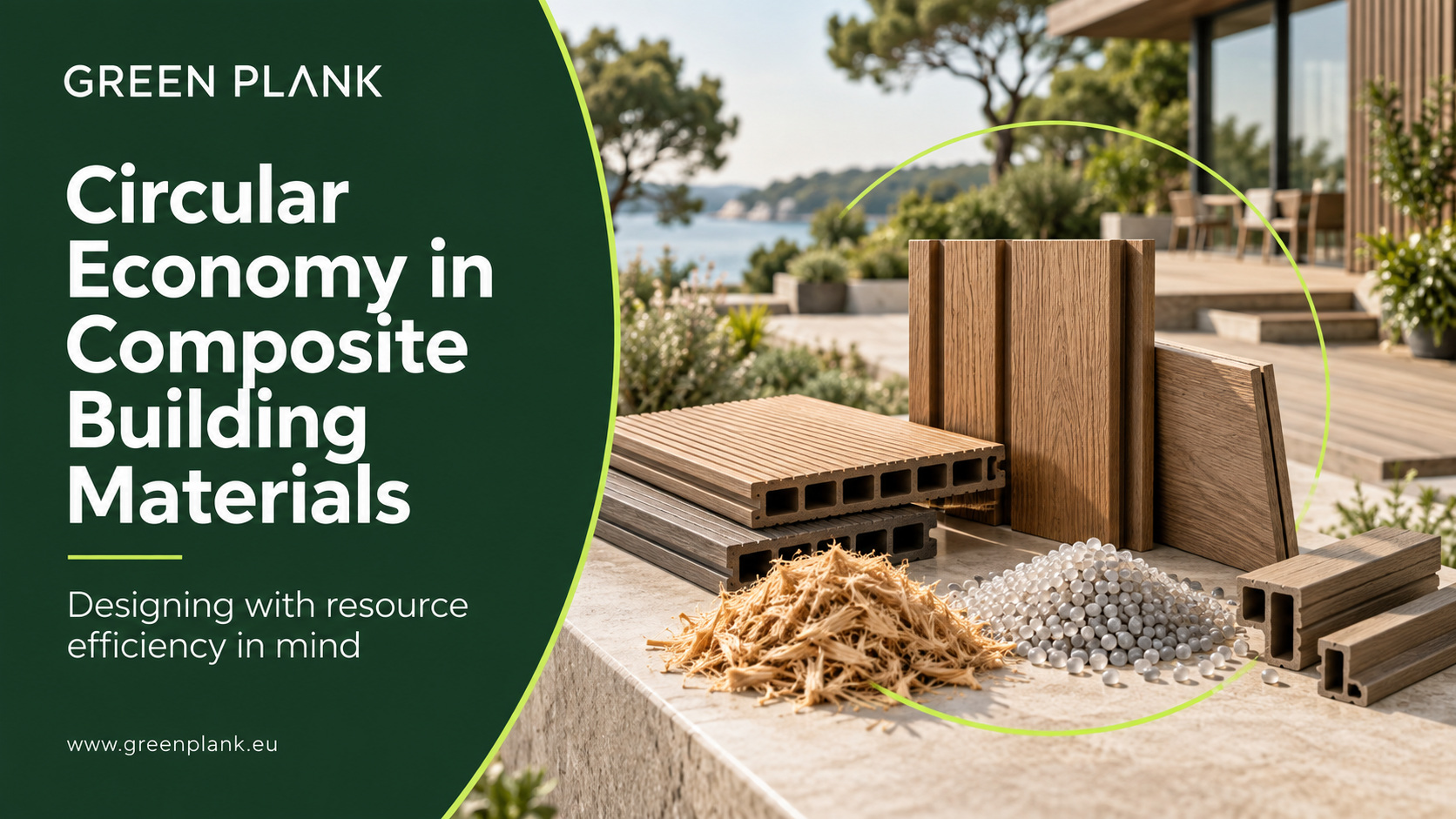
The Circular Economy in Composite Building Materials The construction industry is moving beyond the traditional model of extracting resources, manufacturing products, using them and eventually discarding them. A circular approach aims to keep products and materials in productive use for longer through durability, efficient design, maintenance, repair, reuse and responsible recycling. The European Commission describes circular-economy policy as addressing the entire product lifecycle, including how products are designed. :contentReference[oaicite:0]{index=0} For composite building materials such as Wood Plastic Composite (WPC), this creates an important opportunity. Circularity should not be judged by recycled content alone. Raw-material quality, service life, traceability, replaceability and end-of-life pathways all influence whether a product genuinely supports more efficient resource use. Circularity does not begin when a product becomes waste. It begins when the product is designed, the materials are selected and decisions are made about how long the product should remain useful. What Does Circular Economy Mean for Building Materials? Circular construction seeks to preserve the value of products, components and materials instead of allowing them to become waste prematurely. The European Commission notes that circular construction involves creating, using and repurposing buildings, components and materials while minimising resource depletion and waste. :contentReference[oaicite:1]{index=1} Design products for long service life. Use materials efficiently. Make components accessible for repair or replacement. Maintain reliable information about material composition. Support reuse wherever technically appropriate. Develop realistic collection and recycling pathways. Why Composite Materials Matter in Circular Construction Composite products combine different materials to achieve specific performance characteristics. In WPC, cellulose-based fibres are typically combined with thermoplastic polymers and functional additives. This approach can create durable profiles for decking, cladding, fencing and other outdoor applications. The circular challenge is to maximise the value delivered by that material combination. A well-designed composite product should use material efficiently, perform reliably for its intended service period and avoid unnecessary replacement. Circular Principle Relevance to Composite Products Long service life Reduces premature replacement and additional material demand Material efficiency Optimised profiles place material where structural performance requires it Low maintenance Can reduce repeated coatings and surface treatments Repairability Individual profiles may be replaceable without rebuilding the entire area Traceability Provides better knowledge of origin and composition End-of-life planning Supports more informed reuse, recovery or recycling decisions Durability Is a Circular-Economy Strategy Recycling is important, but extending useful service life can also play a central role in circular construction. European Commission work on circular building design identifies extending service life and closing material cycles as important approaches to making buildings more circular. :contentReference[oaicite:2]{index=2} For outdoor composite products, durability should therefore be evaluated alongside recycled content. Moisture resistance, dimensional stability, UV performance, mechanical strength, surface durability and appropriate installation can all influence how long a finished system remains useful. A Better Circular Question Instead of asking only how much recycled content does this product contain?, professional buyers should also ask how long will it perform, what maintenance will it require, can damaged components be replaced, and what can happen to the material afterwards? Recycled Content Is Important, but It Is Not the Whole Story Secondary raw materials can reduce demand for virgin resources, but recycled percentage alone does not describe total environmental performance. Feedstock consistency, contamination, additives, manufacturing efficiency, expected service life and eventual recyclability also matter. This is why material decisions should be based on the intended application and documented product performance rather than a single marketing figure. In some applications, recycled polymers may provide an appropriate solution; in others, tighter control of polymer properties may be required to meet demanding technical objectives. Traceability Supports Future Circularity A future recycler, contractor or building owner needs information about what a product contains. Traceable materials and production records can therefore become increasingly valuable as construction moves toward more data-driven circular systems. The revised EU Construction Products Regulation strengthens digitalisation in the construction-products sector, including Digital Product Passports containing product performance, conformity, safety and use information. :contentReference[oaicite:3]{index=3} For composite manufacturers, stronger traceability can support: raw-material identification, batch-level quality control, technical documentation, future material sorting, more transparent environmental reporting. Design for Disassembly and Component Replacement Circularity can also be improved through construction design. Mechanically installed decking, cladding or fencing systems may allow individual components to be removed and replaced rather than forcing an entire installation to be demolished. Use accessible mechanical fastening where technically appropriate. Allow damaged profiles to be replaced individually. Document product type and installation system. Avoid unnecessary material combinations that complicate future separation. Consider future dismantling during the original design phase. This approach can extend the useful life of the complete installation while preserving the value of components that remain in good condition. Lifecycle Assessment Provides the Broader Perspective ISO 14040 defines the principles and framework for Life Cycle Assessment, covering goal and scope definition, lifecycle inventory, impact assessment and interpretation. :contentReference[oaicite:4]{index=4} A lifecycle perspective is particularly valuable for composite materials because it prevents environmental evaluation from being reduced to one attribute such as recycled content. Lifecycle Stage Questions to Consider Raw materials Where do they originate and how consistent are they? Manufacturing How efficiently are material, energy and production waste managed? Transport How far and by what means does the product travel? Use What service life and maintenance requirements are expected? Repair Can individual components be replaced? End of life Can products be reused, recovered or recycled? Maintenance Is Part of Circular Performance Every maintenance cycle consumes resources. Surface treatments, cleaning products, replacement materials, labour and transport can contribute to lifecycle impacts. Therefore, materials that provide long service intervals and avoid unnecessary treatments may support a broader resource-efficiency strategy. This does not mean that composite products are maintenance-free. Outdoor surfaces still require cleaning, inspection and correct installation. Circular design means reducing avoidable intervention while preserving performance for as long as reasonably possible. The objective of the circular economy is not simply to recycle more material. It is to prevent useful products, components and resources from becoming waste too early. Europe Is Moving Toward More Circular Construction The European Commission's circular-economy strategy addresses product design, resource use and material cycles across product lifetimes, while EU policy for buildings increasingly promotes material efficiency and circularity throughout the building lifecycle. :contentReference[oaicite:5]{index=5} Level(s), the European framework for sustainable buildings, also provides a common language for assessing sustainability performance and encourages lifecycle-oriented evaluation. :contentReference[oaicite:6]{index=6} 10 Questions Professional Buyers Should Ask Where do the raw materials originate? Can materials and production batches be traced? What service life is the product designed to achieve? What maintenance is required? Can individual components be removed and replaced? What technical performance is documented? Is recycled content appropriate for the intended application? What options exist for reuse or recycling? Is lifecycle or environmental information available? How does the complete system support long-term resource efficiency? Green Plank and Long-Term Material Thinking For WPC decking, cladding, fencing and other outdoor applications, a circular approach means considering more than the original formulation. Raw-material control, durable design, efficient installation, maintenance requirements, traceability and future material handling should be viewed as parts of one connected value chain. Architects, municipalities, contractors and developers should therefore compare composite products using technical documentation and project-specific requirements rather than relying solely on recycled-content percentages or initial purchase price. Explore Green Plank composite solutions at www.greenplank.eu. Conclusion The circular economy in composite building materials requires a broader definition of sustainability. Recycled content is valuable, but true circular performance also depends on durability, material efficiency, traceability, repairability, responsible maintenance and credible end-of-life pathways. The key question for future construction is therefore not simply how much recycled material a product contains. It is how effectively the product preserves material value and delivers useful performance throughout its complete lifecycle. Sources ISO 14040:2006 – Life Cycle Assessment Principles and Framework European Commission – Circular Economy European Commission – Level(s) European Commission – Construction Products Regulation
Specifikér produktet
Brug denne guide i en Green Plank-specifikation
Tekniske WPC-artikler skal understøtte de kommercielle sider — ikke konkurrere med dem. Fortsæt til kompositterrasse, TerraTuff, Nordeka eller de tekniske downloads.