



Before You Pay a Premium for Imported WPC, Ask Three Questions
Two decking boards can look identical while differing in materials, test evidence and lifetime costs. Neither imported nor European-made WPC is automatically better: the distinction is what a supplier can prove.
Three questions before paying a premium:
- Where do the wood fibres, polymers and additives come from?
- Can the manufacturer demonstrate product performance and material traceability?
- Do the full project cost, delivery terms and environmental evidence justify the price?
Question 1: Where Do the Raw Materials Come From?
A “Made in” label does not show where every ingredient originated.
Wood Fibre: More Than a Percentage
Wood fibre adds natural appearance and stiffness, but species, moisture, particle size and processing matter as much as the fibre percentage.
A 2026 study in the Journal of Composites Science found that varying wood-flour and recycled-HDPE proportions changed mechanical properties and water absorption in the tested formulations. It is a useful reminder that composition and processing must be judged together.

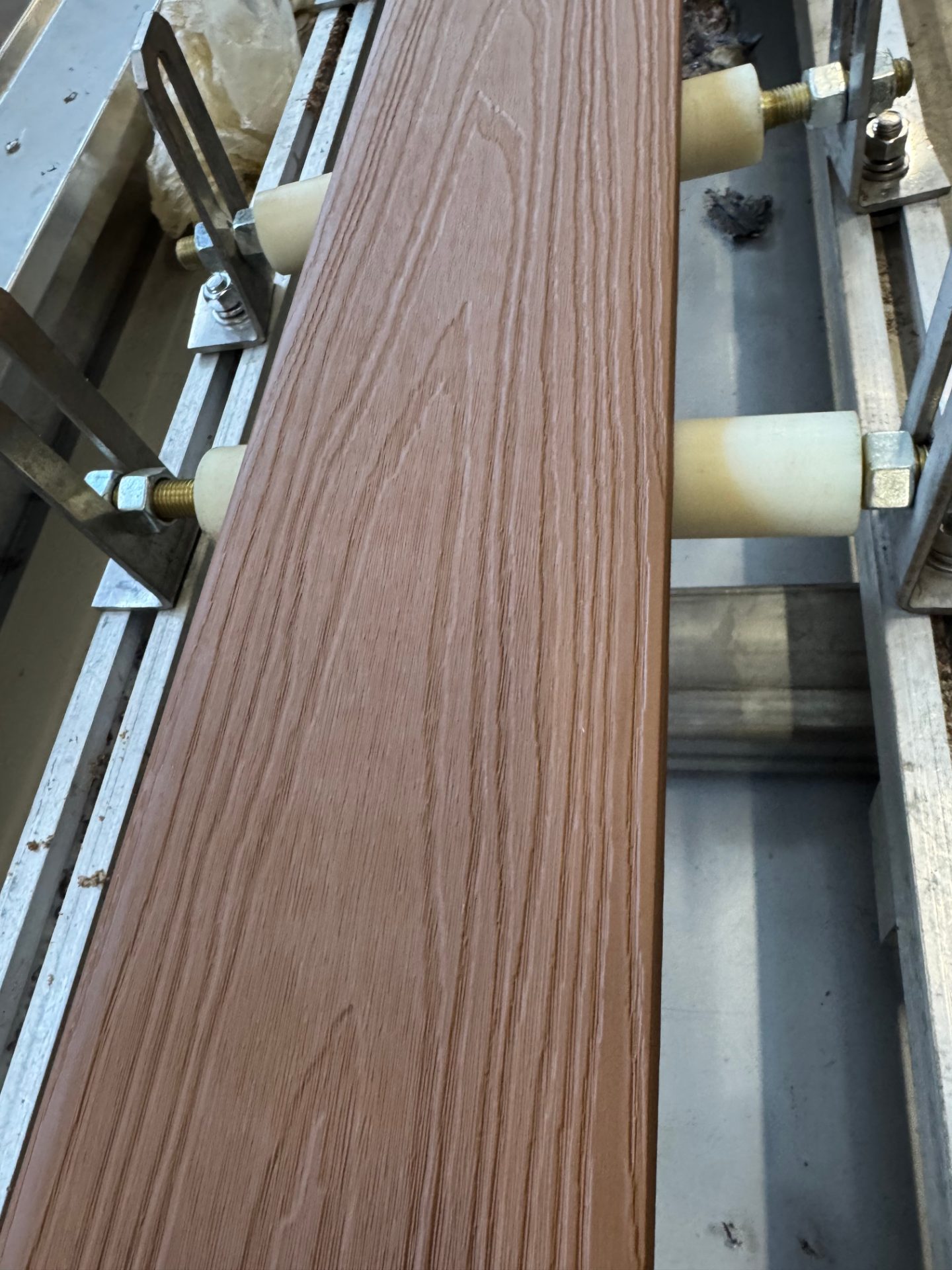
Illustrative WPC samples: Iqmanuelnavarro, Wikimedia Commons (public domain).
HDPE and Additives: What Is Inside the Board?
HDPE can be virgin or recycled. Verify polymer grade, recycled content and contamination controls: “recycled plastic” alone is not a specification.
Coupling agents strengthen fibre–polymer adhesion; UV stabilisers, pigments and lubricants also influence performance. Ask for material and regulatory documentation.

Illustrative polymer granules: ISIPLAST S.A. de C.V., Wikimedia Commons, CC BY-SA 4.0.
Five Material-Origin Questions Worth Asking
- Which countries supply the wood fibre, HDPE and principal additives?
- Is the polymer virgin, recycled or blended, and how is it specified?
- How are fibre moisture, particle size and contamination controlled?
- Can production batches be linked to incoming material records?
- Where are the boards extruded, finished and packed?
Origin is a starting point for due diligence—not a substitute for proof of quality.
Question 2: Can the Manufacturer Prove Performance and Traceability?
Understand the European Decking Requirements
EN 15534-4 addresses characteristics of WPC decking profiles and tiles for external use; related test methods are covered by EN 15534-1. Relevant performance evidence may include bending strength, stiffness, creep, water absorption, dimensional changes, weathering and slip resistance, depending on application and specified requirements.
| Evidence to request | Why it matters |
|---|---|
| Model-specific EN 15534 results | Confirms relevant physical and mechanical properties of the tested decking |
| Wet slip-resistance report | Helps assess the tested surface in wet-use conditions |
| Water absorption and swelling | Indicates moisture response under the stated test method |
| Weathering and UV results | Shows measured changes after specified artificial exposure |
| Installation and warranty documents | Clarifies joist spacing, fixing, ventilation, exclusions and coverage |
Traceability Means Being Able to Follow the Material
ISO 22095:2020 provides a framework for chain-of-custody systems. These systems can help link supplier declarations, material batches, production records and shipments. ISO explicitly warns that the standard alone cannot verify claims about origin or other product characteristics; supporting evidence is still required.
Question 3: Does the Price Reflect Lifetime Value?
Compare total project cost: decking, accessories, freight, labour, offcuts and care.
| Cost factor | What buyers should compare |
|---|---|
| Decking boards | Actual covered area after installation gaps |
| Substructure and fixings | Required joist centres, clips, screws and finishing profiles |
| Board lengths | Cutting plans, end joints and usable offcuts |
| Delivery | Freight, delivery dates and handling of long profiles |
| Ongoing care | Cleaning needs, warranty conditions and realistic service life |
Shorter European Supply Routes Can Mean Faster Delivery
Green Plank's EU-based manufacturing and regional distribution approach are intended to serve Sweden, Denmark, Germany and Norway without relying on a long intercontinental import cycle for every order. For buyers, shorter supply routes can support faster replenishment, clearer delivery planning and greater flexibility for project changes. Actual lead times depend on stock, the chosen profile and colour, production schedules and transport availability.
Ten-Centimetre Length Choices Can Reduce Offcuts
Green Plank offers selected decking ranges in 10 cm length increments: 2.0–5.0 metres for some profiles and up to 6.0 metres for others, subject to availability.
If a terrace needs 3.7-metre boards, cutting from 4.0 metres leaves 30 cm per board. A directly ordered 3.7-metre board could avoid that offcut, depending on the full layout, order quantities and freight.
- Less cutting and potential offcut waste.
- Potential savings in installation time and materials.
- More flexible layout and delivery planning.
Confirm current lengths and ordering terms in the Green Plank decking catalogue.
Does a Shorter Journey Automatically Mean Lower Carbon Emissions?
No. Regional manufacturing may reduce the distance travelled by finished boards and can offer real logistical advantages, but distance alone does not establish a product's total carbon footprint. Material production, recycled content, energy use, transport mode, service life and end-of-life treatment all contribute.
Environmental comparisons should use compatible life-cycle information following frameworks such as EN 15804. The European Commission also stresses credible, verifiable environmental claims.

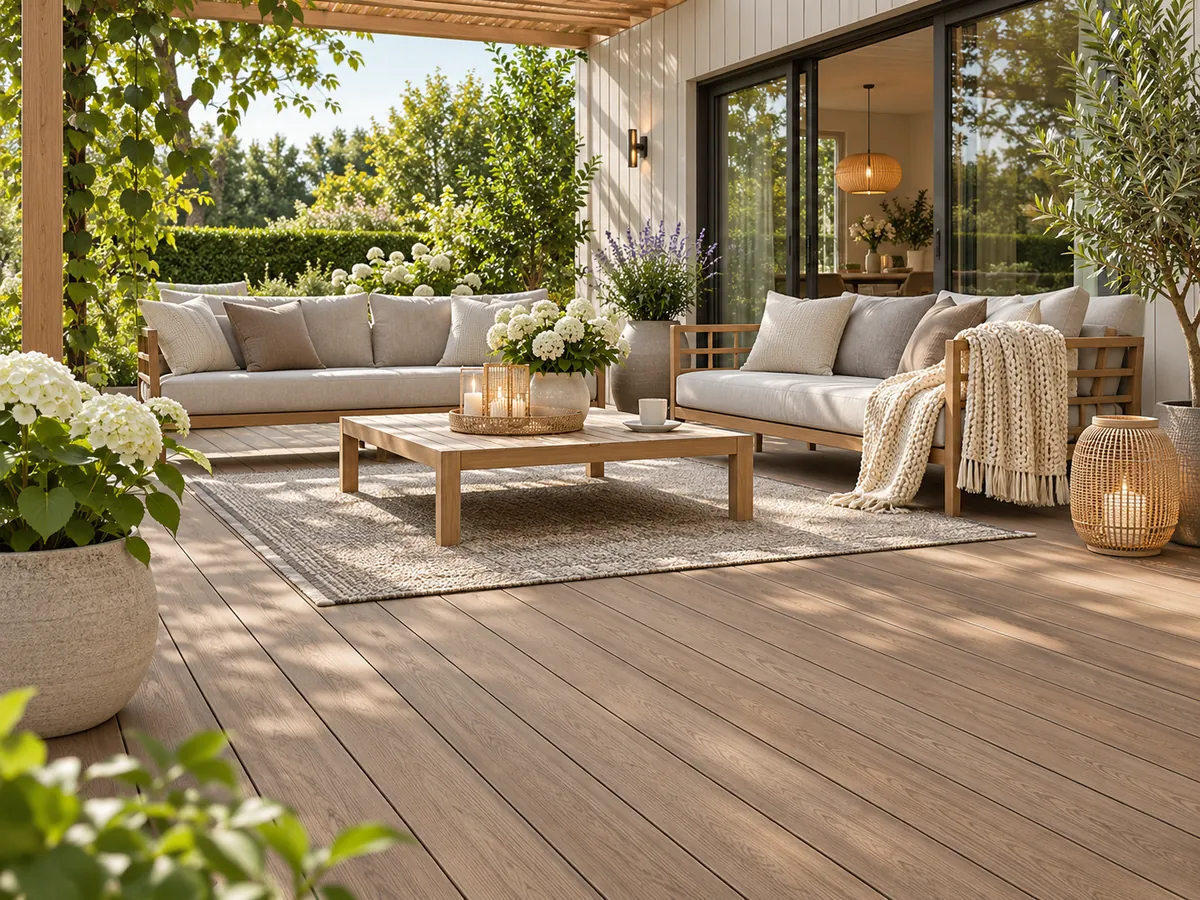
Green Plank terrace lifestyle image, illustrating a contemporary outdoor living design.
Green Plank: European Manufacturing and Documented Product Information
Green Plank is a Swedish brand manufacturing composite decking in the EU, with a focus on traceable European material sourcing and Nordic applications.
Sweden’s BASTA register lists Green Plank Classic and TerraTuff decking and Bastion cladding under Compocentra AB. Green Plank also reports assessments in Byggvarubedömningen. Check the actual product listing and assessment status.
Green Plank’s EPD is in development, not yet a published, verified environmental declaration.
A Seven-Point Checklist Before You Buy Premium WPC
- Check production and raw-material origins.
- Request a formulation summary.
- Review model-specific test reports.
- Check traceability and assessment records.
- Confirm lead times and board lengths.
- Compare complete installed project costs.
- Read warranty and environmental claims.
Don't just compare the price. Compare what's inside, where it comes from, and what the supplier can prove.
Conclusion: Pay for Evidence, Not Just Appearance
Premium decking should justify its price through credible material information, tested performance, reliable delivery and transparent costs. Ask these questions of imported and European-made products alike.
References
- Journal of Composites Science (2026): Influence of Wood Flour and Recycled HDPE on WPC Performance.
- SIS: EN 15534-4, WPC Decking Specifications.
- ISO 22095:2020, Chain of Custody.
- SIS: EN 15804, Environmental Product Declarations.
- European Commission: Green Claims.
- BASTA: Compocentra AB Product Listings.
- Byggvarubedömningen: Product Assessment Information.
- Green Plank: Composite Decking Product Information.
- Wikimedia Commons: WPC Material Samples (Public Domain).
- Wikimedia Commons: Plastic Pellets (CC BY-SA 4.0).
Specify the product
Use this guide with a Green Plank specification
Technical articles support the commercial catalogue — category, product, evidence, then samples or quotes.