


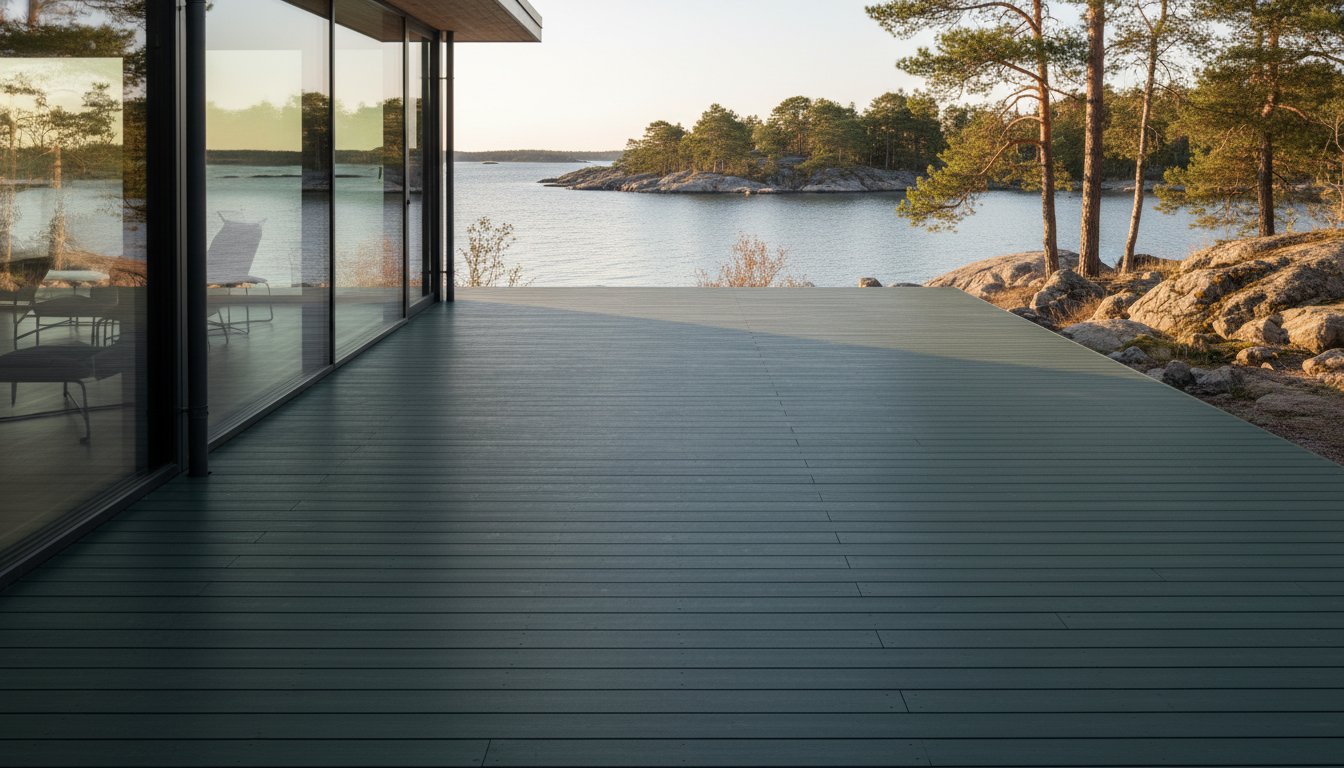
What if your outdoor space could remain pristine for half a century without a single drop of stain or a moment of sanding? You likely understand the frustration of watching traditional timber rot or seeing low-quality imports warp after only a few seasons. It's a cycle that exhausts your budget and compromises your environmental values. Choosing Green Plank means breaking that cycle with European-engineered stability. This guide explores how these high-performance materials provide a maintenance-free solution that stands the test of time while respecting the natural world.
You'll discover why this brand is the definitive choice for professionals who demand both luxury and ecological responsibility. We'll examine the engineering precision of their 100% EU-sourced raw materials and the practical benefits of their Smart System and Terra Tuff technologies. From reducing your construction's CO2 footprint to securing a 50-year service life through cradle-to-cradle ownership, we'll preview the entire ecosystem of decking, cladding, and fencing solutions designed for the modern landscape. We will show you how to achieve a premium, stable appearance that avoids the common pitfalls of fading and structural failure.
Key Takeaways
- Understand how Green Plank sets the European benchmark for composite systems by using 100% EU-sourced raw materials for uncompromising quality.
- Learn how a precision blend of 75% hardwood fiber and 25% HDPE creates superior structural integrity that resists warping and fading better than softwood alternatives.
- Discover how to eliminate the maintenance trap with high-performance surfaces that require no oiling, staining, or sanding for a lifespan of up to 50 years.
- Identify the right solution for your specific project, from heavy-duty Terra Tuff commercial profiles to the intuitive Smart System for residential decking.
- Explore the benefits of Cradle to Cradle ownership and see how utilizing reclaimed fibers reduces the total CO2 footprint of your outdoor infrastructure.
Defining the Green Plank Standard for Modern Outdoor Living
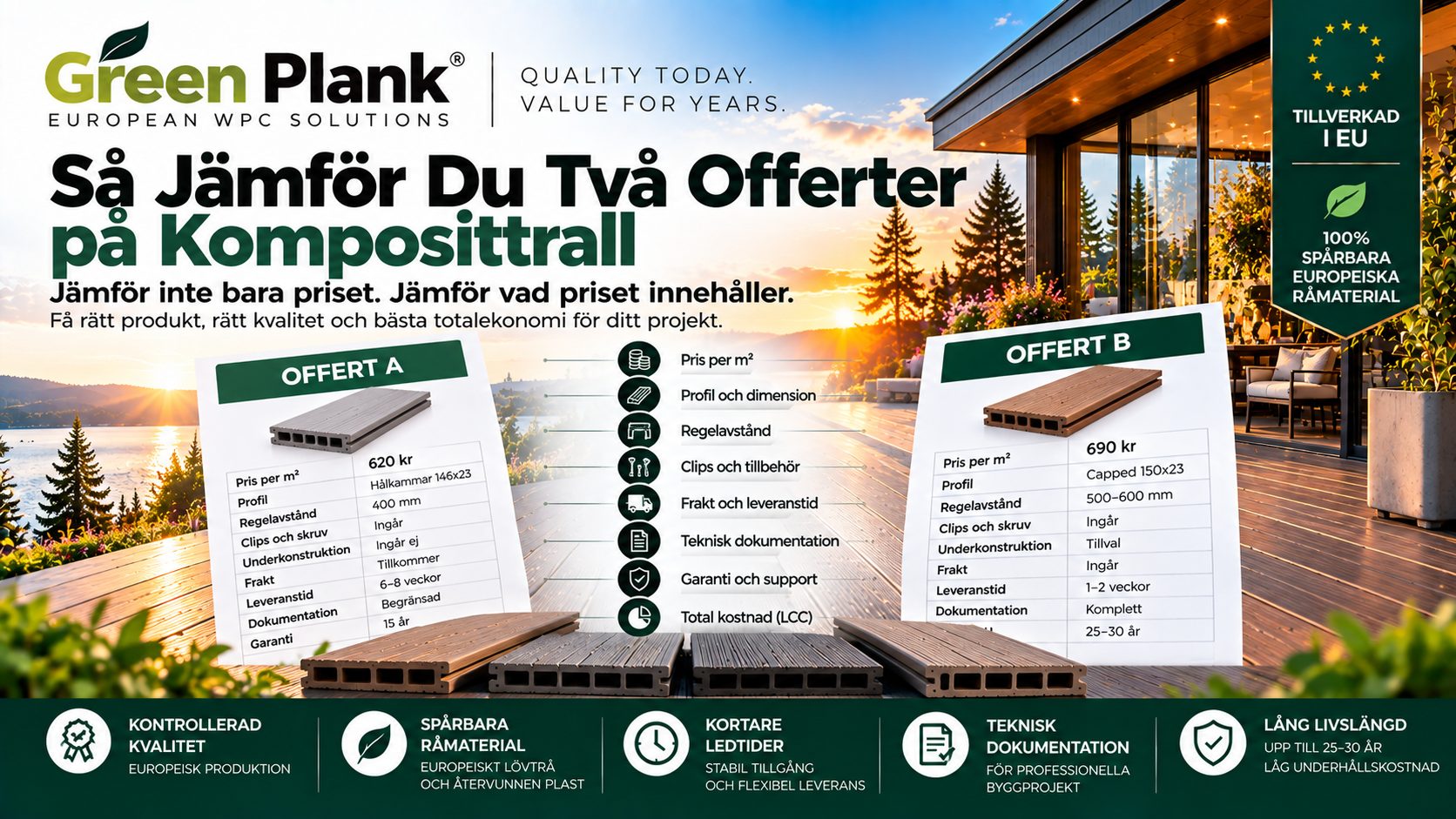
Green Plank represents a shift toward regional reliability in the construction sector. As a premier European manufacturer, the company produces Wood-plastic composites (WPCs) that set a new benchmark for material science and ethical manufacturing. While many competitors rely on fragmented global supply chains, this brand utilizes 100% EU-sourced raw materials. This local focus ensures rigorous quality control and supports a smaller carbon footprint through reduced transport distances. It's a commitment to engineering precision that prioritizes the environment as much as the end user.
The engineering team focuses on low-density, high-durability profiles. These lighter boards maintain exceptional structural integrity while decreasing the total energy required for distribution and installation. It's a practical choice for both residential luxury projects and heavy-duty commercial infrastructure. Professionals choose these systems because they offer a predictable, premium result that doesn't rely on volatile international shipping or lower-grade imports from outside the EU. Reliability is built into the supply chain from the first fiber to the final plank.
The Core Philosophy: Naturally Strong, Intelligently Made
The "Sustainable Craftsman" approach balances the aesthetic warmth of natural timber with the structural resilience of advanced polymers. Green Plank operates as a responsible innovator; it doesn't just sell boards but provides a long-term environmental solution. Every product line meets 2026 European standards for sustainable construction and safety. This ensures that eco-responsibility remains a functional feature rather than just a marketing claim. The result is a material that feels organic yet performs with the consistency of a high-tech alloy.
Beyond Decking: A Multi-Application Material System
Design cohesion is essential for modern architecture. The Green Plank ecosystem provides a uniform aesthetic across decking, wall cladding, and fencing systems. This consistency simplifies the specification process for architects and developers who need a single-source solution. Whether a project is situated in a high-salt marine environment or a dense urban center, the material remains stable and visually striking. Using one material system across different surfaces ensures a rhythmic, professional finish for any outdoor space.
- Marine-grade resistance: Proven performance for coastal boardwalks and docks.
- Urban durability: High-traffic tolerance for public parks and commercial plazas.
- Simplified specification: One reliable standard for all exterior wood-plastic needs.
- Cohesive aesthetics: Matching tones across fencing, cladding, and floor surfaces.
By providing a comprehensive system, the brand removes the complexity of matching disparate materials. It allows designers to focus on the aspirational lifestyle elements of their projects, knowing the technical foundations are secure. This level of integration is why the brand remains a leader in the European market for sustainable outdoor living.
The Science of Durability: 75% Hardwood Fiber Engineering
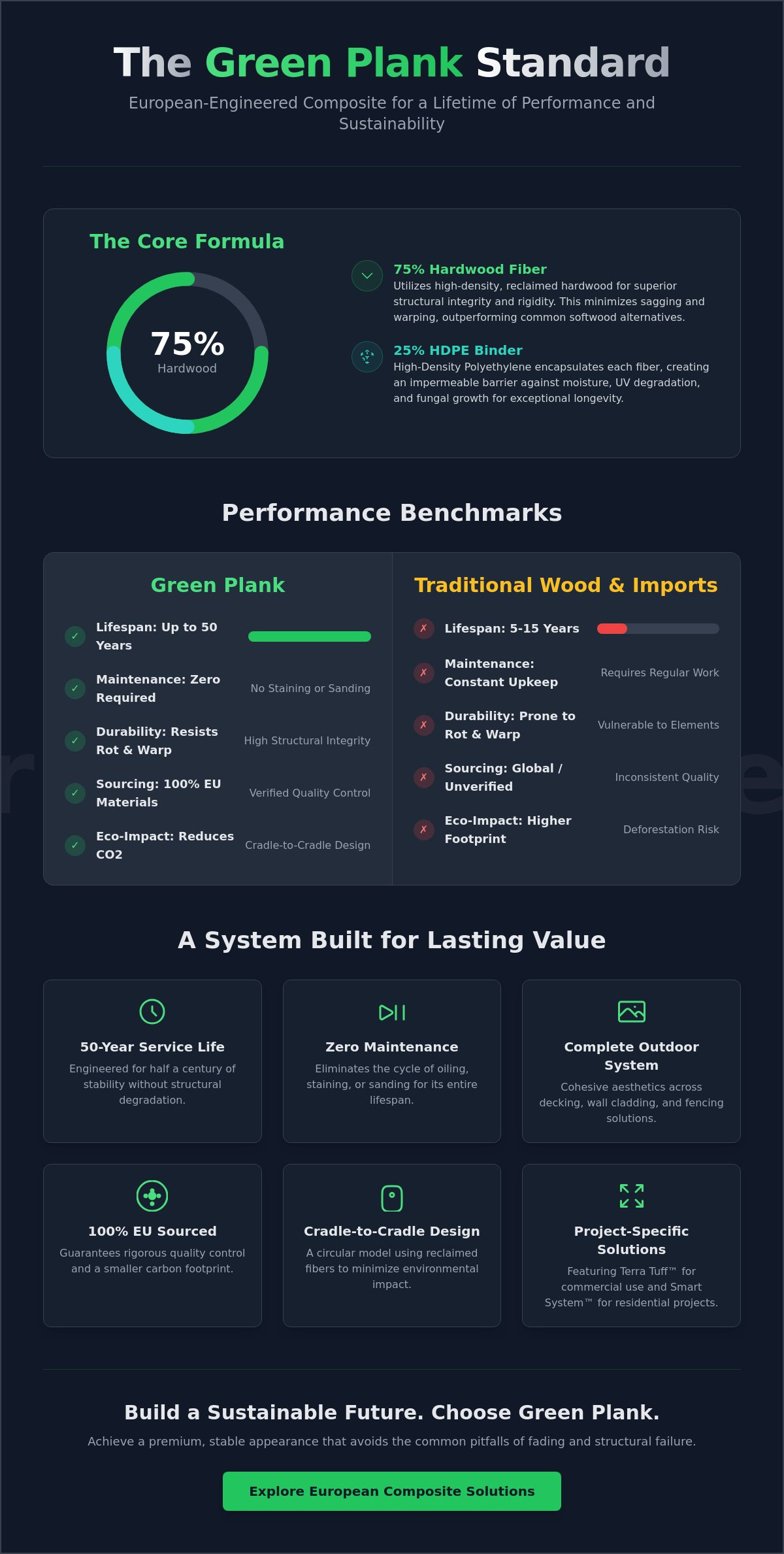
Engineering excellence begins at the molecular level. While many manufacturers provide vague descriptions of their composite makeup, Green Plank utilizes a precise ratio of 75% hardwood fiber and 25% High-Density Polyethylene (HDPE). This specific formulation is a deliberate choice for structural longevity. Hardwood fibers possess a significantly higher density and internal strength compared to the softwood fillers, such as pine or cedar dust, often found in budget alternatives. By selecting hardwood, the material achieves a level of rigidity that minimizes the risk of sagging or snapping under heavy loads.
The 25% HDPE component serves as the high-performance binder. It encapsulates each individual natural fiber to provide a formidable barrier against moisture ingress and UV degradation. To further enhance long-term performance, proprietary additives are integrated into the blend. These specialized agents are engineered to prevent fungal growth and internal rot from the inside out. This ensures the core of the board remains as stable as the surface, even in the most demanding damp environments or shaded areas prone to mildew.
High Natural-Fiber Composite (NFC) Technology
This high ratio of natural fiber distinguishes Green Plank as a leading Natural Fiber Composite (NFC). The primary advantage of this engineering is thermal stability. Because the profiles contain more fiber than plastic, they experience significantly less thermal expansion and contraction during extreme seasonal temperature shifts. This stability allows for tighter installation gaps and more predictable performance over decades. Additionally, the high fiber content provides a superior tactile experience. The surface feels authentic and substantial underfoot, intentionally avoiding the "waxy" or artificial texture often associated with high-plastic-content products.
European Raw Materials: Traceability and Quality
Professional standards are maintained through the exclusive use of 100% EU-sourced materials. Relying on European polymers and reclaimed hardwood fibers eliminates the quality lottery often associated with non-European imports. Project managers looking for a reliable build can view the full range of engineered profiles to see how this material consistency translates to the final installation. Every batch maintains a uniform color and texture. This is critical for large-scale commercial infrastructure where visual continuity across thousands of square meters is non-negotiable. This traceability ensures that the material you specify is exactly what arrives on site, meeting the highest standards of modern material science.
Performance Benchmarks: Why Green Plank Outlasts Traditional Wood
Traditional timber often forces owners into a cycle of constant repair. Pressure-treated wood and exotic hardwoods are inherently susceptible to moisture absorption, which inevitably leads to warping, splintering, and fungal decay. Green Plank engineered systems eliminate these structural vulnerabilities by combining the strength of hardwood fibers with a protective polymer matrix. This results in a material that maintains its integrity for decades without the need for chemical preservatives or invasive repairs. It is a transition from high-maintenance chores to long-term performance.
Predictable aging is a hallmark of this engineering. While natural wood turns gray and develops deep cracks within a few seasons, this composite remains aesthetically stable. It doesn't splinter. This makes it a safer choice for barefoot areas, public parks, and high-traffic commercial zones. The high-performance surface also provides superior slip resistance, ensuring that safety remains a core feature of the design. When you choose an engineered solution, you're investing in a surface that looks as good in year ten as it did on day one.
The Maintenance-Free Reality
Escaping the maintenance trap provides significant lifetime cost savings. When you factor in the annual expense of oils, stains, and labor required for traditional decks, the investment in WPC pays for itself within a few years. Termites and rot cannot penetrate the dense HDPE-encapsulated fibers. Cleaning is remarkably simple; a basic protocol of soap and water is all that's needed to maintain a pristine appearance. This allows homeowners and facility managers to spend their time enjoying the space rather than servicing it. It's an efficient solution for those who prioritize long-term value over temporary savings.
Engineering for Extreme Climates
Coastal environments present the ultimate challenge for building materials. Saltwater and high humidity accelerate the breakdown of standard timber, but Green Plank profiles remain unaffected. They are engineered for thermal stability, meaning they won't buckle during intense summer heat or crack in freezing winters. Because of this reliability, low maintenance decking is the new standard for 2026 projects.
Whether it's a private terrace or a commercial pier, the material delivers consistent performance in the most punishing conditions. These profiles are rated for 600 cc private spans, ensuring they provide a stable foundation for any design. By offering a 50-year service life warranty, the brand demonstrates a level of engineering confidence that traditional wood simply cannot match. It's a forward-thinking choice for anyone looking to build once and build for life.
From Decking to Cladding: Exploring the Product Ecosystem
Green Plank provides a comprehensive ecosystem of Wood Plastic Composite solutions that extend far beyond simple flooring. By integrating decking, cladding, and fencing into a single material language, the brand allows for a seamless transition between horizontal and vertical surfaces. This holistic approach ensures that every component of an outdoor project shares the same engineering DNA and aesthetic quality. It's a structured system designed to simplify the specification process for architects while delivering a unified, high-end result for the end user. You don't just buy a product; you invest in a cohesive architectural solution.
For high-traffic areas and public infrastructure, the Terra Tuff line offers the ultimate in heavy-duty performance. These profiles are engineered to withstand the rigors of commercial use without sacrificing the brand's signature sustainable profile. Conversely, the Smart System provides an innovative, easy-to-install solution for modern residential spaces. Both systems utilize HidLoc™ Hidden Fastening Systems. This proprietary technology removes the need for visible screws. The result is a flawless, splinter-free surface that enhances both safety and visual appeal, ensuring the focus remains on the design rather than the hardware.
Specialized Decking Profiles
The brand offers a diverse range of profiles to meet specific project requirements. The Nordeka and Entra lines provide distinct textures and finishes, while the Classic series remains a staple for traditional aesthetic goals. For those requiring a professional, finished look, Sapphire boards and Skirting options provide the necessary edge treatments to hide substructures. Each profile is rated for specific load-bearing capabilities, such as the standard 600 cc span for private residential builds. This variety allows for a customized approach that respects both the budget and the structural demands of the site.
Modern Fencing and Wall Facades
Privacy and protection are achieved through integrated composite fencing systems. These fences offer the same rot-resistance and UV stability as the decking, creating a durable boundary that never needs painting or staining. Architecture in 2026 is also seeing a significant shift toward composite wall cladding for both interior and exterior applications. Whether utilizing fluted panels for a modern indoor accent or robust cladding for an exterior facade, the material provides a sustainable alternative to traditional siding. It's a versatile system that bridges the gap between indoor comfort and outdoor resilience.
If you're ready to specify a unified material system for your next build, browse the complete product catalog to see how these profiles work together in a professional environment.
Circular Construction: The Cradle to Cradle Commitment
True sustainability isn't just about what a product is made of; it's about what happens at the end of its life. Green Plank embraces a "Cradle to Cradle" ownership model. This approach ensures that materials are viewed as technical nutrients rather than waste. By designing for 50-year circularity, the brand moves beyond the "take-make-waste" paradigm of traditional construction. It's a commitment to a circular economy where every plank is designed to be reclaimed and repurposed at the end of its exceptionally long service life.
The use of 75% reclaimed hardwood fibers is a cornerstone of this commitment. These fibers are salvaged from industrial woodworking processes, preventing them from being incinerated or sent to landfills. This practice effectively locks carbon into the decking profiles for decades. It's a tangible way to integrate sustainable building materials into 2026 circular design projects. Long-term performance is the ultimate form of environmental stewardship; a deck that doesn't need replacing for half a century is inherently more sustainable than one requiring replacement every decade.
Reducing the Carbon Footprint
Choosing local EU manufacturing is a decisive factor in lowering the "embodied carbon" of a build. Global shipping accounts for a significant portion of a material's initial environmental cost. By sourcing 100% of raw materials within Europe, the brand drastically reduces transport-related emissions. This regional reliability ensures that the environmental gains made during production aren't lost during delivery. Additionally, the integration of recycled HDPE instead of virgin plastics further preserves natural resources and reduces energy consumption during manufacturing. Green Plank enables carbon-neutral building goals by transforming reclaimed industrial waste into high-performance architectural systems with a 50-year service life.
Next Steps for Your Project
Transitioning to a sustainable outdoor space is a structured process. You can utilize the Project Estimator to define the scope of your infrastructure needs or explore the Color & Finish Studio to visualize how different profiles complement your design. Requesting physical samples allows you to experience the density and tactile quality of the 75% hardwood blend firsthand. Once you've selected your system, connecting with professional project partners ensures that supply and installation meet the brand's rigorous engineering standards. For expert guidance on creating premium outdoor environments, specialized firms like BigDecks offer the design and construction services needed to bring these high-performance materials to life. It's a straightforward path from an inspired concept to a durable, eco-conscious reality.
Building a Legacy of Sustainable Performance
Choosing a foundation for your outdoor infrastructure requires a balance of engineering precision and ecological ethics. Throughout this guide, we've explored how Green Plank utilizes a 75% hardwood fiber ratio to deliver structural stability that timber cannot match. By prioritizing 100% EU-sourced raw materials, the brand ensures regional reliability while significantly reducing the CO2 footprint of every project. This approach transforms a simple deck or facade into a 50-year maintenance-free solution.
Your commitment to circular construction is supported by a Cradle to Cradle approach that respects the natural world while providing a premium lifestyle. You don't need to settle for high-maintenance timber or low-quality imports when a superior European alternative exists. It's a standard that values longevity as much as you do. By choosing a system backed by a 50-year warranty, you're investing in a future where beauty and responsibility coexist perfectly.
Request Your Material Samples and Start Your Sustainable Project Today
Take the first step toward a beautiful, enduring space that honors the environment for decades to come.
Frequently Asked Questions
How long does Green Plank composite decking actually last?
Green Plank composite decking is engineered for a service life of up to 50 years. This longevity is achieved through a precise 75% hardwood fiber and 25% HDPE blend that resists the biological decay common in traditional timber. Because the material doesn't rot, warp, or splinter, it provides a stable foundation for decades. This extended lifecycle represents a significant reduction in total resource consumption over the life of the project.
Is Green Plank decking more expensive than traditional wood?
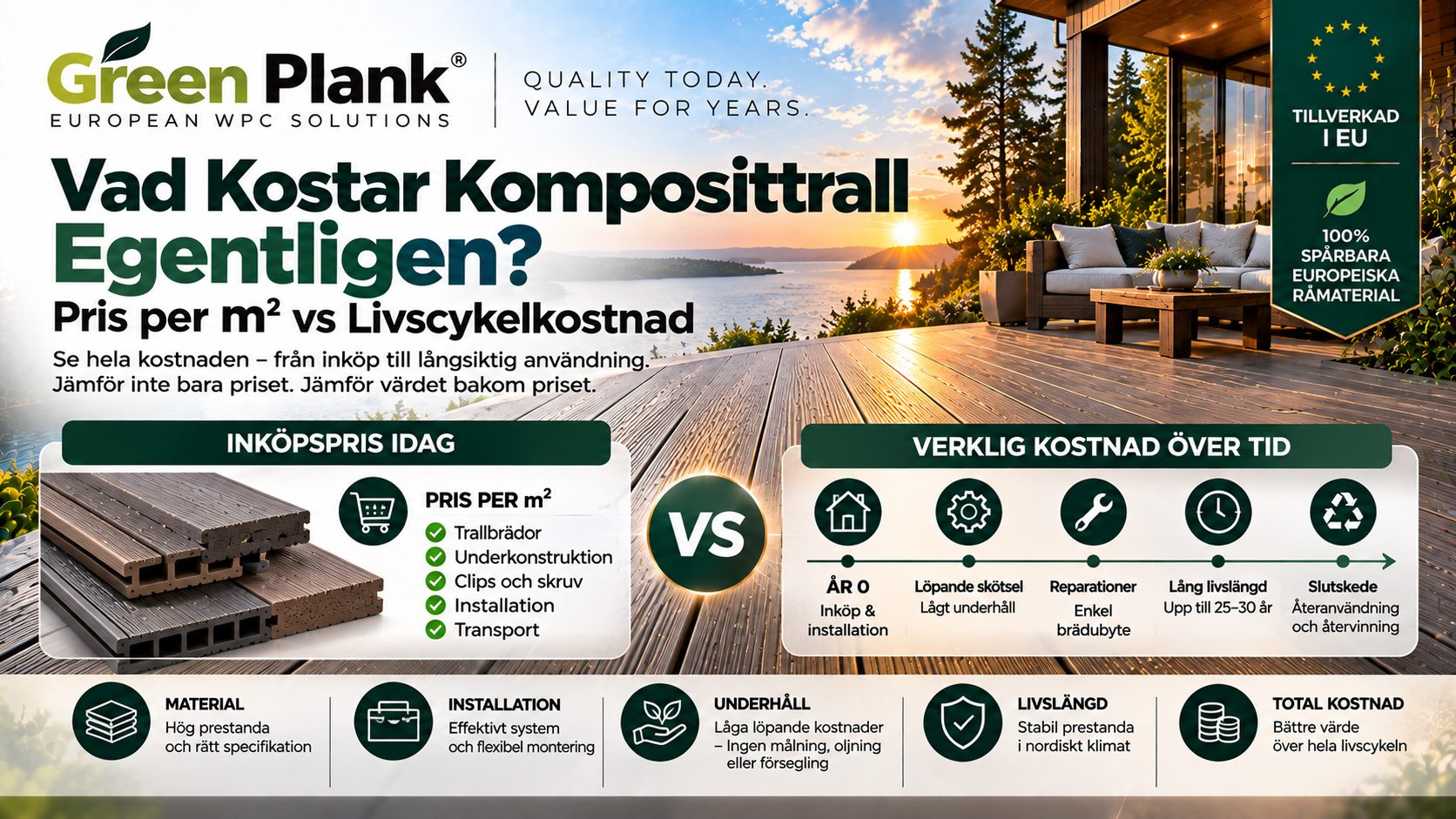
While the initial purchase price of composite systems is typically higher than pressure-treated timber, the lifetime cost is significantly lower. You eliminate the recurring expenses of oils, stains, and sanding required to maintain wood. Over a 50-year service life, these savings make the investment more economical. It's a choice that prioritizes long-term value and predictable performance over short-term savings.
Can I install Green Plank decking myself or do I need a professional?
You can install these systems yourself if you have experience with standard woodworking tools and follow the technical guidelines. The HidLoc™ Hidden Fastening Systems simplify the process by ensuring consistent spacing and a screw-free surface. However, for large-scale commercial infrastructure or complex residential designs, connecting with a professional project partner ensures the installation meets all engineering standards. This guarantees the structural integrity required for the 50-year warranty.
What is the difference between Terra Tuff and Smart System decking?
Terra Tuff is specifically engineered for commercial infrastructure and high-traffic public areas where maximum durability is required. It features a heavy-duty profile designed for rigorous use. The Smart System is an innovative decking solution tailored for modern residential spaces. It focuses on ease of installation and a refined aesthetic finish. Both systems utilize the same high-quality EU raw materials but serve different structural demands.
Is Green Plank WPC resistant to saltwater and pool chemicals?
Yes, the polymer-encapsulated hardwood fibers are highly resistant to saltwater and common pool chemicals. This makes Green Plank an ideal choice for marine environments, piers, and poolside terraces where traditional wood would quickly degrade. The material doesn't absorb moisture, which prevents the internal corrosion and salt-crystallization that often destroys organic timber. It maintains its structural stability even in the most punishing coastal conditions.
What does 'Cradle to Cradle' mean for my building project?
Cradle to Cradle ownership means your building project follows circular economy principles where materials are never treated as waste. At the end of its long service life, the composite can be reclaimed and recycled into new products. This model ensures that the 75% hardwood fibers and HDPE polymers stay within a technical loop. It allows architects and developers to meet high environmental standards while reducing the total ecological impact of the construction.
Does Green Plank offer a warranty on its composite products?
Green Plank provides a comprehensive warranty that covers a service life of up to 50 years. This guarantee reflects the engineering confidence in the material's resistance to rot, fungal decay, and structural failure. It's a primary signature of the brand's commitment to quality and professional standards. For specific residential or commercial applications, you should review the technical warranty documentation to confirm the exact coverage for your project type.
Are Green Plank materials truly sustainable and eco-friendly?
These materials are deeply committed to sustainability through the use of 100% EU-sourced raw materials and reclaimed hardwood fibers. By utilizing industrial waste products and recycled polymers, the manufacturing process significantly reduces the CO2 footprint of your project. The low-density profiles also lower transport emissions. Every board is a result of eco-conscious engineering designed to provide a high-end finish without compromising the health of the planet.
Specificera produkten
Använd den här guiden i en Green Plank-specifikation
Tekniska WPC-artiklar ska stärka de kommersiella sidorna — inte konkurrera med dem. Fortsätt till komposittrall, TerraTuff, Nordeka eller de tekniska nedladdningarna.