



Your deck's fasteners are far more than a cosmetic detail; they're the invisible backbone of a high-performance outdoor space. While it's easy to focus on the grain and color of your boards, choosing the right hidden deck fasteners is the most critical decision for preventing boards from popping or warping over time. You want a surface that remains flawless through decades of seasonal shifts without the eyesore of rusted screws or stained timber. Sustainable materials deserve engineering that matches their longevity, and the wrong clip can compromise even the highest quality composite installation.
We understand the anxiety that comes with technical specifications like 304 versus 316 stainless steel and the complexity of managing thermal expansion in wood-plastic composites. This professional guide will show you how to select a fastening system that balances aesthetic perfection with the engineering precision required for a 50-year lifespan. You'll discover how systems like HidLoc™ secure your investment, providing the structural stability and screw-free finish that turns a simple deck into a sustainable architectural statement. We'll examine material science, installation mechanics, and the essential standards that guarantee long-term performance.
Key Takeaways
- Learn how specialized hardware eliminates visible screws to create a seamless, high-end aesthetic for your outdoor living space.
- Understand the engineering behind clamping force and how it prevents board cracking by accommodating natural thermal expansion.
- Master the technical criteria for choosing the right hidden deck fasteners by selecting the correct stainless steel grade for your specific regional climate.
- Identify the essential installation steps, from joist preparation to the "First Board" rule, that prevent long-term fastener stress.
- Discover how proprietary systems like HidLoc™ are engineered to match the 50-year warranty of premium European-made composite decking.
Table of Contents
- Why Hidden Fasteners are Essential for Modern Composite Decks
- Hidden vs. Face Fastening: Performance and Stability Analysis
- Selecting Fasteners Based on Material and Environment
- The Professional's Checklist for Hidden Fastener Installation
- HidLoc™: The Precision-Engineered Choice for Green Plank Systems
Why Hidden Fasteners are Essential for Modern Composite Decks
Hidden fasteners are specialized hardware components designed to secure deck boards from the side or the bottom rather than through the top surface. This technical shift represents a significant advancement in outdoor engineering. By anchoring the board within its side grooves, these systems leave the walking surface entirely undisturbed. When you are choosing the right hidden deck fasteners, you aren't just selecting a screw; you are choosing a system that protects the structural integrity of your high-performance composite. This approach ensures the aesthetic vision of the project remains intact while the boards stay firmly in place.
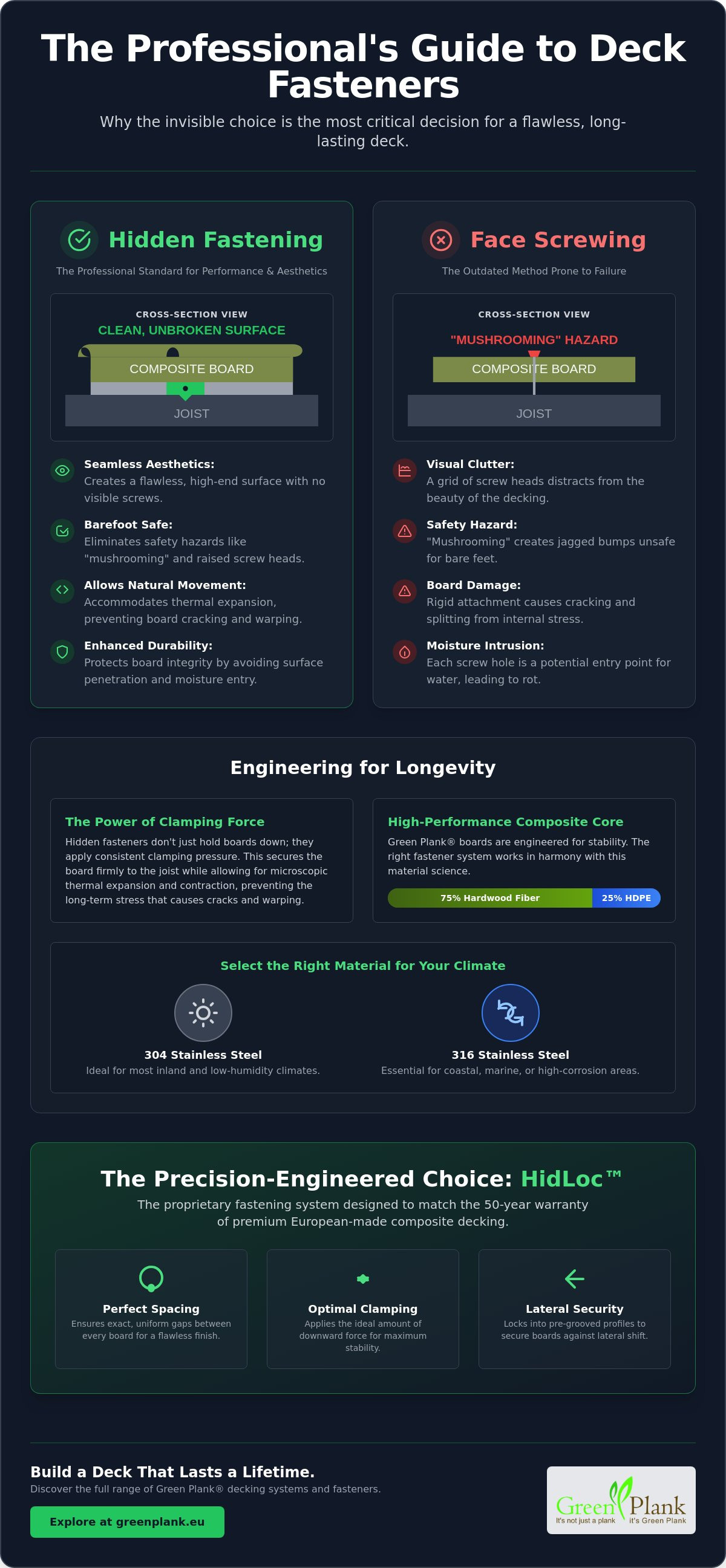
Face-screwing often leads to a phenomenon known as "mushrooming." This occurs when the screw displaces the composite material, forcing it upward to create a jagged, raised bump around the screw head. These bumps are more than an eyesore; they're a safety hazard for bare feet and pets. Hidden systems eliminate this risk entirely. They provide a smooth, barefoot-friendly surface that remains consistent across the entire deck. A clean surface is a safe surface; a safe surface is a premium surface.
Internal stress is another critical factor. Traditional face-fastening forces a rigid screw through the dense 75% hardwood and 25% HDPE matrix of a WPC board. This creates localized tension that can lead to cracking or splitting as the board expands. Pre-grooved profiles, such as those found in the Smart System or Terra Tuff collections, are designed to work in harmony with hidden clips. This lateral attachment allows the boards to move naturally, preserving the material science of the European-made composite. By utilizing the board's existing geometry, hidden fasteners maintain the integrity of the protective outer layer.
The Evolution of Deck Fastening Systems
The industry has moved far beyond the era of simple nails and galvanized face screws. Early composite installations often relied on timber-centric logic, which failed to account for the unique thermal expansion of wood-plastic blends. Modern hidden clips represent the pinnacle of European engineering precision. These systems are manufactured to exact tolerances, ensuring that every board is spaced perfectly and secured with uniform tension. This evolution ensures that the fastening system matches the 50-year service life of the boards themselves.
Aesthetics Meets Architecture
Modern architectural trends favor minimalist, clean lines that blur the boundary between interior and exterior spaces. Hidden fastening systems support this aesthetic by removing the "grid" of screw heads that can distract the eye. A clean, uninterrupted wood-grain surface creates a sense of luxury and calm. In premium commercial projects, concealed fastening is almost always the standard specification. It projects a level of craftsmanship and attention to detail that face-screwing simply cannot replicate. Choosing the right hidden deck fasteners allows the natural beauty of the material to remain the focal point of the design.
Hidden vs. Face Fastening: Performance and Stability Analysis
The debate between traditional face-screwing and modern hidden fastening often centers on a misunderstanding of structural strength. Many builders believe that driving a screw through the top of a board offers the most secure connection. While face screws provide high shear strength, they create a rigid, unforgiving attachment that ignores the fundamental physics of wood-plastic composites. When you are choosing the right hidden deck fasteners, you're prioritizing clamping force over sheer rigidity. A high-quality clip system exerts consistent downward pressure while allowing the board to breathe, ensuring the deck remains stable without compromising the material's internal structure.
Composite boards with a high density, such as those featuring a 75% hardwood fiber and 25% HDPE ratio, possess specific expansion characteristics. Rigid face-fastening forces the board to fight against the screw during temperature fluctuations. This constant tension often results in board cracking or enlarged screw holes that eventually lose their grip. Hidden clips function as a sophisticated tensioning system; they secure the board within the lateral groove, providing enough "give" for micro-movements. This engineering choice prevents the structural fatigue that typically plagues face-screwed installations after only a few seasons of heavy weather.
Longevity is also a matter of moisture management. Every face screw creates a permanent entry point for water to reach the wooden joists beneath. Over time, water pools in these small depressions, accelerating joist rot and compromising the entire subframe. Hidden fastening systems eliminate these penetrations on the walking surface. By maintaining a sealed, uninterrupted board face, you're protecting the structural skeleton of your deck from the silent threat of internal decay. For those seeking long-term reliability, exploring professional-grade WPC solutions reveals that the most durable decks are those that keep their fasteners out of sight and out of the rain.
The Thermal Expansion Factor
HDPE-based composites naturally expand and contract along their length. In regions with significant temperature swings, a 6-meter board can shift by several millimeters. Thermal expansion in WPC is a necessary design consideration for longevity, requiring a fastening system that accommodates movement rather than resisting it. Modern "sliding" clips allow this movement to occur across the joists, preventing the unsightly bowing or "snaking" effect that occurs when boards are pinned too tightly to the frame.
Structural Integrity and Wind Uplift
A common myth suggests that hidden fasteners are less secure against wind uplift than face screws. In reality, professional-grade systems utilize a "biting" force that locks into the board's side groove with remarkable tenacity. These systems are tested to meet rigorous European building safety standards, ensuring that boards remain fixed even in high-wind environments. When the clip is correctly seated, the combined clamping force across the entire deck surface creates a unified structural plane that is exceptionally difficult to dislodge.
Selecting Fasteners Based on Material and Environment
Engineering a deck for a 50-year service life requires more than just high-performance boards. It demands hardware that withstands the specific chemical stresses of its environment. Choosing the right hidden deck fasteners is a matter of material science. While standard carbon steel might suffice for temporary structures, premium WPC installations require the corrosion resistance of stainless steel. This choice ensures that the fasteners remain structurally sound as long as the boards themselves. When choosing the right hidden deck fasteners, you're investing in the longevity of the entire architectural system.
Sustainability shouldn't stop at the deck board. We prioritize 100% EU raw materials to reduce our CO2 footprint, and your choice of hardware should reflect this commitment to quality. Selecting durable, high-grade alloys reduces the need for future replacements. This aligns with the principles of Cradle to Cradle ownership. A fastener that fails prematurely is an environmental waste as much as a technical failure. High-quality hardware supports the lifecycle of the product, ensuring that your outdoor space remains a responsible investment for decades.
Stainless Steel Grades: 304 vs. 316
The primary differentiator between these grades is the addition of Molybdenum in Grade 316. This element provides superior resistance to chlorides, making it the non-negotiable standard for coastal projects, often referred to as the Saltwater Rule. If your project sits within 1,000 meters of the ocean, Grade 304 or 305 alloys may succumb to "tea staining." This surface oxidation compromises both aesthetics and strength. Investing in Grade 316 provides the necessary return on investment by preventing the accelerated corrosion found in marine or high-pollution urban environments.
Coated Fasteners and Galvanization
Ceramic-coated fasteners are sometimes used in inland residential settings as a cost-effective alternative. They serve as a temporary solution, but they carry significant risks. If the coating chips during installation, the underlying steel becomes immediately vulnerable to moisture. Standard galvanized steel is generally unsuitable for high-performance composites. The chemicals used in some manufacturing processes can react with the zinc coating, leading to premature failure. For boards with a 75% hardwood fiber and 25% HDPE matrix, stainless steel remains the only material that guarantees no adverse chemical reactions over decades of exposure.
The Professional's Checklist for Hidden Fastener Installation
Choosing the right hidden deck fasteners requires a shift in mindset from traditional carpentry to engineering precision. A flawless installation begins long before the first board is laid. You must ensure the subframe is perfectly level. An uneven joist creates uneven pressure on the clip, which can lead to premature fastener fatigue. When the joists are aligned, the hidden system can perform its intended function: providing a secure, invisible anchor that respects the material's natural properties. This attention to detail ensures the deck remains as stable as the day it was built.
One of the primary advantages of a clip system is the automatic spacing it provides. Each clip is engineered to maintain a precise gap between boards. This ensures consistent drainage and airflow, which is essential for preserving the 75% hardwood fiber core of the composite. Without this ventilation, moisture can become trapped, leading to issues that compromise the deck’s 50-year service life. Consistent spacing also creates the rhythmic, parallel lines that define a high-end outdoor space. If you are ready to start your project with professional-grade hardware, you can view our HidLoc™ Hidden Fastening Systems here.
The success of the entire surface depends on the "First Board" rule. If the starter clips are even a fraction of a millimeter out of alignment, that error will grow as you progress across the deck. Take the time to snap a chalk line and verify the squareness of the first board. This small investment in time prevents a cascade of alignment issues later. Professionals often choose between manual clipping and pneumatic installation tools. Manual installation allows for maximum control and precision, while pneumatic tools offer speed for large-scale commercial infrastructure projects.
Step-by-Step Installation Logic
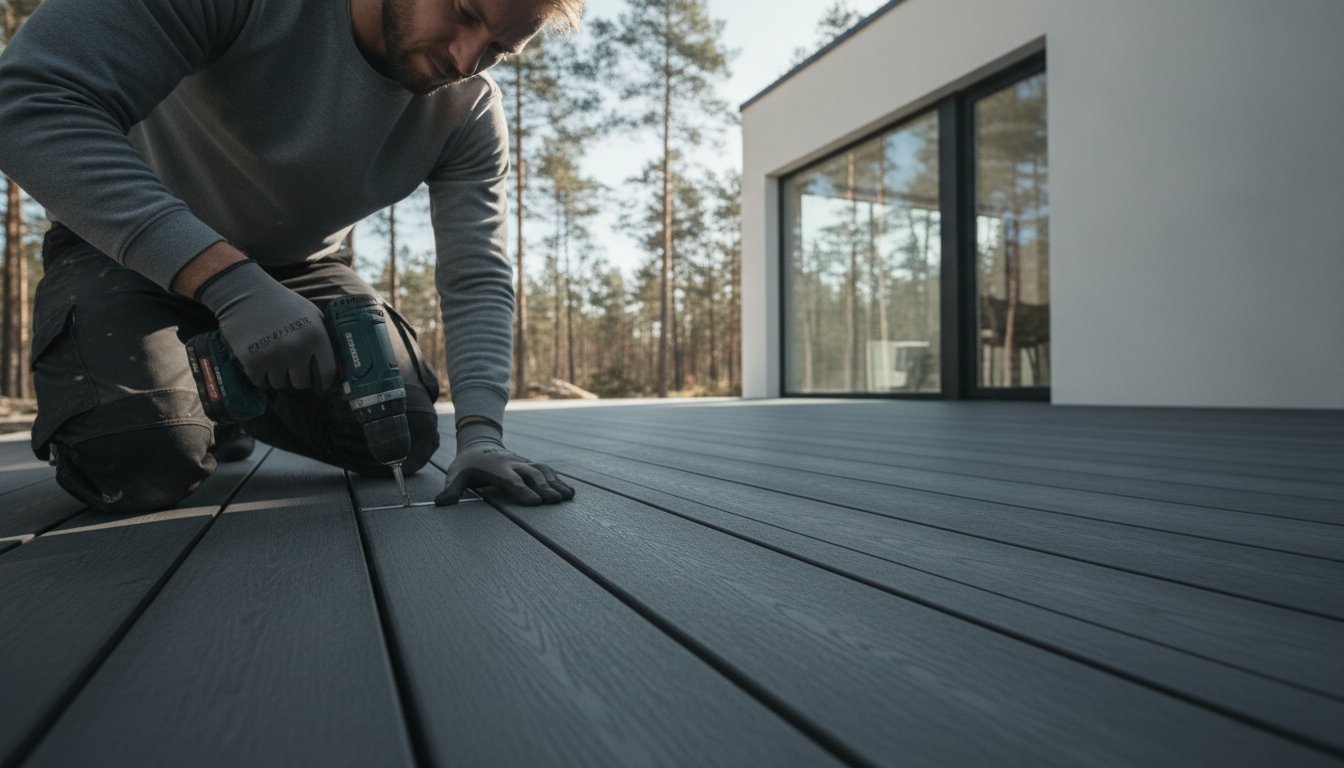
- Secure the starter clips along the outer edge of the frame to lock the first board in place.
- Slide the first grooved board into these clips until it is firmly seated against the rim joist.
- Insert the hidden clips into the opposite side groove and align them with the center of each joist.
- Fasten the clips into the joist using high-grade stainless steel screws.
Set your drill's clutch to a medium torque level to ensure the screw is flush with the clip without stripping the joist or over-driving the head.
Common Mistakes to Avoid
- Over-tightening clips: This restricts the board's ability to slide during thermal expansion, leading to stress fractures.
- Mixing fastener brands: Fasteners are often profile-specific; using an incompatible clip can lead to loose boards or damaged grooves.
- Neglecting butt joints: End-to-end joints require double joisting and specific spacing to allow for the longitudinal expansion of the WPC material.
HidLoc™: The Precision-Engineered Choice for Green Plank Systems
A deck is only as reliable as its weakest connection. HidLoc™ Hidden Fastening Systems are engineered to ensure that no such weakness exists within a Green Plank installation. Specifically designed to integrate with our Terra Tuff and Smart System profiles, these fasteners account for the specific material density of our 75% hardwood and 25% HDPE blend. This precise material ratio requires a fastening system that provides high clamping force while allowing for the subtle longitudinal shifts inherent in high-performance composites. By matching the fastener to the board's specific chemistry, we ensure maximum stability across every square meter.
Regional reliability is a hallmark of our manufacturing process. Our European-made boards and fasteners are developed in tandem to create a synergistic relationship. When you are choosing the right hidden deck fasteners, selecting a system designed by the same engineers who developed the decking eliminates the risks associated with third-party hardware. This unified approach is a fundamental requirement for securing our 50-year service life warranty. It ensures that the structural integrity of the deck matches the environmental credentials of the materials, supporting a truly sustainable outdoor living space.
Engineered for Green Plank Profiles
Generic clips often fail because they are designed for a "one size fits all" market, ignoring the unique groove dimensions of specialized WPC. HidLoc™ follows a perfect-fit philosophy. Each clip seats deeply and securely into the board's lateral channel, providing a lock that generic alternatives cannot replicate. This precision doesn't just improve safety; it reduces installation time by up to 30% for professional contractors. Efficiency and excellence go hand in hand when you utilize Smart System WPC composite decking alongside its dedicated fastening hardware.
Long-Term Performance Guarantees
Our commitment to sustainability is reflected in our Cradle to Cradle ownership model. We design products that last, reducing waste and environmental impact over decades. Choosing the right hidden deck fasteners is the final, essential step in a professional deck installation guide. Using HidLoc™ ensures that your project remains a maintenance-free asset that respects nature while providing premium performance. For detailed technical specifications and load-bearing data, contact Green Plank to request a technical specification sheet for our HidLoc™ systems.
Securing the Future of Your Sustainable Outdoor Space
Choosing the right hidden deck fasteners is the final, most critical step in bridging the gap between high-end design and structural longevity. You've seen how selecting the correct stainless steel grade prevents corrosion and how specialized clips manage the natural expansion of 75% hardwood fiber composites. By prioritizing engineering precision over traditional face-screwing, you're protecting both your aesthetic vision and your long-term investment. It's about more than just a screw-free surface; it's about the technical integrity of the entire system.
Our HidLoc™ systems aren't just compliant with EU building standards; they're built to exceed them. We provide the stability required for a 50-year service life warranty, ensuring your deck remains a maintenance-free sanctuary for decades. This level of performance is only possible when the hardware is as sophisticated as the boards themselves. Explore the HidLoc™ Fastening System for Your Next Project to see how regional reliability meets innovative design. Your commitment to quality and sustainability starts beneath the surface. Build with the confidence that only precision manufacturing can provide.
Frequently Asked Questions
Are hidden deck fasteners as strong as face screws?
Hidden fasteners provide a different type of structural security called clamping force. While face screws offer high shear strength, they create rigid points of tension that can lead to board cracking. Professional-grade clips secure the board within its lateral groove, distributing pressure evenly across the joist. This engineering approach ensures a stable surface that respects the material's natural properties while maintaining a higher aesthetic standard than traditional screws.
Can I use any brand of hidden fastener with Green Plank decking?
We do not recommend using third-party hardware with our profiles. Green Plank collections like Terra Tuff and Smart System feature specific groove geometries that require an exact fit for maximum stability. Using HidLoc™ fasteners ensures total compatibility with the board's 75% hardwood fiber matrix. Choosing the right hidden deck fasteners from the original manufacturer is also a technical requirement for maintaining our 50-year service life warranty.
Do hidden fasteners work with solid (non-grooved) deck boards?
Standard hidden clips require a grooved profile to function. If you're using solid boards for stairs or perimeter picture-framing, you'll typically need to use color-matched face screws or specialized plug systems. Most of our high-performance decking is available in pre-grooved formats specifically to accommodate the HidLoc™ system. This ensures a consistent, screw-free aesthetic across the primary walking surface of your outdoor space.
What is the best hidden fastener for coastal environments?
Grade 316 stainless steel is the non-negotiable standard for any project near saltwater. This marine-grade alloy contains Molybdenum, which provides essential resistance to chloride-induced corrosion. Choosing the right hidden deck fasteners in coastal regions prevents "tea staining" and structural degradation. For inland projects, Grade 304 or 305 stainless steel offers excellent longevity, but coastal climates demand the highest level of material science to ensure a 50-year lifespan.
How much extra do hidden deck fasteners cost compared to screws?
Hidden fastening systems represent a higher initial investment than bulk carbon-steel screws. This cost reflects the use of premium stainless steel and the precision engineering required for a concealed finish. However, the long-term value is significantly higher. By eliminating surface penetrations that lead to joist rot and board "mushrooming," you reduce future maintenance and replacement expenses. The investment supports the premium market position of your property.
Do hidden fasteners prevent the deck boards from expanding and contracting?
High-quality clips are designed to manage thermal movement rather than stop it. Because wood-plastic composites contain HDPE, they naturally expand and contract along their length as temperatures shift. HidLoc™ fasteners allow the boards to slide slightly across the joists. This lateral movement prevents the bowing and snaking that often occurs when boards are rigidly pinned to the frame with face screws, preserving the deck's structural alignment.
Is it harder to replace a single board with a hidden fastening system?
Replacing a mid-deck board requires a specific technical approach but is manageable for a professional. You can remove a damaged board by backing out the screws from the clips on either side and sliding the board out. A new board is then secured using a combination of modified clips or specialized adhesive methods. While it takes more precision than backing out a face screw, the process preserves the flawless, screw-free look of the surrounding surface.
What tools do I need to install HidLoc™ hidden fasteners?
Most installations only require a standard power drill and the specific driver bits provided with the fastener kit. For professional contractors working on large-scale commercial infrastructure, pneumatic installation tools can significantly increase efficiency. Choosing the right hidden deck fasteners involves selecting a system that integrates seamlessly with your existing professional toolkit. We provide detailed technical guides to ensure your installation team achieves a perfect result with standard carpentry equipment.
Specificera produkten
Använd den här guiden i en Green Plank-specifikation
Tekniska WPC-artiklar ska stärka de kommersiella sidorna — inte konkurrera med dem. Fortsätt till komposittrall, TerraTuff, Nordeka eller de tekniska nedladdningarna.