



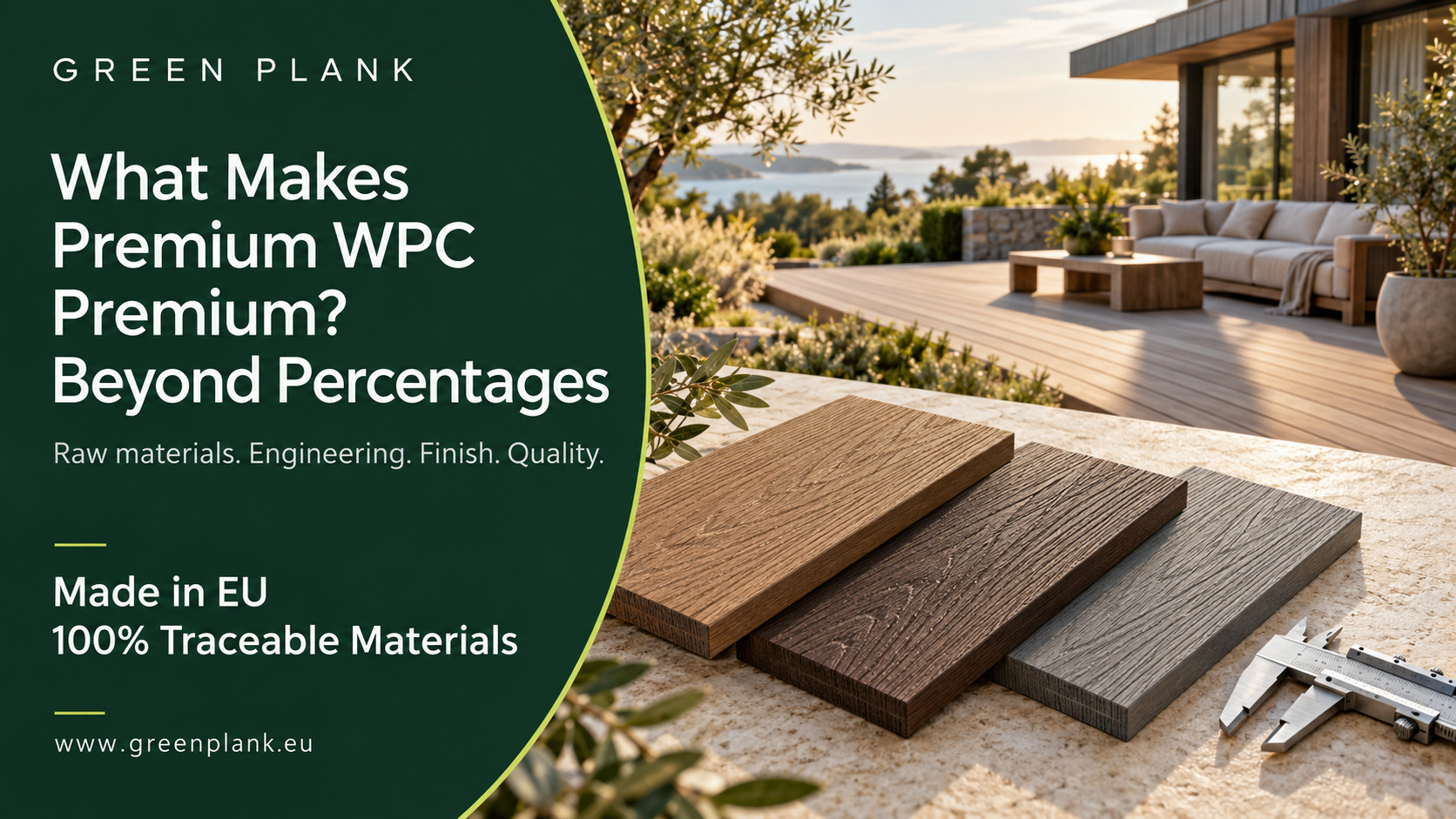
What Makes Premium WPC Premium? Beyond Wood and Plastic Percentages Composite decking is often marketed through simple percentages: 60% wood, 70% wood, recycled polymer or virgin HDPE. These figures provide useful information about composition, but they do not determine whether a Wood Plastic Composite (WPC) is genuinely premium. Two products can contain similar percentages of wood and polymer yet perform very differently. Premium WPC is better understood as a complete engineered system in which raw-material quality, fibre preparation, polymer selection, coupling technology, additives, extrusion control, profile design and quality assurance work together. Premium WPC is not defined by one percentage. It is defined by how effectively the complete material system delivers consistent, measurable and application-appropriate performance. 1. Wood Fibre Quality Comes Before Wood Percentage Natural fibre is one of the defining components of WPC, but not all wood fibre behaves identically. Species, particle geometry, moisture content, cleanliness and consistency can influence processing and finished-product properties. Published research shows that wood particle size and aspect ratio can affect mechanical behaviour in wood-plastic composites. A high wood percentage is therefore most meaningful when the manufacturer also controls fibre preparation and consistency. Factor Why It Matters Wood fibre Influences stiffness, moisture behaviour and material character Polymer Forms the matrix and contributes toughness and moisture resistance Coupling agent Improves interaction between wood and polymer Stabilisers Help protect the material from heat, oxidation and UV exposure Processing Controls dispersion, dimensions, surface quality and consistency 2. Polymer Quality and Consistency Matter In HDPE-based WPC, the polymer creates the continuous matrix surrounding the wood particles. Its melt-flow characteristics, density, purity and processing history can influence manufacturing behaviour and finished properties. Prime HDPE offers predictable resin characteristics, while properly sorted and controlled recycled HDPE can also be successfully used in WPC. Research comparing recycled- and virgin-HDPE wood composites has demonstrated comparable mechanical properties in particular formulations. The key issue is therefore not simply virgin versus recycled, but polymer quality, consistency and control. 3. Fibre-Polymer Bonding Is a Hidden Performance Factor Wood is naturally hydrophilic, while polyethylene is hydrophobic. This difference makes the interface between the two materials critical. Without adequate compatibility, stress transfer can be weaker and moisture pathways may develop around poorly bonded fibres. Coupling agents such as maleic-anhydride-grafted polyethylene (MAPE) are widely used in polyethylene-based WPC to improve fibre-matrix interaction. Scientific studies have shown that suitable compatibilisation can improve adhesion and mechanical performance. The Premium WPC Equation Controlled fibres + suitable polymer + effective coupling + balanced additives + precision extrusion + intelligent profile design + verified testing + traceability = premium WPC. 4. Small Additives Can Make a Major Difference The additive package may represent a relatively small proportion of a WPC formulation, but it performs important functions. UV stabilisers help manage exposure to sunlight, antioxidants protect the polymer system during processing and service, lubricants support controlled extrusion, and pigments contribute both appearance and outdoor colour performance. More additive is not automatically better. Premium formulation requires the correct chemistry at appropriate levels, balanced for the polymer, fibre system, equipment and intended application. 5. Precision Manufacturing Is Part of Product Quality An excellent formulation can still produce an inconsistent board if manufacturing is poorly controlled. WPC extrusion requires careful management of fibre moisture, feeding, mixing, temperature, pressure, screw speed, die conditions, calibration and cooling. Consistent raw-material preparation Uniform fibre and additive dispersion Controlled extrusion temperatures and pressure Stable profile dimensions Effective calibration and cooling Documented batch-to-batch quality control This is why manufacturing expertise should be considered part of the value of a premium composite product. 6. Smart Profile Engineering Matters Premium performance is not determined by formulation alone. Wall thickness, hollow-chamber geometry, overall board dimensions, surface structure, fastening system and recommended support spacing all influence how a decking profile performs in service. A professionally engineered profile aims to place material where it contributes most effectively to strength, stiffness and dimensional stability. Simply making a board heavier does not automatically make it technically superior. 7. Test the Finished Board, Not Just the Recipe For architects, distributors and professional buyers, laboratory and technical data provide a more meaningful basis for comparison than composition percentages alone. Performance Area Useful Information to Request Mechanical performance Flexural strength and modulus Moisture behaviour Water absorption and dimensional change Thermal behaviour Expansion and contraction information Surface performance Slip resistance where relevant Outdoor durability UV, weathering and ageing data where available Quality assurance Production and batch-control documentation 8. Traceability Is Part of Modern Premium Quality Premium building materials increasingly need to combine performance with transparency. Professional buyers may need to understand the origin of natural fibres, polymer type, supplier controls and production batches. Traceability supports quality assurance and more informed procurement decisions. This is particularly important for architects, developers, municipalities and distributors seeking greater visibility into the materials incorporated into their projects. 9. Sustainability Goes Beyond Recycled Content A high percentage of wood or recycled polymer does not by itself establish the environmental performance of a product. A broader assessment should consider raw-material sourcing, manufacturing, transport, durability, maintenance requirements, service life and end-of-life options. Long-lasting products that require limited maintenance can support resource efficiency, but environmental comparisons should be supported by appropriate lifecycle information rather than broad assumptions based solely on composition. What Professional Buyers Should Ask What type and source of wood fibre is used? How are fibre moisture and particle consistency controlled? What polymer system is used and how consistent is it? What coupling technology supports fibre-polymer adhesion? Which stabilisation systems protect outdoor performance? What finished-product test data are available? How is manufacturing quality controlled? Can raw materials and production batches be traced? Answers to these questions reveal considerably more about WPC quality than a wood-to-plastic percentage printed on a brochure. Green Plank: Premium Means Engineering the Complete System At Green Plank, the philosophy behind premium composite solutions goes beyond ingredient percentages. The focus is on combining carefully selected raw materials, controlled formulation, fibre-polymer compatibility, functional additives, profile engineering and manufacturing discipline to create products for demanding outdoor applications. This approach is relevant across residential decking, commercial developments, hospitality, landscape architecture and public environments where consistency, technical performance and long-term value matter. Discover Green Plank European composite solutions at www.greenplank.eu. Conclusion: Premium Is Performance, Not a Percentage What makes premium WPC premium? It is not simply 60%, 70% or 75% wood fibre, nor is it defined solely by virgin or recycled polymer. Premium quality comes from the interaction of carefully controlled materials, intelligent chemistry, precision manufacturing, profile engineering, technical testing and traceability. For professional buyers, the most valuable question is therefore not simply what percentage of wood and plastic is inside the board? It is how well has the complete composite system been engineered, controlled and verified for its intended application? Sources Polymers – Review of Components and Properties of Wood-Plastic Composites Materials – Effects of Wood Flour Characteristics on WPC Performance Polymers – Interface Structure and Coupling in Wood-Plastic Composites Composites Part A – Recycled and Virgin HDPE Wood-Plastic Composites
Spesifiser produktet
Bruk denne guiden i en Green Plank-spesifikasjon
Tekniske WPC-artikler skal støtte de kommersielle sidene — ikke konkurrere med dem. Fortsett til komposittdekke, TerraTuff, Nordeka eller de tekniske nedlastningene.