



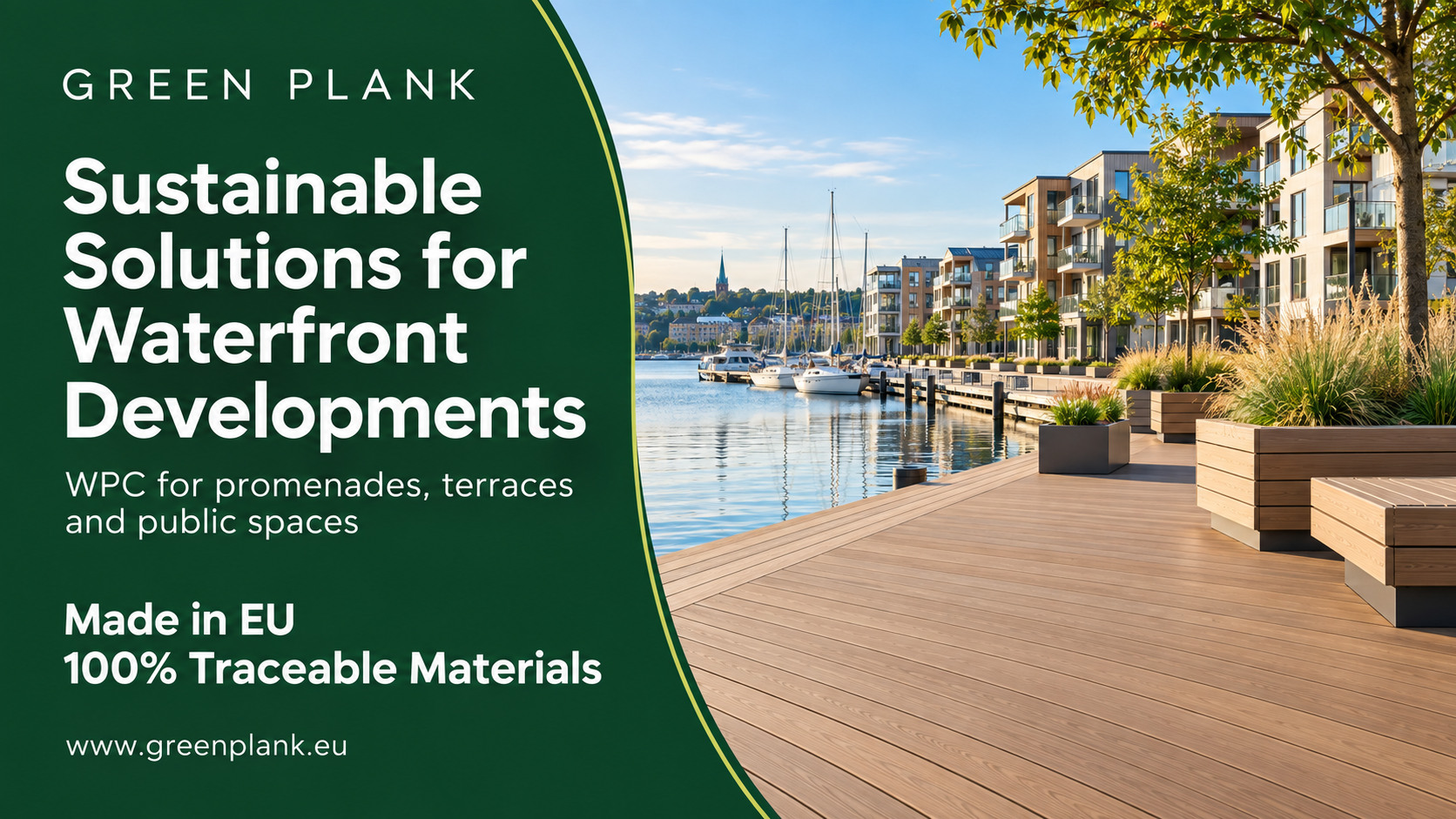
Sustainable Solutions for Waterfront DevelopmentsWaterfront developments create some of the most demanding conditions for outdoor construction materials. Marinas, promenades, boardwalks, canal edges, resorts, restaurants and public waterfront spaces must combine architectural quality with continuous exposure to moisture, sunlight, temperature changes and intensive pedestrian use.For architects, municipalities and developers, sustainable waterfront design therefore requires more than selecting an attractive surface. Materials should be evaluated according to durability, moisture behaviour, maintenance, safety, resource efficiency, lifecycle performance and technical suitability. Properly engineered Wood Plastic Composite, or WPC, can provide an attractive solution when the product and installation system are matched to the environment. Waterfront sustainability begins with durability A material cannot deliver meaningful long-term value if it requires premature replacement. Waterfront projects should therefore consider technical service performance together with raw materials, maintenance, transportation and end-of-life planning. Why Waterfront Environments Are DifferentDecking installed close to water can experience repeated wet-and-dry cycles, high humidity, strong sunlight and seasonal temperature variation. Public boardwalks and promenades may also carry substantial pedestrian traffic. Research by the U.S. Forest Products Laboratory shows that moisture, UV exposure and biological deterioration are relevant considerations in the long-term outdoor durability of wood-plastic composites. Professional specifications should therefore address: moisture and water exposure, UV and weathering resistance, wet-surface slip performance, thermal expansion and contraction, mechanical strength and stiffness, drainage and ventilation, maintenance accessibility, expected traffic and loading conditions. Why WPC Can Be Attractive for Waterfront ProjectsWPC combines natural fibres with a thermoplastic matrix and functional additives. Unlike conventional timber systems that may require recurring surface treatments depending on species and appearance requirements, quality composite decking is generally designed for routine cleaning without regular painting, staining or oiling.The performance of WPC, however, depends strongly on formulation and manufacturing quality. Long-term field research confirms that wood-plastic composites remain exposed to moisture, UV radiation and biological influences outdoors, making product-specific durability data important. Waterfront Requirement Why It Matters What to Evaluate Moisture resistance Frequent wetting can challenge exterior materials Water absorption and dimensional stability Slip performance Walking surfaces may frequently be wet Relevant wet-condition test data UV stability Open waterfronts can receive strong solar exposure Weathering and colour-performance information Mechanical performance Public areas may experience heavy pedestrian traffic Flexural properties and support spacing Maintenance Access and closures can be expensive Cleaning and inspection requirements Lifecycle value Replacement disrupts public infrastructure Installed cost and service strategy Moisture Management Must Be EngineeredWood fibres naturally interact with moisture, while common thermoplastic matrices have much lower affinity for water. In WPC, long-term moisture performance therefore depends on fibre encapsulation, porosity, fibre-polymer bonding, profile design and production quality.Research into WPC durability has identified control of moisture absorption as an important factor for improving durability. Studies of capped and co-extruded composites have also examined protective polymer layers as one strategy for reducing moisture ingress. Waterfront performance is not created simply by adding more plastic. It requires the correct balance of fibre quality, polymer, coupling technology, additives, profile engineering and controlled manufacturing. Slip Resistance Is a Design PriorityWaterfront walking surfaces may be exposed to rain, spray, condensation, algae, leaves or winter contamination. Slip performance should therefore be considered from the earliest design stages, particularly for boardwalks, marinas, ramps and high-traffic pedestrian routes.A deep wood-grain texture or brushed finish may influence surface grip, but appearance alone cannot establish safety. Architects should request the relevant test method and measured values for the specific product and surface condition.Drainage, adequate fall, regular cleaning and prevention of standing water are equally important parts of a safe waterfront installation.Design the Entire Decking SystemThe board itself is only one component of a durable waterfront deck. The substructure, supports, clips, fasteners, drainage and expansion detailing must all work together. Specify support spacing according to the selected profile and expected loading. Provide sufficient support at board ends and joints. Allow for thermal movement at fixed boundaries. Maintain effective airflow beneath the decking. Design positive drainage and avoid persistent standing water. Use fastening components suitable for the environment. Follow product-specific installation instructions. Co-Extruded WPC for Demanding Waterfront ApplicationsFor projects where enhanced surface protection is required, co-extruded WPC can provide another engineering option. A structural WPC core is combined with a protective outer layer designed to improve particular surface properties.Forest Products Laboratory research has investigated polymer caps as a means of improving WPC moisture resistance, while also showing that cap formulation and long-term durability must themselves be engineered carefully. This makes co-extrusion potentially attractive for premium waterfront promenades, hospitality terraces and other exposed locations, but the word capped should never replace technical evaluation of the finished product.Lifecycle Cost Matters More Than Purchase PriceWaterfront infrastructure can be expensive to access, close and repair. For this reason, material evaluation should extend beyond price per linear metre or square metre. Lifecycle Stage Considerations Procurement Decking, substructure, fixings and logistics Installation Labour, site access and preparation Operation Cleaning and inspection Maintenance Repairs and surface treatment where required Disruption Closure of promenades, restaurants or visitor areas End-of-life Removal, transportation, reuse, recycling or disposal ISO 14040 provides the internationally recognised principles and framework for Life Cycle Assessment, including goal and scope definition, lifecycle inventory, impact assessment and interpretation. Sustainability Requires a Lifecycle PerspectiveRecycled content is valuable, but it should not be the only sustainability metric. A complete assessment can also consider raw-material origin, manufacturing energy, transport, material efficiency, maintenance, durability and end-of-life options.The European Commission's Level(s) framework provides a common language for assessing the sustainability performance of buildings and encourages lifecycle-oriented thinking. Questions Waterfront Developers Should Ask What raw materials and polymer system are used? How has moisture performance been evaluated? What wet slip-resistance information is available? What support spacing is approved for the intended use? How should thermal expansion be accommodated? What UV and weathering data are available? What maintenance regime is required? Can production batches and key raw materials be traced? What warranty conditions apply to the specific environment? What environmental or lifecycle documentation is available? Material Documentation for Professional ProjectsProfessional waterfront projects require reliable technical information. The EU Construction Products Regulation provides harmonised rules for construction products and a common technical language for communicating performance where the regulatory framework applies. Architects and procurement teams should determine which standards, technical specifications and national requirements apply to the particular product and project rather than assuming that one generic certificate demonstrates suitability for every waterfront application.Where Sustainable WPC Solutions Can Be Used marinas and yacht harbours, public waterfront promenades, canal-side developments, pedestrian boardwalks, hotel and restaurant terraces, waterfront residential developments, parks and recreation facilities, tourism infrastructure, urban regeneration projects near water. Green Plank – Composite Solutions for Waterfront ProjectsGreen Plank develops composite solutions for professional outdoor applications where material engineering, design, moisture exposure and long-term performance must be considered together. For waterfront developments, the objective is to support architects, municipalities, contractors and developers with WPC systems that can be assessed according to the actual demands of the project.Product selection should always be based on the technical documentation, installation requirements and intended application of the specific Green Plank profile.Explore Green Plank composite solutions at https://www.greenplank.eu/">www.greenplank.eu.Conclusion: Build Waterfronts for Long-Term ValueSustainable waterfront development requires more than choosing a material with an environmentally attractive label. The strongest solutions combine durability, moisture management, pedestrian safety, efficient installation, lower maintenance requirements and responsible lifecycle thinking.For architects and developers, WPC can provide a compelling option when the complete system is engineered and documented for the intended environment. The goal should be waterfront spaces that remain attractive, accessible and functional while keeping maintenance and resource requirements under control throughout their useful life.Sources https://www.iso.org/standard/37456.html">ISO 14040 – Life Cycle Assessment Principles and Framework https://environment.ec.europa.eu/topics/circular-economy/levels_en">European Commission – Level(s) Sustainable Buildings Framework https://single-market-economy.ec.europa.eu/sectors/construction/construction-products-regulation-cpr_en">European Commission – Construction Products Regulation https://research.fs.usda.gov/treesearch/60575">U.S. Forest Products Laboratory – Long-Term Field Exposure of Wood-Plastic Composites https://research.fs.usda.gov/treesearch/28811">U.S. Forest Products Laboratory – Co-Extrusion and WPC Moisture Resistance
Spesifiser produktet
Bruk denne guiden i en Green Plank-spesifikasjon
Tekniske WPC-artikler skal støtte de kommersielle sidene — ikke konkurrere med dem. Fortsett til komposittdekke, TerraTuff, Nordeka eller de tekniske nedlastningene.