



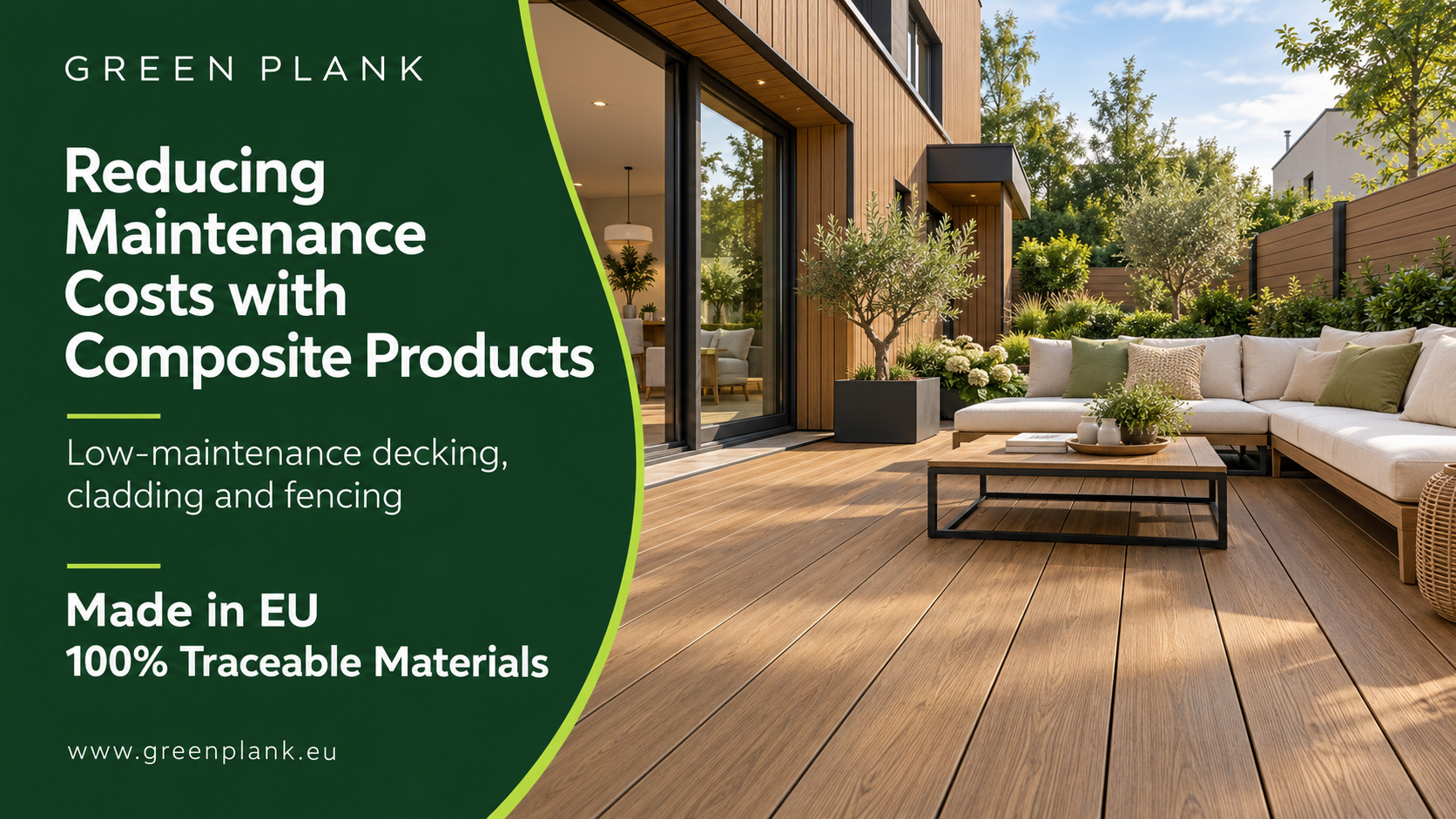
Reducing Maintenance Costs with Composite Products For property owners, architects, municipalities, contractors and developers, the true cost of an outdoor building material is rarely the purchase price alone. Cleaning, inspections, surface treatments, repairs, labour, access equipment, replacement materials and operational disruption can continue for decades after installation. This is why reducing maintenance costs with composite products has become an important consideration in modern material specification. Well-engineered Wood Plastic Composite, or WPC, can offer a practical alternative for decking, walkways, terraces, façades, fencing and public environments where predictable long-term maintenance is important. The economic case should nevertheless be based on lifecycle performance rather than assumptions. ISO 15686-5 provides a framework for lifecycle costing of buildings and constructed assets, covering relevant costs from acquisition through operation to disposal. :contentReference[oaicite:0]{index=0} The cheapest material to purchase is not necessarily the least expensive material to own. For long-term projects, maintenance frequency, labour and replacement cycles can be just as important as the original product price. Why Maintenance Costs Matter More Than They First Appear Maintenance is often underestimated during the specification stage because many costs occur years after construction. For a private terrace, periodic maintenance may represent personal time and materials. For hotels, housing developments, municipalities, marinas and commercial properties, the same work can require professional contractors, safety measures and temporary closure of usable areas. A comprehensive calculation should therefore consider: routine cleaning and inspection, painting, staining, sealing or oiling where required, labour and contractor costs, access equipment and site preparation, repair and replacement materials, downtime or restricted public access, disposal and eventual replacement. Purchase Price vs. Lifecycle Cost Comparing materials only by price per square metre can produce an incomplete economic picture. Lifecycle costing provides a more useful approach because it evaluates costs occurring throughout the period in which the asset is owned and operated. ISO 15686-5 specifically addresses lifecycle cost analysis for constructed assets and their components. :contentReference[oaicite:1]{index=1} Cost Category What Should Be Considered? Initial purchase Boards, profiles, accessories and transport Installation Labour, substructure and fastening system Routine maintenance Cleaning, inspection and scheduled care Surface treatment Paint, stain, oil or protective coatings where applicable Repairs Replacement components and labour Operational disruption Closures, restricted access and safety arrangements End of service Removal, sorting, disposal or recovery How Composite Products Can Reduce Routine Maintenance WPC combines cellulose-based fibres with thermoplastic polymer and functional additives. Unlike untreated natural timber, the polymer-fibre structure does not depend on repeated painting or oiling to maintain the basic composite structure. That does not mean composite products are maintenance-free. Exterior surfaces still require cleaning, inspection and correct drainage. However, reducing recurring treatment cycles can significantly simplify maintenance planning, particularly across large commercial or public installations. The U.S. Environmental Protection Agency has highlighted an outdoor recycled-plastic application where durability and low-maintenance characteristics reduced the time and money required for upkeep and replacement of decked trail pathways. :contentReference[oaicite:2]{index=2} Important Distinction: Low Maintenance Is Not No Maintenance Professional composite products should be described as low-maintenance rather than maintenance-free. Dirt, organic deposits, leaves, pollution and local environmental conditions still require periodic cleaning and inspection. Where the Largest Savings Can Occur The financial value of reduced maintenance tends to increase with project size, accessibility challenges and labour costs. A small residential deck and a large municipal boardwalk may use similar surface materials, but their maintenance economics are very different. Application Potential Maintenance Advantage Residential terraces Less recurring surface-treatment work Hotels and restaurants Less disruption to customer areas Apartment developments More predictable common-area maintenance Public parks Reduced recurring labour across larger areas Boardwalks and waterfronts Potentially fewer treatment interventions in exposed locations Commercial buildings Reduced façade or exterior-surface maintenance burden Durability and Maintenance Costs Are Closely Connected Lower maintenance has limited value if the product itself requires premature replacement. Product durability, therefore, must be considered together with maintenance requirements. The current EU Construction Products Regulation places increased emphasis on sustainability and durability, including the principle that construction products should be designed and manufactured so they can remain in use for as long as possible. :contentReference[oaicite:3]{index=3} For outdoor composite products, professional buyers should examine documented performance relevant to the intended application, including structural behaviour, moisture exposure, temperature movement, UV exposure, surface performance and installation requirements. Material Quality Determines Whether Low Maintenance Lasts Not all composite products perform identically. WPC quality depends on much more than the percentages of wood and polymer printed on a technical sheet. Consistency of the fibres, polymer properties, coupling technology, stabilisation, additives, moisture control, extrusion conditions and profile design all influence the finished product. Product Factor Why It Matters for Maintenance Controlled fibre quality Supports consistent processing and product structure Polymer quality Influences processing, toughness and dimensional behaviour Coupling system Supports interaction between fibre and polymer UV stabilisation Supports exterior performance under sunlight Profile engineering Influences stiffness, drainage and installation behaviour Production control Reduces unwanted variation between batches Capped and Uncapped Composite Products The maintenance strategy can also depend on the type of composite product. Traditional mono-extruded WPC exposes the composite body directly at the surface, while co-extruded products incorporate an additional protective surface layer around the composite core. A properly engineered cap can provide additional resistance to staining, moisture exposure and colour change, but buyers should avoid assuming that every capped product performs equally. Capstock formulation, adhesion to the core, thickness, UV package and manufacturing control all matter. The correct choice should therefore be based on project exposure, appearance expectations, cleaning regime, technical documentation and total lifecycle requirements. Installation Can Make or Break the Maintenance Strategy Even a high-quality composite board cannot compensate for poor installation. Incorrect support spacing, insufficient ventilation, blocked drainage, inappropriate expansion gaps or unsuitable fixings can create avoidable problems later. Follow the manufacturer's specified joist spacing. Provide adequate ventilation beneath the installation. Ensure water can drain efficiently. Allow appropriate thermal expansion gaps. Use compatible clips, screws and substructure materials. Maintain access where future board replacement may be necessary. Good installation should be treated as part of the maintenance-cost strategy, not as a separate consideration. A low-maintenance product installed incorrectly can become a high-maintenance project. Material quality and installation quality must work together. Design for Individual Component Replacement Another way to control lifecycle costs is to specify systems that allow individual components to be removed and replaced. If one board is damaged by unusual impact, replacing that board is generally preferable to dismantling a complete deck section. Mechanically fastened modular systems can therefore offer practical advantages for facilities managers. Accessibility of clips, clear installation documentation and availability of replacement profiles should be considered at the specification stage. Maintenance Costs in Public and Commercial Projects The economics become particularly important where hundreds or thousands of square metres are involved. A maintenance operation that appears inexpensive per square metre can become a substantial recurring budget item across a large property portfolio. Municipalities and commercial property owners should consider not only materials and labour but also procurement administration, contractor mobilisation, barriers, temporary closures and the cost of repeatedly interrupting use of the facility. This makes lifecycle costing especially relevant for parks, promenades, apartment developments, hospitality projects, schools, waterfront environments and other frequently used outdoor spaces. How to Compare Composite Products Before Purchasing Professional buyers should request evidence rather than relying solely on marketing claims. A useful comparison can include: technical data for the exact profile, recommended support spacing and installation method, material composition and raw-material information, relevant mechanical and durability test results, cleaning and maintenance instructions, warranty terms and exclusions, traceability and production documentation, environmental information such as an EPD where available, availability of replacement boards and accessories. Green Plank: Looking Beyond the Initial Price For Green Plank, the value of composite decking, cladding and fencing should be assessed through the complete product lifecycle. The objective is not simply to supply an alternative to timber, but to support projects where durability, predictable maintenance and long-term material performance are important. For architects, contractors, distributors, municipalities and property developers, evaluating the complete system can provide a more meaningful purchasing decision than comparing board prices alone. Explore Green Plank composite solutions at www.greenplank.eu. Conclusion: Calculate Cost per Year, Not Only Cost per Square Metre Reducing maintenance costs with composite products starts with a change in purchasing philosophy. Instead of focusing exclusively on initial price, project teams should consider installation, cleaning, treatment, repairs, labour, disruption and eventual replacement. High-quality composite products can create strong lifecycle value when they combine durable materials, appropriate formulation, good engineering, correct installation, replaceable components and realistic maintenance requirements. The most useful question is therefore not simply what does this decking cost today? It is what will this complete surface cost to own, maintain and keep performing over its intended service life? Sources ISO 15686-5:2017 – Life-Cycle Costing for Buildings and Constructed Assets European Union – Regulation EU 2024/3110 on Construction Products U.S. EPA – Durable Low-Maintenance Outdoor Recycled-Plastic Applications Green Plank – Composite Outdoor Building Solutions
Spesifiser produktet
Bruk denne guiden i en Green Plank-spesifikasjon
Tekniske WPC-artikler skal støtte de kommersielle sidene — ikke konkurrere med dem. Fortsett til komposittdekke, TerraTuff, Nordeka eller de tekniske nedlastningene.