



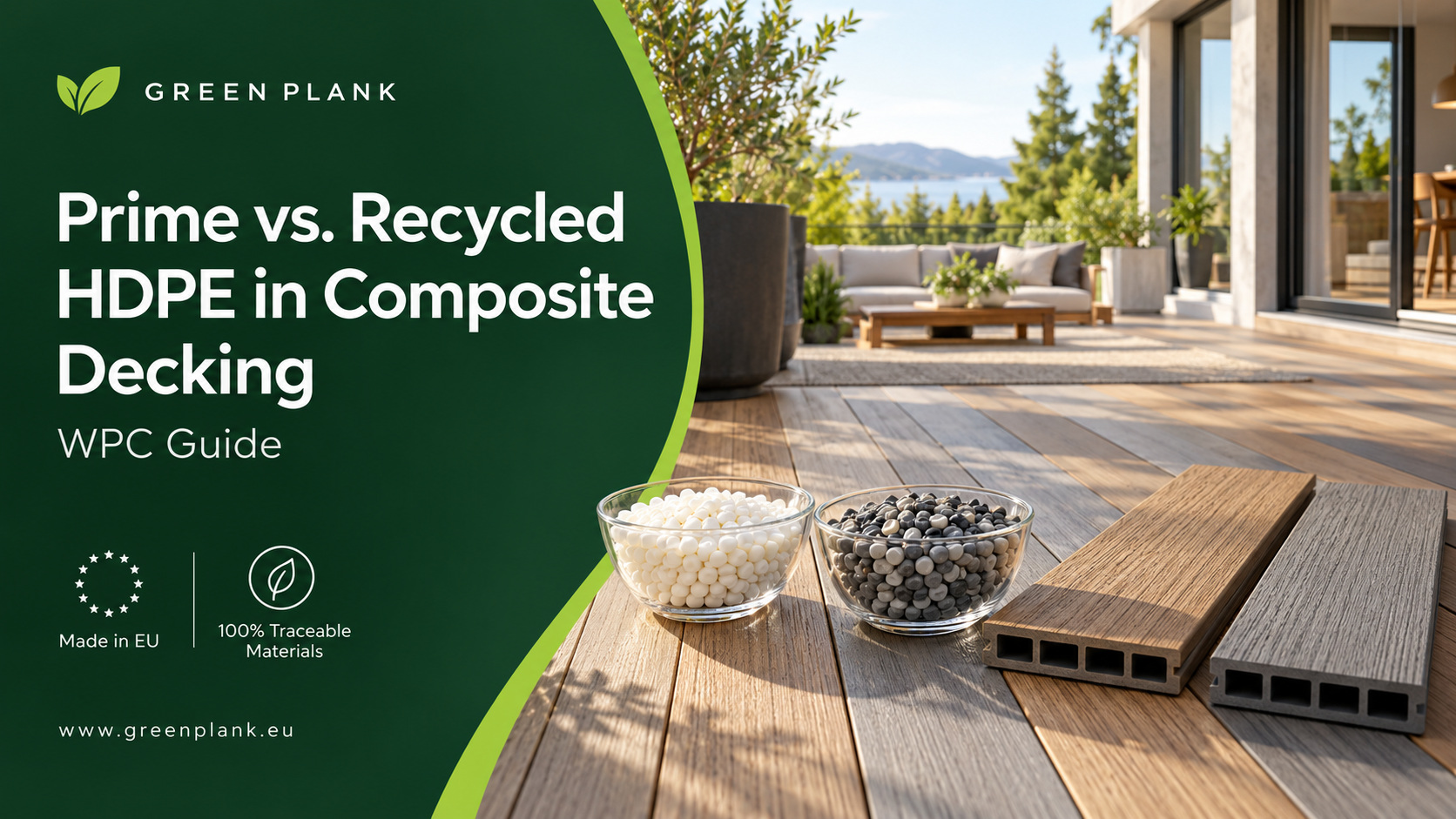
Prime vs. Recycled HDPE in Composite Decking: What Buyers Should Know When selecting Wood Plastic Composite (WPC) decking, buyers often face two competing messages. Prime HDPE is promoted for consistency and predictable processing, while recycled HDPE is valued for keeping existing plastic resources in productive use. But polymer origin alone does not determine whether a composite decking board is technically superior. The more meaningful question is whether the polymer has the right properties, consistency and traceability for the intended formulation. High-performance WPC depends on the complete system: wood fibre, HDPE, coupling technology, stabilisers, lubricants, pigments, profile engineering and manufacturing control. Key principle: The best WPC is not automatically the product with the most virgin or recycled polymer. It is the product with controlled raw materials, an optimised formulation and verified finished-board performance. What Is Prime HDPE? Prime HDPE, commonly called virgin HDPE, is newly manufactured polymer resin with no previous product lifecycle. Manufacturers can select a defined resin grade with controlled characteristics such as density and melt-flow behaviour. This predictability can simplify extrusion control and help maintain consistent production from batch to batch. Controlled and documented polymer grade Predictable processing behaviour Generally low contamination risk Easier colour and formulation control Useful for tightly specified technical profiles What Is Recycled HDPE? Recycled HDPE has previously been used or processed and is recovered for another material cycle. It may originate from relatively controlled post-industrial waste or more complex post-consumer streams. Consequently, recycled HDPE should not be considered one uniform material category. Research has shown that recycled HDPE can successfully be used as the polymer matrix in WPC. Studies comparing virgin- and recycled-HDPE wood composites have reported comparable mechanical performance in specific formulations, demonstrating that recycled polymer is not inherently inferior when feedstock and processing are properly controlled. Factor Prime HDPE Recycled HDPE Polymer history No previous product lifecycle Previously processed or used Consistency Generally highly controlled Depends on feedstock and sorting Contamination risk Typically low Can vary by recycling stream Colour control Generally easier May require additional management Circularity Uses new polymer Keeps existing polymer in circulation Performance potential Excellent Can be excellent with proper control Why Recycled HDPE Quality Can Vary The principal technical challenge with recycled HDPE is not simply that it has been recycled; it is the potential variation in its previous history and composition. Post-consumer material may have experienced heat, UV exposure, oxidation and previous processing cycles. Mixed feedstocks can also introduce different polymer grades, pigments, fillers or contaminants. For professional WPC manufacturing, recycled HDPE should therefore be characterised and controlled. Important parameters can include polymer identity, melt flow index, density, contamination level, moisture, colour and thermal stability. What Buyers Should Remember Prime HDPE offers consistency. Controlled recycled HDPE offers circularity with strong technical potential. Poorly controlled recycled feedstock can introduce variability. None of these factors should be evaluated independently from the finished WPC formulation. The Fibre-Polymer Interface Matters Whether the polymer is prime or recycled, wood and polyethylene have fundamentally different surface characteristics. Wood fibres are hydrophilic, whereas HDPE is hydrophobic. Effective bonding between these phases is therefore essential for transferring mechanical loads and limiting weaknesses at the interface. Maleic-anhydride-grafted polyethylene, commonly known as MAPE, is widely used as a coupling agent in polyethylene-based WPC. Published research demonstrates that suitable coupling treatments can improve fibre-matrix adhesion and mechanical properties. What About Moisture Resistance? It is tempting to assume that virgin HDPE automatically produces a more water-resistant board. In practice, water behaviour in WPC also depends strongly on wood content, fibre encapsulation, porosity, coupling efficiency and processing quality. This is why professional buyers should request water-absorption and dimensional-stability data for the finished profile rather than judging performance from polymer origin alone. Recycled Content and Sustainability Recycled HDPE offers an important circular-material advantage by extending the useful life of an existing polymer resource and potentially reducing demand for virgin feedstock. WPC can also provide a productive application for recovered wood fibres, creating opportunities to combine two secondary material streams. However, sustainability should be considered across the complete lifecycle. Raw-material sourcing, manufacturing, transport, durability, maintenance, service life, replacement frequency and end-of-life options all influence the environmental profile of a decking product. Can Prime and Recycled HDPE Be Blended? Yes. A controlled combination of prime and recycled HDPE can be technically appropriate where manufacturers want to integrate recycled material while maintaining particular processing or performance targets. There is no universal ideal percentage because the optimum ratio depends on recycled-feedstock quality, wood-fibre content, additives, profile geometry and required performance. This reinforces a central principle of composite engineering: formulation should be designed around measurable product requirements rather than a marketing percentage. What Professional Buyers Should Ask What grade and source of HDPE is being used? Is recycled HDPE post-industrial or post-consumer? Can the polymer and wood-fibre sources be traced? How are melt flow, density and contamination controlled? What coupling-agent technology is used? What are the finished profile's flexural properties? What are its water absorption and dimensional stability? How are UV resistance and weathering evaluated? What batch-to-batch quality controls are documented? These questions provide significantly more insight than asking only whether the decking contains virgin or recycled plastic. Green Plank: Performance Through Material Control At Green Plank, composite engineering is based on balancing natural fibres, polymer technology, functional additives and controlled manufacturing. Material traceability and batch-to-batch quality control are important because buyers should understand not only what a product contains, but also how consistently those materials are managed. The objective is not to present prime or recycled HDPE as universally superior. The objective is to use the appropriate material system for the intended product while maintaining the quality, durability and technical performance required for residential, commercial and professional outdoor applications. Discover European composite solutions at www.greenplank.eu. Conclusion Prime HDPE provides predictable raw-material characteristics and excellent manufacturing consistency. High-quality recycled HDPE can support circular-material strategies while also delivering competitive WPC performance when its source, composition and processing are properly controlled. For buyers, the decisive factor should therefore not be a simple prime versus recycled label. Premium composite decking should be evaluated through traceable raw materials, controlled polymer quality, effective fibre-matrix bonding, optimised formulation, disciplined manufacturing and verified finished-product performance. Sources Composites Part A – Comparison of Recycled and Virgin HDPE Wood-Plastic Composites Polymer Degradation and Stability – Virgin and Recycled HDPE Characteristics Journal of Composites Science – MAPE Treatment in Recycled HDPE Wood Composites Journal of Composites Science – Recycled Materials in Wood-Plastic Composites
Spesifiser produktet
Bruk denne guiden i en Green Plank-spesifikasjon
Tekniske WPC-artikler skal støtte de kommersielle sidene — ikke konkurrere med dem. Fortsett til komposittdekke, TerraTuff, Nordeka eller de tekniske nedlastningene.