


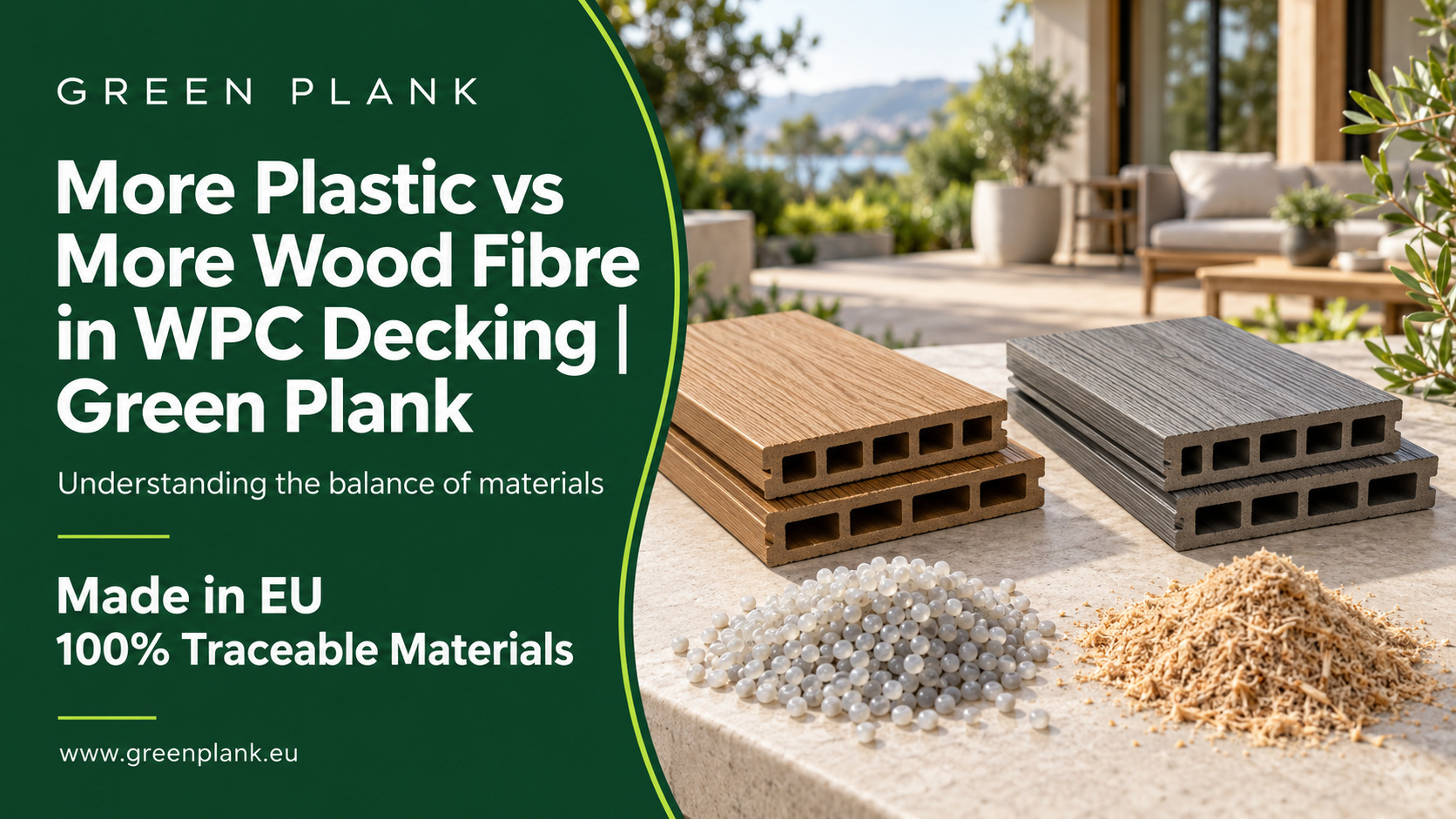
One of the most overlooked questions when choosing wood-plastic composite decking is surprisingly simple:How hot will the decking feel under your feet on a sunny day?WPC is not one single material. Two decking boards may both be marketed as “wood-plastic composite” while having very different ratios of wood fibre and polymer, different colours, densities, surface finishes, internal structures and cap technologies. Those differences can affect how heat moves through the material, how quickly the board responds to solar exposure and how comfortable the surface feels.Research on polyethylene/wood composites provides an important clue: increasing wood content can reduce the thermal conductivity of the composite in the solid state. One study of polyethylene with pine/beech wood flour found decreasing thermal conductivity as wood concentration increased. Another experimental study reported reductions in thermal conductivity as wood flour was introduced into HDPE- and PP-based composites.That makes high-wood-content WPC technically interesting for outdoor decking. But there is an important qualification:Lower thermal conductivity does not automatically guarantee a lower maximum surface temperature.Colour, solar absorptance, capstock, texture, board geometry, wind, ambient temperature, orientation and ventilation can sometimes influence actual surface temperature as much as—or more than—the wood/plastic ratio.Why Can Higher-Plastic WPC Feel Hotter?HDPE is an excellent material for WPC because it provides moisture resistance, toughness and durability. But replacing part of the polymer matrix with wood fibre changes the composite's thermal behaviour.Laboratory research has shown that thermal conductivity decreases as wood concentration increases in solid polyethylene/wood composites.A separate study evaluating wood flour in HDPE and PP composites reported that adding 10% wood flour reduced measured thermal conductivity by approximately 4–10% in the investigated formulations.Another investigation of wood-plastic composites reported decreasing thermal conductivity with increasing wood-filler content.This supports a general engineering principle:More polymer → potentially greater heat transfer through the compositeMore wood fibre → potentially lower thermal conductivityHowever, this should be described as a material-property trend, not as a universal promise that one commercial decking board will always be a certain number of degrees cooler than another.Thermal Conductivity vs. Surface Temperature: An Important DifferenceThese two concepts should not be confused.Thermal conductivity describes how effectively heat moves through a material.Surface temperature is the actual temperature reached by the exposed decking surface.Imagine two WPC boards sitting beside each other under strong summer sunshine. One is light grey and the other dark brown.Even if the dark board contains more wood fibre, it could potentially become hotter at the exposed surface because its darker colour may absorb more solar radiation.Actual decking temperature therefore depends on a combination of factors:FactorPotential influence on surface heatWood-fibre percentageHigher wood content can reduce thermal conductivityPolymer percentageHigher polymer fraction can increase polymer-dominated thermal behaviourColourDark surfaces can absorb more solar radiationSurface finishTexture and reflectivity influence solar interactionCapstockCap chemistry and colour affect the exposed surfaceSolid/hollow constructionChanges mass and heat-transfer behaviourVentilationAirflow below decking helps dissipate heatSolar exposureDirect sunlight is a major driverAmbient temperatureHigher air temperature raises the starting conditionFor this reason, professional comparisons should ideally use side-by-side solar-heating tests on finished commercial boards, rather than predicting surface temperature from formulation alone.High-Wood WPC vs. High-Plastic WPCA simplified comparison illustrates the engineering differences.PropertyHigh-Wood WPCHigh-Plastic WPCNatural fibre contentHigherLowerPolymer contentLowerHigherThermal conductivityCan be lowerCan be higherThermal expansionGenerally lower in comparable formulationsGenerally higherNatural wood-like characterStrongerMore polymer-dominatedMoisture sensitivity of uncapped corePotentially higherGenerally lowerExtrusion difficultyHigherGenerally easierNeed for coupling technologyCriticalImportantSurface protectionParticularly valuableStill beneficialProcessing windowMore demandingUsually widerIncreasing wood fibre is not automatically better in every respect. Research has found that higher wood-fibre content increases processing difficulty and viscosity, while increasing wood content and good interface compatibility can reduce thermal expansion.The objective is therefore not simply maximum wood or minimum plastic.It is finding the correct engineering balance.Green Plank's Approach: Four Different Decking ConstructionsGreen Plank offers several composite decking constructions intended for different applications. Its current technical documentation distinguishes TerraTuff™ capped solid decking, Nordeka™ uncapped solid decking, and Classic™ and Sapphire™ uncapped hollow decking.This distinction matters because formulation is only part of thermal performance. Solid versus hollow construction and capped versus uncapped surfaces also change how a board interacts with the outdoor environment.1. TerraTuff™ — Solid Co-Extruded WPCTerraTuff™ represents the premium capped concept.The engineering philosophy is particularly interesting: use a wood-rich composite core for the main body of the board and an engineered protective outer layer where environmental protection is most valuable.Green Plank's technical documentation describes TerraTuff™ as a capped solid decking product and states that capped products are designed to provide enhanced cleanability, colour stability and stain resistance.Potential advantagesA high natural-fibre core can offer: reduced polymer dependency in the core;potentially lower thermal conductivity compared with more polymer-rich formulations;potentially reduced thermal expansion;high stiffness when properly formulated;a more fibre-reinforced material structure. The cap adds another function: protecting the exposed composite surface.This is one of the strongest arguments for co-extrusion. The core and surface do not have to perform exactly the same job.The core can be optimised around fibre reinforcement and mechanical characteristics, while the cap can be optimised for weathering, staining and cleanability.The thermal trade-offTerraTuff's exposed cap is polymer-rich, so the temperature experienced by bare feet is determined primarily by the complete surface system—not merely by the high wood percentage inside the core.TerraTuff combines a high natural-fibre composite core with an engineered protective surface, balancing dimensional performance, durability, weather protection and outdoor comfort. 2. Nordeka™ — Solid Mono-Extruded WPCNordeka™ uses a different design philosophy.Unlike capped TerraTuff, Green Plank documentation identifies Nordeka™ as an uncapped solid composite decking product.With mono-extrusion, the material composition extends through the board rather than having a separate protective cap.Advantages of the solid mono-extruded conceptThe exposed walking surface is the WPC itself. This can provide: consistent material through the profile;a natural composite appearance;straightforward edge machining where permitted;robust solid construction;no separate cap/core interface. For high-wood-content formulations, the exposed surface also contains the wood-fibre-rich composite rather than a polymer-rich cap.DisadvantagesWithout a protective cap, the composite surface has more direct exposure to water, dirt, food, oils and weather.Green Plank's current technical data specifically notes that uncapped Nordeka™, Classic™ and Sapphire™ products may show greater natural colour maturation and water-mark behaviour during early weathering.Consequently, the decision between Nordeka and TerraTuff is not simply about temperature.It is a balance between uncapped natural-composite character and capped surface protection.3. Classic™ — Hollow Mono-Extruded WPCClassic™ introduces another variable: hollow geometry.A hollow profile contains internal cavities instead of being solid throughout.This reduces material mass and changes how heat is stored and transferred through the profile.It would be incorrect, however, to say that hollow WPC is automatically cooler than solid WPC. The temperature of the top walking surface still depends heavily on colour, formulation, solar exposure and surface characteristics.Where hollow geometry can make a difference is in the board's overall thermal mass and heat-transfer pathway.Advantages of Classic hollow decking lower material use than comparable solid construction;reduced profile weight;easier handling;potentially attractive economics for residential installations;internal cavities reduce the amount of composite material per linear metre. Installation considerationsHollow construction requires particularly careful drainage and ventilation.Green Plank's installation guide states that Classic™ and Sapphire™ hollow profiles should be installed with appropriate slope and with cavities able to drain and ventilate; cavities should not be sealed in ways that trap water.4. Sapphire™ — Hollow Mono-Extruded WPCSapphire™ shares the general hollow, uncapped construction philosophy but offers a different profile/design option within the Green Plank range.From a thermal perspective, the same fundamental principles apply:wood/plastic ratio + colour + profile geometry + surface finish + solar exposure + ventilation = real-world thermal behaviour.The hollow structure can provide lower weight and efficient material use, while the uncapped WPC surface maintains direct composite character.As with Classic™, installation detailing is especially important because the internal chambers must remain capable of drainage and ventilation.TerraTuff vs. Nordeka vs. Classic vs. SapphireCharacteristicTerraTuff™Nordeka™Classic™Sapphire™ConstructionSolidSolidHollowHollowExtrusionCo-extrudedMono-extrudedMono-extrudedMono-extrudedSurfaceEngineered capExposed WPCExposed WPCExposed WPCCore/profile typeFibre-rich compositeCompositeCompositeCompositeSurface protectionHighest of four conceptsStandard uncappedStandard uncappedStandard uncappedThermal massHigherHigherLowerLowerDrainage sensitivityNormal decking detailingNormal decking detailingHigherHigherNatural surface maturationReduced by capMore visibleMore visibleMore visibleBest positioningPremium/high-demand projectsSolid uncapped applicationsEfficient hollow deckingEfficient hollow deckingThis table compares construction concepts, not measured surface temperatures. A controlled side-by-side test would be required before publishing exact temperature differences between these four products.Does More Wood Mean a Cooler Deck?The technically accurate answer is:Higher wood content can reduce WPC thermal conductivity, but it does not by itself guarantee a lower surface temperature in sunlight.That distinction is extremely important for credible WPC marketing.Research demonstrates a relationship between increased wood loading and reduced thermal conductivity in solid wood/polyethylene composites.But a customer's bare foot touches the surface, not the internal core.For capped decking such as TerraTuff™, the cap colour, cap chemistry, texture and solar absorptance therefore deserve particular attention.For uncapped Nordeka™, Classic™ and Sapphire™, the wood-polymer formulation itself forms the exposed surface.More Plastic Can Also Mean More Thermal ExpansionHeat comfort is only part of the story.Increasing wood-fibre content can also reduce the coefficient of linear thermal expansion in comparable WPC formulations. Published research reports decreasing thermal expansion coefficients as wood fibre and interface compatibility increase.This becomes important for long decking boards because thermal movement accumulates with length.A high-polymer profile can therefore face two related considerations:heat transfer and thermal movement.A properly engineered high-wood WPC may offer benefits in both areas, although actual commercial performance should always be verified by testing.The Advantages and Disadvantages of High-Wood WPCAdvantages Potentially lower thermal conductivity.Potentially reduced thermal expansion.Higher renewable natural-fibre fraction.Potentially greater stiffness.Less dependence on polymer in the core.Natural composite character.Particularly interesting when combined with co-extruded surface protection. Disadvantages More difficult extrusion.Higher melt viscosity.Greater sensitivity to fibre moisture.Greater dependence on good coupling-agent chemistry.Poor dispersion can create defects.Unprotected high-wood surfaces can be more moisture-sensitive.Manufacturing process control becomes increasingly important. Research confirms that very high fibre loading presents processing challenges; increasing wood content raises viscosity, and one study found that beyond about 60% fibre, further increases were not favourable for processing under its particular experimental conditions.This does not mean 70% or 75% wood WPC cannot be manufactured successfully. It means that high wood loading requires more sophisticated formulation and extrusion control.Which Green Plank Construction Makes Sense?There is no single profile that is ideal for every project.TerraTuff™ solid co-extruded decking is the strongest concept where premium surface protection, stain resistance, colour stability and solid-board construction are priorities.Nordeka™ solid mono-extruded decking is attractive where customers want solid WPC construction and the natural character of an uncapped composite surface.Classic™ and Sapphire™ hollow decking can be strong choices where lower board weight, efficient material use and residential economics are important, provided drainage, ventilation and support requirements are correctly followed.Green Plank's own current installation documentation makes this distinction between capped solid, uncapped solid and uncapped hollow systems.Conclusion: The Best WPC Is Not Simply the One With the Most PlasticThe WPC industry sometimes treats polymer content as synonymous with durability. The science is more nuanced.Plastic provides essential moisture protection, toughness and processability. Wood fibre provides reinforcement and can reduce thermal conductivity and thermal expansion. Coupling agents connect these fundamentally different materials. Additives protect and stabilise the system. Co-extrusion can then provide another specialised layer of surface performance.This is why the future of high-performance WPC should not necessarily be more plastic everywhere.A more sophisticated engineering strategy is:Use a carefully formulated, high-natural-fibre composite where structural and dimensional properties are needed, and use advanced polymer technology strategically where environmental protection is needed most.That philosophy is particularly relevant to the TerraTuff™ co-extruded concept, while Nordeka™, Classic™ and Sapphire™ provide alternative solid and hollow mono-extruded solutions for different project requirements.For Green Plank, the next valuable step would be independent side-by-side testing of all four profiles—TerraTuff, Nordeka, Classic and Sapphire—in identical colours under controlled solar exposure, recording surface temperatures every 10–15 minutes. That would turn the material-science principle into product-specific evidence and could become a very strong technical marketing study for architects, distributors and professional buyers.Sources: Research on polyethylene/wood composites and thermal conductivity is available from the peer-reviewed studies in Polymers and Polymer Composites, Materials, and related engineering literature. Green Plank product classifications and installation requirements are based on current Green Plank technical documentation.
Spesifiser produktet
Bruk denne guiden i en Green Plank-spesifikasjon
Tekniske WPC-artikler skal støtte de kommersielle sidene — ikke konkurrere med dem. Fortsett til komposittdekke, TerraTuff, Nordeka eller de tekniske nedlastningene.