



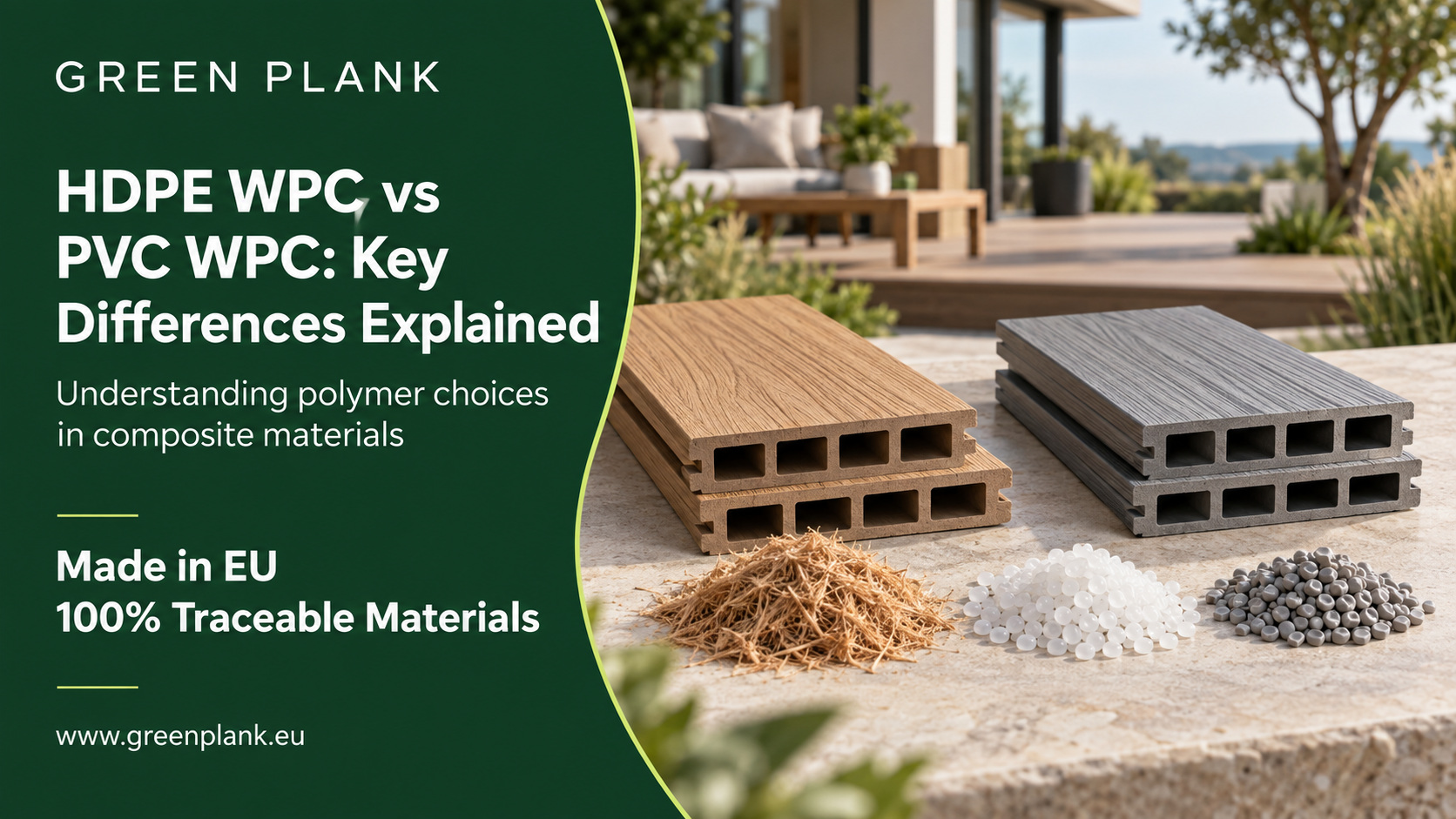
HDPE-Based WPC vs. PVC-Based WPC: What Is the Difference? Wood-Plastic Composite (WPC) has become an established material for decking, cladding, fencing, landscaping, boardwalks and other outdoor applications. Yet the term WPC describes a family of materials rather than one standard formulation. One of the most important differences is the thermoplastic polymer used to bind the wood fibres. Two widely recognised systems are HDPE-based WPC, manufactured with high-density polyethylene, and PVC-based WPC, manufactured with polyvinyl chloride. Both can produce high-quality composite products, but their chemistry, mechanical behaviour, processing requirements and environmental considerations differ. Key point: Polymer type alone does not determine whether a WPC product is premium quality. Raw-material quality, wood-fibre preparation, formulation, additives, profile design, processing control and documented testing all influence final performance. What Is Wood-Plastic Composite? WPC combines wood flour or natural fibres with a thermoplastic matrix. According to the U.S. Forest Service Forest Products Laboratory, polyethylene and PVC are among the thermoplastics used in wood-thermoplastic composites. The polymer forms a continuous matrix around the wood component, while wood can contribute stiffness and reinforcement. Commercial formulations may also contain coupling agents, lubricants, pigments, UV stabilisers, antioxidants, processing aids and other additives. Consequently, two products using the same polymer can perform very differently. What Is HDPE-Based WPC? HDPE-based WPC uses high-density polyethylene as its principal thermoplastic matrix. HDPE belongs to the polyolefin family and its polymer backbone does not contain chlorine. HDPE is relatively ductile, while wood fibres increase stiffness. Because polyethylene and wood have different surface characteristics, appropriate coupling technology, fibre preparation and extrusion control are important for achieving a well-engineered interface. Typical characteristics of HDPE-based WPC Polyolefin-based polymer technology Good toughness when correctly formulated Low water absorption by the polymer itself Suitable for extrusion into decking and other profiles Can incorporate virgin or appropriately controlled recycled HDPE Commonly used for outdoor decking, fencing and landscaping products What Is PVC-Based WPC? PVC-based WPC uses polyvinyl chloride as the thermoplastic matrix. PVC has chlorine incorporated into its molecular structure, making its chemistry fundamentally different from HDPE. Rigid PVC can provide comparatively high rigidity, but PVC-WPC formulations require appropriate stabilisers, lubricants, processing aids and, where necessary, impact modifiers. Temperature control during manufacturing is particularly important. Typical characteristics of PVC-based WPC Vinyl/chlorinated polymer matrix Generally rigid material behaviour Good dimensional characteristics in appropriately engineered formulations Can provide good outdoor weathering performance with suitable stabilisation Used for decking, cladding, fencing and extruded architectural profiles HDPE WPC vs. PVC WPC: Quick Comparison Characteristic HDPE-Based WPC PVC-Based WPC Primary polymer High-Density Polyethylene Polyvinyl Chloride Polymer family Polyolefin Vinyl/chlorinated polymer Chlorine in polymer No Yes General behaviour More ductile polymer matrix More rigid polymer matrix Moisture resistance Potentially very good when properly formulated Potentially very good when properly formulated Thermal movement Must be considered in product and installation design Must also be considered; behaviour differs by formulation Recycled feedstock Recycled HDPE can be used with suitable quality control Recycled PVC can be used in suitable systems Typical applications Decking, fencing, landscaping, outdoor profiles Decking, cladding, fencing, profiles The table describes general material tendencies. Product-specific test data should be used for engineering and purchasing decisions. 1. Mechanical Performance and Stiffness The polymer matrix has a major influence on WPC behaviour, but the finished product cannot be evaluated from polymer type alone. Wood species, fibre dimensions, wood loading, coupling agents, additives, profile geometry and processing conditions all affect mechanical properties. HDPE is naturally more ductile than rigid PVC. In an HDPE-WPC system, wood fibres can significantly increase stiffness while the polymer contributes toughness. PVC-based systems tend toward greater rigidity, although impact modifiers and formulation changes can alter their behaviour. For demanding projects, buyers should request tested values for flexural strength, modulus, impact performance, creep and load capacity rather than relying on generic material claims. 2. Moisture Resistance One reason WPC is attractive for outdoor applications is that thermoplastic polymers absorb relatively little moisture compared with wood. However, the wood component remains moisture-sensitive if inadequately protected. The Forest Products Laboratory notes that polymer matrices can act as barriers to moisture intrusion in a well-designed composite, while wood itself readily absorbs moisture. Therefore, moisture resistance depends on factors such as: Wood-fibre quality and moisture content before processing Fibre dispersion and encapsulation Polymer-to-wood adhesion Coupling-agent technology Profile geometry Manufacturing consistency Both HDPE-WPC and PVC-WPC can perform well in wet environments when properly engineered. Water-absorption and dimensional-stability test results provide a more meaningful comparison than polymer name alone. 3. Thermal Expansion and Dimensional Stability Outdoor decking experiences substantial temperature changes. Thermal movement therefore needs to be considered during product engineering and installation. Polyethylene expands and contracts with temperature, although adding wood fibre changes the behaviour of the resulting composite. PVC has different thermal characteristics and can offer useful dimensional properties in properly designed formulations. For either system, installation instructions should address expansion gaps, board length, fastening systems, joist spacing and expected service temperatures. 4. Weathering and UV Performance Outdoor WPC must withstand sunlight, rain, frost, humidity and temperature cycling. HDPE and PVC respond differently to environmental exposure, but both require a properly designed stabilisation package. UV stabilisers, antioxidants, pigments and protective co-extruded layers can significantly influence colour retention and long-term surface performance. A recent scientific review of WPC technologies also highlights that polymer type influences physical and mechanical behaviour. Professional specification tip: Instead of asking only whether a board is HDPE or PVC, ask the manufacturer for accelerated weathering data, water-absorption results and relevant outdoor performance documentation. 5. Fire Performance HDPE and PVC have different combustion behaviour because of their fundamentally different chemistry. However, a finished WPC profile also contains wood, additives and potentially other layers. Consequently, fire performance should never be assumed solely from the polymer. For façades, public spaces or regulated construction projects, request the applicable fire classification for the finished product. 6. Sustainability: Is HDPE or PVC WPC Greener? Environmental comparisons require more than identifying the polymer. HDPE contains no chlorine in its polymer backbone, whereas PVC does. Nevertheless, this fact alone is not a complete lifecycle assessment. A meaningful sustainability comparison should examine: Origin and traceability of wood fibres Virgin versus recycled polymer content Manufacturing energy and waste Product durability and expected service life Maintenance requirements Transportation distance Potential for recycling or material recovery End-of-life scenarios Where available, an independently verified Environmental Product Declaration (EPD) provides more useful environmental information than broad claims such as environmentally friendly or green. 7. Virgin vs. Recycled Polymer Another common misconception is that virgin polymer automatically produces a superior WPC while recycled polymer necessarily means lower quality. Recycled thermoplastics can be valuable WPC raw materials, but their suitability depends on feedstock control. Manufacturers need to manage contamination, polymer consistency, melt-flow behaviour, moisture and batch-to-batch variation. For professional procurement, ask whether recycled material has a defined specification and whether the manufacturer provides raw-material and batch traceability. 8. Which WPC Is Better for Decking? There is no technically responsible universal answer that HDPE-based WPC is always better than PVC-based WPC, or vice versa. The appropriate choice depends on the product design and application. Project Important Factors to Evaluate Residential decking Appearance, comfort, slip resistance, maintenance, warranty Commercial projects Wear resistance, lifecycle cost, installation efficiency Municipal/public spaces Safety, durability, documentation, maintenance, lifecycle value Cladding Fire classification, dimensional stability, weathering, fixing system Waterfront applications Moisture behaviour, slip resistance, durability and fastening design How to Compare WPC Products Professionally Before specifying HDPE- or PVC-based composite materials, request documentation for the finished product. A useful evaluation should include: Technical Data Sheet Raw-material specification and traceability Mechanical test results Water-absorption and dimensional-stability data Slip-resistance results where relevant UV and weathering performance Fire classification where required Installation requirements Environmental documentation or EPD where available Warranty terms and limitations Proven reference projects The Bottom Line: Evaluate the Complete Engineered System HDPE-based and PVC-based WPC are distinct composite technologies. HDPE provides a polyolefin matrix with comparatively ductile behaviour, while PVC provides a more rigid vinyl-based matrix with different processing and thermal characteristics. But the most important lesson is that the polymer is only one component of WPC performance. A premium composite should be evaluated as a complete engineered system: polymer + wood fibre + additives + coupling technology + profile design + manufacturing control + testing + traceability. Do not specify WPC based only on percentages or polymer names. Specify it according to documented performance, suitability for the application and lifecycle value. Sources U.S. Forest Service Forest Products Laboratory — Wood/Nonwood Thermoplastic Composites U.S. Forest Service — Raw Materials for Wood-Polymer Composites U.S. Forest Service — Wood-Based Composite Materials U.S. Forest Service — Wood Handbook: Wood as an Engineering Material RSC Sustainability — Towards Sustainable Wood-Plastic Composites: Polymer Types, Properties, Processing and Future Prospects
Spesifiser produktet
Bruk denne guiden i en Green Plank-spesifikasjon
Tekniske WPC-artikler skal støtte de kommersielle sidene — ikke konkurrere med dem. Fortsett til komposittdekke, TerraTuff, Nordeka eller de tekniske nedlastningene.