



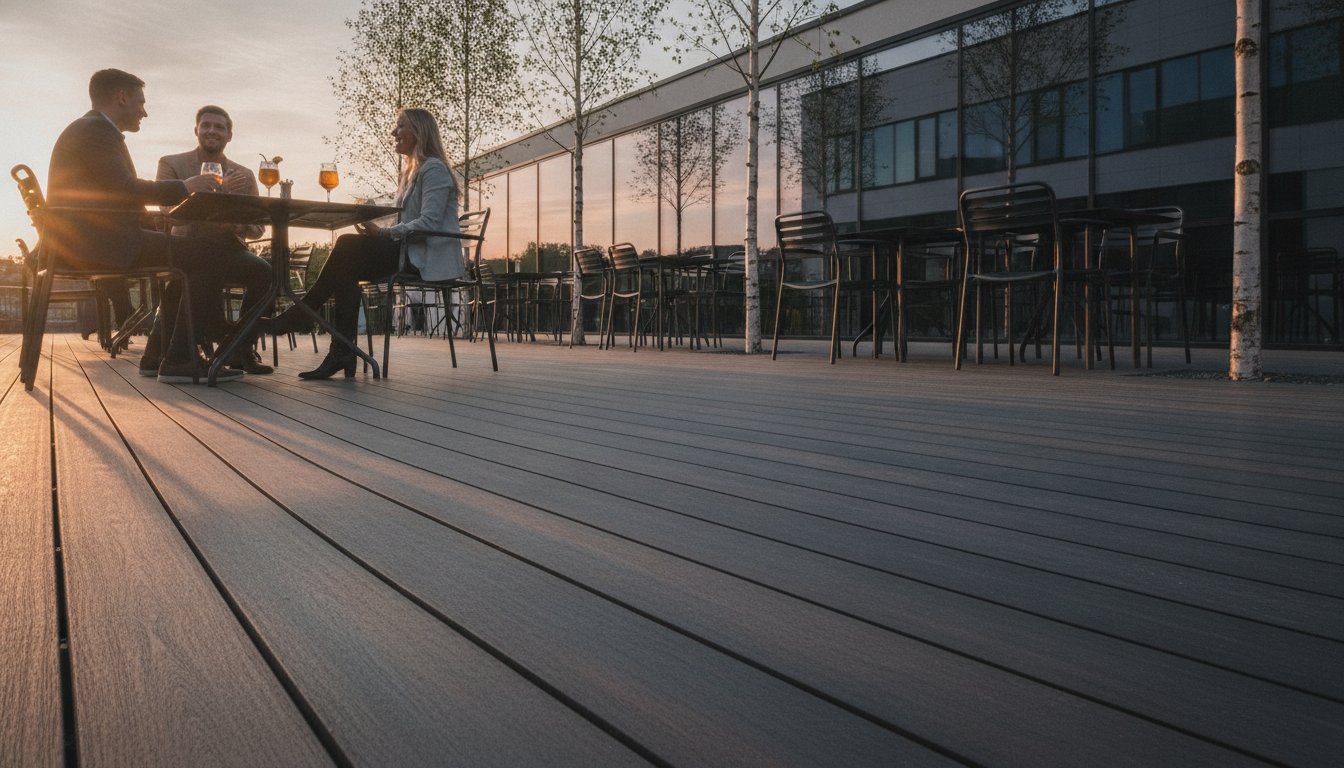
Why are you still spending your off-season sanding and staining a floor that will inevitably splinter under the weight of next summer's crowds? Most hospitality owners agree that traditional timber has become a liability, demanding high annual maintenance while posing significant slip hazards during rain or spills. You need a flooring solution that reflects your commitment to quality without the constant downtime of repairs. By choosing engineered composite decking for beer garden flooring, you're opting for a high-performance material designed specifically to withstand the unique stresses of a commercial environment.
This guide explains why WPC composite is the superior choice for durable, safe, and sustainable outdoor spaces. We'll look at the technical advantages of boards manufactured with 75% hardwood fiber and 25% HDPE, offering a reliable service life of up to 50 years. You'll see how achieving a DCOF of 0.42 or higher meets modern safety standards to protect your patrons and your brand. Finally, we'll outline how European-made materials and Cradle to Cradle ownership provide the sustainable alignment your guests expect from a premium venue.
Key Takeaways
Understand why the 75% hardwood fiber and 25% HDPE composition provides the superior density required for heavy commercial foot traffic.
Identify the specific slip-resistance standards necessary to protect your guests and mitigate liability in high-traffic outdoor environments.
Discover how premium composite decking for beer garden flooring eliminates the recurring labor costs associated with annual sanding, staining, and timber repairs.
Gain technical insights into commercial installation protocols, focusing on why precise joist spacing and HidLoc™ fastening systems are critical for structural longevity.
Explore the environmental benefits of EU-sourced raw materials and how choosing sustainable flooring enhances your brand's reputation for ethical responsibility.
Table of Contents
The Challenges of Traditional Timber in Beer Garden Environments
Why Engineered WPC is the Superior Beer Garden Flooring
Safety First: Slip Resistance and Commercial Compliance
Specifying and Installing for High-Traffic Hospitality
The Green Plank Advantage: Sustainable Commercial Flooring
The Challenges of Traditional Timber in Beer Garden Environments
Traditional timber presents a facade of natural beauty that quickly fades under the relentless pressure of a commercial beer garden. While the initial purchase price of pressure-treated wood is lower than engineered alternatives, the long-term financial burden is substantial. Owners often find themselves trapped in a cycle of annual sanding and staining that eats into profit margins. This is why many architects are shifting toward Wood-plastic composites (WPCs) to ensure structural integrity and reduce overhead. When you choose composite decking for beer garden flooring, you're investing in a material that resists the moisture-heavy environment typical of hospitality venues.
Wood is inherently porous. In a beer garden setting, this porosity becomes a magnet for spilled beverages and rainwater, creating a fertile ground for algae growth. This biological layer turns a charming terrace into a dangerous slip hazard. As wood fibers dry and age, they inevitably splinter. A single guest injury caused by a rough board can lead to significant liability concerns and damage your brand's reputation for quality. High-traffic hospitality areas accelerate this wood rot because constant footfall breaks down the cellular structure of the timber, allowing moisture to penetrate deeper and faster than it would in a residential setting.
Maintenance Fatigue in the Hospitality Sector
The hospitality sector operates on tight schedules. Every day spent closing a terrace for maintenance is a day of lost revenue. Timber requires consistent attention to prevent rot, yet even with diligent care, it often fails the longevity test in public spaces. High foot traffic accelerates the erosion of protective stains, leaving the wood vulnerable to UV damage and moisture ingress. This aesthetic decline is difficult to reverse. Once wood begins to gray and crack, no amount of staining can restore its original structural density. The labor costs associated with this seasonal prep are a recurring drain on resources that could be better spent on guest experiences.
Safety and Liability Considerations
Structural failures often begin with warping and cupping. These physical changes create uneven surfaces that increase the risk of tripping, especially in dimly lit evening environments. Insurance providers increasingly scrutinize the condition of outdoor flooring when assessing risk. You can explore more about these issues in our detailed guide on 5 Common Problems with Traditional Wood Decking. Transitioning to a high-density, engineered solution isn't just about aesthetics; it's a strategic move to safeguard your business from preventable claims. By eliminating the "splinter factor" and the risk of rot, you create a reliable foundation for your patrons.
Why Engineered WPC is the Superior Beer Garden Flooring
High-performance Wood-Plastic Composite (WPC) isn't just a plastic-coated substitute; it's a precision-engineered material designed for high-traffic endurance. In a beer garden setting, flooring must handle heavy furniture, constant foot traffic, and extreme environmental exposure. Our formulation utilizes a precise ratio of 75% hardwood fiber and 25% High-Density Polyethylene (HDPE). This specific blend ensures that the composite decking for beer garden flooring maintains the structural rigidity of wood while gaining the comprehensive weatherproofing benefits of modern polymers.
The science of density plays a vital role in commercial success. Low-density boards often lack the internal strength to support the concentrated loads found in hospitality environments. By contrast, our high-strength profiles are manufactured to resist indentation and structural fatigue. This engineering precision allows for larger deck installations that remain stable and level over decades of use. It's a calculated balance of weight and performance that simplifies installation without compromising the safety of your patrons.
The Role of Hardwood Fiber
The high concentration of hardwood fiber is what distinguishes professional-grade WPC from residential alternatives. This fiber-reinforcement provides the essential load-bearing capacity required for commercial decks where hundreds of people may gather simultaneously. By utilizing 100% EU raw materials, we maintain strict quality control over the fiber density and purity. This results in a product that feels substantial underfoot. Unlike low-quality boards that might feel "springy" or hollow, this high-density profile offers a solid, premium experience that mimics the acoustics and tactile feel of traditional timber.
HDPE vs. PVC in Commercial Settings
Choosing the right polymer is critical for long-term performance in an outdoor venue. While PVC is common in some decking products, it can become brittle over time, especially when exposed to fluctuating temperatures. HDPE offers superior impact resistance. This is essential for environments where glassware might be dropped or heavy furniture moved daily. This material choice supports an environmentally friendly approach to construction, as HDPE is highly recyclable and fits into a circular economy. You can learn more about these technical specifications in our guide on What is WPC Composite Decking?.
Thermal stability and UV resistance are the final pillars of superior engineering. Beer gardens are often fully exposed to the elements. Our boards are designed to resist significant expansion and contraction, preventing the unsightly gaps or warping seen in inferior products. Advanced UV inhibitors are integrated directly into the core of the board. This ensures that the natural tones you choose stay consistent even under constant sun exposure. If you are planning a venue upgrade, you can explore our commercial-grade profiles to find a solution that balances aesthetics with industrial strength.
Safety First: Slip Resistance and Commercial Compliance
Public safety is the cornerstone of any successful hospitality venue. In a beer garden, where the environment is subject to unpredictable weather and frequent spills, flooring must perform as a safety asset rather than a liability. High-performance composite decking for beer garden flooring is engineered with specific surface textures, such as deep grooves and brushed finishes, to maximize traction. These tactile features provide essential grip even when the surface is saturated with rain or spilled beverages.
Unlike traditional timber, which absorbs moisture and fosters the growth of slippery algae, engineered WPC maintains a very low absorption rate. This material science prevents the formation of the "slime" layer that often plagues outdoor wood decks. By resisting organic growth, the boards remain safe and predictable throughout the seasons. Additionally, commercial outdoor structures demand rigorous fire safety standards. Professional-grade composite profiles are manufactured with flame-retardant additives to meet the stringent requirements of public building codes, providing peace of mind for business owners and insurers alike.
Managing Spills and Drainage
Effective liquid management is critical in an environment where beer, soda, and rainwater are constant factors. Proper installation requires precise gap spacing between boards to facilitate immediate runoff and promote sub-structure ventilation. This design ensures that liquids don't pool on the surface, which further enhances the safety profile of the deck. Cleaning protocols are also simplified because the high-density surface resists deep staining from food and acidic drinks. For public safety compliance, a Pendulum Test Value (PTV) of 36 or higher in wet conditions is the recognized benchmark for ensuring low slip potential in outdoor hospitality spaces.
Hidden Fastening and Trip Prevention
A smooth, unobstructed surface is essential for preventing trips and falls in crowded venues. Traditional face-screwing methods often result in popped screw heads or splintered holes over time. Our HidLoc™ hidden fastening systems eliminate these hazards by securing the boards from the side. This creates a clean, screw-free surface that is safe for both footwear and guests who may be moving between indoor and outdoor areas.
Beyond aesthetics, high-performance clips are designed to handle the lateral forces of heavy furniture being moved across the deck. This prevents board movement and ensures the gaps remain consistent over decades of use. A flush finish at transitions and edges is equally important for accessibility. By using dedicated edging profiles, you ensure that the deck remains a seamless extension of your venue, providing a safe and professional environment for every patron.
Specifying and Installing for High-Traffic Hospitality
A commercial beer garden is a high-performance environment that requires more than just an aesthetic surface. The structural foundation must be engineered to withstand constant pressure. When specifying composite decking for beer garden flooring, professionals must prioritize joist spacing to ensure absolute stability. For public spaces, we recommend joist centers of 400mm to provide a rigid, deflection-free surface. While 600mm centers may be suitable for certain residential applications, the tighter spacing in a commercial setting prevents board flexing and extends the structural life of the entire installation.
Selecting the correct board profile is equally critical for longevity. Solid profiles offer maximum impact resistance; this ensures the deck remains undamaged during heavy keg deliveries or the movement of cast-iron furniture. Cellular boards provide a lighter alternative for specific areas, but high-traffic zones benefit most from the density of solid WPC. These boards are designed to manage significant dead and live loads, including large groups of patrons and heavy outdoor heaters, without compromising the integrity of the subframe. Integrated utilities, such as lighting and power for outdoor heaters, can be routed efficiently within the WPC subframe to maintain a clean, professional appearance.
Design Considerations for Pubs and Restaurants
Visual design should serve both style and safety. Choosing darker, variegated colors helps hide the scuffs and dust that naturally accumulate in high-traffic venues. Using contrasting board colors at the edges of terraces or on steps provides clear visual identification for guests, which reduces the risk of accidents in low-light conditions. For a detailed technical breakdown of these methods, you can consult our Professional Deck Installation Guide. This resource explains how to achieve a sustainable outdoor space that balances engineering precision with architectural beauty.
Long-Term Durability and Warranty
Investing in high-grade WPC is a decision that protects your business's asset value for decades. Our 50-year warranty for commercial infrastructure reflects our confidence in the material's performance. This longevity is supported by a Cradle to Cradle ownership model, ensuring that your renovation aligns with modern circular economy principles. Utilizing EU-sourced raw materials significantly reduces supply chain volatility and ensures that large-scale commercial projects remain on schedule regardless of global shipping disruptions. This regional reliability is a core pillar of our manufacturing ethics. To begin your project with a foundation of quality, you can view our commercial infrastructure profiles today.
The Green Plank Advantage: Sustainable Commercial Flooring
Choosing the right material for a public venue is an act of environmental stewardship. Green Plank differentiates itself by bridging the gap between engineering precision and ecological responsibility. By utilizing 100% EU raw materials, we significantly reduce the CO2 footprint of commercial renovations. This regional manufacturing approach ensures that every board of composite decking for beer garden flooring travels a shorter distance from the factory to your site, minimizing logistics-related emissions and supporting ethical labor standards. It's a commitment to quality that resonates with the modern, eco-conscious consumer.
Our Terra Tuff™ and Smart System™ profiles are not merely adaptations of residential products; they're engineered specifically for the most demanding public spaces. These commercial infrastructure profiles provide the structural integrity required to survive decades of constant use. Architects and specifiers choose these systems because they meet rigorous safety standards while offering a sophisticated aesthetic that complements high-end hospitality design. This combination of performance and style is why Green Plank remains the definitive choice for infrastructure projects across the continent.
Terra Tuff: The Infrastructure Choice
In high-turnover hospitality seating areas, the flooring must endure constant friction from chair legs and heavy footfall. Terra Tuff™ is designed for extreme durability, resisting the surface wear that typically degrades lesser materials. This low-maintenance profile is essential for 24/7 commercial operations where there is no window for extensive repairs or refinishing. By integrating these high-performance boards, you align your venue with a circular construction philosophy. You can explore the broader implications of these choices in our Guide to Sustainable Building Materials, which outlines how to future-proof your business through responsible material selection.
Next Steps for Commercial Specifiers
Planning a beer garden renovation for the 2026 season requires early technical consultation to ensure all safety and design goals are met. We invite architects and hospitality owners to request physical samples of our composite decking for beer garden flooring to experience the density and texture of our WPC firsthand. Our technical team is available to consult on infrastructure profiles, providing the data needed for load-bearing calculations and safety compliance. By selecting a European manufacturer with a Cradle to Cradle ownership model, you're not just buying a floor; you're investing in a 50-year solution that respects both your bottom line and the natural world.
Elevating Your Outdoor Hospitality Infrastructure
The transition from high-maintenance timber to engineered WPC is more than a simple renovation; it's a strategic move toward long-term business resilience. By prioritizing materials with a 50-year commercial warranty and HidLoc™ hidden fastening systems, you eliminate the recurring costs of sanding and staining while ensuring a safer environment for every guest. Selecting the right composite decking for beer garden flooring allows you to balance high-end aesthetics with the industrial strength required for heavy foot traffic and outdoor seating.
Our commitment to quality is rooted in regional manufacturing. Every board is Made in the EU using 100% sustainable raw materials, providing a reliable supply chain that aligns with your brand's environmental ethics. This approach ensures that your outdoor space remains a beautiful, low-maintenance asset for decades to come. To see the engineering precision and tactile quality of our profiles firsthand, you can Request a Commercial Sample Pack for Your Hospitality Project today. We look forward to helping you build a sustainable foundation for your next season of success.
Frequently Asked Questions
Is composite decking too hot for guests in a sunny beer garden?
Composite boards absorb heat in a manner similar to traditional wood. Our high-density formulation uses 75% hardwood fiber, which provides better thermal regulation than all-plastic products. Selecting lighter shades further reduces heat retention in areas with full sun exposure. This engineering choice ensures the surface remains comfortable for guests while maintaining the structural rigidity required for high-traffic environments. It's a practical solution for venues that experience intense summer sun.
How do you clean beer and food grease off composite decking?
Spills like beer and food grease are easily managed with warm, soapy water and a soft-bristled brush. The high-density surface of our WPC prevents these substances from penetrating deep into the material fibers. This resistance to staining ensures that your flooring remains clean and professional with minimal effort. Regular rinsing is usually sufficient to maintain the aesthetic quality of your outdoor space, even in high-turnover environments.
Can Green Plank composite decking support heavy outdoor heaters and furniture?
Our commercial profiles are specifically designed to handle the concentrated loads of hospitality environments. When installed correctly, the boards easily support heavy outdoor heaters and cast-iron furniture without risk of indentation. This high-strength profile ensures that your venue remains level and stable under the weight of large groups. It's a durable solution that protects your investment from the physical stress of daily commercial operations.
Does WPC decking require a specific subframe for commercial use?
Commercial applications demand a more rigid foundation than residential decks. We recommend a subframe with joists set at 400mm centers to provide maximum stability for high-traffic public use. This tighter spacing prevents board deflection and ensures the surface stays perfectly flat under heavy loads. A well-engineered subframe is the backbone of a professional installation, guaranteeing that the flooring performs reliably for its full service life.
How does the cost of composite decking compare to hardwood over 10 years?
While composite has a higher upfront cost, it's significantly more economical over a 10-year period. Hardwood requires annual oiling and eventual board replacement due to rot. High-performance composite decking for beer garden flooring eliminates these recurring labor and material expenses entirely. By the five-year mark, the savings on maintenance often exceed the initial price difference. Over a full decade, the total cost of ownership is substantially lower because the structural integrity remains uncompromised.
Is Green Plank decking slip-resistant enough for rainy climates?
Green Plank boards are engineered for superior traction in all weather conditions. The brushed and grooved textures provide a reliable grip that meets stringent public safety standards even when the surface is wet. Unlike wood, our WPC doesn't absorb the moisture that leads to slippery algae growth. Choosing composite decking for beer garden flooring is an ideal decision for rainy climates where guest safety and liability prevention are top priorities for venue owners.
What is the difference between Terra Tuff and standard composite boards?
Terra Tuff is our premier infrastructure-grade solution, built for the most demanding public spaces. While our standard boards are excellent for general use, Terra Tuff features a superior density and enhanced impact resistance. This profile is specifically designed for high-turnover seating areas and zones subject to heavy mechanical stress. It's the definitive choice for architects who prioritize extreme longevity and structural performance in high-traffic hospitality settings.
Does the color of the beer garden flooring fade over time?
The color of our decking is designed for long-term stability. While a minor initial weathering occurs over the first few months of exposure, the integrated UV inhibitors prevent significant fading thereafter. This engineering precision ensures that your beer garden maintains its premium aesthetic for decades. Unlike timber, which grays and requires restaining, our composite boards retain their natural wood tones without the need for chemical treatments or annual maintenance.
Spesifiser produktet
Bruk denne guiden i en Green Plank-spesifikasjon
Tekniske WPC-artikler skal støtte de kommersielle sidene — ikke konkurrere med dem. Fortsett til komposittdekke, TerraTuff, Nordeka eller de tekniske nedlastningene.