


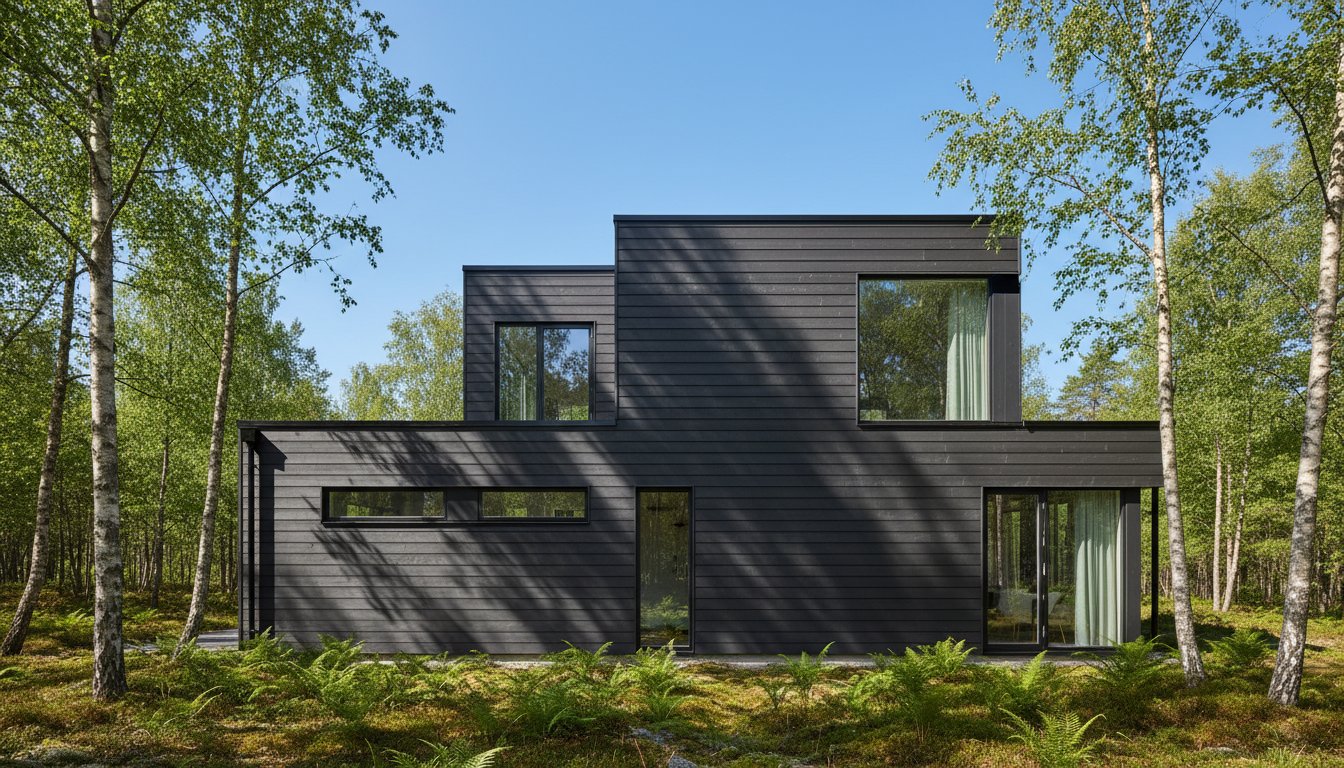
A facade that loses its depth of color within the first 24 months isn't just an aesthetic failure; it's a technical oversight. You likely appreciate the organic warmth of natural timber but dread the inevitable graying that solar radiation causes. It's a valid concern that many composite materials might look like cheap plastic after a few seasons of exposure. We believe your home's exterior should be a permanent statement of quality, not a recurring maintenance burden.
This guide explains how engineered UV resistant composite cladding utilizes advanced molecular stabilizers to maintain its refined Nordic character for 30 to 50 years. Designed in Scandinavia and produced in Europe, our professional-grade materials are built to last and designed for life. You'll discover the specific engineering behind color retention and why premium, traceable WPC delivers a superior return on investment. We'll show you how to achieve a maintenance-free facade that respects both nature and your time.
Key Takeaways
- Understand the molecular engineering that prevents photodegradation, ensuring your facade retains its structural integrity and refined Nordic character for decades.
- Learn how inorganic pigments and high-density polyethylene create a superior color stability that surface-level dyes cannot replicate.
- Compare the long-term performance gap between standard materials and UV resistant composite cladding to protect your architectural investment from premature fading.
- Identify the essential UV ratings and material specifications needed to select a durable cladding profile tailored to your specific regional sun exposure.
- Explore professional-grade, European-made solutions that combine sustainable engineering with the enduring aesthetic of natural fiber composites.
What is UV Resistant Composite Cladding?
UV resistant composite cladding is a high-performance building material engineered to stop the destructive process of photodegradation. Unlike standard exterior finishes, this material integrates specialized UV stabilizers throughout its profile. These additives function as a molecular shield, intercepting solar radiation before it can sever the polymer chains that provide the board's strength. High-grade Wood-plastic composites (WPCs) utilize these stabilizers to ensure the facade retains its original hue and structural density for decades. This engineering precision is vital for modern architectural design, where color fastness directly influences a property's long-term market value and aesthetic consistency.
The demand for UV resistant composite cladding has grown as architects seek materials that offer Nordic reliability without the fragility of natural fibers. When a facade is exposed to direct sunlight, it isn't just the color that's at risk. The chemical bond of the material is under constant stress. Quality engineering ensures that the product remains stable, providing a professional-grade solution that respects both the vision of the designer and the investment of the owner. Built to last. Designed for life.
The Mechanism of Photodegradation
UV radiation specifically targets lignin, a complex organic polymer that constitutes 25% to 30% of natural wood's dry mass. As UV rays break down lignin, the wood loses its structural "glue," causing the characteristic graying and splintering seen in traditional timber. In low-quality plastic composites, this exposure leads to "chalking," a white, powdery oxidation layer that indicates the polymer matrix is failing. Furthermore, solar heat gain can raise surface temperatures to 75°C. Without proper engineering, this thermal energy causes materials to expand and contract rapidly, which compromises the structural integrity of the entire building envelope.
Why Traditional Facades Struggle
Natural timber requires a rigorous maintenance cycle every 24 to 36 months. Homeowners must sand, prime, and restain the wood to combat the effects of the sun. This isn't just a labor issue; it's an environmental one. A single liter of traditional wood stain can contain up to 450 grams of Volatile Organic Compounds (VOCs). By choosing UV resistant composite cladding, you eliminate the need for these repeated chemical treatments. Our European-made cladding provides a circular, low-maintenance alternative that removes toxic preservatives from the maintenance equation. It's a responsible choice for those who value Scandinavian design and environmental ethics.
The Science of WPC Cladding Durability
The durability of UV resistant composite cladding stems from a precise, engineered formulation designed to withstand the harshest environmental stressors. We utilize a proprietary blend consisting of 75% hardwood fiber and 25% high-density polyethylene (HDPE). This high-fiber ratio ensures the material retains the tactile warmth of natural timber while the HDPE matrix provides a protective structural envelope. Unlike budget alternatives that rely on surface-level dyes, our cladding incorporates inorganic pigments integrated directly into the mix. This creates a color-fast material where the hue remains stable through the entire cross-section of the plank.
During the extrusion process, we introduce a sophisticated package of antioxidants and UV absorbers. These chemical stabilizers act as a sacrificial layer at a molecular level, intercepting harmful radiation before it can break the polymer chains. Scientific studies on UV resistance treatments show that the correct balance of these additives is vital for maintaining surface wettability and structural strength over decades. By sourcing 100% EU raw materials, we eliminate the variability found in global supply chains, ensuring every batch meets rigorous Scandinavian standards for molecular stability.
HDPE vs. Lower Grade Polymers
HDPE offers a higher strength-to-density ratio compared to PVC or mixed recycled plastics, which often fail under extreme temperature shifts. It remains flexible and resilient during thermal cycling, preventing the warping or "zipper" cracking common in lower-grade polymers. HDPE is a superior polymer for UV-exposed building envelopes because its high molecular weight provides an inherent resistance to environmental stress cracking. This stability allows architects to specify our UV resistant composite cladding for high-exposure coastal or alpine projects with total confidence.
Hardwood Fiber and Structural Integrity
We select hardwood fiber over softwood because its greater density provides superior resistance to compression and impact. In our manufacturing process, every individual fiber is encapsulated within the synthetic polymer. This encapsulation prevents moisture-driven UV damage, as the wood fibers are never directly exposed to the elements. The result is a powerful synergy where natural fibers provide the skeleton and synthetic stabilizers provide the shield. You can explore our range of engineered cladding solutions to see how this science translates into aesthetic longevity.
- 75% Hardwood Content: Provides natural density and thermal stability.
- Inorganic Pigmentation: Ensures deep color saturation that resists bleaching.
- Molecular Stabilizers: Protects the polymer matrix from photo-oxidation.
- Traceable EU Materials: Guarantees batch-to-batch consistency and ethical production.
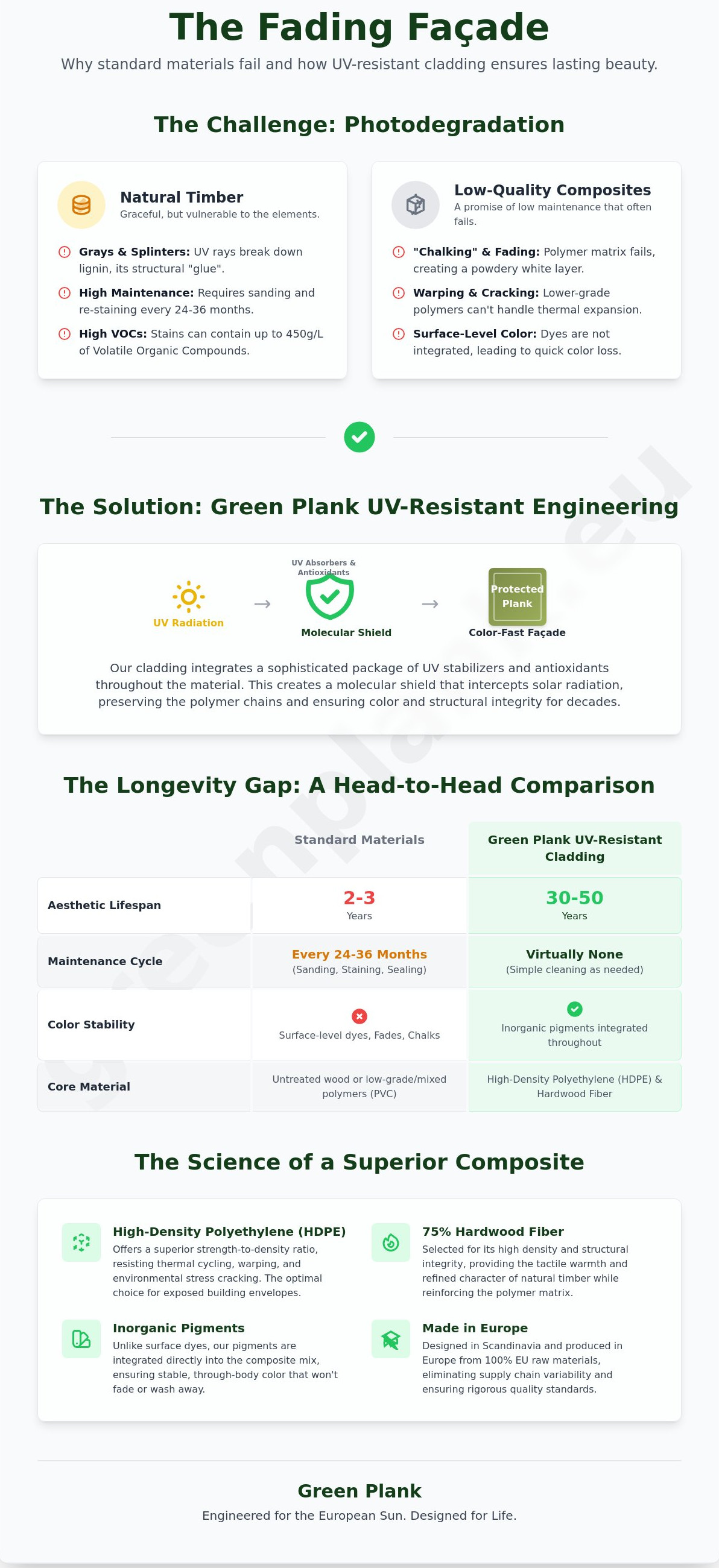
UV Resistant vs. Standard Cladding: The Longevity Gap
Standard cladding materials often lose up to 40% of their color saturation within the first 36 months of intense sun exposure. In contrast, premium UV resistant composite cladding utilizes advanced light stabilizers that protect the polymer matrix at a molecular level. A scientific study on UV resistance of WPCs confirms that specific durability treatments significantly reduce surface wettability and strength loss caused by photo-degradation.
Without these stabilizers, non-UV materials suffer from micro-cracking and structural brittleness. This degradation compromises the building envelope, leading to moisture ingress and reduced insulation efficiency over a 10-year period. By choosing engineered materials, you ensure the facade remains a functional shield rather than just a decorative layer.
Quantifying the ROI
Investing in UV resistant composite cladding transforms a recurring expense into a long-term asset. Traditional timber like larch or cedar requires professional restaining every 3 to 5 years to prevent silvering and rot. At an average cost of €30 per square meter for labor and premium oils, a 200-square-meter facade accumulates over €18,000 in maintenance costs over 15 years. Green Plank products eliminate these expenses. Our 30-to-50-year warranty provides a primary signature of engineering confidence, ensuring the property's resale value remains high because the exterior doesn't require a costly overhaul before a sale.
Aesthetics That Don’t Age
Maintaining a refined Nordic character requires color uniformity across all elevations of a building. Standard materials on south-facing walls weather significantly faster than those in the shade, creating a mismatched, patchy appearance. Our premium facades maintain a consistent tone regardless of orientation.
- Uniformity: Advanced pigments ensure north and south elevations age at the same rate.
- Stability: European-made composites resist the warping common in natural timber.
- Performance: Case studies of installations in high-UV regions show that after 1,825 days of exposure, color shifts remain below the threshold of human perception.
The result is a building that looks as striking in year 20 as it did on day one. Designed in Scandinavia. Produced in Europe. Built to last. Designed for life.
Selecting the Right Fade-Resistant Cladding
Specifying the correct UV resistant composite cladding involves more than selecting a color palette. It requires a technical evaluation of the product's DNA. High-performance facades must meet rigorous UV ratings, often verified through 3,000 hours of accelerated Xenon arc weather testing. This ensures the material maintains structural integrity and color consistency under intense solar loads. Architects should prioritize co-extruded profiles where a protective outer shell encapsulates the natural-fiber core; this engineered layer acts as a shield against photon-induced degradation.
The origin of the product serves as a benchmark for quality. A "Made in EU" designation signifies adherence to strict environmental and performance standards, such as EN 15534. These regulations ensure the composite contains traceable, high-quality polymers rather than inconsistent recycled streams that might fail prematurely. For projects in high-exposure regions, selecting a profile with a deeper grain or ribbed texture can help diffuse light. Utilizing hidden fastening systems like HidLoc™ maintains the aesthetic by eliminating face-screws. This prevents moisture and UV rays from penetrating the core through surface penetrations, preserving the pristine Scandinavian look for decades.
Understanding Warranty Terms
Warranty documents contain technical nuances that define long-term value. In a legal context, fade resistance typically refers to a specific Delta E threshold, which measures the perceptible change in color over time. A standard limited warranty might only cover structural failure, whereas a comprehensive performance guarantee includes color stability. A 50-year warranty serves as a definitive signal of engineering confidence. It reflects a product built to last through decades of seasonal cycles without losing its refined Nordic character.
Installation Best Practices
Correct installation is vital for maintaining the longevity of UV resistant composite cladding. Natural-fiber composites expand and contract with temperature shifts; installers must allow for thermal expansion of approximately 1mm per meter for every 10°C increase in surface temperature. Proper ventilation is equally critical. A minimum 20mm rear ventilation gap prevents heat buildup, which can accelerate the aging process of the polymers. For a detailed technical walkthrough, consult our Installing Composite Cladding: A Professional Guide to ensure your project meets European building standards.
Protect your investment with engineered durability. Browse our full collection of fade-resistant cladding profiles.
Green Plank: Engineered for the European Sun
Green Plank provides high-performance solutions for architects who refuse to compromise between aesthetics and environmental ethics. Our UV resistant composite cladding is engineered to withstand the intense UV indices found throughout Europe, from the heat of the Mediterranean to the reflective coastal light of the North. We focus our engineering on the Terra Tuff and Smart System lines; these products represent our most durable cladding solutions for high-traffic and high-exposure environments. By utilizing a Cradle to Cradle ownership model, we ensure every board contributes to a circular economy. Professional specifiers select our systems for commercial infrastructure because they demand materials that won't degrade, warp, or lose color over decades of exposure. Designed in Scandinavia. Produced in Europe.
Sustainability Meets Performance
We source 100% of our raw materials within the EU to maintain a completely traceable supply chain. This local approach significantly lowers transportation emissions and ensures our products meet strict European environmental standards. A 50-year service life means fewer replacements and a lower lifetime carbon cost. You can learn more about how our WPC reduces your project’s CO2 footprint through our detailed lifecycle analysis. Choosing Green Plank means investing in a circular design philosophy that prioritizes the planet as much as the project. Our commitment includes:
- 100% Traceability: Every component is accounted for within the European market.
- Circular Design: Materials are engineered for reuse and long-term durability.
- Longevity: A projected 50-year service life reduces the need for resource-intensive renovations.
Aspirational Nordic Design
Our boards capture the deep textures and warmth of natural timber while delivering the stability of advanced natural-fiber composites. We follow a simple philosophy: Built to last. Designed for life. This Nordic reliability ensures your facade retains its character without the need for annual staining or chemical treatments. It's a premium finish that serves the needs of modern, low-maintenance architecture. We invite architects and project partners to experience this quality firsthand. Contact our team to request professional samples and technical specifications for your next development. Our UV resistant composite cladding delivers a maintenance-free outdoor space that respects nature while providing a sophisticated, professional-grade finish.
Securing the Future of Your Facade
Choosing the right exterior finish is a decision that impacts both the environment and your property's value for decades. High-performance UV resistant composite cladding bridges the gap between natural aesthetics and engineered longevity. By utilizing 100% EU raw materials and a Cradle to Cradle ownership model, Green Plank ensures every profile maintains its structural integrity against the harshest solar exposure. Standard materials often fail within 10 years. Our professional-grade solutions are backed by an industry-leading 50-year warranty to provide absolute peace of mind. This commitment to circularity means your project remains as vibrant as the day it was installed. It's about more than just color retention; it's about a permanent reduction in maintenance costs and environmental footprint. You're not just building a wall. You're investing in a legacy of Scandinavian design and European engineering. Designed in Scandinavia. Produced in Europe. Built to last. Designed for life. Experience the tactile quality of our sustainable materials firsthand to see how engineering precision meets natural beauty.
Request a Professional Sample Kit for Your Next Project
We look forward to helping you realize a project that stands the test of time and sun.
Frequently Asked Questions
Does composite cladding fade in the sun?
High-quality UV resistant composite cladding is engineered to withstand solar radiation with less than 5% color shift over 25 years. This stability comes from advanced UV inhibitors integrated during the European manufacturing process. Unlike traditional timber that turns gray within 12 months, our Scandinavian-designed facades maintain their intended aesthetic. It's a professional-grade solution for those seeking long-term visual consistency without the need for staining.
How long does UV resistant composite cladding last?
UV resistant composite cladding is engineered for a service life exceeding 30 years. Green Plank products come with a 25-year limited warranty, reflecting our confidence in their Nordic durability. These panels are built to last; they won't rot, warp, or crack even under intense sun exposure. This longevity reduces the total cost of ownership compared to natural wood, which often requires replacement after 10 to 15 years. Built to last. Designed for life.
Is UV resistant cladding more expensive than traditional wood?
The initial purchase price is typically 20% to 30% higher than pressure-treated timber, but it's more cost-effective over its lifespan. You'll save approximately €15 per square meter every 2 years by eliminating the need for oils, paints, and sealants. This low-maintenance profile ensures the investment pays for itself within 7 years. It's a circular choice that combines European-made quality with long-term financial logic and reduced environmental impact.
What is the difference between WPC and PVC cladding regarding sun damage?
WPC uses natural fibers for a matte finish while PVC is entirely synthetic; both utilize different UV stabilization techniques. Our natural-fiber composite blends recycled wood with high-density polymers to achieve 90% resistance to thermal expansion. PVC cladding often lacks this structural stability and can become brittle after 5 years of UV exposure. We choose engineered WPC because it delivers a refined Nordic character without the plastic sheen or degradation common in low-grade synthetics.
Can I install UV resistant cladding in coastal areas?
Yes, our cladding is specifically designed to withstand the high-salt and high-UV environments of coastal regions. Salt spray won't corrode the material, and the UV inhibitors prevent the accelerated fading typically seen within 500 meters of the ocean. Our products are tested to withstand wind speeds up to 200 km/h. They provide a reliable, professional-grade shield for homes facing the North Sea or Mediterranean sun alike. Designed in Scandinavia. Produced in Europe.
Does the color of the cladding affect its UV resistance?
Darker tones absorb more heat but utilize 15% more UV stabilizers to ensure color permanence. Lighter shades like Nordic Oak naturally reflect more solar energy, which keeps the facade cooler during summer months. Regardless of the palette, every plank is manufactured in Europe with consistent pigment distribution. This ensures that even the deepest charcoal shades retain their elegance without the chalking effect found in inferior products that use low-grade pigments.
How do I clean UV resistant composite cladding without damaging it?
You only need warm soapy water and a soft-bristled brush to maintain the facade's appearance. Avoid high-pressure washers exceeding 1,500 PSI, as they can mar the engineered surface texture. Cleaning twice a year removes 99% of surface pollutants and pollen that might dull the finish. This simple routine preserves the traceable quality of the material and ensures the UV protection remains unobstructed by grime. Built to last. Designed for life.
What happens if my cladding starts to fade?
Minor initial weathering is normal during the first 12 weeks as the natural fibers stabilize, but any change beyond 5% is covered by our 25-year warranty. If you notice irregular fading, it's often surface debris rather than structural pigment loss. A quick wash usually restores the original Scandinavian aesthetic. We stand by our European-made engineering, ensuring your home remains a sustainable and beautiful reflection of your values for many decades to come.
Specificera produkten
Använd den här guiden i en Green Plank-specifikation
Tekniska WPC-artiklar ska stärka de kommersiella sidorna — inte konkurrera med dem. Fortsätt till komposittrall, TerraTuff, Nordeka eller de tekniska nedladdningarna.