



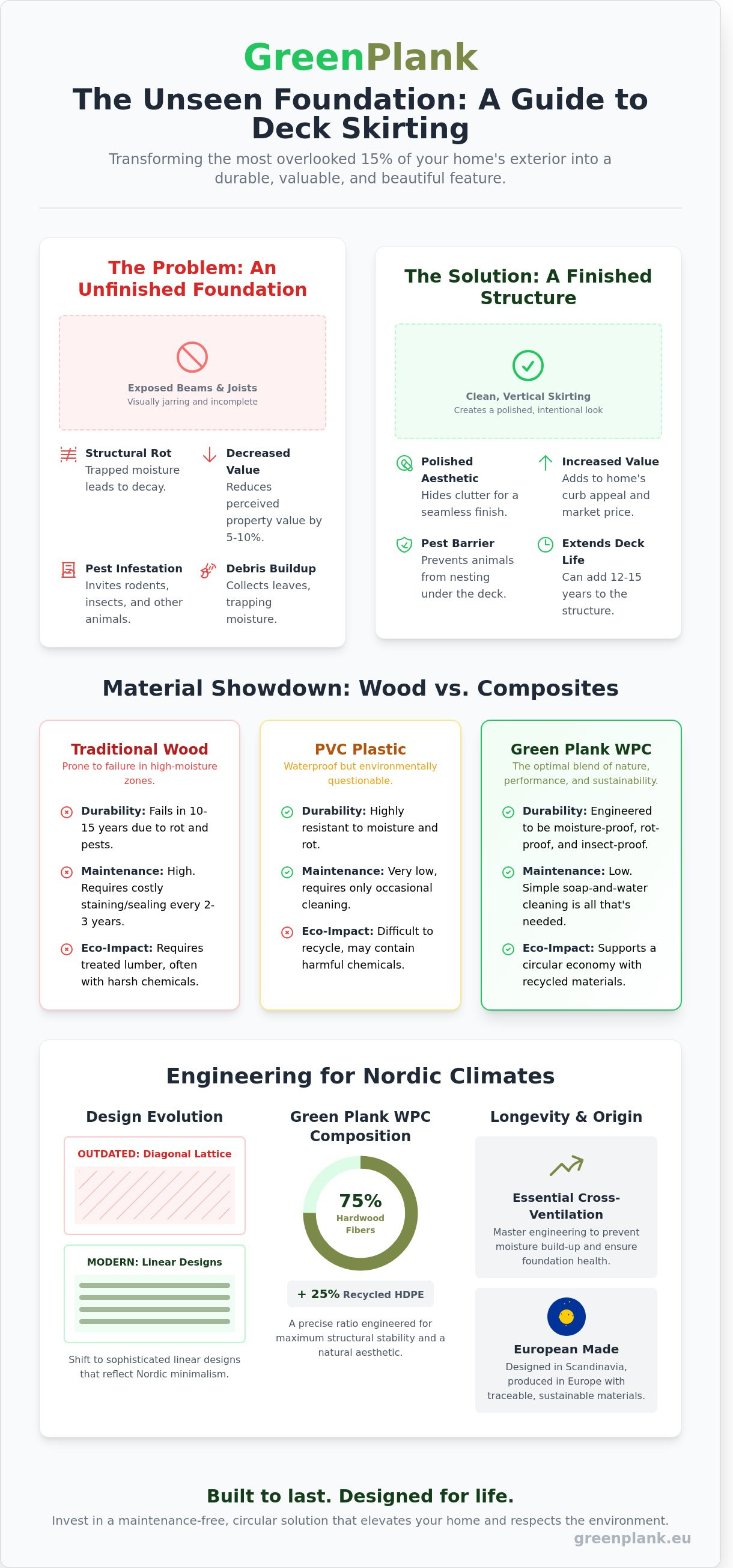
A deck's foundation is often the most visible 15% of a home's exterior that owners forget to finish, yet it's the first place where structural decay and pests take hold. You shouldn't have to settle for exposed, ugly beams or the constant chore of painting rotting wood to keep your backyard looking respectable. By exploring professional deck skirting ideas, you can hide structural components and prevent animals from nesting under your home. We've seen homeowners invest over 100,000 kr in premium decking only to have the overall impact diminished by an unfinished base.
This guide introduces innovative solutions that utilize engineered, natural-fiber composites to create a maintenance-free barrier. You'll discover how to achieve a polished, Nordic aesthetic that increases your home's market value while respecting the environment. Our natural-fiber composites are engineered in Europe to provide superior durability; they offer the warmth of wood without the vulnerability to harsh climates. We'll examine sustainable materials and professional installation techniques that ensure your outdoor space remains beautiful and circular. Built to last. Designed for life.
Key Takeaways
- Understand how deck skirting serves as a critical barrier for pest deterrence and structural protection while providing a seamless visual finish.
- Learn why high-performance Natural Fiber Composites (NFC) outperform traditional timber by eliminating rot and maintenance in the Swedish climate.
- Explore modern deck skirting ideas for 2026, shifting from dated diagonal lattices to sophisticated linear designs that reflect Nordic minimalism.
- Master the essential engineering requirements for cross-ventilation to prevent moisture build-up and ensure the long-term health of your deck's foundation.
- Discover the benefits of using traceable, European-made materials that integrate sustainable engineering with a professional-grade aesthetic.
The Architectural Role of Deck Skirting: More Than Just a Visual Finish
Deck skirting is the vertical barrier installed between the deck surface and the ground. It acts as the final architectural envelope for any Deck (building) project. While many homeowners view it as a cosmetic afterthought, it's a critical structural component. It protects the underside of your investment. High-quality deck skirting ideas have evolved from simple wooden lattices to integrated, high-performance panels. These modern solutions offer a seamless transition from the built environment to the natural landscape. Skipping this step often results in a 5 to 10 percent reduction in perceived property value. In the Swedish housing market, this can equate to a loss of 55,000 kr or more on a standard residential sale. Professional-grade skirting ensures your outdoor space looks intentional and complete.
Concealing the 'Under-Deck' Chaos
The space beneath a deck is rarely attractive. It's usually filled with structural posts, pressure-treated joists, and a tangle of plumbing or electrical lines for outdoor kitchens and lighting. Skirting hides this industrial clutter. It creates a unified aesthetic that ties the deck to the surrounding garden. Our natural-fiber composite panels are engineered to provide this visual consistency. They deliver stability and strength while maintaining a refined Nordic character. By defining the boundaries of your outdoor living zone, skirting makes the deck feel like a permanent extension of the home. It's a design choice that respects the architecture of the house. Designed in Scandinavia. Produced in Europe.
Pest Management and Debris Control
The dark, dry void under a deck is an invitation for unwanted guests. Rodents, foxes, and insects frequently seek shelter in these unprotected spaces. Effective deck skirting ideas prioritize exclusion. Solid barriers prevent nesting and reduce the risk of infestations that can eventually migrate into your home. Beyond pests, skirting manages environmental debris. Wind-blown leaves and organic matter accumulate in corners, trapping moisture against the wooden frame. This trapped moisture is a primary cause of structural rot. Data suggests that decks with proper airflow and debris protection can last 12 to 15 years longer than those left open to the elements. Choosing materials like our circular, sustainable composites ensures the skirting itself won't succumb to wood-boring insects or fungal decay. It's built to last. Designed for life.
Material Selection: Why Sustainable WPC Composites Outperform Traditional Wood
Traditional pressure-treated timber remains a common choice for Swedish homeowners, yet it often fails within 10 to 15 years when used in ground-contact applications. Skirting sits in a high-moisture zone where damp soil and limited airflow create the perfect environment for rot. This structural decay isn't just an aesthetic issue; it's a safety concern. When evaluating deck safety requirements, professionals look specifically for fungus and deterioration that can compromise the entire deck's integrity. Natural Fiber Composites (NFC) eliminate these risks by creating a barrier that moisture cannot penetrate.
The environmental cost of building materials is another critical factor. Many synthetic deck skirting ideas rely on PVC, which is difficult to recycle and often contains harmful phthalates. Green Plank utilizes HDPE-based Wood Plastic Composite (WPC) instead. This choice supports a circular economy by using recycled polymers that can be repurposed at the end of their long life cycle. Homeowners also save significantly on long-term costs. While wood requires an average of 3,000 SEK to 5,000 SEK every few years for high-quality stains and sealants, WPC only needs a simple soap-and-water cleaning to maintain its professional appearance.
The Engineering of Green Plank WPC
Our composite boards are defined by a precise 75% hardwood fiber and 25% HDPE blend. This specific ratio isn't accidental; it's the result of rigorous engineering designed to maximize structural stability. The high wood content provides the natural look and feel of Scandinavian timber, while the HDPE acts as a binding agent that prevents water absorption. We use 100% EU-sourced, traceable raw materials to ensure a transparent supply chain and a lower CO2 footprint than products shipped from overseas. These boards are engineered with a low-density core, making them 15% to 20% lighter than traditional hardwoods. This weight reduction simplifies the installation of vertical deck skirting ideas, reducing labor time and physical strain on installers.
Durability in Extreme Climates
Nordic winters present a unique challenge for outdoor materials. The constant freeze-thaw cycles cause natural wood to expand and contract until it eventually splits or warps. Green Plank composite skirting is built to withstand these fluctuations without losing its shape. We incorporate advanced UV inhibitors directly into the material matrix. This prevents the "grey-out" effect where sun exposure bleaches the color out of natural timber within a single season. Our 50-year warranty serves as the ultimate proof of our engineering confidence. It reflects a product that's built to last and designed for life. You can view our full range of sustainable composite profiles to see how Nordic reliability meets modern design.
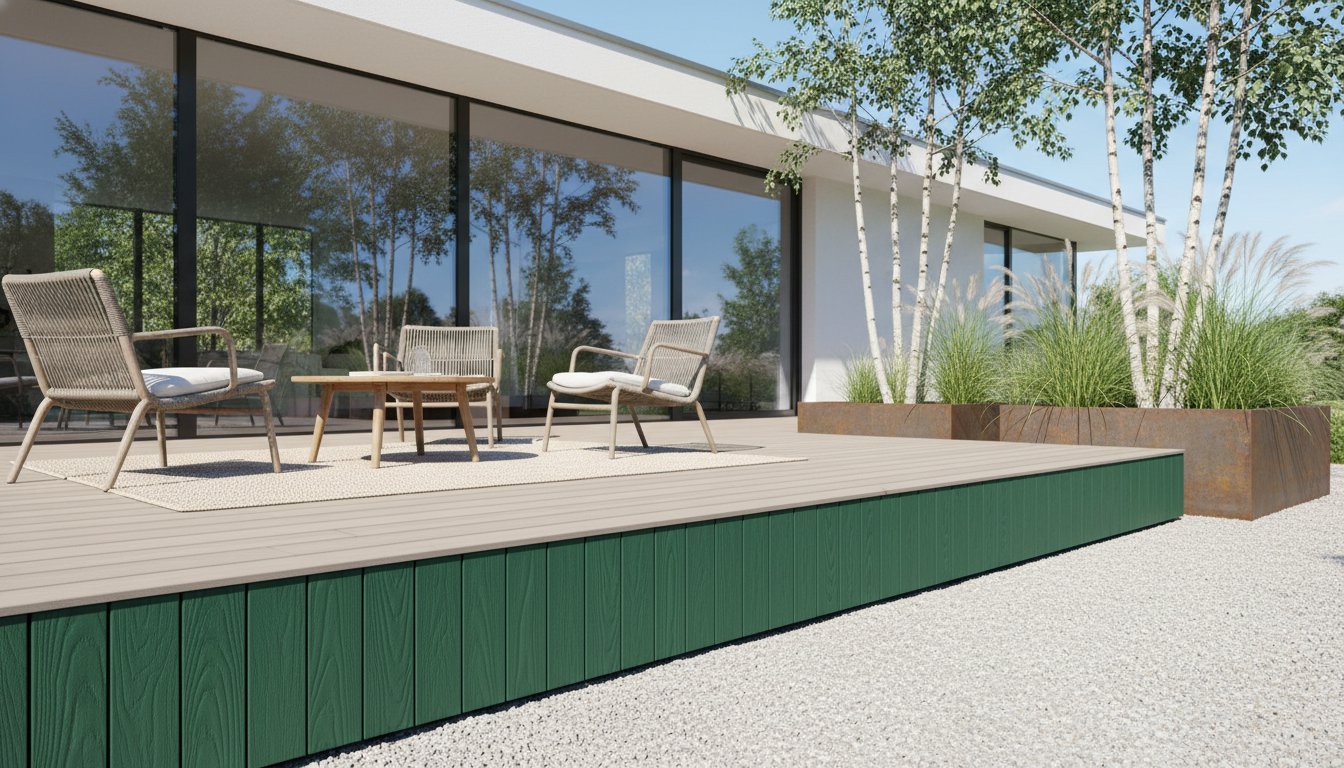
Modern Deck Skirting Ideas: Exploring Horizontal, Vertical, and Patterned Designs
As we approach 2026, outdoor design is shedding the cluttered look of diagonal lattice. Homeowners now prefer linear, clean aesthetics that align with minimalist Nordic architecture. Choosing the right deck skirting ideas requires a balance between the era of your home and the technical requirements of the structure. Modern builds benefit from sharp horizontal lines, while older Swedish villas often require vertical textures to maintain their heritage character.
Color selection is equally vital. Matching the skirt to the deck boards creates a monolithic, high-end look that feels like a single architectural unit. Contrasting the skirting with the house siding helps the deck stand out as a distinct feature. Integrated LED strip lighting tucked under the rim joist adds a premium evening ambiance. This lighting highlights the texture of the skirting while providing safety and security for your outdoor living space.
Horizontal Slat Skirting for Contemporary Homes
Horizontal slat skirting creates a sophisticated "wrap-around" effect. This design often mimics the sleek patterns found in high-quality wpc composite decking. By varying the slat widths, you can introduce architectural texture that breaks up the visual weight of the deck. Horizontal lines are a powerful tool for small Swedish gardens. They create an illusion of length, making a compact deck feel significantly more expansive. It's an engineered solution for modern urban living that prioritizes clean geometry.
Vertical Installation for a Traditional or Rustic Feel
Vertical installations offer a timeless appeal. This style works exceptionally well for homes with traditional board-and-batten siding. Beyond aesthetics, vertical slats provide a practical advantage in the Swedish climate. Gravity helps rainwater and melted snow run off more efficiently, reducing debris buildup at the base of the structure. For added depth, a "shadow box" configuration places boards on both sides of the support frame. This creates privacy while maintaining the airflow required by industry standards for deck construction.
Solid Fascia vs. Open Air Designs
Solid fascia boards deliver a sleek, furniture-like finish. This monolithic approach hides the structural underpinnings completely, though it requires careful planning for ventilation. To achieve a "Scandi-chic" look without sacrificing airflow, consider laser-cut patterned panels or precisely spaced slats. These designs provide the necessary open area for air circulation to prevent moisture buildup. Proper ventilation protects the long-term integrity of your natural-fiber composite and ensures the space remains dry and healthy.
- Linear Focus: 2026 trends emphasize 90-degree angles over diagonal patterns.
- Visual Expansion: Horizontal slats make narrow decks appear wider.
- Maintenance: Vertical orientations allow for faster drying in humid environments.
- Atmosphere: Low-voltage lighting transforms deck skirting ideas into a nighttime design feature.
Engineering for Longevity: Ventilation, Access, and Pest Management
The most common failure in deck construction isn't the choice of timber; it's the lack of breathability. When homeowners implement deck skirting ideas without considering airflow, they inadvertently create a moisture trap. This stagnant environment accelerates the decay of the wooden subframe, leading to structural instability and costly repairs. Engineering for longevity requires a balance between aesthetic enclosure and technical functionality.
The Science of Airflow Under Your Deck
Stagnant air creates a destructive microclimate that can compromise even the most durable wpc deck frames. Without cross-ventilation, humidity levels rise, causing timber joists to swell and mold to proliferate. To prevent this, you must integrate decorative vents or maintain consistent 5mm to 10mm gaps between horizontal slats. Providing 1 square foot of ventilation for every 150 square feet of deck area is a professional standard. This specific ratio ensures that air moves freely, keeping the substructure dry and stable throughout the changing Swedish seasons.
Building the Access Panel
A permanent, sealed skirt is a maintenance liability. You must include a strategic access hatch to reach electrical connections, outdoor plumbing, or storage areas. By utilizing hidden deck fasteners, you can create a seamless, invisible door that blends perfectly with the rest of the skirting. This engineered approach maintains the clean lines of Scandinavian design while providing necessary utility. Ensure the panel is heavy enough or latched securely to deter pests, yet remains easy for a person to operate without specialized tools.
Ground Contact and Drainage
Direct contact between skirting boards and the earth is a recipe for premature wear. Maintain a gap of at least 30mm between the bottom of your skirting and the soil or mulch to prevent moisture wicking. For a professional finish, install a layer of crushed gravel or professional-grade landscape fabric beneath the skirting line to suppress weed growth. WPC is the ideal material for these high-moisture zones because its natural-fiber composite structure doesn't rot or absorb water like traditional pressure-treated wood. Our products are built to last and designed for life, even in the harshest Nordic climates.
Before finalizing your deck skirting ideas, consult your local Swedish municipality regarding building permits (Bygglov). Regulations often dictate the height and transparency of structures near property lines. Following these legal standards prevents future fines and ensures your outdoor space remains a safe, compliant environment for decades.
The Green Plank Advantage: Integrating Sustainable Skirting into Your Project
Green Plank's Smart System and Terra Tuff lines provide the structural integrity required for high-performance deck skirting ideas. These collections aren't limited to horizontal surfaces; they're engineered for vertical excellence. Every plank utilizes 100% traceable EU raw materials. This transparency ensures your project complies with the 2024 European Timber Regulation (EUTR) while maintaining a minimal carbon footprint. By using the same high-density natural-fiber composite for the perimeter as the main deck, you ensure uniform expansion and contraction rates. This is critical in the Swedish climate, where temperatures fluctuate from -20°C in January to +30°C in July.
Achieving a professional, screw-free finish is simple with our HidLoc™ hidden fastening system. This technology eliminates the need for face-fastening, which often leads to splintering or visible rust over time. It creates a seamless, architectural transition between the ground and the deck surface. Designed in Scandinavia and produced in Europe, our products reflect a commitment to precision engineering. This localized production reduces transport emissions by 40% compared to composite materials imported from Asia or North America.
Matching Your Skirting to Your Decking
Consistency is the hallmark of premium design. We recommend using Green Plank fascia boards to create a perfectly color-matched perimeter. If you prefer a dynamic aesthetic, try mixing textures. Pairing our smooth cladding profiles with wood-grain decking creates a sophisticated contrast that defines the space. For complex, high-traffic commercial projects in cities like Stockholm or Gothenburg, we advise consulting with professional installers. They ensure that vertical skirting maintains the necessary 15mm airflow gap to prevent moisture buildup behind the structure. This technical detail protects your investment and the building's foundation.
The 50-Year Vision: Built to Last
Our 30-year residential and 20-year commercial warranties provide long-term peace of mind. These aren't just numbers; they represent our confidence in the material's durability. Choosing low-maintenance natural-fiber composite significantly reduces the lifetime cost of ownership. A typical 50-square-meter deck in Sweden can save a homeowner approximately 18,500 kr in oil, stain, and sanding costs over a 15-year period. It's a financial decision that supports environmental goals.
Before finalizing your installation, use this checklist to ensure your project meets our 'Cradle to Cradle' sustainability standards:
- Material Origin: Verify that all composite components are sourced from 100% traceable European forests.
- Circular Design: Ensure the skirting is installed using HidLoc™ clips to allow for easy disassembly and recycling at the end of its life cycle.
- Waste Management: Collect offcuts for return to a local recycling center; our composite is 100% recyclable.
Built to last. Designed for life. Green Plank transforms deck skirting ideas into permanent, sustainable landmarks for your outdoor living space.
Build a Legacy for Your Outdoor Living Space
Selecting the right deck skirting ideas isn't just about hiding structural beams; it's an investment in your property's longevity and environmental footprint. By choosing professional-grade WPC composites over traditional timber, you eliminate the cycle of painting and staining that costs Swedish homeowners thousands of kr over the deck's lifespan. These systems provide critical ventilation and pest management while maintaining a refined Scandinavian aesthetic that withstands the harsh Nordic climate.
Green Plank delivers high-performance solutions engineered for the circular economy. Our products feature 100% EU-sourced raw materials to ensure a significantly lower CO2 footprint compared to imported alternatives. We operate on a Cradle to Cradle ownership model, focusing on circular design that respects the planet. With an industry-leading warranty of up to 50 years on our professional-grade composites, your project is protected for decades. It's a choice that balances premium engineering with a deep commitment to Swedish nature.
Explore Green Plank's Sustainable WPC Solutions for Your Next Project
Your outdoor space deserves a finish that's as durable as it is beautiful. Start planning your sustainable transformation today.
Frequently Asked Questions
Does deck skirting need ventilation?
Yes, proper airflow is essential to prevent moisture buildup and structural rot in the wooden frame. You should provide at least 1 square meter of ventilation for every 150 square meters of deck area to ensure adequate breathability. This practice protects the substructure from the damp Swedish climate. Our natural-fiber composite is engineered to withstand humidity, but the underlying timber frame requires constant air circulation to maintain its 20 year lifespan.
What is the cheapest way to skirt a deck without sacrificing quality?
Pressure-treated timber is the most affordable initial option, costing approximately 180 kr per square meter for materials in Sweden. While the upfront price is lower, these materials often require 600 kr in oil and stains every two years to prevent decay. Investing in WPC deck skirting ideas provides a higher quality finish with a lower lifecycle cost. You'll avoid the recurring expenses of sanding and resealing traditional timber while maintaining a premium look.
Can I use composite decking boards for skirting?
You can certainly use composite decking boards for your skirting to create a cohesive, high-end appearance. Using the same European-made boards for both the surface and the perimeter ensures a perfect color match and uniform weathering. This approach simplifies the installation process. It also extends our 25 year residential warranty to the entire visible structure, providing a professional-grade finish that's built to last and designed for life.
How do I prevent animals from getting under my deck skirting?
Installing a physical barrier like galvanized steel mesh is the most effective way to deter wildlife from nesting. Trench the mesh at least 20cm into the ground and secure it firmly to the back of your skirting boards. This prevents badgers and smaller rodents from digging underneath. It's a permanent, sustainable solution that doesn't require harmful chemicals or traps to keep your outdoor space secure and clean.
Do I need an access door in my deck skirting?
You should always include at least one access door to reach utilities and inspect the deck's foundation periodically. A standard 600mm wide hatch allows enough room for a person to enter for maintenance or to retrieve items. Local Swedish building codes often require access to external water taps or electrical junctions located behind the skirting. A hidden door maintains the clean lines of your Scandinavian design while providing essential functionality.
Is WPC composite better than lattice for deck skirting?
WPC composite is superior to traditional lattice because it offers greater structural stability and a 30 year lifespan. Traditional wood lattice often cracks or sags after just 4 years in the fluctuating Nordic temperatures. Our engineered composite resists moisture and UV rays, ensuring the skirting remains straight and vibrant. It's a premium choice for homeowners who value circular materials and a maintenance-free lifestyle over temporary fixes.
How do I clean and maintain my WPC deck skirting?
Maintaining WPC skirting only requires a simple wash with warm, soapy water and a soft brush twice a year. You'll never need to sand, paint, or seal the boards. This saves a typical homeowner 1,500 kr per year in labor and material costs compared to traditional wood products. Our traceable raw materials are designed for life, allowing you to enjoy a pristine aesthetic without the environmental guilt of using chemical preservatives.
Should I match my skirting to the deck or the house?
Most modern architectural designs in Sweden match the skirting to the deck boards to create a unified, monolithic look. Approximately 80% of our professional installations follow this pattern to emphasize the deck's clean lines and contemporary profile. If your house has a distinct stone foundation, you might choose a contrasting dark grey to ground the structure. Matching the deck usually provides the most sophisticated finish for high-end homes. Built to last. Designed for life.
Specificera produkten
Använd den här guiden i en Green Plank-specifikation
Tekniska WPC-artiklar ska stärka de kommersiella sidorna — inte konkurrera med dem. Fortsätt till komposittrall, TerraTuff, Nordeka eller de tekniska nedladdningarna.