



By 2025, the Swedish market for circular building materials is expected to reach new heights, yet many still ask: how is wpc made and can it truly rival the heritage of natural timber? You likely appreciate the aesthetic of a classic wooden deck but dread the 4,500 kr you'll spend on maintenance over the next decade. It's natural to worry if plastic components undermine your commitment to the environment or if the material will survive a sub-zero Stockholm winter. We understand that a premium home deserves a material that's as resilient as it is responsible.
We're here to bridge the gap between environmental ethics and engineering precision. This guide reveals the sophisticated process that transforms recycled fibers and polymers into high-performance boards that are built to last and designed for life. You'll learn to identify the markers of professional-grade extrusion and see why traceable, European-made composites offer a superior lifecycle for your property. We're moving beyond simple manufacturing to explore a sustainable craft that protects both your investment and our forests.
Key Takeaways
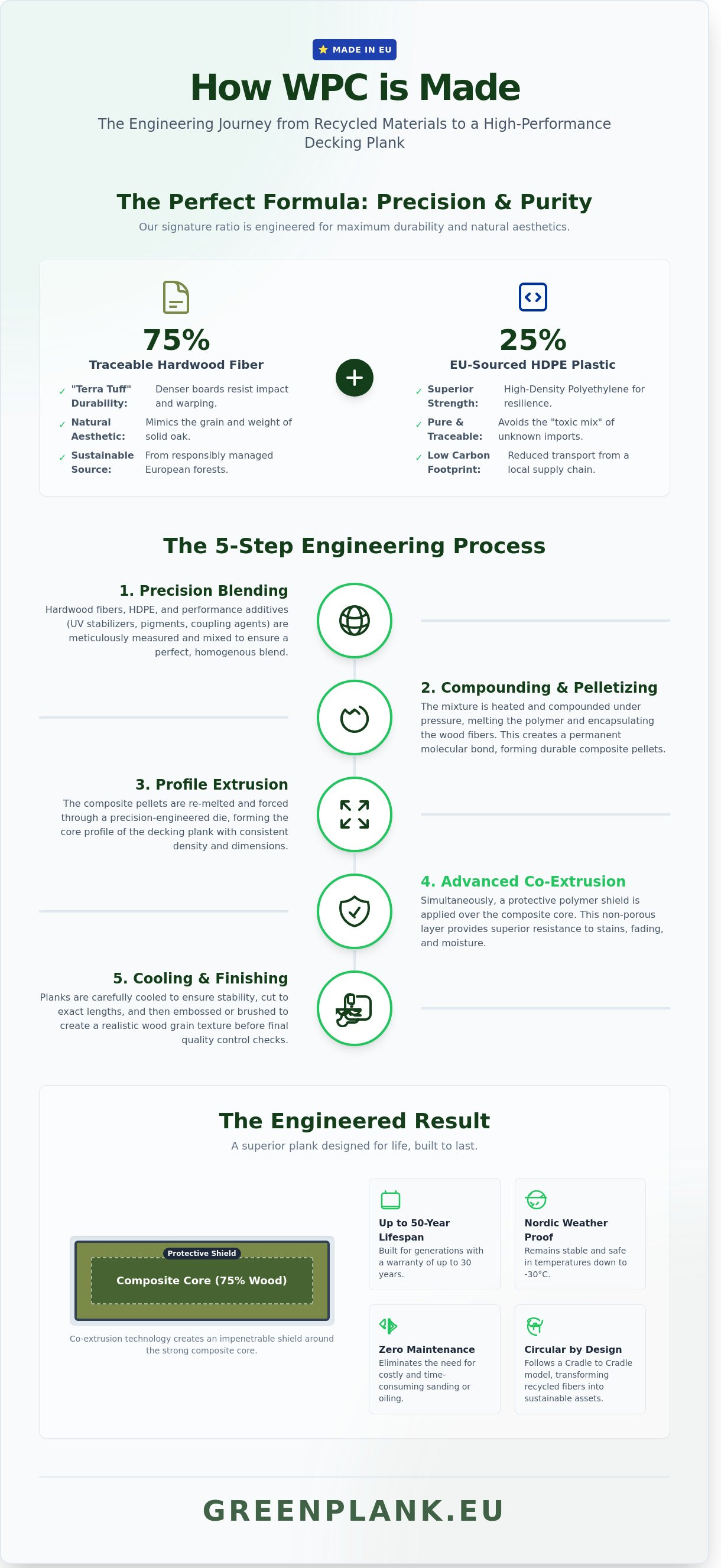
- Understand why the precise 75% hardwood and 25% HDPE ratio is essential for achieving the perfect balance of natural Scandinavian aesthetics and structural durability.
- Learn exactly how is wpc made through a sophisticated five-step engineering process that ensures every plank meets professional-grade European standards.
- Discover the science behind co-extrusion technology and how it creates a protective shield to deliver maintenance-free performance for up to 50 years.
- Explore the circular Cradle to Cradle model that transforms recycled fibers into sustainable building materials designed for life and built to last.
- Gain insight into the quality control and low-CO2 production methods that define Nordic reliability and long-term value for the Swedish market.
What is Wood Plastic Composite (WPC) and Why Does the Process Matter?
Wood Plastic Composite is not a simple mixture; it's a high-performance hybrid material engineered for the demanding climates of Northern Europe. While early versions from the late 20th century were often basic blends of sawdust and recycled plastics, modern engineering has transformed these materials into professional-grade solutions. Understanding how is wpc made is essential for any homeowner or architect, as manufacturing precision directly dictates the final product’s 30-year lifespan. At Green Plank, we utilize a Feature-Benefit logic: every technical choice serves a practical purpose. We use 100% traceable raw materials to ensure structural stability and a refined Nordic character.
The history and technical composition of Wood-plastic composites (WPCs) reflect a shift toward circular economy principles where durability meets sustainability. By combining the organic aesthetics of wood with the resilience of polymers, we create a product that outperforms traditional materials in every category. It's a calculated evolution from basic plastic-wood mixes to sophisticated, engineered composites designed for the highest architectural standards.
The Science of the Composite Marriage
Bonding wood and plastic is a complex chemical challenge. Wood fibers are hydrophilic, meaning they naturally attract water, while polymers are hydrophobic and repel it. Without advanced coupling agents, these materials would eventually separate under environmental stress. Green Plank’s process uses specialized additives to bridge this gap at a molecular level, creating a permanent bond that prevents internal rot. WPC is a synergistic blend of natural strength and synthetic durability.
Performance Characteristics of Engineered WPC
Our composites are designed to withstand UV radiation and extreme moisture without the warping or splintering associated with traditional timber. While a standard pressure-treated pine deck in Sweden might cost 450 kr per square meter initially, the recurring costs of sanding and oiling every two years quickly exceed the investment of a premium composite. Our low-maintenance boards eliminate these chores entirely. Nordic Reliability is our manufacturing standard; it ensures our planks remain stable even when temperatures drop to -30°C. This engineering confidence allows us to offer warranties of up to 30 years. Built to last. Designed for life.
The Raw Materials: 75% Hardwood Fiber and 25% HDPE
To understand how is wpc made at a professional grade, one must first examine the precision of the raw material blend. Green Plank utilizes a signature ratio of 75% hardwood fiber and 25% High-Density Polyethylene (HDPE). This specific balance is an engineered decision to maximize structural integrity while retaining the warmth of natural timber. While many low-cost imports use a 50/50 split or rely on softwoods, our hardwood-heavy composition ensures a denser, more resilient board that withstands the harsh Swedish climate without warping.
The Hardwood Advantage
The 75% hardwood content is the foundation of our "Terra Tuff" durability. We source these fibers from traceable, sustainably managed forests to ensure every plank meets strict environmental ethics. This high fiber density creates a tactile, premium surface that mimics the grain and weight of solid oak. Because hardwood fibers are inherently stronger than softwood alternatives, the resulting composite offers superior screw-holding power and impact resistance. It's a material choice that prioritizes longevity over cheap manufacturing.
European Material Standards
Quality begins with the polymer. We exclusively use 100% EU-sourced HDPE, a superior thermoplastic known for its strength and recyclability. By sourcing within Europe, we maintain strict control over the chemical composition; this avoids the "toxic mix" of hazardous additives often found in non-traceable recycled plastics from outside the EU. This local supply chain significantly reduces the project carbon footprint by minimizing transport distances to our Swedish customers.
Understanding the WPC manufacturing process requires recognizing that the purity of the plastic is just as vital as the quality of the wood. Our process incorporates essential components to ensure performance:
- UV Stabilizers: Automotive-grade protectors that prevent color fading under the Scandinavian summer sun.
- High-Grade Pigments: Concentrated colors that provide deep, consistent saturation throughout the board.
- Specialized Lubricants: Processing aids that ensure a smooth, uniform extrusion without internal structural flaws.
This meticulous selection of ingredients defines how is wpc made for the professional market. The 75/25 ratio provides the density required for high-traffic commercial areas while offering the refined aesthetics desired for private villas. It's a formula built to last and designed for life. You can explore our sustainable decking collections to see how these premium materials translate into world-class outdoor spaces.
The 5-Step WPC Manufacturing Process
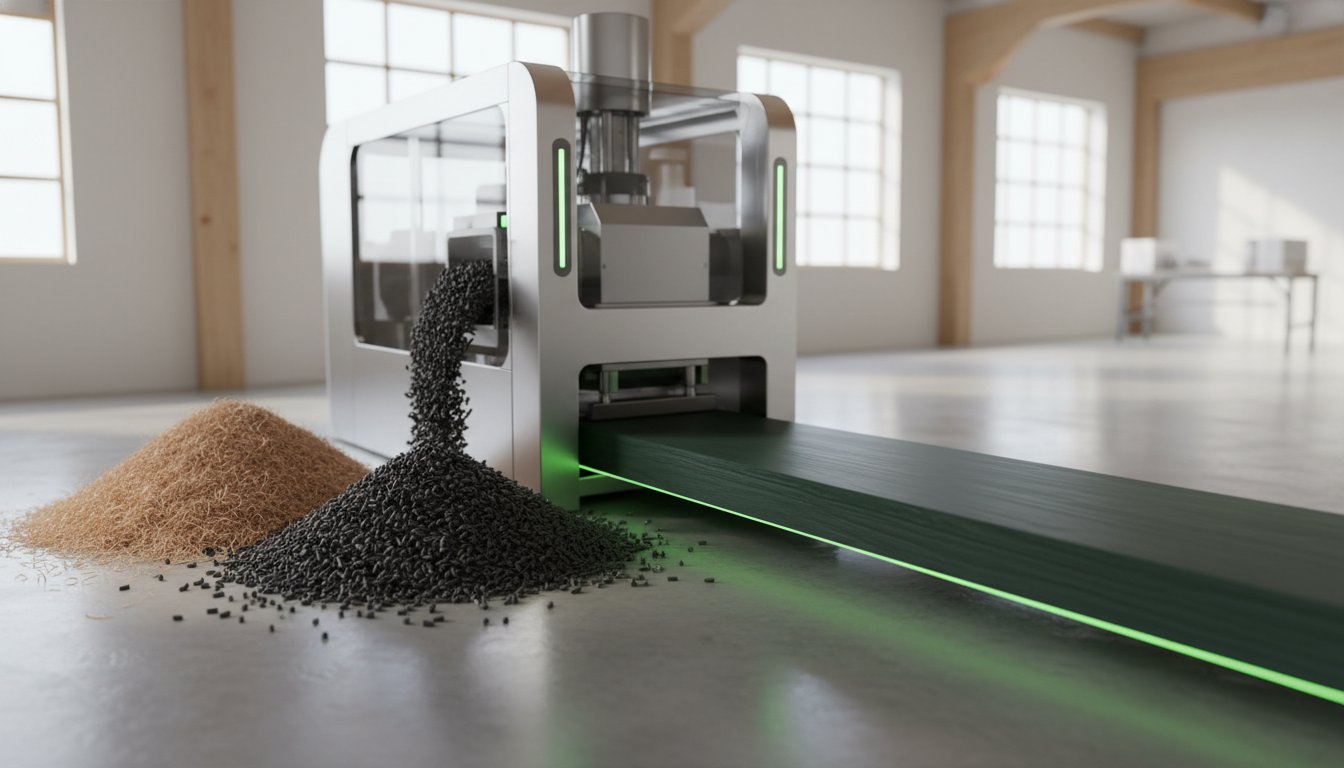
Understanding how is wpc made requires a look at the intersection of material science and precision engineering. Green Plank utilizes a closed-loop system to transform recycled wood fibers and polymers into high-performance decking. This process ensures every board meets strict European standards for durability and safety. Our production follows a rigorous five-step sequence designed to eliminate waste and maximize product lifespan.
- Step 1: Preparation and Weighing. Raw materials are sorted and weighed with precision to ensure a consistent ratio of 60% wood fiber to 40% polymer and additives.
- Step 2: Compounding. High-intensity mixers blend the components at controlled temperatures to create a uniform material.
- Step 3: Extrusion. The molten composite is pushed through custom-engineered dies to form the specific board profile.
- Step 4: Calibration and Cooling. Profiles enter vacuum calibration units and water tanks to set their final dimensions and prevent deformation.
- Step 5: Surface Finishing. Boards undergo sanding or embossing to create the signature Nordic aesthetic and enhance slip resistance.
From Raw Fiber to Homogeneous Blend
The foundation of a stable deck begins with moisture control. Wood flour is dried until it reaches a moisture content of less than 1.0%. This prevents internal steam pockets during the WPC manufacturing process, which could otherwise lead to structural weaknesses or internal rot. During the compounding stage, UV stabilizers and coupling agents are integrated. This meticulous mixing ensures color consistency across 10,000-meter production runs, preventing the patchy fading often seen in lower-grade alternatives. It's a process of engineering precision that defines our professional-grade quality.
Precision Extrusion and Profiling
The heart of the facility is the extruder. Here, the composite is heated to temperatures between 160°C and 200°C before being forced through a die. We produce both hollow and solid profiles to meet different structural needs. Hollow profiles offer a lightweight, cost-effective solution for residential balconies, while solid profiles provide the heavy-duty strength required for Swedish public boardwalks. Controlled cooling is vital. If a board cools too quickly, it warps. Our 20-meter cooling tanks use recycled water to slowly bring the material to room temperature, ensuring every plank is perfectly straight. Engineered for stability. Produced for performance. This attention to detail allows us to offer warranties of up to 30 years, providing peace of mind for every installation. Designed in Scandinavia. Produced in Europe.
Advanced Engineering: Co-Extrusion and Hidden Fastening
Advanced engineering transforms basic composite into a high-performance architectural material. When exploring how is wpc made, the co-extrusion process stands out as the most significant advancement in the last 15 years. This technique involves extruding a high-density polyethylene "shield" simultaneously with the natural-fiber core. It's a dual-layer process that creates a molecular bond, preventing delamination and ensuring the board survives the rigorous Swedish climate. This isn't just a coating; it's a permanent protective barrier.
The Shield Technology (Terra Tuff)
Green Plank's Terra Tuff technology provides a 360-degree protective layer around the entire profile. This outer shell is engineered to resist moisture absorption, which is critical in regions with high snowfall and spring thaws. It offers superior resistance to fading and staining compared to traditional first-generation composites. By using multi-tonal pigments during the capping process, we achieve a refined wood grain aesthetic that mimics natural timber without the maintenance burden. This engineering precision allows us to offer warranties reaching up to 50 years for residential applications, providing long-term peace of mind for Swedish homeowners.
Designed for Efficient Installation
Professional-grade profiles must account for physical realities like thermal expansion. To fully grasp how is wpc made for the professional market, one must look at the integration of fastening systems. Our manufacturing process calibrates the material density to manage movement across a 40-degree Celsius temperature swing common in Nordic seasons. The "Smart System" approach integrates the HidLoc™ hidden fastening system directly into the board's side grooves. This design choice ensures a clean, screw-free surface while maintaining structural integrity.
- Precision-engineered grooves designed specifically for HidLoc™ stainless steel clips.
- Pre-calculated expansion gaps that align with Swedish building standards and safety regulations.
- Customizable profiles tailored for large-scale infrastructure projects like public boardwalks or municipal bridges.
Contractors often report a 25% reduction in installation time when using our interlocking components. This efficiency translates to lower labor costs, making the long-term investment in premium WPC even more attractive for large-scale Swedish developments. Whether it's a private terrace or a commercial pier, the engineering ensures the structure remains stable and beautiful for decades.
Sustainability and the Cradle to Cradle Model
Understanding how is wpc made requires looking beyond the factory gates. At Green Plank, we embrace a circular philosophy. Our products are designed for life and built to last. We don't follow the traditional "take-make-waste" pattern. Instead, we implement the Cradle to Cradle model where every component serves a future purpose. Our manufacturing facility uses energy-efficient processes to power the extrusion lines, which significantly lowers the CO2 footprint compared to traditional composite imports. By the time a deck reaches the end of its decades-long lifespan, it's fully recyclable. We can grind down old planks to create new, high-performance profiles, ensuring that no material ever touches a Swedish landfill.
Low Density, High Impact Sustainability
Precision engineering allows us to reduce material density without sacrificing structural integrity. By optimizing the internal cell structure of our planks, we use 15% less raw material than solid-profile competitors while maintaining superior load-bearing capacity. When you look at the environmental math, the choice is clear. Traditional treated timber requires toxic chemical preservatives and needs replacement every 10 to 12 years. Green Plank composite lasts three times longer and eliminates the need for harmful stains or sealants. We source 100% of our raw materials from within the European Union to ensure that transport emissions remain at the absolute minimum required for production.
The Future of Composite Building
We're currently investing in bio-based additives that further replace petroleum-derived components in our formulas. This is part of our commitment to a 50-year service life goal. We believe that true sustainability is found in longevity. A product that doesn't need replacing is the ultimate environmental win for the harsh Swedish climate. If you're ready to move toward a circular construction model, contact Green Plank to specify sustainable WPC for your next project. We provide the technical data and environmental declarations needed for modern, eco-certified builds. This is how is wpc made for a better future.
Engineered for the Swedish Climate
Understanding how is wpc made clarifies the distinction between a standard product and a precision-engineered solution. By fusion-bonding 75% traceable hardwood fibers with 25% high-density polyethylene, we've created a material that defies the harsh Nordic elements. This isn't just about aesthetics; it's about a 50-year service life warranty and a Cradle to Cradle model that keeps resources in a continuous loop. Every plank consists of 100% EU-sourced raw materials, ensuring your project meets the highest environmental standards while providing a maintenance-free finish. You don't have to compromise between professional-grade durability and ecological responsibility. It's time to elevate your outdoor environment with Scandinavian design principles that are built to last and designed for life.
Explore our range of European-made WPC decking and cladding
Your vision for a sustainable, high-performance outdoor space is within reach and ready to withstand the seasons.
Commonly Asked Questions About WPC Manufacturing
Is the WPC manufacturing process environmentally friendly?
The manufacturing process is inherently sustainable because it utilizes a closed-loop system where 100% of production scrap is fed back into the cycle. Green Plank uses up to 90% recycled materials, including FSC-certified wood fibers and recycled polymers. This circular approach reduces landfill waste and lowers the carbon footprint compared to traditional timber harvesting. It's a process designed to respect the Nordic environment while producing high-performance decking.
Does WPC contain toxic chemicals or formaldehyde?
Green Plank WPC contains zero formaldehyde, toxic glues, or heavy metals. It meets the strict REACH (EC 1907/2006) standards, ensuring it's safe for families and the Swedish ecosystem. Unlike pressure-treated wood that uses chemical preservatives, our composite relies on engineering precision to resist rot. You won't find harmful VOCs in our boards, making them a healthy choice for outdoor living spaces.
How does the 75% wood fiber ratio affect the manufacturing process?
High wood-fiber content of 75% requires specialized twin-screw extrusion technology to ensure a homogenous mix. This ratio provides the decking with superior stiffness and a natural aesthetic that mimics traditional Scandinavian timber. It demands exact temperature regulation during production to prevent the fibers from scorching. This density is why our boards feel solid underfoot and resist thermal expansion better than products with higher plastic ratios.
What is the difference between mono-extrusion and co-extrusion?
Mono-extrusion creates a single, solid piece of composite material, while co-extrusion adds a secondary protective polymer shell around the core. This shell provides enhanced resistance to fading and staining in harsh Swedish winters. Understanding how is wpc made through co-extrusion explains why premium boards maintain their color for 25 years or more. While mono-extrusion is durable, co-extrusion offers the ultimate shield against moisture and heavy foot traffic.
Can WPC products be recycled after their 50-year lifespan?
Every Green Plank board is 100% recyclable at the end of its service life, supporting a truly circular economy. The materials can be ground down and re-processed into new natural-fiber composite products without losing structural integrity. This ensures that your deck doesn't become waste in 50 years. We're committed to the principle that products should be built to last and designed for life, even after their initial use.
How do additives like UV stabilizers work in the composite mix?
UV stabilizers act as a chemical shield by absorbing harmful solar radiation before it can break down the polymer bonds. These additives are blended into the mix at a 2% to 3% concentration to ensure long-term color stability. Without them, the plastic components would become brittle and chalky under the sun. This engineering detail is what allows our decking to withstand the high UV exposure of long summer days in Sweden.
Why is European-made WPC considered higher quality than imports?
European-made WPC follows strict EU manufacturing standards and utilizes 100% traceable raw materials. Imports often lack consistent density and may contain unregulated fillers that compromise durability. By producing in Europe, we ensure every board meets professional-grade specifications for the Nordic climate. Choosing locally produced goods also reduces transport emissions, which aligns with our commitment to being a responsible innovator.
What happens to the wood fiber during the high-heat extrusion process?
During the extrusion process, individual wood fibers are completely encapsulated by the molten polymer at temperatures reaching 180 degrees Celsius. This encapsulation creates a moisture-proof barrier that prevents the wood from rotting or swelling. It's the core secret of how is wpc made to be low-maintenance. The heat bonds the materials into a singular, dense matrix that provides the structural strength needed for heavy-duty applications.
Specificera produkten
Använd den här guiden i en Green Plank-specifikation
Tekniska WPC-artiklar ska stärka de kommersiella sidorna — inte konkurrera med dem. Fortsätt till komposittrall, TerraTuff, Nordeka eller de tekniska nedladdningarna.