



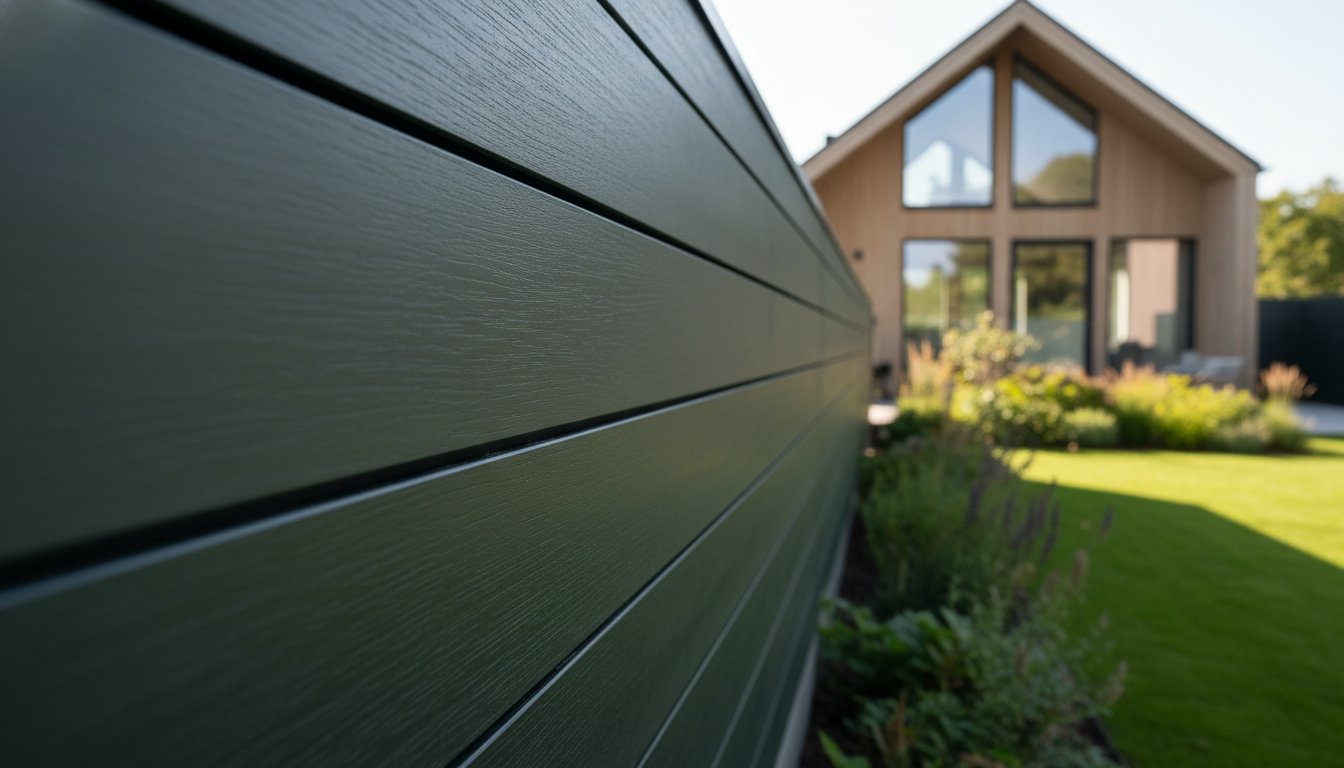
What if your property boundary could endure the next 30 years of harsh Nordic winters without a single drop of paint or chemical sealant? You likely value the organic warmth of wood, yet you're tired of the maintenance costs revealed in a standard fence material comparison. It's frustrating to watch a premium investment degrade under the elements or feel the environmental weight of non-traceable PVC alternatives. Choosing the wrong material often results in structural failure within 10 years, leading to avoidable waste and recurring costs.
This 2026 guide provides a definitive analysis of modern fencing solutions to help you balance high-end design with ethical responsibility. We promise to guide you toward a solution that's built to last and designed for life, ensuring your outdoor space remains maintenance-free and aesthetically pristine. We'll examine natural-fiber composites and engineered materials manufactured in Europe using 100% traceable raw materials. You'll discover how circular manufacturing and Cradle to Cradle compliance can transform your perimeter into a sustainable, professional-grade asset that respects both your time and the planet.
Key Takeaways
- Understand the evolution from traditional, high-maintenance boundaries to high-performance engineered systems designed for long-term structural integrity.
- Utilize a comprehensive fence material comparison to identify the ideal balance between refined Scandinavian aesthetics and lifelong durability.
- Analyze the 30-year total cost of ownership to see how low-maintenance materials provide a superior return on investment through engineered UV stability.
- Discover how to reduce your environmental footprint by selecting European-made, circular materials that prioritize traceability and carbon reduction.
- Learn to select a professional-grade fencing system that harmonizes with your home’s architectural character while meeting specific privacy and security requirements.
The Evolution of Fencing: Why Material Choice Matters in 2026
The fencing industry has undergone a fundamental transformation. For decades, boundaries were viewed as temporary structures, often replaced every 10 to 15 years. By 2026, this "disposable" mindset has vanished. High-performance engineered systems now dominate the market, replacing the fragile barriers of the past. Modern fencing must balance architectural beauty with uncompromising structural integrity. To understand these shifts, property owners often consult a comprehensive overview of fencing to see how these structures evolved from simple timber pickets to sophisticated, sustainable systems.
Climate change has accelerated material degradation across Northern Europe. Increased annual rainfall and milder, more humid winters have created a breeding ground for wood-rotting fungi. Traditional softwoods, even when pressure-treated, struggle to survive these conditions for more than a decade. Project specifiers now reject chemical-treated wood due to its poor performance and environmental toxicity. They prefer materials that prioritize longevity and circularity. A detailed fence material comparison reveals that the future of boundary design lies in materials that resist moisture while maintaining a refined aesthetic.
What Makes a 'Best' Fencing Material?
Durability is the primary benchmark for quality in 2026. A superior material must resist rot, UV degradation, and high-velocity impacts without warping or cracking. Beyond strength, the aesthetic factor remains vital. Homeowners demand materials that maintain a "Nordic character," preserving the warm, textured appearance of natural wood over several decades. Sustainability is no longer a luxury; it's a core requirement for European construction. We use 100% traceable raw materials to ensure every fence is as responsible as it is beautiful. Built to last. Designed for life.
The Hidden Costs of Traditional Timber
Traditional wood fences carry significant long-term burdens that are often overlooked during initial installation. These include:
- Annual maintenance cycles: Timber requires staining, painting, or sealing every 24 months to prevent moisture ingress.
- Frequent replacement: Most pressure-treated softwoods fail within 12 years in damp Northern European climates, leading to high labor and disposal costs.
- Chemical leaching: Older treatment methods use copper and other chemicals that can leach into the soil, damaging local ecosystems.
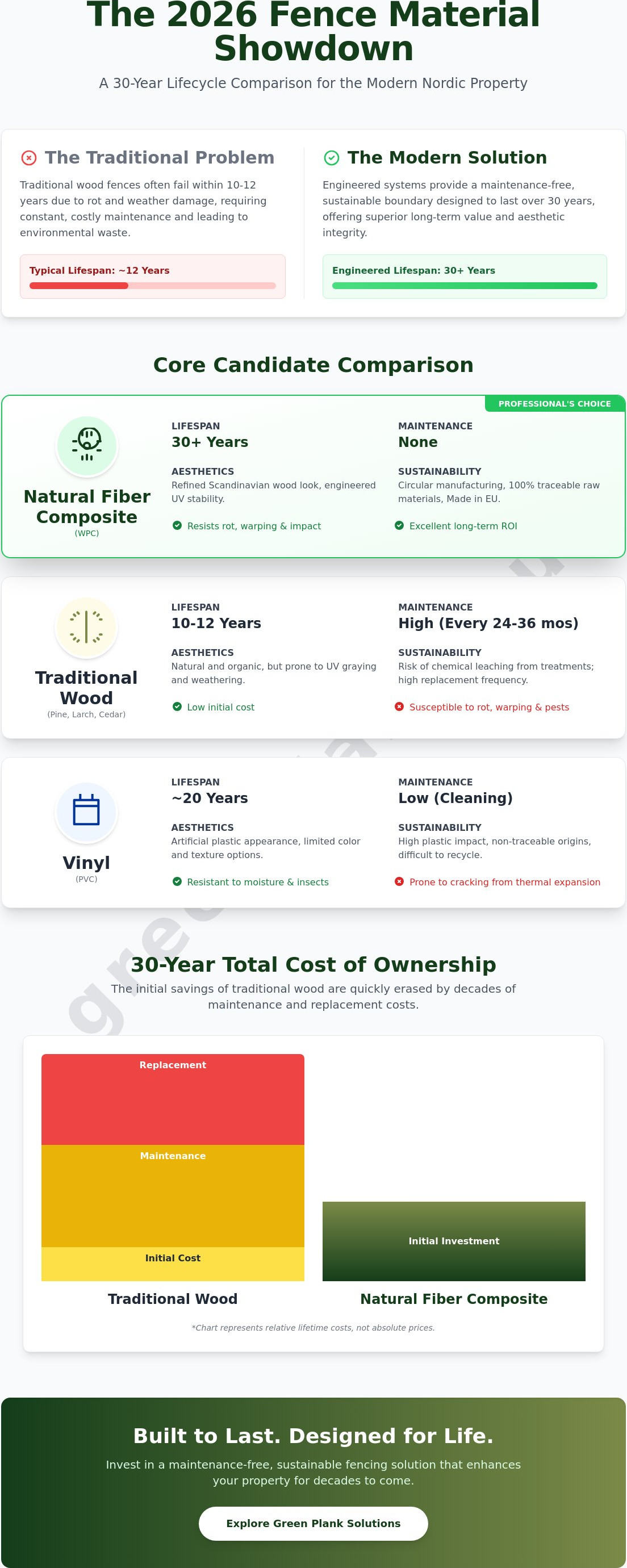
Analyzing a fence material comparison shows that the initial savings of timber are quickly erased by these recurring expenses. Choosing an engineered, natural-fiber composite eliminates these chores, delivering a maintenance-free lifestyle that respects the environment. Our professional-grade solutions provide the reliability that modern homeowners and architects demand.
Comparing the Core Candidates: Wood, Metal, Vinyl, and WPC
Selecting the right boundary involves balancing aesthetic appeal against long-term performance. A thorough fence material comparison reveals that while initial costs vary, the true value lies in the lifecycle durability and environmental footprint of the chosen product. Homeowners and architects must weigh the organic warmth of timber against the industrial resilience of synthetics and the engineered stability of modern composites.
Wood Fencing: Natural Beauty vs. Biological Decay
Wood remains the traditional choice, typically utilizing species like Cedar, Larch, or pressure-treated Pine. It offers a low initial investment and a classic organic appearance that integrates seamlessly with garden landscapes. However, wood is inherently porous. It absorbs moisture, which leads to warping, splitting, and rot. Even species labeled as "low-maintenance" require chemical staining or sealing every 24 to 36 months to prevent UV graying and structural failure. In harsh Nordic climates or high-moisture areas, biological decay can compromise a wooden fence within 10 years, necessitating costly repairs or full replacement.
Vinyl and Metal: Industrial Solutions
Vinyl (PVC) is often marketed as a maintenance-free alternative, yet it carries a high plastic impact and limited aesthetic flexibility. It suffers from significant thermal expansion. Panels can expand or contract up to 2% of their length during temperature swings, which leads to structural brittleness and cracking over time. Metal fencing, such as Aluminum or Steel, provides high security but lacks natural warmth. In coastal regions, salt spray causes rapid corrosion unless the material meets specific ASTM powder-coating standards. Repairing industrial materials is notoriously difficult; a cracked vinyl panel or a dented metal post usually requires a full section replacement. Research regarding the life cycle assessment of fencing materials indicates that these synthetic and metallic options often carry a heavier environmental burden during both production and disposal phases compared to bio-based alternatives.
WPC Composite: The Sustainable Innovator
Wood Plastic Composite (WPC) serves as the engineered hybrid designed for balance. Professional-grade WPC, such as that produced by Green Plank, utilizes a blend of 75% hardwood fiber and high-density polyethylene (HDPE). This high fiber content provides the natural feel and thermal stability of wood, while the HDPE encapsulation prevents moisture absorption and fungal growth. European-made WPC outperforms generic imports by utilizing traceable raw materials that ensure superior density and UV stability. This composition eliminates the risk of rot and insect damage. It is a solution built to last and designed for life. For those seeking a permanent boundary, exploring engineered composite solutions provides a path to a 30-year lifecycle without the burden of constant upkeep.
Durability and ROI: A 30-Year Fence Lifecycle Analysis
Selecting a boundary isn't just an aesthetic choice; it's a long-term financial commitment. A comprehensive fence material comparison reveals that the initial purchase price rarely reflects the final expenditure over three decades. While softwood options appear cost-effective at the point of sale, their Return on Investment (ROI) diminishes as replacement cycles accelerate. Most timber systems fail within 12 to 15 years due to ground rot or structural warping. In contrast, professional-grade composites maintain their integrity for 30 years or more.
Performance metrics extend beyond mere survival. UV stability and color retention are critical for maintaining property value. High-performance composites utilize advanced UV inhibitors to ensure the "grey-out" effect common in natural wood is virtually eliminated. This engineering precision provides structural strength that withstands high wind loads, ensuring post-system integrity remains intact during extreme weather. This technical superiority is why Green Plank provides warranties in the 50-year range. Designed for life. Built to last.
When evaluating these systems, the USDA guide to fencing materials serves as an authoritative reference, highlighting that material selection directly dictates the frequency of repair and total cost of ownership. Our European-made products are engineered to exceed these standard expectations through circular manufacturing processes.
The Maintenance-Free Myth vs. Reality
Many homeowners believe "low-maintenance" is a marketing buzzword, but the data tells a different story. Maintaining a traditional timber fence requires roughly 20 hours of labor every two years for scraping, sanding, and restaining. Over a ten-year period, that's 100 hours of manual labor and significant material costs. Choosing a composite system doesn't just save money; it reclaims your time. For those planning a project, Mastering Composite Fence Installation provides the technical foundation for a lasting, worry-free boundary.
Engineered for the Nordic Climate
Scandinavian environments demand exceptional resilience. When conducting a fence material comparison for northern latitudes, the ability to withstand moisture absorption is the primary differentiator. Our natural-fiber composites are specifically engineered to resist the expansion and contraction caused by freeze-thaw cycles. We utilize 100% EU raw materials to ensure consistent quality standards and traceable sustainability. This local sourcing prevents the structural failures often seen in imported materials that lack the density to handle heavy snow loads. By integrating high-density fibers with stabilized polymers, we deliver a product that retains its refined Nordic character regardless of the season. Designed in Scandinavia. Produced in Europe.
Sustainability and the Circular Economy in Fencing
In a modern fence material comparison, durability no longer stands alone; it must be paired with environmental accountability. While many products claim to be "recyclable," this often results in downcycling where material quality degrades over time. True sustainability requires a circular approach. Green Plank operates on a Cradle to Cradle philosophy, ensuring materials remain in a continuous loop of value. This transition from a linear model to a circular economy is the definitive standard for 2026 construction.
Cradle to Cradle: Building for the Future
Green Plank implements circular ownership models by utilizing up to 90% recycled content in its natural-fiber composites. By repurposing hardwood fibers from the timber industry, we actively reduce the demand for virgin wood. This helps curb global deforestation rates, which reached 10 million hectares per year between 2015 and 2020. These fibers are bonded with high-density polyethylene (HDPE) rather than toxic PVC. Unlike PVC, which releases chlorine gas and dioxins during production, HDPE is safer for the environment and maintains higher structural integrity over its 30 year lifespan. For a deeper look at these processes, see our Sustainable Building Materials Guide.
Why 'Made in EU' is a Quality and Ethical Marker
Localization is a core pillar of our sustainability strategy. By manufacturing within the European Union, we eliminate the heavy carbon cost of transoceanic shipping from Asia. Long-distance shipping accounts for over 3% of global CO2 emissions; a cost we refuse to pass on to the planet. Our production facilities adhere to strict REACH regulations, ensuring that no harmful substances leach into your soil or groundwater. This engineering precision ensures our products are as safe as they are strong.
We provide 100% traceable raw materials, which is vital for commercial projects seeking BREEAM or LEED certifications. Architects and contractors can verify the origin of every panel, ensuring ethical labor practices and environmental compliance. Our commitment to transparency means you know exactly what constitutes your boundary. Designed in Scandinavia. Produced in Europe. Built to last. Designed for life.
When performing a fence material comparison, the chemical makeup and origin of the product are as critical as its aesthetic appeal. Our professional-grade composites offer the warmth of wood without the ecological debt. It's a choice that respects both your property and the natural world.
Selecting the Right System: From Privacy to Professional Grade
Choosing a boundary system requires balancing functional requirements with long-term environmental impact. Your primary objective dictates the material selection. A privacy fence needs solid, interlocking profiles to block sightlines and reduce wind noise. A security boundary prioritizes vertical strength and rigid post systems. For those defining an aesthetic boundary, the focus shifts to architectural harmony and material texture.
A comprehensive fence material comparison reveals that natural-fiber composites offer the most versatile design language for modern estates. You can match the clean lines of Scandinavian minimalism or the bold textures of contemporary industrialism. Precision-engineered fastening systems play a critical role in this aesthetic. Hidden fasteners eliminate visible screws; this creates a seamless finish and prevents moisture ingress at attachment points. It's a professional-grade solution that protects the core of the profile.
Integrating your boundary with wider WPC composite decking projects ensures a unified outdoor environment. Using the same sustainable material palette across horizontal and vertical surfaces creates a cohesive landscape. When performing a detailed fence material comparison, architects often prioritize these integrated systems to ensure color consistency and matching weathering patterns across the entire property.
Green Plank Fencing Systems: Terra Tuff and Beyond
Our Terra Tuff series represents the peak of high-density composite engineering. We design these systems for demanding commercial environments and refined residential spaces alike. We utilize low-density, high-strength profiles to ensure the installation remains manageable for contractors. This engineering choice reduces labor time while maintaining the structural integrity required for high-wind zones. Professional specifiers can choose from a range of Nordic-inspired colors and textures. Heights are fully customizable to meet specific site requirements or local building codes.
Next Steps: Planning Your Sustainable Boundary
The tactile quality of our natural-fiber composite is best experienced firsthand. Requesting a sample allows you to feel the density and see the authentic grain that defines our European-made products. For infrastructure projects or large-scale developments, our professional partners provide technical consultations to ensure every specification meets European standards. We focus on circularity and engineering precision to deliver a boundary that respects the planet.
Your final checklist should include:
- Warranty: Look for a 20 to 30 year performance guarantee to ensure long-term value.
- Sustainability: Verify the use of 100% traceable raw materials and carbon-efficient manufacturing.
- Maintenance: Confirm the system requires no painting, staining, or toxic chemical treatments.
Designed in Scandinavia. Produced in Europe. Built to last. Designed for life.
Securing Your Landscape for the Next Half-Century
Selecting the right boundary involves more than just aesthetics; it's a decision that impacts your property's ROI and environmental footprint for decades. This fence material comparison demonstrates that modern engineering has surpassed traditional wood, which often requires replacement or heavy chemical treatment within a decade. By prioritizing a 30-year lifecycle analysis, you're choosing a path of lower maintenance and higher durability. Green Plank leads this transition by utilizing a Cradle to Cradle circular ownership model. We manufacture our systems using 100% EU-sourced traceable raw materials to ensure maximum strength and ethical transparency. It's a professional-grade solution that respects both your time and the natural world. Our natural-fiber composites are built to last and designed for life, supported by an extensive service life warranty of up to 50 years. You don't have to sacrifice beauty for responsibility. Explore our range to find a system that combines refined Nordic character with unmatched engineering precision.
Explore Green Plank's Sustainable Fencing Systems and build a boundary that stands the test of time.
Frequently Asked Questions
Which fence material lasts the longest without maintenance?
Natural-fiber composite is the longest lasting material available in 2026, requiring zero painting or staining over its 25 year lifespan. Unlike timber that rots or metal that eventually corrodes, our European-made composite resists biological decay and moisture. It's engineered to maintain structural integrity in harsh Nordic climates. This makes it the superior choice for a long-term fence material comparison where durability is the primary metric.
Is composite fencing more expensive than wood in the long run?
Composite fencing provides a lower total cost of ownership because it eliminates the financial burden of biennial staining and structural repairs. A 2023 industry report showed that traditional timber fences require professional maintenance every 24 months to prevent failure. By choosing a professional-grade composite, you invest upfront to save on labor and material costs for decades. It's a circular economy approach that respects your time and resources.
What is the most eco-friendly fencing material available in 2026?
Natural-fiber composite engineered from 90% recycled wood fibers and recycled polymers is the most sustainable option for modern boundaries. Green Plank products use 100% traceable raw materials to ensure a low carbon footprint and ethical sourcing. This circular manufacturing process reduces landfill waste and avoids the toxic chemical treatments found in pressure-treated timber. Designed in Scandinavia. Produced in Europe.
Can composite fence panels withstand high winds?
Our engineered composite panels are tested to withstand wind speeds up to 120 kilometers per hour when installed according to our professional-grade specifications. The tongue-and-groove system creates a solid, interlocking barrier that distributes pressure evenly across the entire structure. This engineering precision prevents the rattling and warping often seen in thinner PVC or wood alternatives during autumn storms. Built to last. Designed for life.
Do composite fences fade in the sun like wood does?
Composite fences don't fade like natural wood because they contain advanced UV-inhibitors that protect the material at a molecular level. While wood turns gray within 12 months of exposure, our Nordic-inspired colors remain vibrant for decades. You'll see a slight weathering effect in the first 12 weeks of installation, but the color then stabilizes and stays consistent for the remainder of its 30 year warranty.
What is the difference between HDPE and PVC in fencing?
HDPE is a high-density polyethylene that offers superior impact resistance and environmental safety compared to brittle PVC alternatives. While PVC often contains chlorine and can become fragile in sub-zero temperatures, HDPE remains flexible and strong. We use HDPE in our natural-fiber composite to ensure the product is 100% recyclable at the end of its life. It's a deliberate choice for quality and sustainability.
Is it possible to install a composite fence on existing posts?
You can install composite panels on existing posts if they're spaced at the standard 1.8 meter intervals and show no signs of structural decay. We recommend using our aluminum post inserts to ensure the system meets our 25 year durability standards. This retrofitting capability makes the fence material comparison even more favorable for homeowners looking to upgrade their boundaries without the waste of a full demolition.
How do I clean a composite fence to keep it looking new?
Clean your composite fence with a simple solution of warm, soapy water and a soft brush once or twice a year. You don't need specialized chemicals or high-pressure washers that can damage surface fibers and void warranties. A quick rinse every 6 months removes surface dust and organic debris, keeping the Scandinavian aesthetic looking fresh. It's the definition of low-maintenance living.
Specificera produkten
Använd den här guiden i en Green Plank-specifikation
Tekniska WPC-artiklar ska stärka de kommersiella sidorna — inte konkurrera med dem. Fortsätt till komposittrall, TerraTuff, Nordeka eller de tekniska nedladdningarna.