


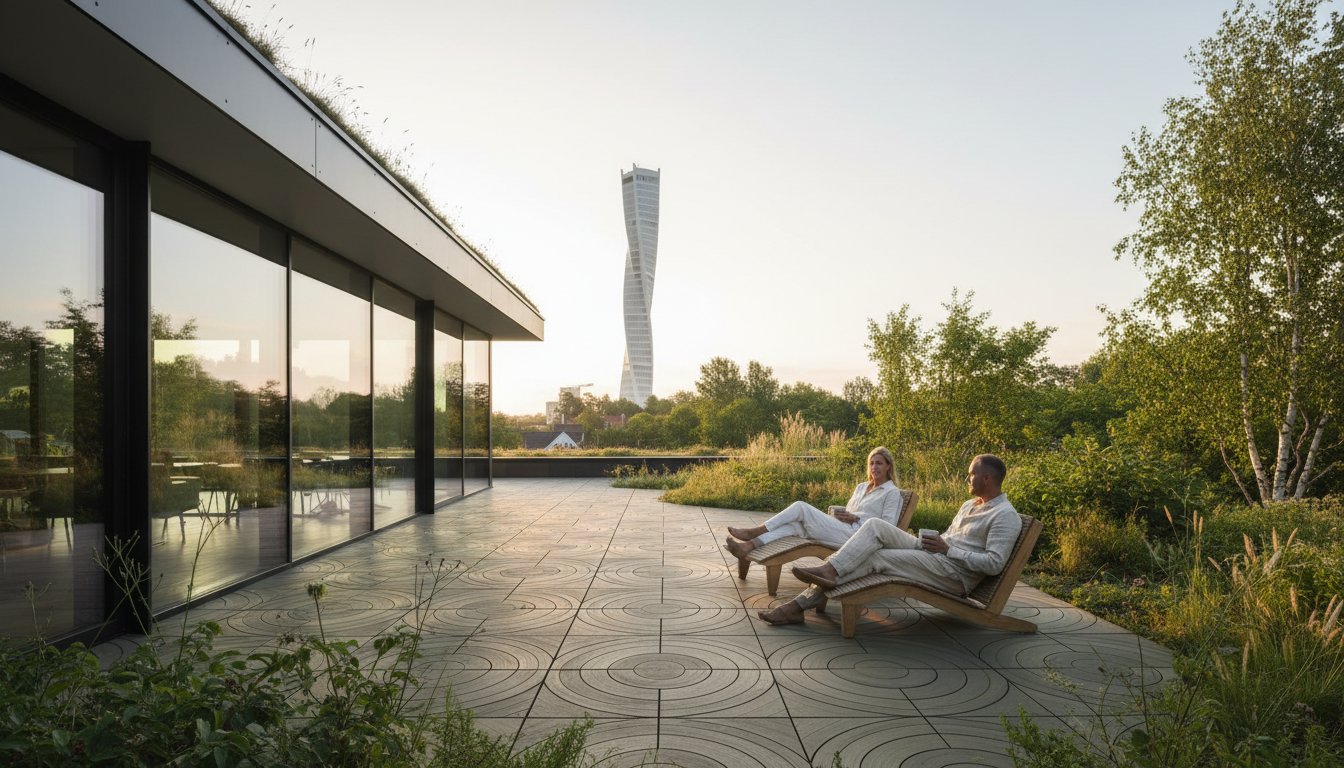
Recycling is no longer enough to meet Sweden’s 2045 climate neutrality goals. While many products claim to be green, true sustainability requires a shift from linear consumption to a closed loop system. In 2023, the Swedish construction sector generated over 14 million tonnes of waste, proving that traditional disposal methods are failing our environment. Selecting cradle to cradle building materials represents the next evolution in professional-grade construction. It moves beyond the simple "reduce, reuse, recycle" mantra to ensure every component is designed as a biological or technical nutrient for future use. Designed in Scandinavia and produced in Europe, these solutions are built to last and designed for life.
You likely recognize that greenwashing makes material sourcing a minefield of vague claims and hidden toxins. It's frustrating to seek high-performance solutions only to find they don't actually support a circular economy. This guide will show you how C2C principles are transforming the building industry and provide a clear framework for selecting materials that offer both environmental integrity and long-term financial value. We'll explore material health standards, specific sourcing strategies for circular exterior products, and why investing in durable, traceable materials yields a superior ROI in the Swedish market.
Key Takeaways
- Understand the fundamental shift from traditional waste-based models to a renewal system where building components act as technical nutrients for future use.
- Learn how to effectively specify cradle to cradle building materials in project tenders to ensure long-term sustainability and compliance with circular economy standards.
- Compare the lifecycle performance of European-made composites against traditional timber to reduce both environmental impact and maintenance costs in the Swedish climate.
- Master the principles of "Designing for Deconstruction" to create high-performance facades and decks that are built for life and engineered for easy renewal.
- Discover how Scandinavian design and traceable European manufacturing processes provide the structural integrity required for modern, circular construction projects.
What are Cradle to Cradle Building Materials?
Cradle to cradle building materials represent a fundamental departure from the linear "take-make-waste" model that has dominated construction for decades. These materials are engineered as technical nutrients. They circulate within a perpetual loop without losing quality or structural integrity. The traditional "Cradle to Grave" approach ends in a landfill; it's a dead end for resources. In contrast, Cradle-to-cradle design ensures every component can be disassembled and safely returned to the soil or re-entered into industrial production. This shift prioritizes renewal over disposal.
The year 2026 marks a decisive shift for the Swedish construction sector. New EU Energy Performance of Buildings Directive (EPBD) requirements and stricter Swedish climate declaration laws (Klimatdeklaration) take full effect. Developers must now account for the entire lifecycle of a structure. Circularity isn't just a trend; it's a regulatory mandate. Material health plays a central role in this transition. By selecting non-toxic, C2C-certified components, architects create indoor environments free from off-gassing and hazardous chemicals. This protects occupants and simplifies future deconstruction, ensuring the building remains a safe "material bank."
Cradle to Cradle vs. Traditional Sustainability
Recyclable labels are often misleading in the building industry. Most "recyclable" materials are actually downcycled into lower-quality products that eventually become waste. C2C moves beyond this by treating waste as food for the next production cycle. It doesn't just focus on the carbon footprint. It examines the total ecosystem impact, including water stewardship and social fairness. High-performance projects in 2026 require cradle to cradle building materials that maintain their integrity across multiple lifecycles. This ensures that a facade or terrace installed today remains a valuable resource fifty years from now.
The Economic Case for Circular Materials
Investing in circularity protects capital. Using recoverable materials reduces future disposal fees, which can exceed 1,500 kr per tonne in Swedish waste management facilities. Property values increase when projects achieve Gold or Platinum LEED and BREEAM certifications. These frameworks reward C2C products for their low environmental risk and high material health scores. Asset managers recognize that buildings made from traceable, durable materials are more resilient to future carbon taxes and resource scarcity. Cradle to Cradle is a comprehensive framework for ensuring long-term material quality and the protection of real estate assets.
- Designed for life: Materials are selected for their ability to be recaptured.
- Built to last: High-performance engineering ensures durability matches the circular intent.
- Nordic reliability: Products are tested against harsh climates to guarantee performance.
By integrating cradle to cradle building materials, the construction industry moves from being a consumer of resources to a generator of value. It's a professional-grade approach to building that respects both the environment and the balance sheet.
The Five Pillars of the Cradle to Cradle Framework
The Cradle to Cradle (C2C) Certified® Product Standard represents the world's most advanced science based framework for designing and manufacturing products for the circular economy. This isn't a simple checklist. It's a rigorous engineering methodology that evaluates cradle to cradle building materials across five critical categories of sustainability. For architects and developers in Sweden, these pillars provide a roadmap to ensure that exterior systems don't just look premium but perform with ecological integrity for decades. Third party verification remains the only reliable defense against greenwashing. It ensures that every claim of "eco-friendly" performance is backed by audited data rather than marketing rhetoric.Material Health and Product Circularity
Safety begins at the molecular level. The C2C framework requires manufacturers to identify and eliminate "X-listed" chemicals, such as certain phthalates or heavy metals, that are common in low grade composites. Green Plank prioritizes material health by utilizing 100% traceable raw materials. We design for disassembly. Our HidLoc™ hidden fastening systems allow for the easy removal and reuse of planks without damaging the substructure. This approach supports a truly circular lifecycle where materials return to the technical cycle instead of the landfill. For professionals focused on quality and ethics, choosing made in eu building materials ensures that every component meets strict European REACH regulations and traceability standards.Clean Air, Climate Protection, and Water Stewardship
Circular construction demands a radical reduction in carbon footprints. By 2026, the industry expectation is that 100% of manufacturing energy should come from renewable sources. We minimize CO2 emissions by sourcing raw materials locally within the EU, which significantly reduces transport distances compared to importing tropical hardwoods or Asian composites. Water stewardship is equally vital. The C2C standard ensures that manufacturing processes protect local soil and water quality during the extraction and production phases. When evaluating procurement options, the EPA Recommendations for Greener Products highlight how these rigorous standards help buyers identify products that truly reduce environmental impact across their entire lifecycle.Social Fairness and Ethical Manufacturing
Sustainability is as much about people as it is about the planet. Ethical manufacturing ensures fair labor practices and safe working conditions throughout the European supply chain. By maintaining local production, we support regional sustainability goals and contribute to the Swedish economy. 100% traceable raw materials serve as the foundation of social responsibility. They provide the transparency required to guarantee that no part of the product's journey involves exploitative practices. This commitment to ethics is what defines a "Responsible Innovator" in the modern construction era. You can explore our range of high-performance decking systems to see how these five pillars translate into durable, beautiful outdoor spaces. Built to last. Designed for life.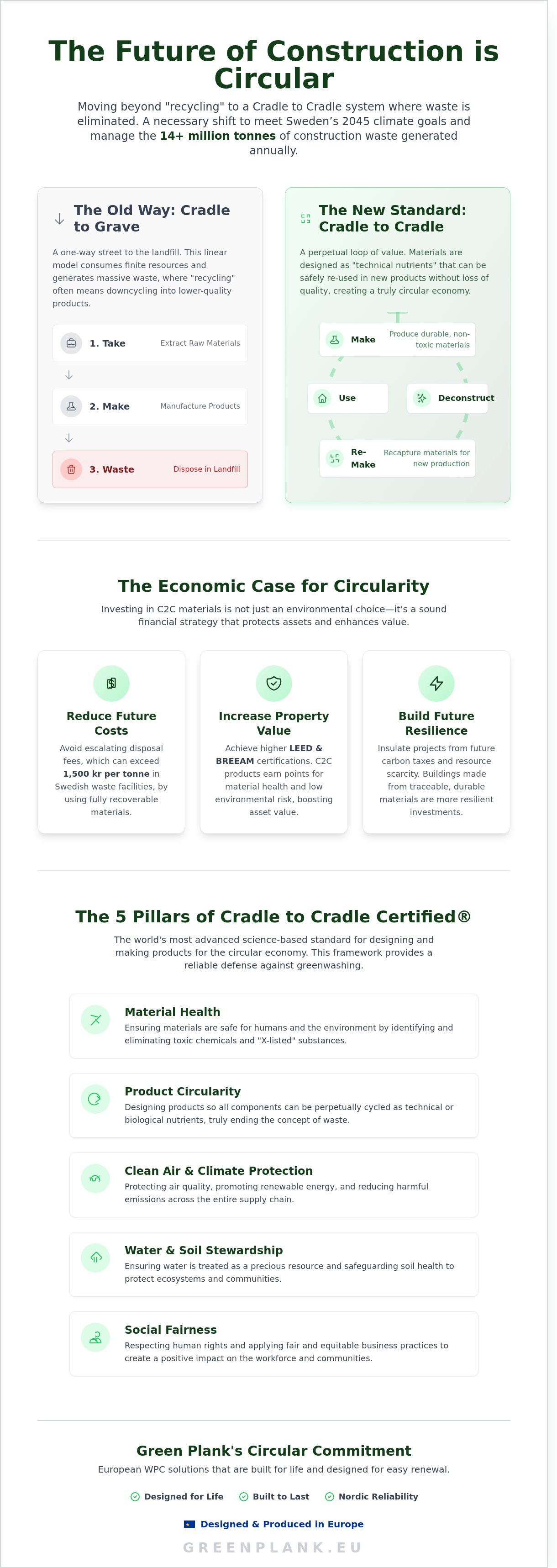
Comparing C2C Materials to Traditional Construction Options
WPC Composites vs. Tropical Hardwoods
Tropical hardwoods often lack true transparency. Even with labeling, illegal logging affects nearly 15% of the global timber trade. We utilize traceable European wood fibers to ensure ethical sourcing. Our engineered composites provide the aesthetic of premium wood without the environmental guilt. While treated wood is classified as hazardous waste at Swedish recycling centers and must be incinerated, our WPC is designed for upcycling. It's ground down and manufactured into new building profiles. Built to last. Designed for life.The Problem with PVC and Virgin Plastics
PVC remains a circular dead end because it contains chlorine and phthalates. We choose high-density polyethylene (HDPE) for its superior stability and recyclability. Using recycled EU plastics reduces the CO2 footprint by 60% compared to imported virgin resins. Our high-stability engineering prevents the shedding of microplastics, ensuring the material stays intact throughout its lifecycle. This creates a professional-grade product that respects the Nordic landscape. We don't just build; we engineer for a cleaner future.Implementing Circular Design: A Guide for Architects and Contractors
Transitioning from linear to circular construction requires a shift in how we specify and handle cradle to cradle building materials. For Swedish architects, this begins at the tender stage. Instead of focusing solely on initial procurement costs, contracts must prioritize material health and residual value. By integrating Byggvarubedömningen or SundaHus requirements directly into project specifications, you ensure that every component meets rigorous non-toxic standards. Designing for deconstruction is the technical cornerstone of this approach. In modern facades and decking projects, we replace permanent adhesives with mechanical fixings. This allows components to be disassembled without damage at the end of their 30-year or 50-year functional life. The Green Plank Ownership Model supports this by treating materials as assets rather than waste. Under this framework, we track the material lifecycle, providing a clear path for take-back and upcycling once a building undergoes renovation. This system ensures that a deck costing 75,000 kr today retains its resource value decades later. Collaboration between manufacturers and installers is vital for achieving zero-waste sites. We provide precise cutting lists to reduce on-site waste by 15% compared to traditional timber methods. When installers and suppliers work in a closed loop, off-cuts are collected and returned to the production cycle, ensuring nothing reaches a Swedish landfill.Sourcing and Logistics for Circular Projects
Success in circularity depends on knowing where your materials come from. We evaluate every supplier based on 100% material transparency and European origin. By selecting European-made systems, you significantly lower the carbon intensity of your logistics chain. Choosing regional production reduces transport emissions by up to 40% compared to importing composites from Asia. You can explore more about how to reduce co2 footprint building through smarter material selection and localized sourcing.
Installation Best Practices for Longevity
Durability is the highest form of sustainability. To ensure a 50-year service life, contractors must follow precise engineering standards. We recommend using hidden fastening systems; they preserve the material's surface integrity and allow for easy board replacement. Proper joist spacing of 400mm and a minimum 20mm ventilation gap prevent moisture buildup. We also train installation teams on the proper handling of cradle to cradle building materials, focusing on collecting and upcycling every off-cut. It's a professional-grade approach where technical precision meets environmental ethics.
Green Plank’s Circular Commitment: European WPC as a C2C Solution
Green Plank redefines the technical nutrient cycle by transforming recycled resources into high-performance architecture. Our Wood Plastic Composite (WPC) serves as a benchmark for cradle to cradle building materials, ensuring that every deck board or cladding panel remains a resource for the future. By utilizing a precise composition of 75% hardwood fiber and 25% High-Density Polyethylene (HDPE), we create a material that is both exceptionally durable and fully recyclable at the end of its functional life.
Our "Designed in Scandinavia; Produced in Europe" philosophy ensures short supply chains and ethical labor practices. This regional focus minimizes carbon footprints while maintaining the strict quality standards expected in the Swedish market. We view our products as part of a continuous loop. Our 50-year warranty represents a firm commitment to the technical nutrient cycle. It guarantees that materials stay functional for decades, providing a long-term value of thousands of kr in avoided replacement costs, rather than entering landfills after a few seasons.
The Science of the Green Plank Blend
The 75% hardwood fiber and 25% HDPE ratio is the result of rigorous engineering. This specific balance provides the structural integrity of natural timber with the moisture resistance of advanced polymers. It ensures the boards don't warp or rot, making them ideal for the harsh Swedish climate. We exclude toxic additives, glues, and volatile organic compounds (VOCs) to ensure our products are safe for residential environments and children's play areas. Green Plank uses 100% traceable EU raw materials to maintain complete transparency across the supply chain. This level of traceability is essential for developers seeking cradle to cradle building materials that meet 2026 sustainability certifications.
- 75% Hardwood Fiber: Sourced from post-industrial wood waste.
- 25% HDPE: High-quality polymers that allow for repeated recycling.
- Zero Toxins: No PVC or harmful chemicals used in the manufacturing process.
Building for the Future with Nordic Reliability
Sustainability shouldn't compromise aesthetics or logistics. Our low-density profiles are engineered to reduce the environmental load of transport, saving on fuel costs and carbon emissions during delivery to sites across Scandinavia. Technologies like Terra Tuff and our Smart System installation kits future-proof projects by allowing for easy disassembly and reuse. This modular approach aligns with circular economy goals, where buildings act as material banks for future generations. The refined, minimalist aesthetic of Scandinavian design is paired with this circular engineering to create spaces that are as beautiful as they are responsible.
Built to last. Designed for life.
Architecting a Regenerative Future
Transitioning to a circular economy requires more than intent; it demands the integration of cradle to cradle building materials that eliminate waste at the design stage. By focusing on material health and technical cycles, architects can specify solutions that remain valuable long after their initial use. Green Plank supports this shift with professional-grade European WPC, engineered with a 75% hardwood fiber composition to ensure structural integrity and natural aesthetics. Our commitment to Nordic reliability means every profile is manufactured using 100% EU-sourced traceable raw materials. This transparency provides the certainty needed for Swedish infrastructure and residential projects. We stand behind our engineering with a 50-year warranty on commercial profiles, offering a long-term investment that reduces lifetime costs. It's time to move beyond the linear model and embrace a regenerative approach to the built environment. Download our Sustainable Material Specification Guide to begin your transition toward circularity. Let's build a legacy that respects both our landscape and our future.
Frequently Asked Questions
What are the main criteria for Cradle to Cradle building materials?
Cradle to Cradle building materials must meet five specific criteria: material health, product circularity, clean air and climate protection, water and soil stewardship, and social fairness. Under the Version 4.0 framework, every ingredient is scrutinized for its impact on human health and the environment. This ensures that products are safe for biological or technical cycles and don't contain harmful toxins.
Is Cradle to Cradle certification the same as LEED or BREEAM?
No, C2C is a product-specific certification, while LEED and BREEAM assess the performance of an entire building. They work together because using Cradle to Cradle building materials helps architects earn credits for material transparency and optimization. In Sweden, these certified products can contribute up to 2 points toward LEED v4.1 certification, making them a strategic choice for high-end green building projects.
How do C2C materials help in reducing the CO2 footprint of a building?
These materials lower a building's CO2 footprint by utilizing renewable energy during production and locking carbon into a circular loop. Buildings are responsible for 21% of Sweden's greenhouse gas emissions, so choosing materials made with 100% renewable power is critical. Because they're designed for reuse, they prevent the waste and emissions associated with traditional demolition and landfilling.
Can WPC composite decking be truly circular?
WPC composite decking is truly circular when it's engineered for recovery and re-manufacturing. Our products use 90% recycled wood fibers and polymers, creating a durable material that's 100% recyclable at the end of its life. This closed-loop system eliminates the need for virgin resources and prevents waste, aligning perfectly with Nordic sustainability goals and the demand for low-maintenance outdoor spaces.
Are Cradle to Cradle materials more expensive than traditional options?
C2C materials often have a slightly higher purchase price, but they provide significant savings through their extended lifespans and low maintenance requirements. For a 30-square-meter terrace in Sweden, you can expect to save approximately 18,000 kr in oiling, staining, and repair costs over 25 years. It's a long-term investment where the durability and Scandinavian quality pay for themselves over the product's life.
How does "Design for Disassembly" work in exterior cladding?
Design for Disassembly in cladding relies on mechanical fixings like hidden clips rather than permanent glues or nails. This method allows 100% of the material to be salvaged during renovations or building decommissioning. It transforms the facade into a material bank, where planks can be easily removed, sorted, and returned to the manufacturing cycle without any structural damage.
What happens to Green Plank materials at the end of their service life?
Once Green Plank materials reach the end of their 30-year warranty period, they're reclaimed through dedicated recycling streams. The old planks are ground down into raw material for new production, ensuring nothing is wasted. This process maintains the integrity of the natural-fiber composite and keeps the material out of the waste stream indefinitely, supporting a zero-waste economy.
Why is European manufacturing important for C2C standards?
Manufacturing in Europe is vital for C2C standards to ensure traceable supply chains and ethical production. It reduces transport emissions by 85% compared to products shipped from Asia to the Swedish market. European facilities also operate under strict environmental laws, ensuring that the water and soil stewardship required for certification is strictly monitored and maintained at every stage.
Specificera produkten
Använd den här guiden i en Green Plank-specifikation
Tekniska WPC-artiklar ska stärka de kommersiella sidorna — inte konkurrera med dem. Fortsätt till komposittrall, TerraTuff, Nordeka eller de tekniska nedladdningarna.