



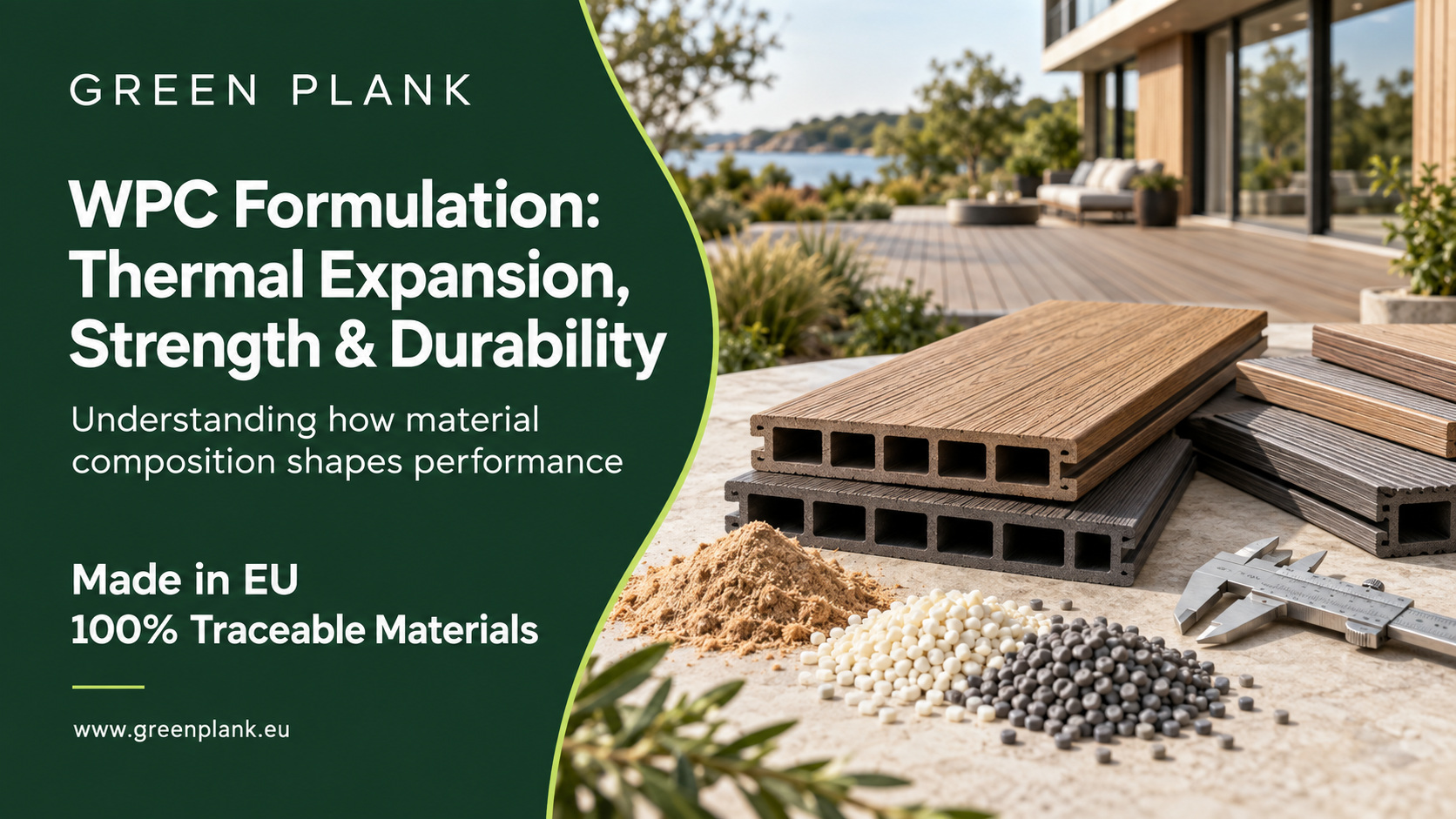
How WPC Formulation Affects Thermal Expansion, Strength and Durability The performance of Wood Plastic Composite (WPC) depends on much more than the percentage of wood and plastic shown on a technical data sheet. Premium WPC is an engineered material system in which wood fibre, polymer, coupling agents, lubricants, UV stabilisers, antioxidants and processing conditions must work together. Premium WPC is not created by maximising one ingredient. It is created by optimising the complete formulation for strength, dimensional stability and long-term outdoor performance. Thermal Expansion and Dimensional Stability Thermoplastics such as HDPE expand when temperatures rise and contract when they fall. Wood fibre can help restrain this polymer movement and increase stiffness. However, wood is hygroscopic, meaning it can interact with moisture. A higher wood content therefore requires effective fibre encapsulation, controlled moisture and strong bonding between wood and polymer. How Formulation Influences Strength Wood fibre acts as reinforcement, but more wood does not automatically mean a stronger board. Performance depends heavily on fibre quality, particle size, dispersion and the fibre-polymer interface. In polyethylene-based WPC, coupling agents such as MAPE are commonly used to improve compatibility between hydrophilic wood and hydrophobic HDPE. Component Main Function Performance Influence Wood fibre Reinforcement Stiffness and dimensional restraint HDPE Polymer matrix Toughness and fibre encapsulation MAPE Coupling agent Improved fibre-polymer bonding UV/antioxidant package Stabilisation Protection against outdoor ageing Durability Starts Inside the Board Outdoor WPC must withstand moisture, sunlight, temperature cycling and repeated mechanical loading. Long-term durability therefore depends on much more than surface appearance. Poor fibre encapsulation, excessive porosity or an unbalanced additive package can create weaknesses that may only become visible after prolonged outdoor exposure. A well-engineered formulation focuses on: controlled wood-fibre quality and moisture; appropriate polymer properties; effective fibre-polymer coupling; balanced lubrication for stable extrusion; UV and oxidation protection; consistent temperature, pressure and cooling control. Why More Wood or More Plastic Is Not the Answer A high wood percentage can provide excellent stiffness and reduce the proportion of polymer, but it also makes moisture management, dispersion and coupling increasingly important. Higher polymer content may improve matrix continuity and toughness, but can increase polymer-driven thermal movement. Neither approach is automatically superior. What Professional Buyers Should Evaluate Architects, distributors and contractors should look beyond formulation percentages and evaluate the finished product. Important indicators include flexural strength, modulus, water absorption, dimensional stability, thermal movement, impact performance, weather resistance and recommended support spacing. Green Plank: Engineering the Complete WPC System At Green Plank, WPC performance is approached as a complete engineering system. The objective is to balance wood fibre, polymer technology, coupling, stabilisation, processing and profile design to achieve reliable performance for decking and demanding outdoor applications. Conclusion WPC formulation directly influences thermal expansion, strength and durability. Wood fibre contributes reinforcement, HDPE forms the protective structural matrix, coupling agents strengthen the interface, and stabilisers help protect the composite during outdoor exposure. The best WPC is therefore not defined by the highest percentage of wood or plastic, but by how effectively the entire formulation is engineered, manufactured and verified. Discover premium WPC solutions at www.greenplank.eu. Sources Polymers – Review of Components and Properties of Wood-Plastic Composites Polymers – Coupling and Interfacial Performance in Wood-Plastic Composites
Specificera produkten
Använd den här guiden i en Green Plank-specifikation
Tekniska WPC-artiklar ska stärka de kommersiella sidorna — inte konkurrera med dem. Fortsätt till komposittrall, TerraTuff, Nordeka eller de tekniska nedladdningarna.