



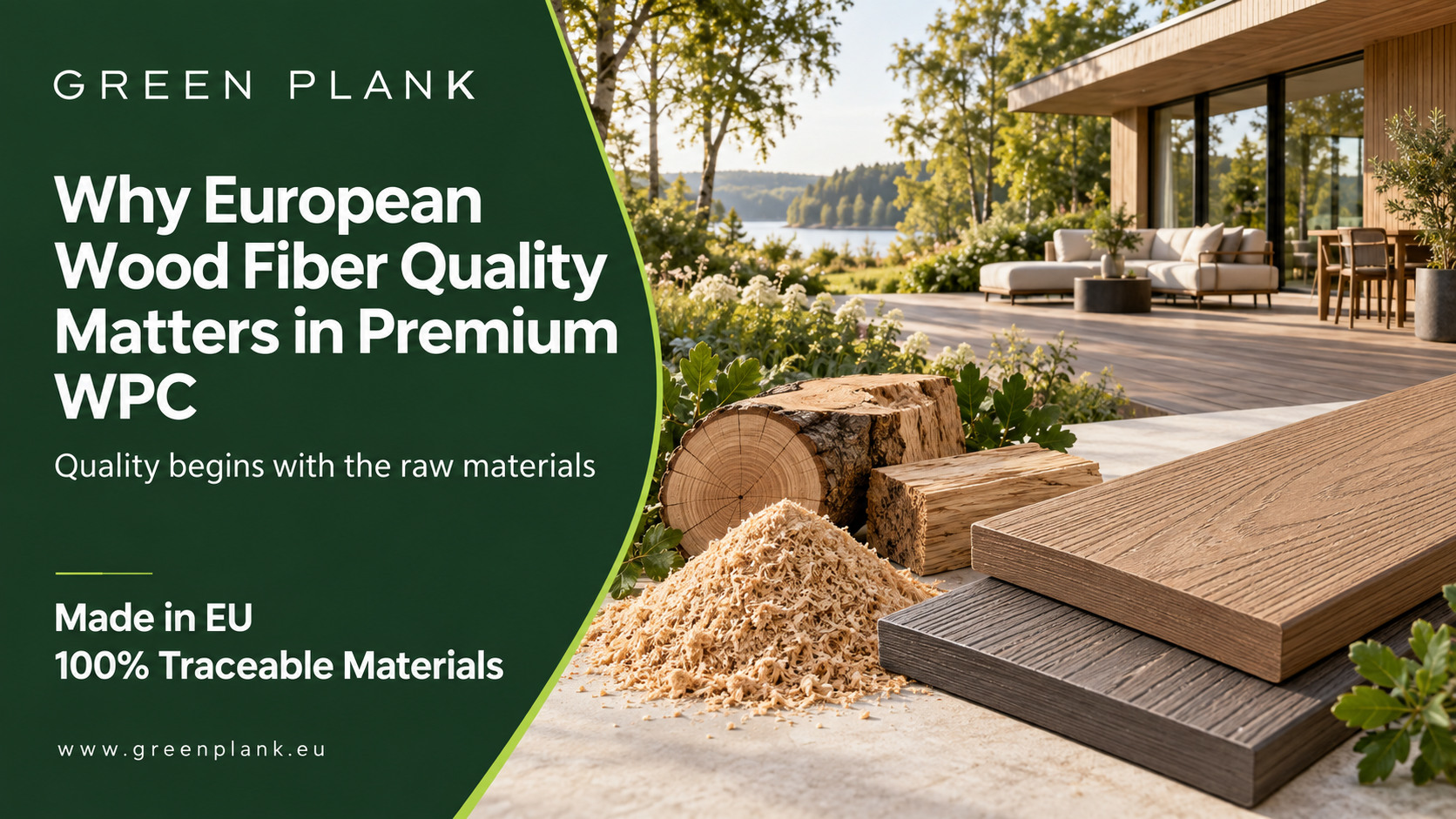
Why European Wood Fiber Quality Matters in Composite Manufacturing In Wood Plastic Composite (WPC) manufacturing, attention often focuses on the percentage of wood and polymer. Yet wood percentage alone says surprisingly little about final quality. Wood species, particle dimensions, moisture, cleanliness, consistency and fibre-polymer compatibility can all influence how a composite processes and performs. Scientific reviews confirm that WPC properties depend strongly on wood morphology, particle size, moisture and the interaction between the natural reinforcement and polymer matrix. For premium decking, cladding, fencing and architectural profiles, the more meaningful question is therefore not simply how much wood is inside the product? It is what quality of wood fibre is being used, where does it come from, and how consistently is it controlled? Premium WPC begins before extrusion. Consistent, controlled and traceable wood fibre provides the foundation on which formulation engineering and manufacturing quality can build. Wood Fiber Is an Engineering Material, Not Just a Filler Wood flour performs an important reinforcing role in WPC. Its characteristics influence stiffness, processing behaviour, water interaction and surface quality. Research shows that the final properties of WPC are influenced by particle morphology, including particle diameter, shape and aspect ratio, as well as the type of wood used. :contentReference[oaicite:0]{index=0} This means two boards advertised with the same wood percentage can behave differently if their raw materials have different specifications. Wood Fiber Parameter Why It Matters Possible Manufacturing Impact Wood species Different fibres have different physical characteristics Influences formulation and processing behaviour Particle size Affects dispersion and interface area Can influence strength and extrusion Moisture Excess water interferes with processing May contribute to voids and instability Cleanliness Reduces unwanted contaminants Supports consistent production Batch consistency Provides predictable raw-material behaviour Supports repeatable finished profiles Traceability Documents material origin Strengthens quality assurance Why Moisture Control Is Critical Wood is naturally hygroscopic, while thermoplastics such as HDPE are comparatively hydrophobic. Moisture must therefore be carefully managed before compounding and extrusion. A recent WPC review notes that excessive fibre moisture can reduce mechanical and thermal performance and identifies drying as an important part of wood-flour preparation. :contentReference[oaicite:1]{index=1} Research has also demonstrated that higher wood-flour moisture during processing can reduce the effectiveness of certain crosslinking reactions, illustrating how moisture can influence the fibre-polymer system at a fundamental level. :contentReference[oaicite:2]{index=2} Professional production therefore requires more than simply purchasing dried wood fibre. Moisture must remain controlled during transportation, storage, dosing and processing. Particle Size Can Change WPC Performance Wood flour is available in different particle sizes and distributions, and these characteristics should be considered part of the formulation. Research on extruded WPC has demonstrated that changing wood-flour particle size can affect tensile and flexural properties as well as swelling behaviour. :contentReference[oaicite:3]{index=3} There is no single particle size that is automatically ideal for every WPC. The optimum specification depends on polymer, wood loading, profile geometry, extrusion technology and targeted performance. The Premium Manufacturing Principle Consistent fibre specification + controlled moisture + appropriate polymer + effective coupling + balanced additives + controlled extrusion = consistent WPC performance. European Sourcing: Quality Through Control and Transparency European origin alone does not automatically make a wood fibre technically superior. The advantage comes when regional sourcing is combined with defined specifications, qualified suppliers, documented origin and batch-level quality control. For a European WPC manufacturer, a well-managed regional supply chain can offer practical benefits: greater visibility of raw-material origin; closer communication with fibre suppliers; defined species and particle specifications; shorter and more manageable supply chains; stronger batch-to-batch documentation; greater ability to investigate quality variations; support for responsible procurement requirements. European policy has also placed increasing emphasis on due diligence and traceability in forest-related supply chains, reinforcing the broader importance of knowing where wood materials originate. :contentReference[oaicite:4]{index=4} The Fiber-Polymer Interface Determines Whether the Fiber Works Even premium wood fibre cannot deliver its full potential if it does not bond effectively with the polymer matrix. Wood is polar and hydrophilic, whereas polyethylene is non-polar and hydrophobic. This natural incompatibility can create a weak interface if the formulation is not properly engineered. Coupling agents such as maleic-anhydride-grafted polyethylene (MAPE) are used in polyethylene-based WPC systems to improve compatibility. Research has shown that coupling treatments can improve wettability, resin penetration and interfacial adhesion, resulting in improved tensile strength and stiffness in the investigated composites. :contentReference[oaicite:5]{index=5} Recent research on highly wood-filled polyethylene composites similarly demonstrates the importance of compatibilisation when high fibre loading is combined with demanding mechanical and dimensional-performance targets. :contentReference[oaicite:6]{index=6} Why Consistency Matters in Industrial Production A WPC factory does not manufacture one laboratory specimen; it must produce thousands of metres of profiles with repeatable dimensions, surfaces and properties. Raw-material consistency is therefore fundamental. Variations in fibre moisture, particle distribution or bulk behaviour can influence feeding, mixing, melt flow and extrusion stability. Manufacturing research also shows that processing conditions themselves can influence moisture behaviour and finished WPC performance. :contentReference[oaicite:7]{index=7} A controlled wood-fibre specification helps manufacturers target: stable material feeding; predictable extrusion pressure; uniform fibre dispersion; consistent profile dimensions; repeatable surface appearance; lower batch-to-batch variation. Traceability Adds Another Dimension to Quality Technical performance tells buyers how a product behaves. Traceability tells them what they are buying. For architects, distributors, contractors and public procurement teams, documented raw-material origin can provide greater transparency regarding the supply chain. A strong batch-traceability system can connect incoming wood fibre with production records, quality-control information and finished-product batches. This is particularly valuable as professional construction increasingly demands better environmental documentation, responsible sourcing and verifiable product information. What Professional WPC Buyers Should Ask Instead of evaluating decking only by wood percentage, professional buyers should ask manufacturers deeper questions: What wood species or fibre source is used? Can the raw-material origin be documented? Is incoming fibre controlled by batch? How is moisture measured and controlled? Is particle-size distribution specified? How are contaminants managed? What coupling technology is used? How is production consistency verified? Are finished profiles mechanically and physically tested? These questions provide a far more meaningful picture of composite quality than a simple statement such as 70% wood content. Green Plank: From European Raw Materials to Finished WPC At Green Plank, premium composite manufacturing is approached as a complete material and production system. The focus is not simply on achieving a particular wood percentage, but on controlling the relationship between carefully selected European wood fibre, polymer technology, coupling chemistry, functional additives and extrusion conditions. Traceability and raw-material consistency are particularly important because they connect the beginning of the supply chain with finished-product quality. This approach supports WPC solutions designed for residential decking, commercial developments, landscape architecture and demanding outdoor applications. Discover Green Plank European composite solutions at www.greenplank.eu. Conclusion Wood fibre quality is one of the foundations of premium WPC manufacturing. Species, particle size, moisture, cleanliness, consistency and traceability can all influence processing and finished-product performance. European sourcing can provide valuable advantages when it is supported by controlled specifications, qualified suppliers and transparent documentation. The key lesson is simple: premium WPC is not defined by how much wood is used, but by how carefully that wood is selected, controlled, combined and transformed into the finished composite. Sources Polymers – A Concise Review of the Components and Properties of Wood-Plastic Composites Construction and Building Materials – Optimized Material Composition of Extruded WPCs Polymer Testing – Coupling Agent Treated Wood Plastic Composites
Specificera produkten
Använd den här guiden i en Green Plank-specifikation
Tekniska WPC-artiklar ska stärka de kommersiella sidorna — inte konkurrera med dem. Fortsätt till komposittrall, TerraTuff, Nordeka eller de tekniska nedladdningarna.