



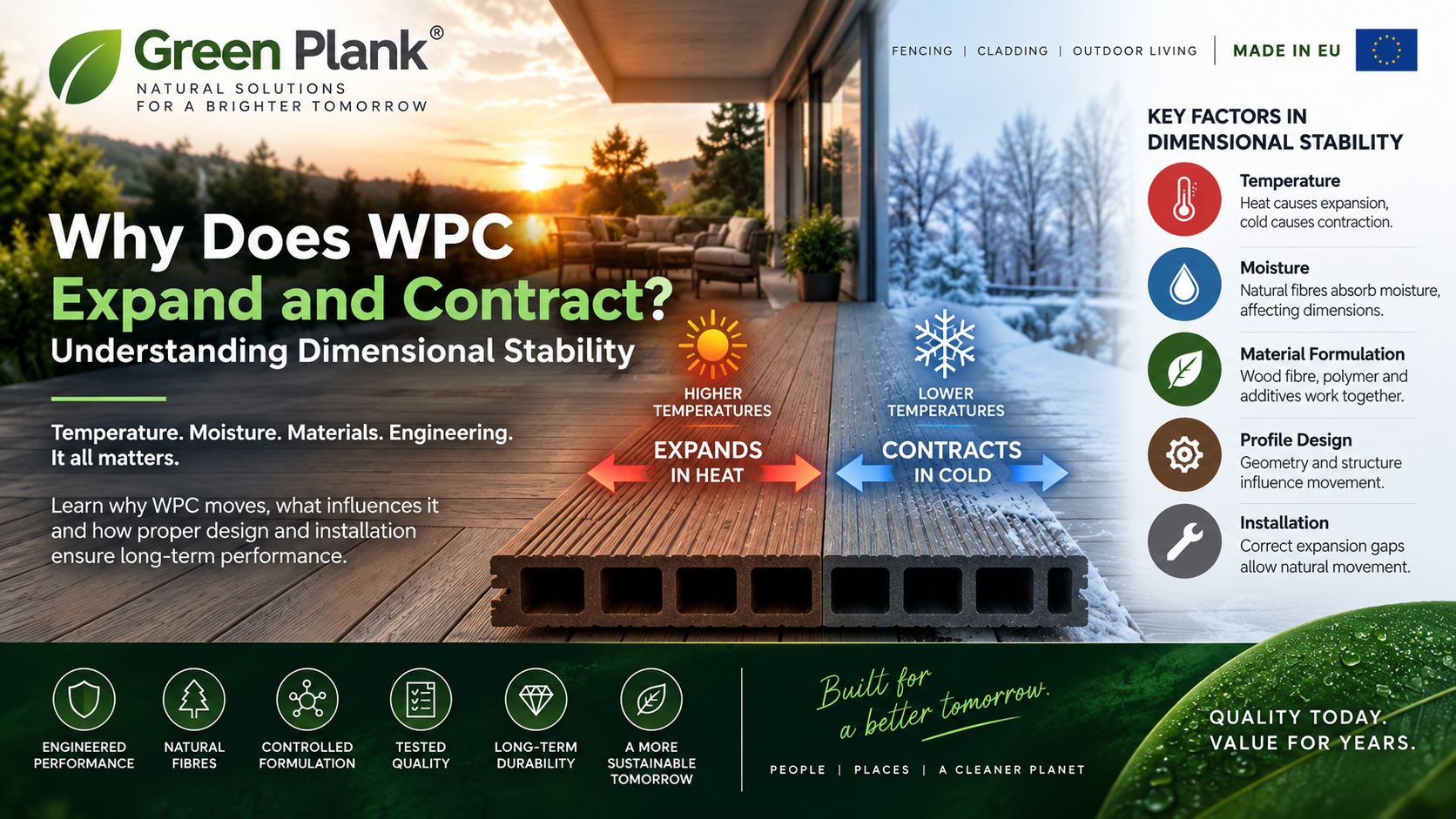
Composite decking is engineered for outdoor environments—but it is not dimensionally motionless. Temperature, moisture, formulation, profile geometry and installation all influence how a WPC board behaves throughout the seasons.For architects, distributors, installers, contractors and purchasing managers, understanding this movement is important because many problems attributed to “poor WPC quality” can actually involve a combination of material behaviour, product design and installation conditions.At the same time, not all WPC products behave identically.Two boards with similar dimensions and appearance can have different dimensional behaviour because the materials and engineering behind them are different.The right question is therefore not:“Does WPC expand?”It does.The more useful question is:“How much does this particular WPC product move under defined conditions—and has the product and installation system been designed to accommodate that movement?”1. Why Does WPC Move?Wood Plastic Composite, or WPC, combines two very different material families:natural fibres and thermoplastic polymers.Wood fibres respond particularly to moisture, while thermoplastics respond strongly to temperature. When these materials are combined, the finished composite inherits characteristics from both—but the behaviour is also modified by the interaction between them.As temperatures rise, the polymer phase tends to expand.As temperatures fall, it contracts.Wood fibres can restrict some of this thermal movement because they are generally much less thermally expansive than the polymer matrix. At the same time, natural fibres can absorb moisture, which can contribute to dimensional changes of their own.This is why WPC dimensional stability is not controlled by a single ingredient.It is the result of the entire composite system.2. Thermal Expansion: The Basic PrincipleThe basic engineering relationship for thermal movement is:ΔL = α × L × ΔTwhere:ΔL = change in lengthα = coefficient of linear thermal expansion (CLTE)L = original board lengthΔT = temperature changeThis equation explains something extremely important for decking design:The longer the board and the greater the temperature change, the greater the potential dimensional movement.Consider a purely illustrative example.Suppose a 4.8 m profile had a CLTE of 50 × 10⁻⁶/°C, and its temperature changed by 50°C.The theoretical movement would be:50 × 10⁻⁶ × 4,800 mm × 50 = 12 mmThat is approximately:12 mm total theoretical length changeThis is only an example—not a Green Plank product value—but it demonstrates why manufacturers must establish appropriate expansion allowances for their specific products.3. Why Surface Temperature Matters More Than Air Temperature AloneOne of the most common misunderstandings is to look only at the weather forecast.If the air temperature is 30°C, that does not necessarily mean the decking surface is also 30°C.A board exposed to strong solar radiation can become substantially warmer than the surrounding air. Colour, surface finish, orientation, wind, ventilation and solar intensity all influence the actual board temperature.Likewise, a decking board installed during cold weather may later experience a much larger temperature increase during direct summer sunlight.For installation purposes, what matters is therefore not simply:“What is today's air temperature?”but the temperature range the product itself may experience throughout its service life.This is particularly relevant for long boards and dark surfaces exposed to strong sunlight.4. Does More Wood Fibre Mean Less Thermal Expansion?Often, within otherwise comparable WPC formulations, increasing wood-fibre content can reduce the composite's coefficient of thermal expansion because wood fibres constrain movement of the polymer matrix.Published research supports this general principle.For example, a study examining recycled-HDPE WPC with different wood-fibre contents reported decreasing coefficients of linear thermal expansion as wood-fibre content increased from 50% to 70%.That is an important engineering advantage.But it should not be converted into the marketing statement:“More wood always means better WPC.”That would be too simplistic.Higher fibre loading can also create processing challenges and can increase the importance of moisture control, fibre–polymer adhesion and effective encapsulation.The correct engineering objective is not simply to maximise the percentage of wood.It is to optimise the entire formulation.5. The Fibre–Polymer Interface Is CriticalWood and polyethylene naturally have different surface characteristics.Wood is relatively hydrophilic—it has an affinity for moisture.Polyethylene is hydrophobic.Getting these materials to work effectively together therefore requires careful formulation and processing.This is where coupling agents such as maleic-anhydride-grafted polyolefins can play an important role.A properly engineered coupling system can improve adhesion between the fibre and polymer phases, supporting mechanical properties and helping create a more integrated composite structure.Lubricants, antioxidants, UV stabilisers, pigments and processing aids also have specific functions.This is why WPC should not be judged by a simple recipe such as:70% wood + 30% plasticor75% wood + 25% polymer/additives.Those percentages tell only part of the story.6. Moisture Creates a Different Type of Dimensional MovementThermal expansion is only one part of dimensional stability.Natural fibres can absorb moisture.When fibre moisture increases, dimensional changes can occur. The magnitude depends on factors including fibre type, particle characteristics, fibre content, polymer encapsulation, interfacial quality, profile design and exposure conditions.This is why proper raw-material drying and moisture control before extrusion are so important.Excessive moisture during processing can also contribute to manufacturing defects such as porosity, surface imperfections and inconsistent extrusion.For professional WPC production, moisture is therefore not simply a raw-material purchasing specification.It is a process-control parameter.7. Why Two 70% Wood WPC Boards Can Behave DifferentlyImagine two manufacturers both advertise:70% wood fibreTheir products may still perform differently.Manufacturer A might use a controlled fibre source, consistent particle distribution, carefully managed moisture, an appropriate HDPE grade, an optimised coupling system and stable extrusion parameters.Manufacturer B could use a different fibre species, particle distribution, polymer stream, additive package and processing conditions.Both labels say 70% wood.But they are not necessarily the same composite.Dimensional stability can also be influenced by:fibre typeparticle size and distributionpolymer type and gradepolymer consistencycoupling agentlubrication systempigmentsstabilisersprocessing temperaturescrew designextrusion speedcooling conditionsprofile geometrydensityresidual stressesquality controlThis is why purchasing professionals should compare finished-product performance, not just formulation percentages.8. Profile Geometry MattersThe same formulation can behave differently when converted into different profile designs.A solid board and a hollow board do not have identical geometry.Wall thickness, cavities, ribs, width, thickness and overall cross-sectional design influence stiffness, heat distribution and structural behaviour.The profile should therefore be evaluated as a complete engineered product.A supplier should not assume that a successful formulation in one profile can automatically be transferred to another geometry without validation.Formulation + process + geometry = finished-product performance.9. Capped WPC Adds Another Engineering LayerCo-extruded or capped WPC introduces an additional material system.A protective polymer-rich surface layer is applied around some or all of the composite core.This can provide important surface benefits, depending on the cap formulation and design.But from a dimensional-stability perspective, the core and cap must function together.They may have different thermal expansion characteristics.Cap thickness, adhesion, material selection and coverage therefore become important engineering considerations.A 360° capped product should not simply be described as “better” because it has a cap.Professional buyers should ask:What is the core formulation?What is the cap formulation?How thick is the cap?How is cap adhesion controlled?What dimensional testing has been performed on the complete finished profile?The finished board—not the individual ingredients—is ultimately what must perform outdoors.10. Colour Can Influence TemperatureColour is not purely an aesthetic decision.Darker surfaces generally absorb more solar energy than lighter ones under comparable exposure conditions, which can result in higher surface temperatures.Higher product temperature means a greater temperature difference from cold-weather conditions, potentially increasing thermal movement.However, colour alone does not determine surface temperature.Surface chemistry, texture, cap material, solar reflectance, profile geometry, ventilation and environmental conditions also contribute.This is why broad claims such as:“Light WPC stays cool”or“High-wood WPC never gets hot”should be avoided.Outdoor thermal performance should be evaluated on the actual finished product.11. Installation Is Part of the Engineering SystemEven a dimensionally stable WPC board still needs room to move.That is why professional installation instructions specify expansion allowances.Typical design considerations include:end gapsdistance from walls and fixed structuresboard-to-board spacingsubstructure spacingventilationdrainagefastener systemboard lengthinstallation temperatureThe fastening system is particularly important.Decking clips generally control the board while allowing the system to accommodate appropriate movement.If boards are fixed in a way that prevents designed movement, stresses can accumulate.The result may include deformation, movement of the substructure, fastener problems or other installation-related issues.The objective is not to eliminate movement.The objective is to control it.12. Longer Boards Require More AttentionReturn to the thermal-expansion equation:ΔL = α × L × ΔTIf all other conditions remain equal, a 6 m board has greater absolute thermal movement than a 3 m board.This is why expansion allowances should not always be treated as one universal number regardless of board length.For example, if a hypothetical material moved 2 mm per metre across a particular temperature range:A 3 m board could move:3 × 2 = 6 mmA 4.8 m board:4.8 × 2 = 9.6 mmA 6 m board:6 × 2 = 12 mmAgain, these are illustrative calculations, not universal installation requirements.Always use the installation guidance for the specific product.13. Why Installation Temperature MattersImagine a long WPC board being installed on a cold morning.The board may be relatively contracted.If the installer leaves insufficient end clearance and the board later reaches a much higher temperature in direct summer sunlight, it needs somewhere to expand.Now consider the opposite situation.A board installed when very warm may subsequently contract in colder weather.The installer therefore needs to consider both the current board temperature and the expected service-temperature range.This is one reason professional installation manuals are an essential part of the product—not an optional accessory.14. Joist Spacing and Expansion Are Different IssuesThese two subjects are sometimes confused.Joist spacing primarily relates to structural support, deflection and loading.Expansion allowance relates to dimensional movement.A board might have excellent stiffness and permit a particular support spacing while still requiring appropriate longitudinal expansion gaps.Conversely, low thermal expansion does not automatically mean high structural strength.These properties should be assessed separately.Professional buyers should therefore request both:mechanical performance information and dimensional-stability information.15. What Should Purchasing Managers Ask?When evaluating WPC, purchasing teams should go beyond asking for wood percentage and warranty length.Ask the supplier:What is the finished profile's dimensional behaviour under temperature changes?Which test method or internal validation supports the figures?Does the value apply to the actual profile being purchased?How does moisture exposure affect dimensional stability?What installation gaps are required at different board lengths and temperatures?Does the guidance differ for dark and light colours?How are fibre moisture and raw-material consistency controlled?How is the fibre–polymer interface engineered?For capped products, how do the core and cap behave together?Can the manufacturer trace the finished product back to its production batch?These questions tell a buyer much more than a brochure stating:“Low expansion.”16. Dimensional Stability Should Be Measured, Not AssumedThis is perhaps the most important point.A manufacturer can develop a theoretically excellent formulation.But the market purchases a finished board, not a theoretical formulation.The finished profile should therefore be validated under relevant conditions.For European WPC products, the EN 15534 family provides an important framework for evaluating wood-plastic composites and natural-fibre composites, including decking applications.Professional product development can also include additional testing for thermal cycling, moisture exposure, dimensional changes, mechanical performance, weathering and other characteristics appropriate to the intended application.The strongest technical claim is not:“Our formula should have low expansion.”It is:“Here is how our finished production profile performed when tested.”17. Dimensional Stability Is Also a Quality-Control IssueEven when the original product design performs well, manufacturing consistency matters.Changes in raw materials, moisture, processing temperatures, extrusion speed, cooling or formulation can potentially affect finished-product characteristics.This connects dimensional stability directly with another important subject:Batch traceability.If an unusual issue occurs on a project, the manufacturer should ideally be able to identify the production batch and investigate the relevant manufacturing and raw-material records.Without traceability, distinguishing a systematic product issue from an isolated batch, installation problem or unusual site condition can become much more difficult.For distributors and project buyers, this has real commercial value.18. Green Plank's Approach: Engineer the Complete SystemAt Green Plank, we believe WPC should be evaluated as an engineered composite system rather than marketed through one impressive percentage.Natural-fibre content matters.Polymer selection matters.Additives matter.Moisture control matters.Extrusion matters.Profile geometry matters.Capping technology matters.Installation matters.Testing matters.And production consistency matters.Our objective in European manufacturing is to bring these elements together through controlled production, traceable materials and product-specific engineering.We do not believe customers should choose Green Plank simply because our products are manufactured in Europe.Ask us for the technical evidence.That is a healthier standard for the entire industry.19. The Goal Is Controlled Movement, Not Zero MovementNo responsible manufacturer should suggest that an outdoor thermoplastic composite never expands or contracts.Movement is normal material behaviour.Engineering determines how effectively it is managed.A well-designed WPC system therefore seeks to combine:appropriate dimensional stabilitymechanical strengthmoisture managementweather resistancecontrolled manufacturingcorrect profile designappropriate fasteningclear installation instructionsWhen these elements work together, seasonal movement can be anticipated and accommodated as part of the design.Conclusion: Understand the Movement Before You Install the BoardWPC expansion and contraction should not be treated as a defect in itself.It is a predictable consequence of placing a fibre-reinforced thermoplastic material outdoors, where it experiences changing temperatures, moisture and environmental conditions.The real measure of quality is how the product has been formulated, manufactured, tested and designed to manage those conditions.For architects and contractors, that means designing and installing with movement in mind.For purchasing managers, it means comparing actual technical performance rather than relying solely on wood percentages, warranty claims or price.For manufacturers, it means controlling materials and production—and providing clear evidence of how the finished product behaves.Because dimensional stability is not created by one ingredient.It is engineered into the complete product.Green Plank®QUALITY TODAY. VALUE FOR YEARS.European Production • Controlled Manufacturing • Traceable Materials • Engineered Performance
Specificera produkten
Använd den här guiden i en Green Plank-specifikation
Tekniska WPC-artiklar ska stärka de kommersiella sidorna — inte konkurrera med dem. Fortsätt till komposittrall, TerraTuff, Nordeka eller de tekniska nedladdningarna.