


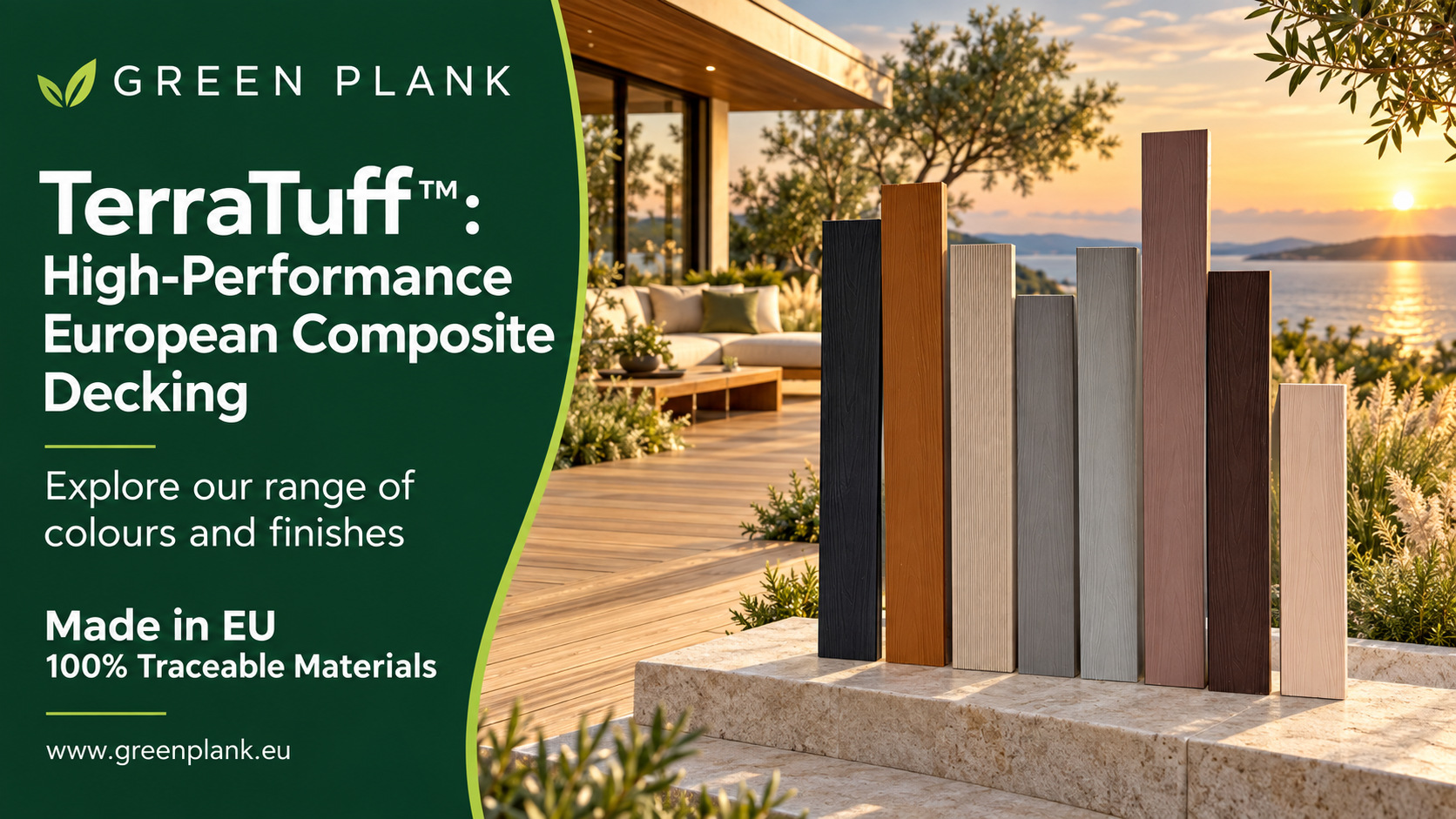
Green Plank TerraTuff™: Where Natural Fibre Meets Advanced Composite EngineeringThe composite decking industry is entering a new phase. For many years, the market conversation focused largely on one question: how much wood and how much plastic are inside the board?Today, that is no longer enough.A premium decking product must bring together material engineering, structural performance, surface protection, dimensional stability, aesthetics, sustainability, installation reliability and long-term maintenance economics.This is the engineering philosophy behind Green Plank® TerraTuff™: a European-made, solid, co-extruded composite decking system designed to combine a high natural-fibre composite core with an engineered protective surface.Green Plank currently describes TerraTuff™ as its premium co-extruded decking system using FortiShell™ technology and positions it for demanding applications where durability and long-term reliability are priorities.A Better Question Than “How Much Plastic Is in the Board?”WPC is sometimes marketed as though adding more polymer automatically produces a better product.That is an oversimplification.Wood fibre and polymer perform different functions. The objective of composite engineering is not to maximize one component, but to create the right interaction between the reinforcement, polymer matrix, coupling chemistry, additives, extrusion process and profile geometry.Green Plank's broader NFC platform uses high natural-fibre content—up to 75% according to its current technical information—and combines natural fibres with HDPE-based composite technology.TerraTuff takes this concept one step further through co-extrusion.Instead of asking one homogeneous material to perform every function, TerraTuff separates two important engineering responsibilities:The core provides the composite structure.The cap protects the exposed surface.That distinction is central to understanding the product.The TerraTuff™ Engineering PhilosophyA premium outdoor decking board must survive much more than a laboratory bending test.It encounters summer heat, winter cold, rain, snow, dirt, food, drinks, foot traffic, furniture, UV exposure and repeated wet-dry cycles.A high-performance composite therefore needs several properties working together:structural strength and stiffness;dimensional stability;moisture resistance;UV and weathering resistance;stain resistance and cleanability;surface durability;controlled thermal movement;attractive, consistent appearance;low maintenance;and long service life.TerraTuff's co-extruded construction allows these requirements to be addressed through different layers of the board.1. High Natural-Fibre Composite CoreThe core represents the structural body of the decking.A properly engineered high-fibre composite can use the natural fibre as reinforcement rather than treating it merely as inexpensive filler.This is an important distinction.Higher natural-fibre content can contribute to stiffness and reduce dependence on polymer in the core, but it also makes extrusion more technically demanding. Fibre moisture, particle distribution, polymer rheology, coupling chemistry, dispersion and processing conditions must all be controlled.That is why high wood content should never be presented as proof of quality by itself.The engineering achievement is making a high-fibre formulation perform consistently.2. Engineered Protective CapThe exposed surface has a completely different job.It must face weather, stains, moisture, UV radiation and daily use.TerraTuff therefore uses a co-extruded protective surface rather than leaving the structural composite core directly exposed.Green Plank describes its capped products as providing enhanced cleanability, colour stability and stain resistance.This creates an elegant materials-engineering concept:Put natural-fibre reinforcement where structural composite performance is required, and put advanced polymer protection where environmental exposure is greatest.Why Co-Extrusion Can Be More Intelligent Than Simply Adding More Plastic to the CoreConsider two design philosophies.A conventional polymer-rich WPC may use additional polymer throughout the entire cross-section partly to achieve moisture and surface protection.A co-extruded system can take a different approach: optimize the core as a structural composite and concentrate specialized surface protection at the exterior.That does not automatically make every co-extruded product superior. Cap adhesion, core quality, processing stability and the performance of the complete finished board remain essential.But when engineered correctly, the architecture is compelling.Engineering objectiveConventional mono-extruded WPCTerraTuff™ co-extruded conceptStructural bodySame material as surfaceDedicated composite coreSurfaceCore material remains exposedEngineered protective capNatural-fibre strategyDepends on formulationHigh natural-fibre philosophyStain protectionDepends heavily on base formulationCap provides additional barrierColour stabilitySurface formulation dependentCap engineered for surface performanceMoisture exposureDirectly reaches WPC surfaceCore receives additional surface protectionDesign philosophyOne formulation performs multiple jobsCore and surface perform specialized jobsThis is one of the strongest arguments for modern co-extrusion: material can be placed according to function rather than simply according to percentage.TerraTuff™ Is Solid—And That MattersTerraTuff is not merely a capped product; it is a solid decking construction.Solid and hollow decking should not automatically be classified as good versus bad. They serve different market requirements.Hollow profiles can reduce weight and material consumption and can be highly effective for suitable residential applications.Solid construction becomes particularly interesting where projects demand robust profile geometry, high traffic capability and a substantial board structure.Green Plank currently identifies TerraTuff as its heavy-duty decking option and positions it for demanding applications.Potential applications therefore include:premium residential terraces;swimming-pool surrounds;hotels and hospitality projects;restaurants and outdoor dining;public promenades;marinas and waterfront environments;commercial terraces;roof terraces;public landscaping;and other high-use outdoor spaces.Green Plank's existing project portfolio includes public waterfront and coastal applications where long-term outdoor performance and reduced maintenance are important design considerations.The Natural-Fibre Advantage—Without Making Unsupported ClaimsThere is an important responsibility when discussing high-wood-content WPC.More wood is not automatically better.But neither is more plastic.The correct comparison is the performance of the engineered system.Green Plank's approach is particularly interesting because it does not need to argue that every WPC should contain maximum wood fibre. Instead, the stronger position is that natural fibre should be used intelligently as a functional component of the composite.A high natural-fibre core can potentially provide several advantages when properly formulated:Greater natural-material contributionMore of the core can originate from natural fibre rather than thermoplastic.Fibre reinforcementProperly dispersed and bonded fibres can contribute significantly to composite stiffness.Different thermal behaviourWood and thermoplastic have very different thermal properties. Increasing fibre content can change thermal conductivity and thermal expansion behaviour, although finished-board temperature and movement also depend on polymer type, colour, capstock, geometry, density and environmental conditions.Natural aesthetic philosophyA wood-rich composite better supports the fundamental concept behind WPC: combining characteristics of wood with the durability and processability offered by polymers.But these advantages only become meaningful when supported by good fibre preparation, controlled moisture, appropriate coupling technology, proper extrusion and finished-product testing.The Cap Is Not There to Hide a Weak CoreThis point deserves special emphasis.The WPC market sometimes focuses so heavily on capstock that the structural core receives insufficient attention.A beautiful cap cannot transform an inadequately engineered core into a premium composite.If the core has poor fibre dispersion, excessive voids, weak interfacial adhesion or unsuitable mechanical characteristics, the surface layer cannot solve those fundamental structural issues.A premium co-extruded product therefore requires two successful technologies simultaneously:High-performance core + high-performance surfacenot:Weak core + attractive cap.That principle sits naturally with Green Plank's stated approach of ongoing testing and collaboration with European testing and research institutions.Made in Europe Is More Than a Marketing StatementAnother important element of TerraTuff's positioning is its European manufacturing platform.Green Plank states that its composite products are manufactured in Europe using traceable European raw materials, with the company establishing European production in Klaipėda, Lithuania, in 2025.For professional buyers, European production can have significance beyond branding.It can support:shorter and more controllable supply chains;material traceability;responsive technical communication;shorter replenishment distances for European customers;closer manufacturing oversight;easier project coordination;and reduced dependency on long intercontinental logistics.For architects, distributors and project developers, predictability can be as valuable as the product itself.Sustainability Should Include Service LifeA sustainable product should not be judged solely by how much recycled or natural material enters the factory.The more meaningful question is:How efficiently does that material perform throughout the life of the building or landscape?Green Plank states that its broader composite platform uses recycled plastics and reclaimed natural fibres and is designed around recyclability and circular construction principles.But longevity is equally important.A decking material that requires less frequent replacement, avoids repeated painting or oiling and remains serviceable for a long period can reduce maintenance interventions and material consumption throughout its lifecycle.This leads to a broader definition of sustainable decking:Responsible raw materials + efficient manufacturing + long service life + low maintenance + end-of-life material recovery.That is a much stronger sustainability proposition than recycled content alone.What Makes TerraTuff™ Different?TerraTuff should not be marketed simply as another WPC board.Its strongest proposition is the combination of technologies.High natural-fibre composite philosophyThe structural core uses natural fibre as a meaningful engineering component.Solid constructionDesigned for applications where robust profile architecture is important.Co-extruded protectionThe core and surface are allowed to perform different jobs.Engineered exterior surfaceDesigned to improve properties such as stain resistance, cleanability and colour stability.European manufacturingProduction closer to the primary European market supports traceability and supply-chain control.Low-maintenance conceptComposite construction eliminates many of the recurring treatments associated with conventional exterior timber.Circular-material directionThe broader Green Plank platform incorporates recycled plastics and reclaimed natural fibres while emphasizing recyclability.Is TerraTuff™ the “Best” Composite Decking?From an engineering perspective, no responsible manufacturer should claim that one decking product is universally the best for every project.A lightweight residential balcony, a swimming-pool deck, a public promenade and a commercial marina do not necessarily require the same profile.A more credible statement is:TerraTuff™ is Green Plank's premium solution for projects where solid construction, co-extruded surface protection, high natural-fibre composite technology and long-term outdoor performance are priorities.That is a technically stronger position than simply saying “our decking has more wood” or “our decking has more plastic.”The future of WPC is not a competition to maximize one ingredient.It is a competition to engineer the complete material system better.From WPC to NFC: A More Natural Direction for Composite MaterialsPerhaps the most interesting development is therefore conceptual.Traditional WPC—Wood Plastic Composite—has often been understood primarily through its plastic component.Green Plank increasingly describes its technology as NFC—Natural Fibre Composite. Its current product platform emphasizes high natural-fibre content, European hardwood, recycled materials, European production and long-term performance.That terminology reflects a different philosophy.The polymer is essential—but it is not necessarily the identity of the product.The natural fibre is not waste filler—it is part of the engineering.The cap is not the structure—it is protection.And the percentage printed on a technical sheet is not the final measure of quality—the finished product's performance is.Conclusion: TerraTuff™ Is About Balance, Not a Single PercentageThe most advanced composite decking will not necessarily be the product with the highest wood percentage or the highest polymer percentage.It will be the product where natural fibre, polymer, coupling technology, additives, extrusion engineering, profile geometry and surface protection work together as one system.That is the principle behind TerraTuff™.A high natural-fibre composite core provides the foundation. Solid construction provides robust profile architecture. Co-extrusion places an engineered protective surface between the structural composite and the outdoor environment. European manufacturing adds traceability, quality control and supply-chain proximity.The result is not an attempt to make plastic look like wood.It is an attempt to take the strengths of both material families and engineer them into something more appropriate for modern outdoor construction.Natural fibre where it adds structural value.Engineered polymer where protection matters.European manufacturing where control matters.Performance where it matters most.That is a stronger definition of premium composite decking—and the direction represented by Green Plank TerraTuff™.Explore Green Plank® and TerraTuff™
Specificera produkten
Använd den här guiden i en Green Plank-specifikation
Tekniska WPC-artiklar ska stärka de kommersiella sidorna — inte konkurrera med dem. Fortsätt till komposittrall, TerraTuff, Nordeka eller de tekniska nedladdningarna.