



While traditional timber remains a common choice for public infrastructure, nearly 48% of professional deck renovations have now transitioned to advanced composite materials to combat rising maintenance costs and safety concerns. You likely understand the frustration of managing timber walkways that warp, splinter, and require constant chemical treatments just to remain safe for public use. These recurring expenses and the inherent slip hazards of weathered wood create a significant burden on commercial property managers and municipal planners alike.
This guide demonstrates how high-performance composite decking for commercial walkways provides a definitive solution. It combines precision WPC engineering with a 50-year service life that prioritizes pedestrian safety and ecological responsibility. We'll examine the technical benefits of a 75% hardwood to 25% HDPE ratio, the security of HidLoc™ fastening systems, and how sourcing EU-manufactured materials reduces the CO2 footprint of your project. By the end, you'll see how a Cradle to Cradle ownership model ensures your infrastructure remains durable, compliant, and sustainable for decades.
Key Takeaways
Understand why high-density WPC engineering provides a maintenance-free alternative to traditional timber in high-traffic zones.
Learn how a precise 75% hardwood and 25% HDPE blend ensures structural stability while significantly reducing your project's CO2 footprint.
Discover the safety benefits of specifying composite decking for commercial walkways that features advanced slip resistance and HidLoc™ hidden fastening systems.
Evaluate the long-term ROI of a 50-year service life warranty compared to the frequent replacement cycles of wood or concrete infrastructure.
Identify the technical specifications for Terra Tuff and Smart System profiles to ensure your project meets specific joist span and load-bearing requirements.
Table of Contents
Defining Performance: Why Composite Decking is the Standard for Modern Commercial Walkways
The Science of Sustainability: 100% EU Raw Materials and the 75/25 Hardwood Ratio
Safety and Structural Integrity: Slip Resistance, HidLoc™ Fastening, and Scuff Resistance
Commercial ROI: Comparing WPC to Traditional Timber and Concrete Walkways
Specifying Your Project: Selecting Profiles and Implementing Sustainable Infrastructure
Defining Performance: Why Composite Decking is the Standard for Modern Commercial Walkways
Commercial-grade Wood-plastic composites (WPCs) represent a fundamental shift from decorative surfaces to high-performance structural assets. For architects and municipal planners, composite decking for commercial walkways isn't merely a finishing touch; it's a high-density engineered material designed to withstand tens of thousands of daily footfalls. While traditional timber demands a relentless cycle of sanding, staining, and board replacement, high-performance WPC offers a "set-and-forget" durability that maintains its integrity for up to 50 years. This longevity transforms the walkway from a recurring expense into a long-term infrastructure investment.
The transition toward wpc composite decking has moved beyond simple aesthetics. In public spaces, the risks of splinters, rot-induced structural failure, and slippery surfaces aren't just maintenance headaches, they're significant liability concerns. Engineered composites mitigate these risks through precision manufacturing. Every board is produced to exact standards, ensuring a uniform surface that doesn't warp or decay under the pressure of constant public use.
The Evolution of High-Traffic Walking Surfaces
Traditional materials like concrete and stone are losing ground to WPC because they lack the flexibility and natural warmth that modern urban design demands. Concrete often cracks and retains excessive heat, while stone can be prohibitively expensive to install over complex terrain. WPC offers a superior alternative by providing the organic feel of wood with the slip resistance of an industrial surface. Modern engineering now allows for longer spans between joists. This capability reduces the required volume of sub-structure materials, effectively lowering both the environmental impact and the total installation cost of the project.
Key Requirements for Commercial Infrastructure
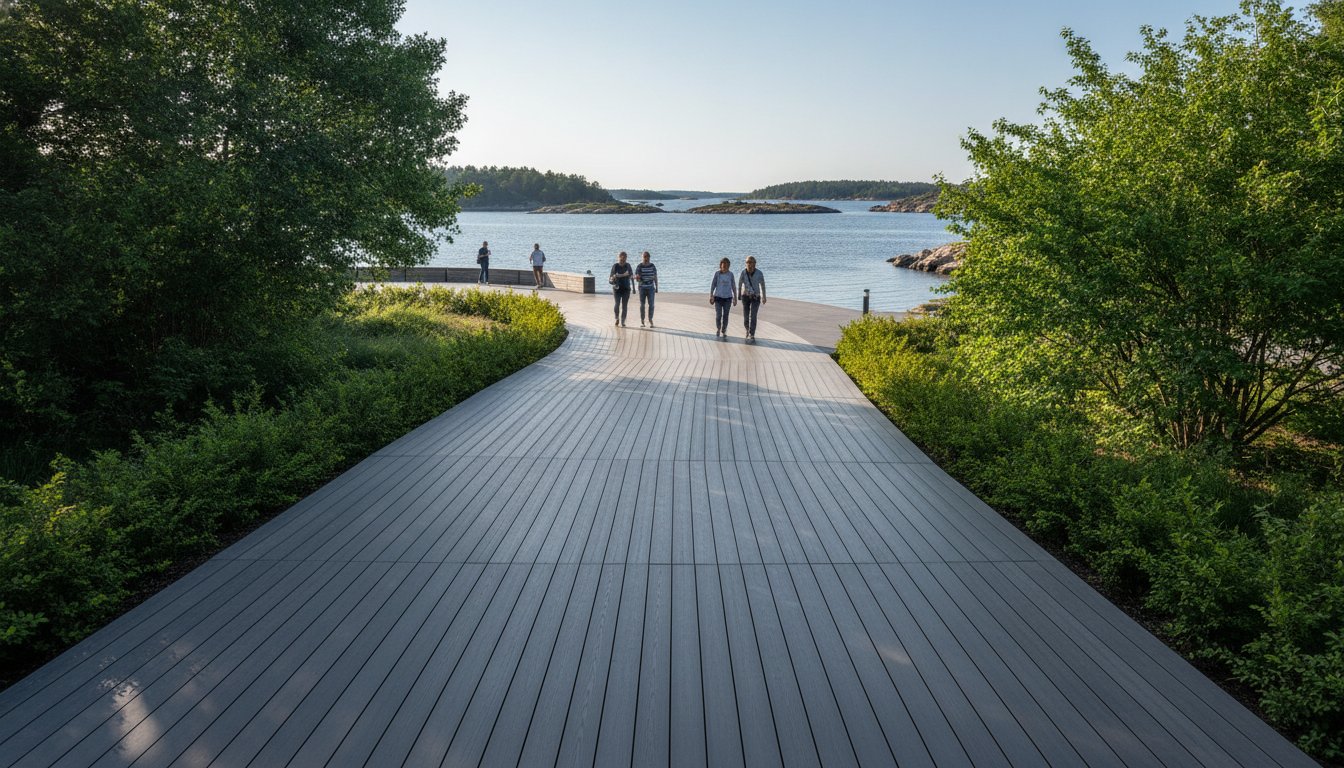
Public boardwalks, coastal piers, and urban pathways face environmental stressors that would quickly destroy standard residential materials. Commercial-grade profiles must meet rigorous benchmarks to ensure public safety. Key requirements include:
Load-Bearing Capacity: Boards must support heavy pedestrian flow and light service vehicles without sagging.
Environmental Resilience: Materials must resist intense UV radiation, salt water corrosion, and extreme temperature fluctuations.
Safety Compliance: High slip-resistance ratings are mandatory to prevent accidents in wet or icy conditions.
Fire Performance: The inclusion of fire-retardant additives is essential to meet strict commercial building codes.
By prioritizing these technical attributes, planners ensure that their infrastructure remains safe and functional. High-performance WPC doesn't just mimic the look of wood; it solves the engineering failures that have historically plagued timber in the public square.
The Science of Sustainability: 100% EU Raw Materials and the 75/25 Hardwood Ratio
The environmental integrity of composite decking for commercial walkways depends entirely on the transparency of its supply chain. While many manufacturers rely on generic "recycled plastic" claims, Green Plank utilizes a precise engineering ratio of 75% hardwood fibre and 25% High-Density Polyethylene (HDPE). This specific formulation ensures maximum density and structural stability. By sourcing 100% of our raw materials within the EU, we maintain rigorous quality control while significantly reducing the CO2 footprint associated with long-distance shipping. This regional manufacturing approach aligns with Regulation (EU) 2023/1115, ensuring that every component in our walkways is deforestation-free and ethically produced.
Engineering a sustainable walkway requires a move away from the toxic additives found in low-cost imported alternatives. Many non-EU products contain volatile organic compounds (VOCs) or heavy metal stabilizers that can leach into the soil over time. Our manufacturing process excludes these harmful substances, focusing instead on a clean blend of hardwood and HDPE. This commitment to material purity is a core pillar of the sustainable building materials framework, where the goal is to create infrastructure that respects both the user and the environment. Architects seeking to align their projects with these ethical standards can explore our full range of EU-certified commercial profiles.
Hardwood Fibre vs. Softwood Fillers
The choice of wood species within the WPC matrix determines the board's long-term performance. Hardwood fibres provide superior impact resistance and density compared to the softwood fillers often used in residential-grade products. This increased density is vital for composite decking for commercial walkways, where constant foot traffic and heavy maintenance equipment are common. The 75/25 ratio also serves an aesthetic purpose. It prevents the artificial, "plastic" sheen found in cheaper composites, providing a matte, natural finish that ages gracefully without losing its structural integrity.
Cradle to Cradle: Circularity in Commercial Construction
True sustainability in infrastructure is measured through a Cradle to Cradle ownership model. This approach views decking boards as technical nutrients that can be reclaimed and repurposed at the end of their lifecycle. Choosing EU-manufactured WPC contributes directly to LEED and BREEAM certifications by providing documented proof of sourcing and carbon reduction. A 50-year service life warranty further reinforces this circular logic. By extending the replacement cycle, we drastically reduce the total volume of raw materials required over the life of the project. This ensures that the environmental cost of construction is amortized over half a century, making it the most responsible choice for modern public infrastructure.
Safety and Structural Integrity: Slip Resistance, HidLoc™ Fastening, and Scuff Resistance
Public infrastructure requires more than aesthetic appeal; it demands absolute physical reliability. When specifying composite decking for commercial walkways, safety is the primary metric of success. High-traffic environments, such as coastal piers and urban boardwalks, face constant exposure to moisture and heavy pedestrian flow. These conditions necessitate materials that exceed standard slip-resistance ratings. Our engineered WPC profiles utilize a high-density hardwood matrix that naturally resists moisture absorption, preventing the internal rot and surface slickness that often plague traditional timber walkways.
Structural integrity is further reinforced through advanced material science. We utilize color-through formulas where pigments are integrated into the entire board profile. This engineering choice ensures that high-traffic wear, such as scuffs from trolleys or maintenance equipment, remains nearly invisible. Unlike capped composites that can peel or scratch to reveal a different colored core, our boards maintain a consistent appearance even under extreme duress. This durability is essential for maintaining a professional image in public spaces over a 50-year service life.
Eliminating Trip Hazards with HidLoc™ Technology
Safety in public walkways is often compromised by traditional top-down fastening. Exposed screw heads eventually "pop" due to thermal expansion, creating dangerous trip hazards and snagging points. The HidLoc™ hidden fastening system solves this by securing boards from the side. This system creates a completely smooth, fastener-free surface that is safe for all pedestrians, including those using wheelchairs or strollers.
The HidLoc™ system also manages the natural thermal movement of the boards. By allowing for controlled expansion and contraction, it prevents the buckling and warping that can lead to structural failure. This precision is why the system is a staple of professional deck installation in commercial settings. It ensures the walkway remains level and secure regardless of seasonal temperature fluctuations.
Surface Performance: Scuff and Slip Resistance
Traction is a non-negotiable requirement for commercial infrastructure. Our composite decking for commercial walkways is engineered with specific surface textures to maximize grip in wet conditions. We offer both ribbed and grooved profiles that are tested against rigorous slip-resistance standards. The ribbed surface provides multi-directional traction, which is particularly effective for ramps and inclined paths.
Ribbed Surfaces: Provide high-friction pathways ideal for public piers and marinas.
Grooved Textures: Offer a classic aesthetic with reliable linear slip resistance.
Impact Resistance: The 75% hardwood fibre content provides the density needed to resist denting from dropped objects.
Moisture Barrier: The HDPE encapsulation prevents water from penetrating the fibre, stopping decay before it starts.
Maintaining these safety standards doesn't require the aggressive chemical treatments or frequent pressure washing associated with wood. A simple maintenance protocol of periodic rinsing is usually sufficient to keep the surface clear of debris that might compromise traction. This ease of care ensures that safety remains a permanent feature of the infrastructure, not a temporary result of a maintenance cycle.
Commercial ROI: Comparing WPC to Traditional Timber and Concrete Walkways
Total Cost of Ownership (TCO) serves as the most critical metric for municipal and commercial procurement. While the initial material cost of composite decking for commercial walkways may be higher than pressure-treated timber, the financial trajectory shifts dramatically within the first five years. Traditional wood requires bi-annual staining, sanding, and sealing to prevent rot and splintering. These maintenance cycles represent a significant drain on operational budgets. In contrast, our WPC profiles are engineered for a 50-year service life, effectively eliminating the labor and material costs associated with timber upkeep. This "set-and-forget" performance allows municipalities to reallocate maintenance funds to other critical infrastructure needs.
Installation speed provides another immediate boost to ROI. Traditional masonry or concrete pours require extensive site preparation and long curing times, often closing public pathways for weeks. Our pre-engineered WPC systems allow for rapid assembly. The precision of the boards ensures they fit perfectly every time, reducing onsite labor costs and minimizing the duration of public disruption. By choosing a material that installs quickly and lasts decades, you maximize the utility of the public space from day one.
WPC vs. Pressure-Treated Timber
The liability risks associated with aging timber are a hidden cost often overlooked during the initial design phase. Splintering boards and loose fasteners lead to insurance claims and frequent emergency repairs. By choosing high-performance trex decking alternatives manufactured in the EU, project managers secure a structural asset that remains dimensionally stable. A life-cycle assessment reveals that 75/25 hardwood composite outperforms wood by avoiding the environmental and financial toll of repeated replacements. Timber infrastructure typically requires full replacement every 10 to 15 years in public settings; our WPC is built to last half a century.
WPC vs. Concrete and Stone Walkways
Concrete and stone are often perceived as the permanent choice, yet they present significant engineering challenges. These materials are exceptionally heavy, requiring massive sub-structures that increase overall project costs. Our low-density WPC profiles offer a high strength-to-weight ratio, making them ideal for elevated walkways, ramps, and piers where weight is a primary concern.
Thermal performance is another key differentiator. Concrete absorbs and retains solar heat, creating heat islands that make public spaces uncomfortable during summer months. Composite decking stays cooler underfoot, maintaining a comfortable temperature for pedestrians. It achieves the warm, organic aesthetic of natural timber without the structural weaknesses of cracking concrete or shifting stone. To evaluate the specific ROI for your next infrastructure project, you can review our full range of commercial infrastructure profiles.
Specifying Your Project: Selecting Profiles and Implementing Sustainable Infrastructure
Successful procurement of composite decking for commercial walkways begins with precise technical specification. Architects and engineers must evaluate the specific load requirements and environmental exposure of the site before selecting a profile. Choosing the correct board thickness and width is essential for maintaining structural integrity over a 50-year service life. For high-traffic public infrastructure, thicker profiles are typically required to accommodate wider joist spans and heavier pedestrian loads. Integrating these WPC systems with existing infrastructure or modern metal sub-frames ensures a stable foundation that resists the warping common in timber alternatives.
Our engineering team provides comprehensive support for large-scale projects. We offer detailed technical specifications and physical samples to ensure the selected material meets all local safety and building codes. By aligning the material science of our EU-manufactured WPC with your project's specific engineering needs, you create a sustainable asset that serves the community for decades. This technical alignment ensures that every board contributes to the overall safety and longevity of the walkway.
Terra Tuff: The Heavy-Duty Commercial Infrastructure Choice
The Terra Tuff line is specifically engineered for the most demanding environments. Its high-density composition makes it the premier choice for public piers, marina boardwalks, and urban walkways where constant exposure to salt water and heavy traffic is expected. These profiles provide maximum durability without sacrificing the natural aesthetic of hardwood. To support large-scale efficiency, we offer custom length options. This capability allows contractors to minimize on-site cutting and significantly reduce material waste, further lowering the project's environmental impact.
Structural Stability: High-density hardwood fibres ensure boards remain dimensionally stable under heavy loads.
Installation Efficiency: Compatible fastening systems reduce labor time and ensure a uniform, safe surface.
Resource Responsibility: Custom lengths and EU-sourced materials minimize waste and carbon emissions.
Smart System: Innovation in High-Traffic Design
The Smart System profile offers a sophisticated balance of lightweight design and commercial-grade strength. It is particularly suited for modern commercial courtyards, rooftop terraces, and hospitality spaces where aesthetics and performance must coexist. This system allows for a cohesive design language across the entire project. You can match your walkway decking with our compatible wall cladding and fencing systems to create a unified commercial facade. This holistic approach ensures that every element of the outdoor space reflects the same high standards of quality and sustainability. It's a choice that respects both the architectural vision and the natural environment.
Securing the Future of Public Infrastructure
Specifying composite decking for commercial walkways isn't just a design choice; it's a commitment to long-term structural resilience and environmental ethics. By prioritizing high-performance WPC engineering, you replace the high-maintenance cycle of timber with a reliable, sustainable asset. Our 75/25 hardwood to HDPE ratio provides the density required for heavy foot traffic, while the HidLoc™ fastening system eliminates the trip hazards common in aging infrastructure. These technical advancements ensure that public spaces remain safe, accessible, and beautiful for decades without the burden of constant repairs.
Every board we produce carries a 50-year commercial performance warranty, reflecting our confidence in regional manufacturing and material science. Our Cradle to Cradle ownership model ensures that your project respects the circular economy, utilizing 100% EU-sourced raw materials to minimize carbon impact. You can now bridge the gap between architectural vision and practical durability with a solution that is engineered and manufactured in the EU for the public good. To begin your transition to high-performance infrastructure, Request a Technical Specification and Samples for Your Commercial Project. Let's build a maintenance-free future together.
Frequently Asked Questions
What is the maximum joist span for commercial composite decking walkways?
The maximum joist span for commercial walkways typically ranges between 300mm and 400mm on center, depending on the specific profile and expected pedestrian load. Our Terra Tuff profiles are engineered to handle high-traffic infrastructure while maintaining structural integrity across these spans. It's essential to consult the technical data sheet for your specific project to ensure compliance with local building codes and safety standards.
Is composite decking safe for public walkways in wet or coastal conditions?
Composite decking for commercial walkways is exceptionally safe for wet and coastal environments due to its high slip-resistance ratings and moisture-repelling properties. The 75% hardwood fibre is encapsulated in HDPE, which prevents the internal rot and surface slickness that often occur with wood. This ensures a stable, high-traction surface even in harsh marine conditions or areas with frequent rainfall.
How does the 50-year warranty apply to commercial projects?
The 50-year service life warranty covers structural integrity against rot, decay, and manufacturing defects under normal commercial usage conditions. This performance guarantee reflects our commitment to engineering precision and the use of high-quality EU raw materials. It provides facility managers with long-term financial security, knowing the infrastructure is built to last half a century without the need for full replacement.
Can Green Plank WPC be used for load-bearing walkways?
Green Plank WPC is designed as a high-performance surface material for walkways but is not intended for use as load-bearing structural beams. It must be installed over a properly engineered sub-structure, such as a metal frame or treated timber joists. This distinction ensures that the decking provides the necessary durability and safety for pedestrian traffic while the sub-frame handles the primary structural loads.
How does composite decking compare to concrete in terms of maintenance costs?
While concrete has low initial maintenance, it often requires expensive repairs for cracks and thermal expansion issues over time. WPC composite decking significantly reduces long-term operational budgets by eliminating the need for sealing, painting, or heavy-duty structural patching. The "set-and-forget" nature of our profiles means the primary maintenance task is periodic cleaning, which is much more cost-effective than managing masonry infrastructure.
What is the difference between Terra Tuff and standard composite boards?
Terra Tuff is specifically engineered for commercial infrastructure, offering a higher density and greater load-bearing capacity than standard residential boards. It features a more robust profile designed to withstand the constant pressure of public footfall and light service vehicles. While standard boards are excellent for private decks, Terra Tuff provides the industrial-grade performance required for piers, marinas, and urban boardwalks.
Are Green Plank materials compliant with EU fire safety regulations for commercial use?
Yes, Green Plank materials are manufactured to comply with rigorous EU fire safety regulations for commercial applications. We integrate fire-retardant additives into our WPC matrix to meet the strict standards required for public spaces and high-traffic infrastructure. This engineering focus ensures that your walkway project adheres to all necessary safety protocols while providing a durable and sustainable surface for the community.
How does the HidLoc™ system improve the safety of commercial walkways?
The HidLoc™ system improves safety by securing the composite decking for commercial walkways from the side, creating a smooth, fastener-free surface that eliminates trip hazards. Traditional top-down screws can pop out over time as boards expand and contract, leading to dangerous snagging points. By removing these exposed fasteners, the HidLoc™ system ensures a safer environment for all users, including those with strollers or mobility aids.
Specificera produkten
Använd den här guiden i en Green Plank-specifikation
Tekniska WPC-artiklar ska stärka de kommersiella sidorna — inte konkurrera med dem. Fortsätt till komposittrall, TerraTuff, Nordeka eller de tekniska nedladdningarna.