



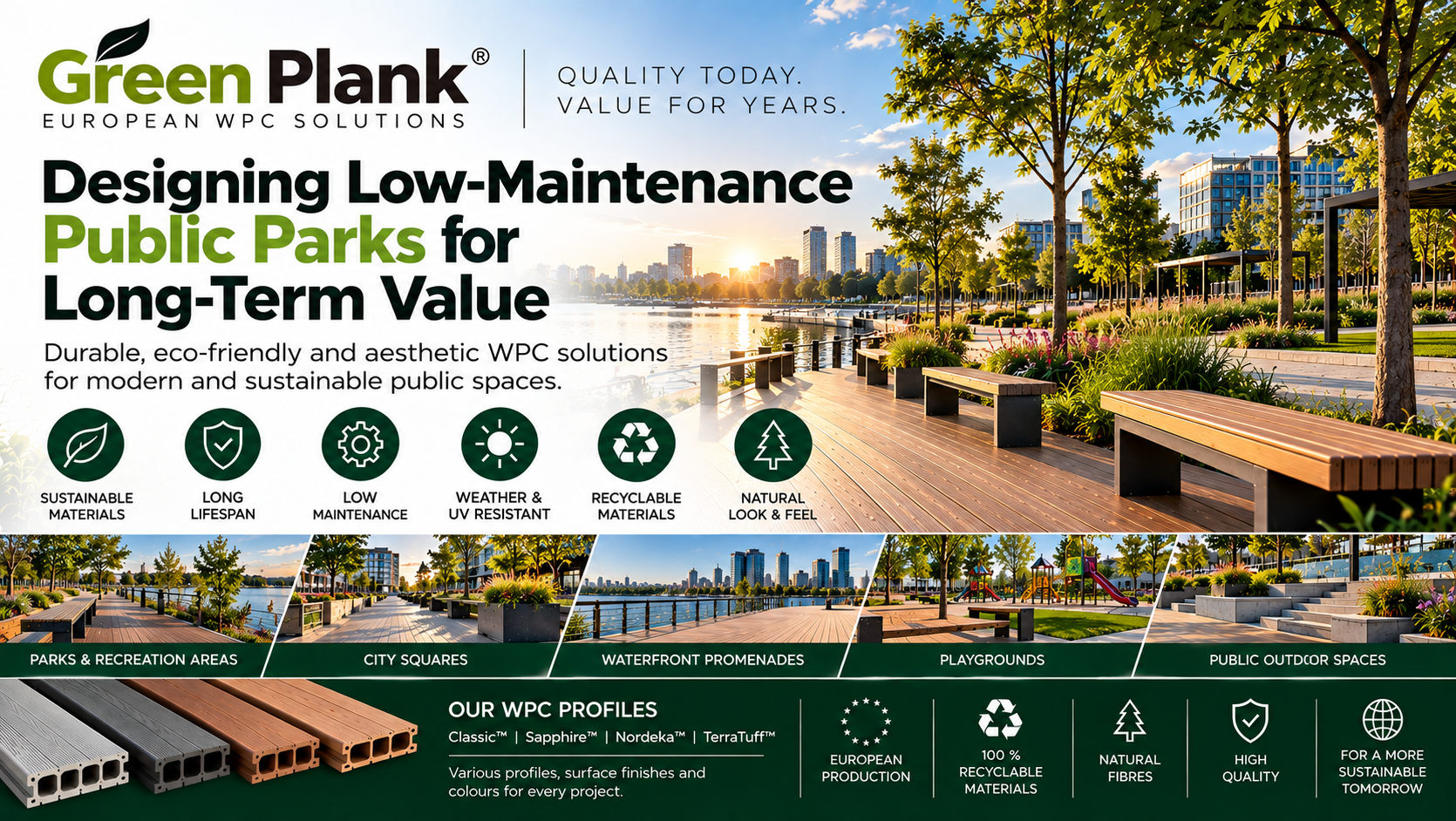
Designing Low-Maintenance Public Parks for Long-Term Value Public parks are expected to deliver far more than attractive landscaping. They must provide safe, accessible and welcoming environments while coping with intensive use, changing weather, limited maintenance budgets and increasingly demanding sustainability objectives. For municipalities, architects and landscape designers, the challenge is therefore to create low-maintenance public parks that remain functional and visually appealing over many years. Successful low-maintenance design is not about eliminating maintenance. Every public landscape requires inspection, cleaning and care. The objective is to reduce unnecessary interventions by selecting durable materials, designing effective drainage, choosing appropriate vegetation and considering maintenance requirements from the earliest planning stage. The most effective low-maintenance park is not necessarily the simplest park. It is the one where materials, vegetation, drainage, access and construction details are designed around real lifecycle requirements. Why Maintenance Should Be Designed Into the Project Many long-term costs arise after construction is complete. Cleaning, surface treatments, vegetation management, repairs, replacement components and temporary closures can collectively represent a substantial part of a public space's lifecycle expenditure. Before specifying materials, project teams should therefore consider: How intensively will each area be used? Which surfaces will experience the most moisture and contamination? Which materials require repeated painting, staining or oiling? Can individual components be replaced without dismantling larger areas? How easily can maintenance teams reach drainage and structural elements? What are the likely costs over the intended service period? Choose Materials for Performance, Not Only Purchase Price Public seating decks, pathways, platforms, viewing areas and terraces should be evaluated according to their complete service requirements. A material that costs less initially may become more expensive if it demands frequent surface treatment or premature replacement. Evaluation Area Short-Term Approach Lifecycle Approach Material selection Lowest initial cost Performance matched to intended use Maintenance Considered after installation Planned from design stage Drainage Basic water removal Integrated surface and substructure strategy Repairs Reactive replacement Accessible and modular components Economics Construction budget Lifecycle and operating costs Where WPC Can Support Low-Maintenance Park Design Wood Plastic Composite (WPC) can be an attractive option for selected public park applications such as decking, seating platforms, raised walkways, viewing areas and recreational structures. WPC combines cellulose-based reinforcement with a thermoplastic matrix and functional additives. Unlike many traditionally finished timber surfaces, quality composite decking is generally designed to function without recurring painting, staining or oiling. Routine cleaning and inspection remain necessary, but reducing repeated surface-treatment cycles can simplify long-term facility management. However, WPC is a product category rather than a quality guarantee. Architects should examine product-specific mechanical properties, moisture behaviour, thermal movement, slip performance, profile geometry and installation requirements before specification. What Determines the Quality of Composite Products? A long-lasting composite system depends on the interaction of several technical factors rather than one headline percentage of wood or polymer. Fibre quality: particle characteristics and controlled moisture support consistent manufacturing. Polymer system: influences processing, toughness and thermal behaviour. Coupling technology: helps manage the interface between natural fibres and polymer. Stabilisation: pigments, antioxidants and UV stabilisers can support outdoor performance. Profile engineering: dimensions and geometry influence stiffness and load transfer. Production control: consistent extrusion is essential for repeatable finished products. Drainage Is One of the Most Important Maintenance Decisions Water that cannot drain effectively can increase cleaning requirements and contribute to contamination, algae formation and deterioration of surrounding construction. Good park design should therefore move water away efficiently while avoiding unnecessary moisture traps. For decked areas, designers should consider positive drainage, sufficient ventilation beneath the surface, accessible drainage paths and construction details that do not retain dirt and water. Design Principle Good drainage reduces problems before maintenance teams have to solve them. Surface falls, open drainage routes and accessible construction details can be more valuable than attempting to correct persistent moisture problems after completion. Design for Easy Cleaning and Component Replacement Public infrastructure inevitably experiences wear. The objective should therefore not be to design a system that can never require repair, but one that can be maintained efficiently when intervention becomes necessary. Use accessible fastening systems where practical. Design components so individual pieces can be replaced. Avoid concealed areas where debris and moisture accumulate. Select corrosion-resistant fixings appropriate to the environment. Provide sufficient access for inspection and cleaning. Modular design can be particularly valuable for benches, decking zones, edging systems and platforms because damaged components may be replaceable without removing large sections of surrounding infrastructure. Plant Selection Has a Major Impact on Maintenance Low-maintenance landscape architecture should not mean less vegetation. Instead, it means selecting planting strategies appropriate to the site's soil, climate, water availability and expected use. Suitable groundcover, robust perennials, resilient shrubs and carefully positioned trees can potentially reduce unnecessary irrigation, replanting and intensive horticultural intervention. Planting should also consider visibility, accessibility, drainage and the interaction between vegetation and hard surfaces. Lifecycle Cost Creates a Better Business Case Public authorities often manage assets for decades. This makes lifecycle cost more meaningful than purchase price alone. Environmental management standards also encourage lifecycle thinking: ISO 14040 establishes the principles and framework for Life Cycle Assessment, including goal and scope definition, lifecycle inventory, impact assessment and interpretation. :contentReference[oaicite:0]{index=0} Lifecycle Stage Typical Considerations Construction Materials, installation and site preparation Operation Cleaning, inspection and landscape management Maintenance Repairs, coatings and component replacement Disruption Closures and restricted public access End of service Removal, reuse, recovery or disposal Sustainability and Low Maintenance Should Work Together A genuinely sustainable park should not be evaluated through a single environmental claim. Material origin, manufacturing, transport, maintenance, service life and end-of-life options all contribute to the wider picture. The European Commission's Level(s) framework provides a common approach for assessing sustainability performance across a building's lifecycle and encourages lifecycle-oriented thinking rather than focusing only on initial construction. :contentReference[oaicite:1]{index=1} This principle is equally valuable when thinking about public landscapes: long-lasting materials and efficient maintenance strategies can help keep resources in productive use while reducing unnecessary replacement. Low maintenance should never be confused with no maintenance. The objective is to make inspection, cleaning and repair more predictable, efficient and resource-conscious throughout the life of the public space. Technical Documentation Matters in Public Projects Professional buyers should request meaningful product documentation rather than relying on marketing terms such as durable, sustainable or maintenance-free. Within the EU, the Construction Products Regulation provides harmonised rules for construction products and a common technical language for assessing and communicating product performance where the regulatory framework applies. :contentReference[oaicite:2]{index=2} Harmonised European standards can provide a technical basis for assessing construction-product performance where relevant to the specific product and intended use. :contentReference[oaicite:3]{index=3} A Practical Checklist for Municipalities and Landscape Architects Is the material suitable for the expected intensity of use? What cleaning and maintenance procedures are required? What mechanical and dimensional performance is documented? How does the surface perform when wet? Can individual components be replaced efficiently? Does the design prevent unnecessary water and dirt accumulation? What technical and environmental documentation is available? What are the expected costs over the intended service period? Can matching replacement components be supplied in the future? Where Low-Maintenance Materials Can Add Particular Value municipal parks and urban gardens; public seating platforms; boardwalks and pedestrian routes; waterfront recreation areas; schools and community facilities; visitor centres and tourism infrastructure; public roof terraces; outdoor cultural and recreational spaces. Green Plank – Composite Solutions for Professional Public Spaces Green Plank develops WPC solutions for professional outdoor environments where design, material engineering, long-term performance and maintenance efficiency need to work together. For municipalities, architects, landscape architects, contractors and developers, composite products can provide an additional material option when their documented properties match the requirements of the project. The correct product should always be selected according to the technical documentation, intended application, installation requirements and environmental conditions of the specific project. Explore Green Plank composite solutions at www.greenplank.eu. Conclusion Designing low-maintenance public parks is ultimately about better long-term planning. Durable materials, efficient drainage, appropriate planting, accessible construction details and lifecycle-based procurement can all help reduce unnecessary maintenance while protecting the quality of the public environment. The strongest public parks are therefore not simply those that cost least to build. They are spaces designed to remain attractive, safe, functional and manageable throughout years of intensive public use. Sources ISO 14040:2006 – Environmental Management, Life Cycle Assessment Principles and Framework European Commission – Level(s), European Framework for Sustainable Buildings European Commission – Construction Products Regulation European Commission – Harmonised Standards for Construction Products
Specificera produkten
Använd den här guiden i en Green Plank-specifikation
Tekniska WPC-artiklar ska stärka de kommersiella sidorna — inte konkurrera med dem. Fortsätt till komposittrall, TerraTuff, Nordeka eller de tekniska nedladdningarna.